A Sacred Heart tattoo most commonly represents divine love, faith, sacrifice, compassion, and devotion. Rooted in Christian tradition, especially Roman Catholicism, the image depicts the heart of Jesus Christ, often surrounded by flames, a crown of thorns, or a cross.
Some people choose it to express religious beliefs, while others connect it with emotional strength, unconditional love, or the willingness to endure hardship for someone they care about.
Have you ever wondered why the Sacred Heart tattoo carries such deep spiritual and emotional meaning? Recognized for its distinctive heart, flames, crown of thorns, and sometimes a cross, this design has strong roots in Christian devotion.
Each element can communicate a different aspect of love, sacrifice, compassion, and suffering. Beyond its religious significance, some people also connect the imagery with personal healing, loyalty, and the strength to keep loving through difficult experiences.
In this guide, you will explore the Sacred Heart tattoo meaning, including its Christian origins, traditional symbolism, and modern interpretations. You will also discover how popular design elements, colors, and placements can influence its appearance and personal significance.
By understanding the history behind this recognizable symbol and the ways people interpret it today, you can appreciate why the Sacred Heart remains a meaningful tattoo choice for religious believers and those drawn to its themes of devotion, compassion, and enduring love.
Table of Contents
- The Religious Meaning Behind the Sacred Heart
- What the Flames, Thorns, and Cross Represent
- Love, Sacrifice, and Emotional Strength
- Sacred Heart Tattoos Beyond Religious Devotion
- Popular Sacred Heart Tattoo Designs
- Sacred Heart vs. Immaculate Heart Tattoos
- Placement, Color, and Style Choices
- Frequently Asked Questions
The Religious Meaning Behind the Sacred Heart
The Sacred Heart is a well-known Christian symbol that represents the love of Jesus Christ for humanity. In Roman Catholic tradition, it expresses a love that is compassionate, self-giving, and willing to endure suffering for others.
Unlike a simple heart symbol, which commonly represents romance or affection, the Sacred Heart carries a specific theological meaning. It connects love with Christ’s life, sacrifice, and relationship with humanity.
A Symbol of Jesus Christ’s Love
The Sacred Heart is usually depicted as a human heart with distinctive religious elements, such as flames, a crown of thorns, or a cross. These details refer to different parts of Christian belief, particularly Christ’s love, suffering, and sacrifice.
For a religious wearer, the tattoo may serve as a visible reminder of faith and spiritual commitment. It can represent trust in God, gratitude for divine mercy, or a desire to follow the example of Christ by treating others with compassion.
Some people choose the design after a significant spiritual experience, while others have felt connected to the image since childhood. In either case, the tattoo can express a belief that remains important in daily life.
Devotion and Personal Faith
A Sacred Heart tattoo can also represent a personal relationship with Christianity. Rather than being only a decorative religious image, it may act as a reminder to pray, forgive, remain compassionate, or stay grounded during difficult periods.
For some wearers, the design reflects a commitment to Catholic traditions. Others may appreciate its Christian symbolism without identifying closely with a particular denomination.
The meaning depends on the individual. A tattoo cannot establish how religious someone is, and people may choose the image for reasons that are deeply personal.
What the Flames, Thorns, and Cross Represent
The details surrounding the heart are not merely decorative. In traditional Christian imagery, each element helps communicate a particular part of the Sacred Heart devotion. Understanding these features is useful if you want your tattoo to reflect a specific belief or message.
Flames: Divine Love and Passion
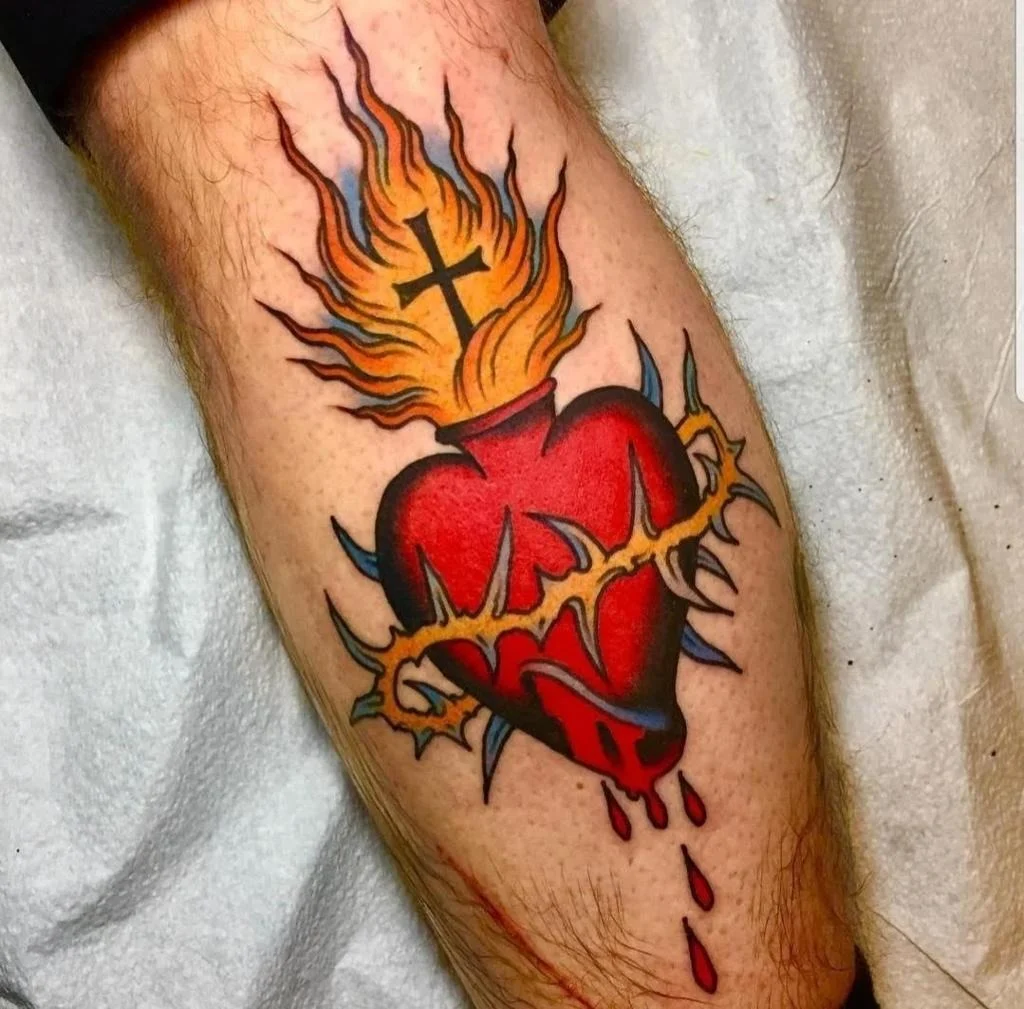
Flames rising from the heart commonly represent the burning love of Christ for humanity. They can also suggest spiritual devotion, warmth, and a faith that remains alive through hardship. In a more personal interpretation, fire may represent a love or conviction that continues despite difficult circumstances.
Crown of Thorns: Suffering and Sacrifice
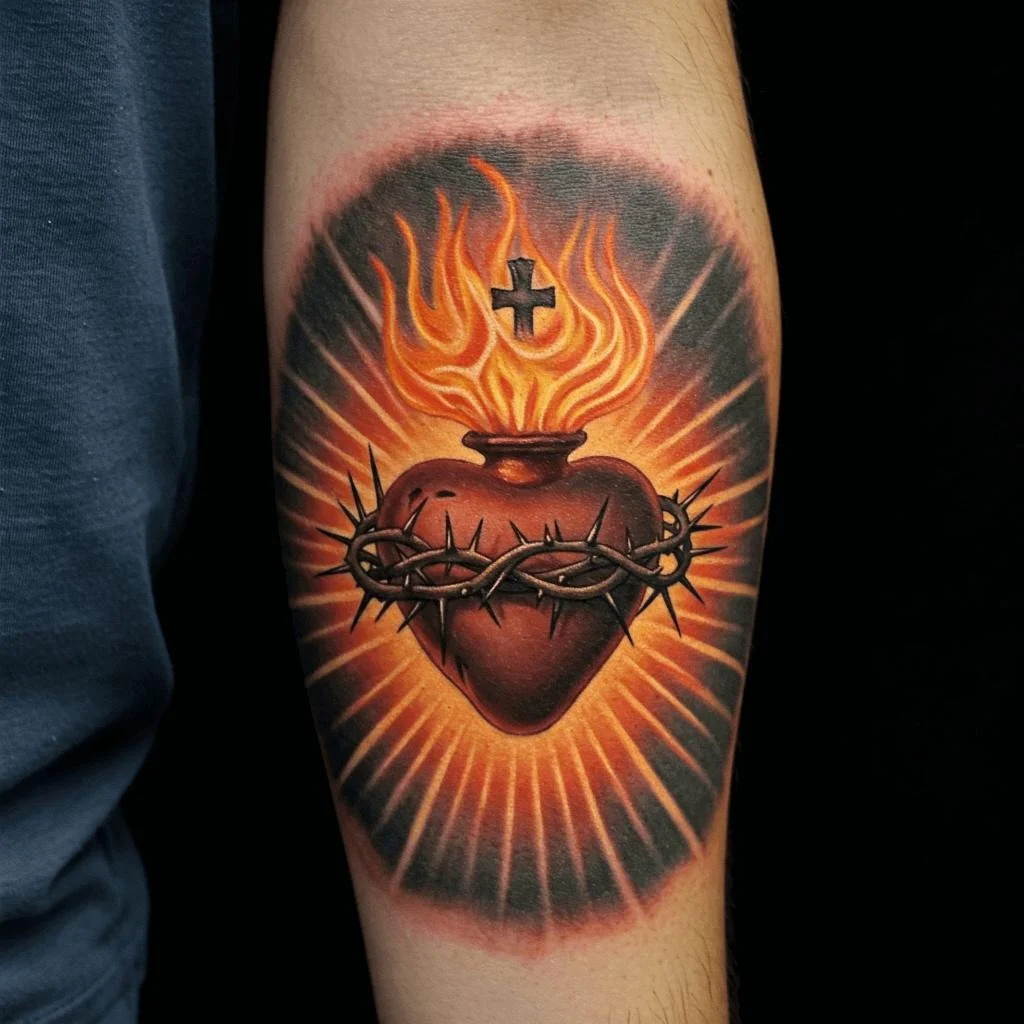
The crown of thorns recalls the suffering of Jesus during his Passion. When it wraps around the heart, it connects love with sacrifice and pain. For a wearer, this may represent Christ’s suffering, compassion for others, or the belief that genuine love can require difficult choices.
Cross: Faith and Redemption
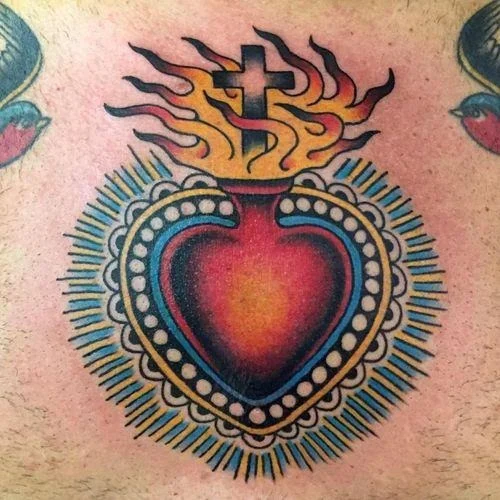
A cross above the heart points directly to Christianity and the crucifixion of Jesus. It may express trust in God, gratitude for Christ’s sacrifice, or a commitment to live according to Christian teachings. Some designs use a small, simple cross, while others make it the most prominent feature.
Wound: Compassion and Vulnerability
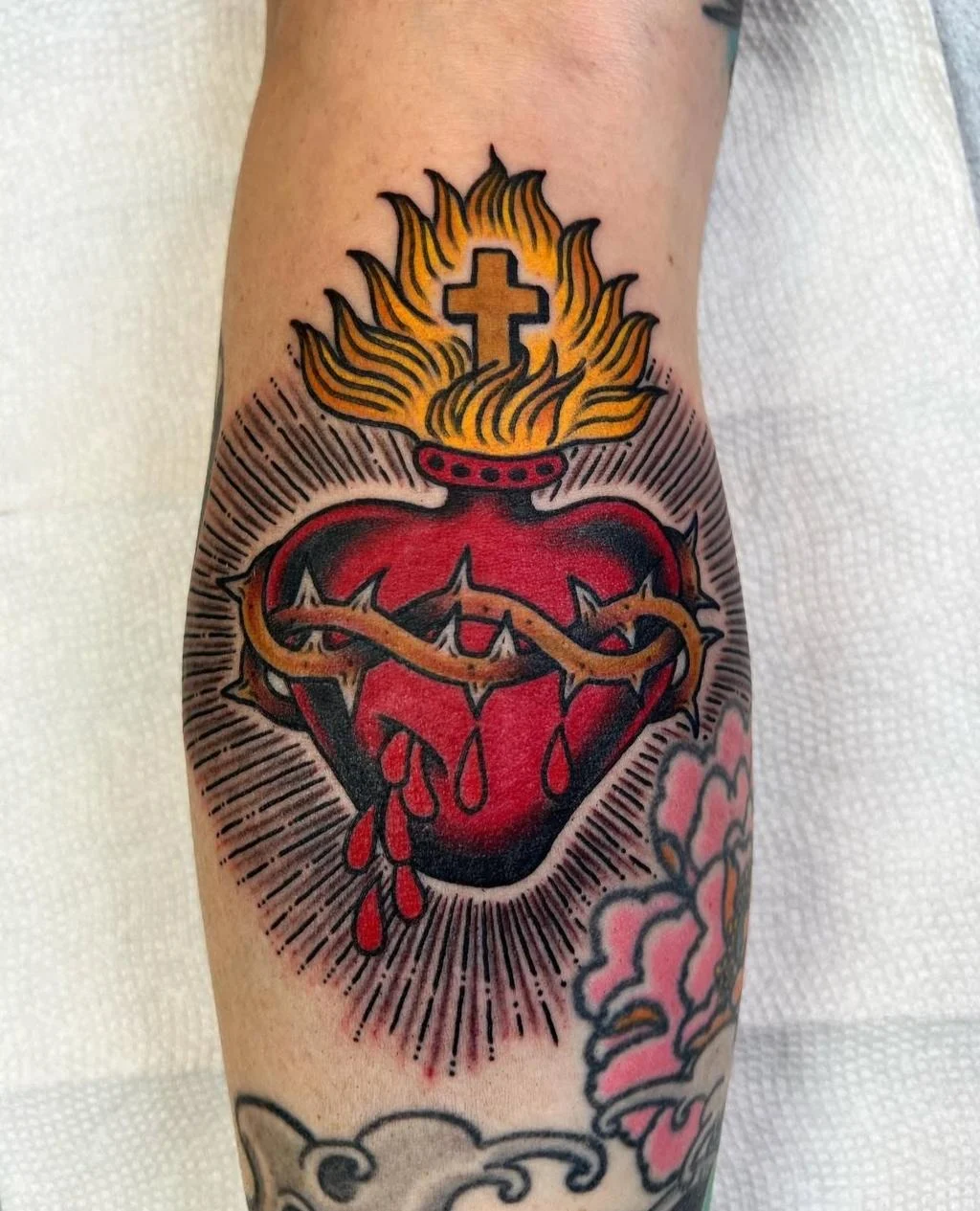
Some Sacred Heart images show a wound in the heart, recalling the pierced side of Christ described in the Gospel of John. The image connects physical suffering with spiritual love and mercy. Outside a strictly religious interpretation, it may also speak to emotional vulnerability and the willingness to care despite the risk of being hurt.
These elements do not have to appear together. A tattoo with flames and a cross may emphasize devotion, while one featuring a crown of thorns may place more attention on sacrifice. Traditional religious interpretations are grounded in Catholic teaching, while personal meanings can vary.
Love, Sacrifice, and Emotional Strength
Even outside a formal religious setting, the Sacred Heart can appeal to people who see love as something deeper than romance. The image often combines tenderness with suffering, creating a symbol that acknowledges both the beauty and difficulty of caring deeply for someone.
Unconditional Love
A Sacred Heart tattoo may represent love that remains compassionate even when circumstances become difficult. For a religious person, this can reflect the love of Christ. For someone interpreting the image more personally, it may represent devotion to a partner, family member, child, or close friend.
This does not mean that love requires accepting mistreatment. Rather, the tattoo can express a desire to remain caring without losing one’s own dignity or boundaries.
Some people add a name, initials, or a date to connect the image with a specific relationship. Others prefer the traditional design on its own, allowing its symbolism to speak without extra text.
Sacrifice and Loyalty
The crown of thorns gives the image a connection with sacrifice. In a personal context, the tattoo may commemorate a time when someone made a difficult choice for a loved one or remained committed through a challenging period.
The design can also acknowledge the cost of devotion. Caring for another person may involve patience, responsibility, and difficult decisions, not only affection.
For some wearers, the message is about loyalty. For others, it represents learning that meaningful love involves both generosity and self-respect.
Healing After Heartbreak
A Sacred Heart tattoo can also serve as a personal marker after grief, heartbreak, or a painful change. The wounded heart may acknowledge emotional pain, while the flames can suggest love that continues rather than disappears.
This interpretation is personal rather than a standard religious definition. Someone might choose the design to honor a relationship that ended, remember a loved one, or recognize the emotional strength it took to move forward.
A tattoo does not need to suggest that every wound has healed. Sometimes it simply marks a moment when a person decided to keep living with an open heart.
Sacred Heart Tattoos Beyond Religious Devotion
The image has a recognizable Catholic identity, but tattoo designs can also carry artistic, cultural, and personal meanings. Some people appreciate the bold lines, vivid colors, and dramatic details associated with traditional Sacred Heart artwork.
Traditional Tattoo Art
The Sacred Heart is a familiar motif in traditional tattooing. Artists often use a heart with strong outlines, red shading, flames, and a crown of thorns to create a design that remains visually clear.
Traditional tattoo art often draws on established imagery and bold contrast. A Sacred Heart design can therefore work as both a religious symbol and a striking piece of body art.
However, the image’s religious background remains important. Someone choosing it mainly for its appearance may still want to understand what the design communicates to people who recognize its Christian meaning.
A Reminder of Personal Values
Some wearers connect the image with compassion, forgiveness, or the decision to remain loving after difficult experiences. They may not follow every Catholic practice, but the heart’s association with mercy and sacrifice still resonates with them.
Others choose the tattoo to reflect family heritage or memories of a religious upbringing. In those cases, it may represent a connection to parents, grandparents, a community, or a childhood shaped by Christian traditions.
Because the Sacred Heart has a specific religious history, it is worth distinguishing personal interpretation from Catholic teaching. Both can be meaningful, but they are not necessarily the same.
Popular Sacred Heart Tattoo Designs and Their Meanings
Different styles can shift the focus of the tattoo. Some emphasize the traditional religious image, while others simplify it or combine it with personal elements.
| Design | Common interpretation | Best suited to |
| Traditional red Sacred Heart | Christian devotion, love, and sacrifice | People who appreciate classic religious tattoo art |
| Sacred Heart with flames | Divine love, passion, and spiritual commitment | Wearers emphasizing faith or enduring love |
| Sacred Heart with a crown of thorns | Suffering, sacrifice, and compassion | People connecting love with hardship |
| Sacred Heart with a cross | Christianity, redemption, and faith | Those wanting a clear religious symbol |
| Black and gray Sacred Heart | Reflection, devotion, and a restrained aesthetic | People who prefer monochrome tattoos |
| Sacred Heart with roses | Love, devotion, beauty, and sacrifice | Those combining religious symbolism with affection |
| Minimalist Sacred Heart | Personal faith or a quiet reminder of values | People who prefer small, simple designs |
| Sacred Heart with a dagger | Pain, heartbreak, sacrifice, or dramatic traditional imagery | Wearers drawn to a more intense design |
The table describes common associations, not fixed rules. A dagger can suggest different things depending on the wearer, and a rose may represent a particular person rather than a broad idea of love.
Sacred Heart With Roses
Roses introduce a softer visual element to the traditional design. Red roses may emphasize love and devotion, while their thorns can echo the suffering represented by the crown of thorns.
This combination can be suitable for someone who wants to connect religious faith with family, romance, or personal remembrance. A single rose creates a simpler image, while several flowers can form a larger composition across the arm or chest.
Sacred Heart With a Dagger
A dagger piercing a heart is a familiar motif in traditional tattoo art. When paired with the Sacred Heart, it can emphasize suffering, sacrifice, or the painful side of love.
The dagger is not a required element of the traditional Sacred Heart image, so its meaning depends more heavily on the artist’s design and the wearer’s intention. It may also make the tattoo feel more dramatic than a simple heart with flames and a cross.
Minimalist Sacred Heart
A minimalist version may use a simple heart outline, a small flame, or a compact cross. This style suits people who want a discreet tattoo without the extensive shading and detail of traditional religious artwork.
Simplification can make the design more personal, but it may also remove details that distinguish the Sacred Heart from an ordinary heart tattoo. If religious accuracy matters to you, ask the artist which features are essential to the image you want.
Sacred Heart vs. Immaculate Heart Tattoos
These two designs can look similar because both use a heart surrounded by religious imagery. However, they refer to different figures in Catholic tradition.
| Feature | Sacred Heart of Jesus | Immaculate Heart of Mary |
| Represents | Jesus Christ and his love for humanity | Mary, her love for God, and her maternal compassion |
| Common details | Crown of thorns, flames, cross, and wound | Roses, flames, and sometimes a sword |
| Main themes | Divine love, sacrifice, mercy, and redemption | Maternal love, purity, sorrow, and devotion |
| Religious association | Devotion to the Heart of Jesus | Devotion to the heart of Mary |
| Typical tattoo intention | Expressing Christian faith or Christ’s love | Honoring Mary or expressing Marian devotion |
The Immaculate Heart of Mary often includes a sword or swords, referencing the sorrow she experienced, while roses are also associated with her purity and love. The exact details can vary by artistic tradition.
If you want a tattoo specifically representing Jesus, look for the crown of thorns, cross, or flames associated with the Sacred Heart. If your intention is to honor Mary, the Immaculate Heart may be a better fit.
Choosing the Right Placement, Color, and Style
Placement can influence how much detail your tattoo can include and whether it feels like a private expression of faith or a visible statement.
Chest
The chest is a natural choice for a heart symbol because of its proximity to the physical heart. Some people choose this location to express a close personal connection to their beliefs or to honor someone important.
A larger chest design can accommodate flames, a cross, a crown of thorns, and decorative elements without crowding them together.
Forearm and Upper Arm
The forearm is suitable for a design that you want to see regularly. It can hold a compact Sacred Heart or a more elaborate traditional composition with roses and flames.
The upper arm offers room for larger artwork and can be covered with clothing when desired. It is also a practical option if you might want to extend the tattoo into a larger religious sleeve later.
Black Ink or Traditional Color
Traditional Sacred Heart tattoos often use red for the heart and flames, with black outlines and darker shading. Red creates a vivid focal point, while the cross and crown of thorns add contrast.
Black and gray designs offer a more restrained appearance. They can emphasize texture, shadows, and fine details without relying on bright colors.
Neither style is more meaningful than the other. Choose based on the look you prefer and the way you want the image to age on your skin.
Before booking, review healed examples of your tattoo artist’s work, discuss the size needed to preserve small details, and follow professional aftercare instructions.
FAQs
Is a Sacred Heart tattoo disrespectful to Christianity?
Christian views on Sacred Heart tattoos vary, so consult a trusted faith leader if you are unsure whether the design aligns with your beliefs.
Can a Sacred Heart tattoo represent someone who has died?
A Sacred Heart tattoo can honor a loved one, with a name or date adding a personal touch to the memorial.
What does a Sacred Heart tattoo with tears mean?
Tears in a Sacred Heart tattoo can symbolize sorrow, grief, compassion, or suffering, depending on the wearer’s intention and design.
Is the Sacred Heart tattoo only for Catholics?
The Immaculate Heart of Mary tattoo has Catholic origins, but others may choose it for its Christian symbolism, artistic style, or personal significance.
What does a Sacred Heart tattoo with a sword mean?
A sword in a tattoo can symbolize pain, sacrifice, or conflict and may reference the Immaculate Heart of Mary, so confirm religious details with your artist.
Conclusion
A Sacred Heart tattoo carries a rich history of Christian devotion, love, mercy, and sacrifice. Its flames, thorns, and cross can express distinct aspects of that tradition, while personal additions allow the wearer to connect the image with family, remembrance, or emotional strength.
Think about whether you want a traditional religious design or a more personal interpretation before choosing your artwork. The strongest design is one whose meaning you understand and feel comfortable carrying with you.










2 thoughts on “Sacred Heart Tattoo Meaning: Symbolism, Faith And Designs For 2026.”