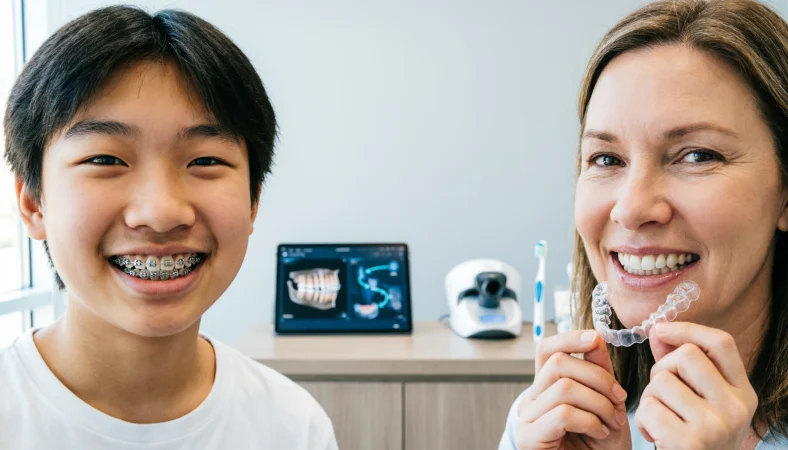
Braces and Invisalign can both straighten teeth and improve alignment, but the better option depends on your dental needs, treatment complexity, lifestyle, budget, and preferences. Traditional braces can be effective for complex orthodontic problems, while Invisalign offers a discreet, removable alternative for suitable cases. An orthodontist can evaluate your teeth and bite to determine which treatment is most appropriate for you.
Choosing between braces or Invisalign isn’t simply a decision about appearance. Your bite, tooth alignment, treatment goals, oral health, daily routine, budget, and ability to follow treatment instructions can all affect which option is right for you. Both treatments are widely used in orthodontics, but they aren’t equally suitable for every patient.
This guide compares their effectiveness, comfort, appearance, maintenance, treatment time, cost, and suitability using evidence based orthodontic information, helping you understand your options before discussing treatment with a qualified orthodontist.
Braces or Invisalign: What’s the Difference?
Traditional braces are a fixed orthodontic appliance. They normally consist of brackets attached to the teeth and an orthodontic wire that applies controlled pressure. The orthodontist periodically adjusts the system to guide teeth into better positions.
Invisalign refers to a system of clear, removable orthodontic aligners. Patients wear a sequence of custom made aligners, with each aligner designed to make a small change in tooth position.
The two treatments share the same broad objective, but their methods are different.
| Feature | Traditional braces | Invisalign |
| Type | Fixed orthodontic appliance | Removable clear aligner system |
| Appearance | Visible | Generally less noticeable |
| Removal | Cannot normally be removed by the patient | Can be removed |
| Eating | Food restrictions may be necessary | Aligners are removed for eating |
| Cleaning | Requires careful cleaning around brackets | Teeth can normally be brushed without aligners |
| Discipline | Treatment remains attached | Requires consistent wear |
| Complex movements | Can be highly versatile | Suitable for many cases, but not every case |
| Lifestyle | Requires adapting to a fixed appliance | Often fits more easily into daily routines |
| Maintenance | Requires cleaning around brackets and wires | Requires cleaning both teeth and aligners |
Quick recap
Braces stay attached to the teeth throughout treatment.
Invisalign aligners can be removed for eating, brushing, and certain occasions.
Both approaches can improve tooth alignment and bite problems.
The most appropriate treatment depends on the individual orthodontic problem rather than appearance alone.
Is Braces or Invisalign a Grammar, Vocabulary, or Usage Issue?
In this context, the phrase is not a grammar problem. It is a medical and everyday usage question involving two different treatment options.
Braces is a general noun referring to an orthodontic appliance. Invisalign is a brand name associated with clear aligner treatment.
The terms should not normally be treated as interchangeable. Someone saying, “I am getting braces” generally means a fixed appliance, although everyday language sometimes uses braces as a broad term for orthodontic treatment.
Someone saying, “I am getting Invisalign” is specifically referring to clear aligner treatment associated with that brand.
In casual conversation, people may use simplified expressions such as “I need braces” even when they are discussing orthodontic treatment generally. In academic, professional, or healthcare writing, greater precision is preferable.
The distinction is particularly important when discussing treatment recommendations, costs, expected results, or eligibility.
Understanding Traditional Braces
Traditional braces have been used for decades and remain one of the most established orthodontic treatment methods.
Small brackets are attached to the teeth, and an orthodontic wire passes through them. The orthodontist uses controlled forces to gradually move teeth.
Modern braces aren’t necessarily the bulky metal appliances many adults remember from childhood. Today, patients may have several aesthetic choices, depending on their needs and orthodontic practice.
Braces can be especially useful when significant tooth movement or detailed control is required. They can also be useful for correcting certain bite relationships.
Workplace example
An adult working in a customer facing profession may initially worry about the appearance of braces. However, treatment may still be appropriate if the orthodontic problem requires the control offered by a fixed appliance.
For some patients, the fact that braces cannot be removed is actually an advantage because there is no need to remember to put them back in.
Academic example
A student with significant crowding may benefit from a treatment plan involving braces. Although appearance can influence the decision, the orthodontic requirements should come first.
Technology example
Modern orthodontic planning may involve digital scans, computer assisted treatment planning, digital photographs, and specialized imaging. These technologies can support diagnosis and treatment planning regardless of whether the final appliance is braces or clear aligners.
Braces usage recap
Braces are fixed appliances designed to produce controlled tooth movement.
They can be suitable for many types of orthodontic correction.
They require careful cleaning and adaptation to having an appliance attached to the teeth.
Understanding Invisalign
Invisalign uses a sequence of clear aligners that are designed to move teeth progressively.
One of the biggest differences is removability. Patients can generally take the aligners out when eating and brushing their teeth. They then need to put them back in according to their orthodontist’s instructions.
This flexibility can be attractive to people who want a less noticeable treatment option.
However, removability creates an important responsibility. If a patient frequently leaves the aligners out, the treatment may not progress as planned.
Workplace example
An adult professional may appreciate being able to remove clear aligners briefly for certain situations. The relatively discreet appearance can also make aligner treatment appealing to people who are concerned about visible orthodontic appliances.
Academic example
A teenager or university student may prefer clear aligners because they can be removed for meals and regular oral hygiene. However, the patient needs enough responsibility to wear them consistently.
Technology example
Clear aligner treatment commonly relies on digital scanning and computer based treatment planning. Digital models can help orthodontic professionals visualize tooth movement and create a sequence of aligners.
Invisalign usage recap
Invisalign offers a removable and relatively discreet approach to orthodontic treatment.
It can be convenient for eating and oral hygiene.
Its success depends heavily on patient cooperation and appropriate case selection.
When You Should NOT Use Braces or Invisalign
The important question isn’t simply which treatment looks better. It is whether the treatment is appropriate for the specific orthodontic problem.
Here are common situations in which choosing an option without professional assessment can lead to problems.
- Do not choose treatment solely because it looks better.
Aesthetic preference matters, but the treatment must be capable of addressing the orthodontic problem.
- Do not choose clear aligners simply because they are removable.
Removability is useful only when the patient is disciplined enough to wear the aligners as instructed.
- Do not choose braces simply because they are traditional.
A familiar treatment isn’t automatically the right treatment for every patient.
- Do not ignore bite problems.
Straight looking front teeth do not necessarily mean the bite is healthy or properly aligned.
- Do not rely only on online treatment claims.
An orthodontic assessment can reveal problems that aren’t obvious from photographs.
- Do not make a decision based only on price.
The cheapest initial option may not provide the most appropriate treatment.
- Do not assume age alone determines eligibility.
Children, teenagers, and adults can have different orthodontic considerations, but age isn’t the only deciding factor.
- Do not begin treatment without understanding retention.
After active orthodontic treatment, retainers are commonly important for helping maintain the new tooth positions.
Common Mistakes and Decision Rules
People frequently make mistakes when comparing orthodontic options because they focus on the appliance rather than the treatment objective.
| Correct sentence | Incorrect sentence | Explanation |
| My orthodontist recommended braces for my bite problem. | My orthodontist recommended Invisalign because it looks better. | Appearance is only one consideration. |
| I need clear aligners that I can remove for meals. | I need braces that I can remove for meals. | Traditional braces are fixed. |
| My child needs an orthodontic evaluation. | My child definitely needs Invisalign. | Treatment should follow professional assessment. |
| I need to wear my aligners consistently. | I can leave my aligners out most of the day. | Clear aligners depend on patient cooperation. |
| I need to clean carefully around my brackets. | I can brush normally without paying attention to my brackets. | Fixed appliances require additional cleaning care. |
Decision Rule Box
If you need a fixed appliance that stays attached to your teeth, braces may be appropriate.
If you want a removable clear aligner system and your orthodontic condition is suitable for it, Invisalign may be an option.
The final decision should come from an orthodontic examination rather than a general rule.
Braces or Invisalign in Modern Technology and AI Tools
Technology has changed how orthodontic treatment is planned and monitored.
Digital impressions can replace traditional physical impressions in many situations. Three dimensional models can help orthodontic professionals examine tooth positions and plan movement.
Computer based systems can also simulate potential treatment sequences. Artificial intelligence is increasingly being explored in dentistry and orthodontics for tasks such as image analysis, prediction, documentation, and treatment planning support.
However, technology should support professional judgment rather than replace it.
An attractive digital simulation does not guarantee that a particular treatment will produce the expected clinical result. Biological responses vary between individuals, and orthodontic treatment involves factors that software cannot always predict perfectly.
A Brief History and Etymology of the Terms
The word braces comes from the broader concept of something that supports, holds, or strengthens. In dentistry, braces became associated with appliances used to support controlled movement of teeth.
Invisalign is a modern brand name created around the idea of making orthodontic treatment less visually obvious. The name combines the concept of invisibility with alignment.
The terminology reflects a major change in orthodontic technology. Traditional braces emphasize a visible fixed appliance, while clear aligner systems emphasize discreet treatment.
An important principle in professional communication is that a brand name should not automatically be treated as a generic synonym for every product in the same category.
Expert style perspective
“Good orthodontic decision making starts with the movement the teeth need, not with the appliance the patient happens to prefer.”
This principle captures the most important point. Treatment selection should be based on clinical requirements, patient circumstances, and realistic expectations.
Two Practical Case Studies
Case study one: A teenager with inconsistent routines
Consider a 15 year old student who wants clear aligners because they are less noticeable. The treatment could be appealing, but the teenager frequently forgets routines and often leaves removable appliances out.
In this representative scenario, fixed braces may be more practical because treatment does not depend on remembering to insert an appliance every day.
The concrete result is improved treatment consistency because the patient cannot accidentally leave the appliance at home during school.
Case study two: An adult professional
Consider a 34 year old professional with a suitable orthodontic condition who is concerned about visible appliances at work. The patient is highly organized and can follow a prescribed aligner schedule.
In this representative scenario, clear aligner treatment may offer a convenient solution.
The concrete result is greater day to day flexibility, particularly around meals, oral hygiene, and professional situations.
These are illustrative cases rather than claims about a specific patient’s medical outcome. Real treatment results depend on diagnosis, biology, compliance, and the orthodontist’s treatment plan.
Author expertise
Written from the perspective of an SEO content specialist and language focused health information writer with an emphasis on clear terminology, evidence aware communication, and reader friendly explanations.
Error Prevention Checklist
Always consider braces when
- A fixed appliance is recommended for the orthodontic problem.
- Consistent treatment participation is a concern.
- The orthodontist believes detailed tooth control is required.
- The patient prefers not to manage a removable appliance.
Never choose Invisalign simply when
- You want the least visible option regardless of clinical suitability.
- You expect to remove the aligners frequently.
- You don’t plan to follow the prescribed wearing schedule.
- You are making the decision without an orthodontic assessment.
The safest approach is to ask the orthodontist why a particular treatment is recommended and what alternatives are realistic for the specific case.
Related Grammar Confusions You Should Master
Although the central issue here is orthodontic terminology rather than grammar, readers often benefit from understanding similar distinctions between everyday and precise language.
Related terminology questions include:
- Braces vs orthodontic treatment
- Invisalign vs clear aligners
- Dentist vs orthodontist
- Orthodontics vs dentistry
- Aligner vs retainer
- Treatment vs procedure
- Diagnosis vs consultation
- Correction vs prevention
- Cosmetic dentistry vs orthodontics
- Fixed appliance vs removable appliance
Knowing these distinctions makes conversations with healthcare professionals clearer and helps patients ask more useful questions.
FAQs.
What is better, braces or Invisalign?
Neither option is universally better. The appropriate choice depends on the patient’s orthodontic condition, treatment goals, age, lifestyle, ability to follow instructions, and professional assessment.
Are braces more effective than Invisalign?
Braces can be highly effective for a wide range of orthodontic problems. Clear aligners can also be effective for many cases. Effectiveness depends on case selection, treatment planning, and patient compliance.
Is Invisalign cheaper than braces?
Cost varies considerably depending on the complexity of treatment, location, provider, treatment duration, and other factors. Patients should compare complete treatment costs rather than only the initial price.
Is Invisalign better for adults?
Clear aligners can be attractive to adults because they are discreet and removable. However, adults can also receive successful treatment with braces when that option is clinically appropriate.
Are braces better for children?
Not necessarily. Children and adolescents may require different orthodontic approaches depending on dental development and the nature of the problem. An orthodontic evaluation is essential.
Can Invisalign fix severe crowding?
Clear aligners can address many forms of crowding, but suitability depends on the severity and type of tooth movement required. Some complex cases may be better managed with braces or another approach.
Can you eat normally with Invisalign?
Aligners are generally removed before eating. Patients then put them back in after cleaning their teeth as instructed. This differs from fixed braces, where certain foods may need to be avoided.
Which treatment is easier to clean?
Clear aligners can make ordinary brushing easier because the appliance is removable. Braces require careful cleaning around brackets and wires, which can take additional time and technique.
Do braces or Invisalign hurt more?
Both can cause temporary discomfort as teeth respond to orthodontic forces. The level of discomfort varies between patients and can also vary during different stages of treatment.
How do I choose between braces and Invisalign?
Start with a professional orthodontic evaluation. Ask what type of tooth movement is required, which options are suitable, how long treatment may take, what responsibilities each option involves, and what retention will be needed afterward.
Final Verdict:
Choosing between braces and clear aligners shouldn’t be reduced to a simple question of which one looks better. Braces offer a fixed approach that can provide highly controlled tooth movement, while Invisalign offers a removable and discreet alternative for many suitable cases.
For parents, reliability and the child’s ability to cooperate may be especially important. Also for teenagers, appearance and convenience may influence the decision. For adults, professional appearance and lifestyle flexibility can matter greatly.
The best choice is the treatment that fits the patient’s clinical needs as well as their ability to follow the treatment plan.
If you’re comparing braces or Invisalign, the most useful question to ask an orthodontist is not simply, “Which one is better?” Instead, ask, “Which option is most appropriate for my specific teeth and bite, and why?”
That question shifts the conversation from marketing and appearance toward the factor that matters most: achieving a healthy, functional, and stable result.