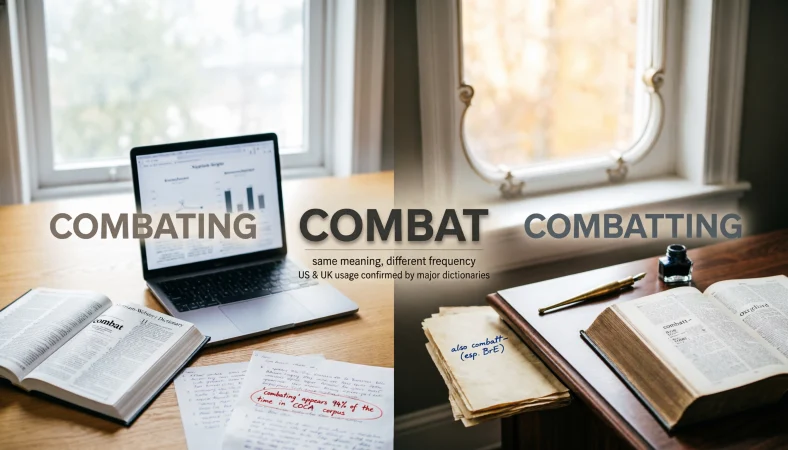
Both combatting or combating are accepted spellings of the present participle and gerund form of the verb combat. The main difference is spelling preference rather than meaning. Combating is more common and widely preferred, while combatting is also grammatically correct and follows a traditional pattern in which the final consonant is doubled before adding ing.
If you’ve ever stopped while writing a report and wondered whether to use combatting or combating, you’re dealing with a genuine English spelling variation. Both forms come from the verb combat, meaning to fight against, resist, or take action to reduce something harmful. The confusion matters because professional, academic, government, health, and technology writing frequently uses this verb in phrases such as combating misinformation or combatting climate change. Although both spellings are valid, combating is generally the more common choice, while combatting remains established in English, particularly in British usage.
Combatting vs Combating: What’s the Difference?
Combatting and combating are both present participle and gerund forms of the verb combat.
The base verb combat means to oppose, resist, or fight against something.
For example:
Governments combat organized crime.
When the verb takes the ing form, writers may use either:
Governments are combating organized crime.
or:
Governments are combatting organized crime.
The meaning does not change.
The difference lies primarily in spelling convention and regional preference.
| Form | Part of speech | Meaning | Common usage |
| Combat | Verb | To fight or oppose something | Standard |
| Combating | Present participle or gerund | Fighting against something | Very common |
| Combatting | Present participle or gerund | Fighting against something | Correct but less common |
| Combated | Past tense or past participle | Fought or opposed | Standard |
| Combatant | Noun or adjective | A person involved in fighting | Different word |
Mini recap
Combating and combatting have the same basic meaning.
Combating is generally the more common spelling.
Combatting is also accepted and can be found in reputable British English writing.
For most general audiences, combating is the safest default.
Is Combatting vs Combating a Grammar, Vocabulary, or Usage Issue?
The distinction between combatting and combating is primarily a spelling and usage issue, not a difference in grammar or meaning.
Both forms are derived from the same verb.
Are combating and combatting interchangeable?
In most contexts, yes.
Consider:
The organization is combating poverty.
and:
The organization is combatting poverty.
The intended meaning is identical. Both sentences describe an active effort to oppose or reduce poverty.
The choice therefore isn’t comparable to a pair such as affect and effect, where the words have different grammatical functions and meanings.
Instead, this is a spelling variation.
Why does one form have two ts?
The answer involves English spelling conventions surrounding words ending in a consonant.
Writers often learn a rule that says a final consonant is doubled before ing in certain circumstances.
For example:
run becomes running
sit becomes sitting
stop becomes stopping
That pattern can lead writers to expect:
combat becomes combatting
However, combat has unusual stress and spelling characteristics, and combating has become the dominant modern spelling.
This means the traditional doubling logic doesn’t give you a simple answer for every verb.
Formal versus informal usage
Both spellings can appear in formal writing.
However, combating is more widely recognized and generally looks more familiar to contemporary readers.
If you’re preparing a formal report, academic article, business document, or web page and don’t have a specific reason to use combatting, combating is usually the better choice.
Academic versus casual usage
Academic writing generally favors the spelling that is most established within the publication’s preferred variety of English.
For example:
Researchers are combating antibiotic resistance.
This is natural in scientific writing.
A British publication might also use:
Researchers are combatting antibiotic resistance.
The second version is not inherently incorrect. It simply reflects a less common spelling preference.
How to Use Combating
Combating is the most broadly useful form of the two.
It means actively fighting, resisting, reducing, or attempting to overcome something undesirable.
The word frequently appears with abstract nouns.
Common combinations include:
- combating poverty
- combating corruption
- combating disease
- combating misinformation
- combating climate change
- combating discrimination
- combating cybercrime
- combating inflation
The word doesn’t necessarily imply physical fighting. In modern English, it is frequently used for social, economic, medical, environmental, and technological problems.
Workplace example
A company might write:
We are combating workplace harassment through stronger reporting procedures.
The company isn’t physically fighting harassment. It is taking measures to oppose and reduce it.
Academic example
A public health paper might state:
Researchers are developing new strategies for combating antibiotic resistance.
This is a natural academic use because combat can describe sustained efforts against a serious problem.
Technology example
A cybersecurity company might say:
The platform uses automated tools for combating online fraud.
Again, the meaning is resisting or reducing a threat.
Usage recap
Use combating when you want the most widely recognized spelling.
It works naturally in formal, academic, professional, journalistic, and everyday writing.
It can describe efforts against both physical threats and abstract problems.
How to Use Combatting
Combatting is also a legitimate form of the verb combat.
For example:
The government is combatting organized crime.
The sentence is grammatically sound.
The main consideration is audience and editorial style.
In some varieties of British English, combatting is familiar and accepted. However, it is generally less frequent than combating.
This means that writers should not automatically correct combatting to combating as though the original spelling were always an error.
Workplace example
The company is combatting fraud through improved internal controls.
This is acceptable, particularly when the organization follows a British English style.
Academic example
The study examines methods for combatting social inequality.
Again, the spelling is valid.
Technology example
New security measures are being developed for combatting cyber threats.
The meaning is identical to combating cyber threats.
Usage recap
Use combatting when it fits the English variety or style guide you’re following.
It is not a misspelling that must always be changed.
If you’re writing for a broad international audience, however, combating will usually be the more familiar option.
When You Should NOT Use Combatting or Combating
Understanding the distinction also means knowing when neither form is appropriate.
- Don’t use either form when you need the base verb.
For example:
The organization works to combat fraud.
Not:
The organization works to combating fraud.
- Don’t use combating when the sentence requires a past tense.
Use:
The organization combated fraud.
Not:
The organization combating fraud last year.
- Don’t assume combatting is always wrong. It is an accepted spelling.
- Don’t switch between forms randomly within the same document. Consistency creates a more polished result.
- Don’t use combatting simply because you think every verb ending in a consonant must double that consonant. English spelling rules have exceptions and historical variation.
- Don’t use either word when you mean a person who fights. The relevant noun is combatant.
- Don’t confuse combat with debate. Although combat can be metaphorical, it generally suggests active opposition.
- Don’t let an automated spelling checker make the entire decision without considering regional style. Software may favor one accepted form.
Common Mistakes and Decision Rules
| Correct sentence | Incorrect sentence | Explanation |
| The campaign is combating misinformation. | The campaign is combat misinformation. | The continuous form requires combating or combatting. |
| The government is combating corruption. | The government is combatinged corruption. | Combating is already the participle form. |
| The group works to combat disease. | The group works to combating disease. | After to in this construction, use the base verb. |
| Researchers are combating resistance. | Researchers are combatted resistance. | The sentence requires the present participle. |
| The agency combated the problem last year. | The agency combating the problem last year. | A completed past action requires the past tense. |
| The organization is combatting fraud. | The organization is combat fraud. | A continuous construction requires the ing form. |
Decision Rule Box
- If you need the present participle or gerund, use “combating” or “combatting.”
- If you want the most widely recognized spelling, choose “combating.”
- If your publication follows British usage and permits it, “combatting” is also correct.
- If the sentence requires the base verb after “to,” use “combat.”
- If you are describing a completed past action, use “combated.”
Why Does Combat Become Combating?
The spelling of combating can feel unusual because many English verbs follow a more predictable consonant doubling pattern.
For example:
plan becomes planning
admit becomes admitting
control becomes controlling
Yet:
combat becomes combating
is the dominant spelling.
This is partly connected to the stress pattern of the word.
In English, consonant doubling before ing is influenced by pronunciation, syllable structure, and stress. The rules are not as simple as “double the final consonant whenever a verb ends in one.”
That is why learning the established spelling of individual verbs remains important.
The existence of combatting reflects another aspect of English: historical spelling variation can survive even when one form becomes more common.
Combating in American English
American English strongly favors combating.
Consider:
The government is combating inflation.
Researchers are combating infectious diseases.
The platform is combating online fraud.
Communities are combating food insecurity.
These examples sound natural in contemporary American English.
If you are writing for an American newspaper, university, company, or website, combating is normally the better choice.
That doesn’t mean combatting is unintelligible. Most readers will understand it immediately. It simply isn’t the dominant spelling.
Combatting in British English
British English provides more room for combatting.
A British writer may use:
The organization is combatting poverty.
Another may write:
The organization is combating poverty.
Both are understandable and acceptable.
This illustrates an important principle in English usage: a spelling can be valid without being equally common everywhere.
Writers should therefore distinguish between incorrect and less preferred.
Calling combatting incorrect in every context would be too strong.
Combatting or Combating in Formal Writing
Formal writing benefits from choosing the form that matches the intended publication style.
Suppose you’re writing an academic paper about environmental policy.
You could write:
Governments are combating climate change through coordinated environmental policies.
This is a safe choice for a broad international readership.
A British academic publication might instead use:
Governments are combatting climate change through coordinated environmental policies.
Neither sentence changes the underlying argument.
The difference is orthographic preference.
For editors, consistency is more important than pretending that one accepted form does not exist.
Combatting or Combating in Business Writing
Business communication frequently uses combat in metaphorical expressions.
Companies may talk about:
- combating fraud
- combating waste
- combating inefficiency
- combating employee turnover
- combating cyber threats
The word is especially useful because it communicates active resistance without necessarily implying physical conflict.
For example:
The company is combating rising costs by improving its supply chain.
The sentence means the company is taking action to reduce or control rising costs.
If the audience is international, combating is generally the safest spelling.
Combatting or Combating in Scientific and Medical Writing
Scientific and medical writing often uses combat to describe efforts against diseases, infections, resistance, and public health challenges.
Examples include:
- combating antibiotic resistance
- combating infectious diseases
- combating obesity
- combating malaria
- combating antimicrobial resistance
The word is especially common because scientific writing often describes organized efforts to overcome complex problems.
For example:
Researchers are exploring new approaches to combating antimicrobial resistance.
Here, combating follows the preposition to as part of the gerund phrase to combating. This is different from an infinitive construction such as:
Researchers hope to combat antimicrobial resistance.
This distinction is important because the two to constructions work differently.
Combating After the Word “To”
One of the most useful grammar distinctions involves to combat versus to combating.
Consider:
The program was created to combat fraud.
Here, to introduces an infinitive, so the base verb combat follows.
Now consider:
The program is dedicated to combating fraud.
Here, to is part of the prepositional phrase dedicated to, so a gerund follows.
This distinction can prevent many errors.
Compare:
The agency aims to combat corruption.
The agency is committed to combating corruption.
Both are correct, but the grammar is different.
The same principle applies to combatting:
The agency is committed to combatting corruption.
This is also grammatically possible.
Combatting or Combating in Modern Technology and AI Tools
Technology writing frequently uses both forms in discussions of security, misinformation, fraud, harmful content, and artificial intelligence.
For example:
AI systems are being developed for combating online misinformation.
A British style publication might use:
AI systems are being developed for combatting online misinformation.
The meaning is unchanged.
Automated grammar and spelling tools may flag combatting even though it is a recognized form. Conversely, a tool configured for British English may accept it without comment.
AI writing assistants can also change one form into the other when rewriting text.
This is why human review still matters. A spelling difference is not necessarily a grammatical error.
For technical documentation, the best practice is to establish a style guide at the beginning of a project and apply it consistently.
Etymology of Combat
The word combat entered English through French and ultimately traces back to Latin roots associated with fighting or striking together.
Its historical connection with physical conflict explains why the word originally carried a strongly martial sense.
Over time, English expanded its metaphorical use.
Today, people don’t only combat armies or enemies. They can combat:
poverty
corruption
disease
misinformation
discrimination
climate change
This broad metaphorical development is one reason the word appears so frequently in modern professional and academic writing.
Expert style quotation
When two established spellings share the same grammatical function and meaning, the strongest editorial choice is usually the form that best matches the intended audience and style.
That principle applies especially well to combating and combatting.
Two Practical Case Studies
Case Study 1: International public health writing
Imagine an international health organization preparing a report for readers in North America, Europe, Asia, and Africa.
The sentence reads:
Countries are combating antimicrobial resistance through coordinated surveillance.
The choice of combating provides a broadly familiar spelling across international English.
If the same sentence used combatting, readers would still understand it, but some audiences might perceive it as distinctly British or less familiar.
The practical result of choosing combating is greater stylistic neutrality for a global audience.
Case Study 2: British editorial writing
Now imagine a British publication preparing an article about efforts to reduce online fraud.
The editor writes:
Financial institutions are combatting increasingly sophisticated scams.
The spelling is acceptable within British English.
Another editor might choose:
Financial institutions are combating increasingly sophisticated scams.
That version is also correct.
The practical lesson is that editing should distinguish between a genuine spelling error and a legitimate regional variant.
Error Prevention Checklist
Always use combating when
- You want the most widely recognized form.
- You’re writing American English.
- You’re writing for a broad international audience.
- Your publication prefers the more common spelling.
- You want to minimize regional variation.
Combatting is appropriate when
- Your publication follows British English.
- Your organization has adopted the spelling.
- Your surrounding text follows the same regional convention.
- You are preserving an original British English source.
Never assume
- Combatting is always wrong.
- Combating is the only accepted spelling.
- The two forms have different meanings.
- A spelling checker can determine regional style perfectly.
- Consonant doubling rules work identically for every English verb.
Combating or Combatting in Common Expressions
Some phrases occur so frequently that their conventional spelling is easy to recognize.
Combating misinformation
Governments are combating misinformation online.
Combating poverty
Community programs are combating poverty.
Combating corruption
Stronger oversight can help combat corruption.
Combating climate change
Countries are developing policies for combating climate change.
Combating cybercrime
New technologies are being developed for combating cybercrime.
In broad modern usage, combating is generally the form you’ll encounter most often.
Related Grammar Confusions You Should Master
If you’re interested in English spelling and verb formation, these related topics are worth learning.
- Focused or focussing
- Traveling or travelling
- Canceling or cancelling
- Labeling or labelling
- Modeling or modelling
- Signaled or signalled
- Benefit or benefitted
- Kidnapped or kidnapped
- Controlled or controled
- Preferred or prefered
These examples demonstrate that English spelling can vary according to regional conventions, pronunciation, historical development, and established usage.
Some pairs have clear regional preferences, while others contain one accepted spelling and one common error.
FAQs
Is combatting or combating correct?
Both combatting and combating are accepted forms of the present participle and gerund of combat. Combating is more common, while combatting is also established, particularly in British English.
Is combating or combatting more common?
Combating is generally more common in contemporary English, particularly in American English and broad international usage.
Is combatting grammatically correct?
Yes. Combatting is a recognized form of combat. It should not automatically be treated as a spelling mistake.
Is combating the preferred spelling in American English?
Yes. American English strongly favors combating.
Is combatting British English?
Combatting is particularly associated with British English, although British writers also commonly use combating.
Should I use combating or combatting in academic writing?
Follow your institution or publication’s style guide. If there is no specific requirement, combating is generally the safer choice for a broad audience.
Why is combating spelled with one t?
English consonant doubling rules depend on factors such as stress, syllable structure, pronunciation, and established spelling conventions. The common modern spelling of combat with ing is combating.
Can I say committed to combatting?
Yes. Combatting can correctly follow to, as in “The organization is committed to combatting fraud.” Combating is also correct and widely used.
Can I say committed to combating?
Yes. This is grammatically correct and extremely common.
What is the past tense of combat?
The past tense is combated.
For example:
The organization combated the problem for years.
Final Verdict:
The choice between combatting or combating is much simpler once you understand that both forms are legitimate.
Combating is the more common and broadly preferred spelling. It is especially suitable for American English, international communication, academic writing, professional documents, and general web content.
Combatting is also correct and remains established, particularly in British English and certain editorial contexts.
Neither spelling changes the basic meaning of the verb. Both mean actively fighting, resisting, opposing, or working to reduce something.
If you’re unsure which form to choose, use combating. It is familiar to the widest range of English readers.
Most importantly, don’t mistake regional preference for grammatical correctness. Good English writing isn’t only about choosing the one spelling you have seen most often. It is also about understanding variation, identifying your audience, and applying your chosen style consistently.