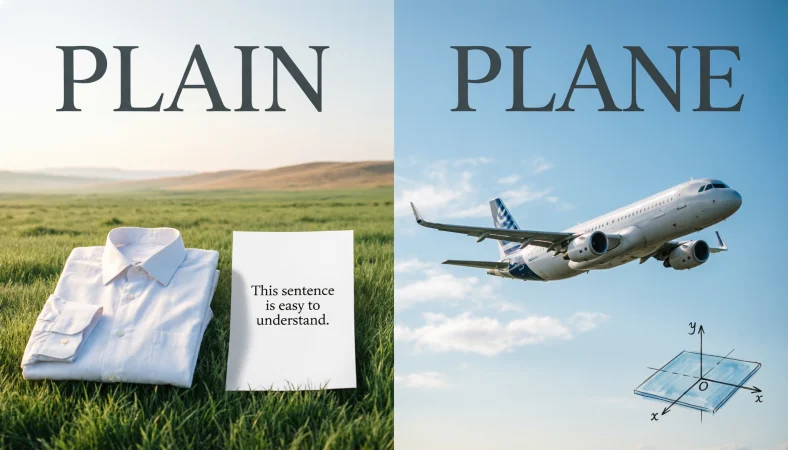
Plain and plane are both correct words, but they have different meanings. Plain can describe something simple, ordinary, or without decoration, and it can also refer to a large area of flat land. For example, “She wore a plain white shirt.” Plane usually refers to an aircraft or a flat surface, as in “The plane landed safely.”
Understanding the difference between plain or plane helps you choose the correct word based on your intended meaning and avoid common spelling mistakes.
Have you ever wondered whether to write plain or plane in a sentence? These words sound alike but have different meanings, making them common sources of confusion in English writing. Plain often describes something simple or refers to flat land, while plane commonly means an aircraft or a flat geometric surface.
Learning how each word works can help you express your ideas clearly and avoid mistakes in everyday communication.
In this guide, you will learn the difference between plain and plane, explore their meanings and grammatical uses, and review practical examples of each word.
With straightforward explanations and clear sentence comparisons, you will understand when to use each spelling and feel more confident applying these words in school assignments, professional writing, and daily conversations.
Plain vs Plane: What’s the Difference?
The difference between plain and plane depends on what you want to describe. Plain is commonly an adjective meaning simple or unadorned, and it can also be a noun for a large area of flat land. Plane is commonly a noun for an aircraft or a flat surface, and it can also refer to a level of existence or thought.
Because both words are pronounced alike in many English accents, writers sometimes confuse them. However, they aren’t interchangeable. Choosing the wrong spelling can change the meaning of a sentence completely.
What Does Plain Mean?
Plain is an adjective and a noun.
As an adjective, plain means simple, easy to understand, not decorated, or lacking unnecessary features. It can describe clothing, language, food, design, or appearance.
Examples:
- She wore a plain white shirt.
- Please explain the instructions in plain English.
- We ordered plain rice with our meal.
- The room looked plain without any decorations.
As a noun, plain refers to a broad area of relatively flat land, often with few trees or major changes in elevation.
Examples:
- The farmers grew wheat across the wide plain.
- Herds of animals moved across the open plains.
- The village stood on a fertile plain near the river.
Plain can also appear in expressions such as “plain and simple,” “plain sight,” and “plain truth.” In these expressions, it emphasizes simplicity, visibility, or clarity.
What Does Plane Mean?
Plane is most often a noun. Its most familiar meaning is an aircraft that flies through the air.
Examples:
- Our plane landed ahead of schedule.
- She boarded a plane to visit her family.
- The plane flew above the clouds.
Plane also has technical meanings. In geometry, a plane is a flat, two dimensional surface that extends infinitely in all directions. In woodworking, a plane is a tool used to smooth or shape a wooden surface.
The word can also refer to a level or dimension of existence, thought, or activity.
Examples:
- The points lie on the same plane in geometry.
- He used a plane to smooth the wooden board.
- The discussion moved to a different plane of thought.
These meanings share an idea of a surface, level, or defined technical object, although the aircraft meaning has a separate everyday use.
Plain or Plane Comparison Table
| Feature | Plain | Plane |
| Part of speech | Adjective and noun | Primarily a noun; also a verb |
| Main meaning | Simple, clear, undecorated, or flat land | Aircraft, flat geometric surface, or woodworking tool |
| Describes clothing | A plain shirt | A plane shirt is incorrect if you mean a simple shirt |
| Describes travel | Plain travel is not the usual expression for flying | We traveled by plane |
| Describes land | A grassy plain | A plane is not the usual word for an area of flat land |
| Technical use | Plain language means easy to understand | A geometric plane is a flat two dimensional surface |
| Common expression | Plain English | By plane |
| Example | The instructions are plain. | The plane took off. |
Quick recap: Use plain for something simple, clear, undecorated, or a stretch of flat land.
Use plane for an aircraft, a flat geometric surface, or a tool for smoothing wood.
The words sound alike, but their meanings and spellings are different.
Think of a plane in the sky and a plain shirt on the ground to remember the distinction.
Is Plain vs Plane a Grammar, Vocabulary, or Usage Issue?
Plain versus plane is primarily a vocabulary and spelling issue. Both words are correct English words, but each has its own meanings and uses. The confusion occurs because they are homophones in many accents: words that sound the same but have different meanings and spellings.
Are Plain and Plane Interchangeable?
No. Plain and plane are not interchangeable when they refer to their usual meanings.
Consider these sentences:
- The passenger boarded a plain.
- The passenger boarded a plane.
The second sentence is correct when describing air travel. Plain refers to simplicity or flat land, not an aircraft.
Now consider another pair:
- She wore a plane black dress.
- She wore a plain black dress.
The second sentence is correct because plain describes the dress as simple or undecorated.
The meaning of the sentence determines which word belongs there.
Formal vs Informal Usage
Both words are suitable for formal and informal English. The distinction does not depend on how professional or casual the sentence sounds.
In a formal report, you might write, “The aircraft crossed the plain before reaching the mountain range.” Here, plain describes the landscape.
In a travel email, you might write, “My plane arrives at six in the evening.” Here, plane refers to the aircraft.
In business communication, plain is also common in the phrase “plain language,” which means writing that readers can understand easily.
Academic vs Casual Usage
In academic writing, plain may describe a landscape, an uncomplicated method, or language designed for clarity. Plane often appears in mathematics, engineering, aviation, and technical descriptions.
For example, a geography student might describe a river flowing across a broad plain. A mathematics student might explain that three points lie on a plane.
In everyday conversation, people are more likely to use plane when discussing flights and plain when describing simple food, basic clothing, or clear explanations.
The distinction remains the same in every setting: use the word that matches the intended meaning.
How to Use Plain Correctly
Plain is useful when you want to describe simplicity, clarity, a lack of decoration, or a broad area of flat land. Its exact meaning depends on whether you use it as an adjective or a noun.
Plain as an Adjective
As an adjective, plain can describe something without decoration or unnecessary complexity.
Examples:
- He chose a plain black jacket for the interview.
- The recipe uses plain yogurt rather than a flavored variety.
- The teacher gave us plain instructions.
- The room had plain walls and simple furniture.
Plain can also mean obvious or unmistakable in certain expressions.
For example, “It was plain that she needed help” means that the situation was clear.
Plain as a Noun
As a noun, plain describes an extensive area of flat or gently rolling land. Plains often support farming, grazing, and settlements, although their climates and vegetation vary.
Examples:
- The river crossed a wide plain.
- The grassland plain supported many grazing animals.
- The town developed on a fertile coastal plain.
Workplace Example
A manager preparing a policy document may ask a colleague to rewrite the instructions in plain English. The goal is to make the document understandable without unnecessary jargon.
In this context, plain means clear and easy to understand. It has nothing to do with aircraft or geometric surfaces.
Academic Example
A geography student might write, “The fertile plain supports intensive agriculture because its relatively level terrain is suitable for farming.”
Here, plain is a noun referring to a landform. The word helps identify the physical landscape being discussed.
Technology Example
A software developer may create a plain text file containing unformatted text. Unlike a richly formatted document, a plain text file does not normally store elaborate fonts, colors, or page layouts.
Similarly, a website may use plain language to make instructions easier for users to follow.
Usage recap: Use plain when describing simplicity, clarity, an undecorated appearance, or a broad area of flat land. Check whether the sentence needs an adjective or a noun.
How to Use Plane Correctly
Plane commonly refers to an aircraft, but it has several important meanings in mathematics, engineering, and practical work. Recognizing the context helps you choose the correct meaning.
Plane as an Aircraft
In everyday English, a plane is an aircraft with fixed wings that uses engines or other propulsion to fly.
Examples:
- The plane departed at noon.
- We watched the plane disappear into the clouds.
- She booked a plane ticket for her vacation.
The word is common in travel conversations, airport announcements, and aviation writing.
Plane in Geometry
In mathematics, a plane is a flat, two dimensional surface that extends without end. It has length and width but no thickness in the ideal geometric model.
Examples:
- A line can lie entirely within a plane.
- The teacher drew a triangle on the coordinate plane.
- The two geometric planes intersect along a line.
This meaning appears in geometry, algebra, architecture, physics, and engineering.
Plane as a Woodworking Tool
A plane is also a hand tool or powered tool used to remove thin layers of wood. Woodworkers use it to smooth surfaces, adjust thickness, or fit pieces together.
Example: The carpenter used a plane to smooth the edge of the wooden door.
Workplace Example
A travel coordinator might write, “The plane carrying the project team is scheduled to arrive at 8:30 a.m.”
Here, plane means an aircraft. Using plain would make the sentence incorrect because plain cannot name an aircraft.
Academic Example
A mathematics student may explain that a point has coordinates on a coordinate plane. In this context, plane refers to the flat geometric surface used to represent points, lines, and shapes.
Technology Example
Computer graphics and engineering software often represent objects using planes, surfaces, and three dimensional coordinates. A coordinate plane helps users visualize mathematical relationships, while aviation software may display an aircraft’s route and position.
Usage recap: Use plane for an aircraft, a geometric surface, or a woodworking tool. The surrounding context usually makes the intended meaning clear.
When You Should NOT Use Plain or Plane
These common mistakes show why it is important to check the meaning before choosing a spelling.
When You Mean an Aircraft
Incorrect: Our plain leaves at seven.
Correct: Our plane leaves at seven.
An aircraft is a plane, not a plain.
When You Mean Something Simple
Incorrect: He prefers plane black coffee.
Correct: He prefers plain black coffee.
Plain describes coffee without additional ingredients or flavorings.
When You Describe Flat Land
Incorrect: The cattle grazed across the plane.
Correct: The cattle grazed across the plain.
Plain is the appropriate noun for an area of flat land. Plane has other meanings.
When You Discuss Geometry
Incorrect: The points lie on the same plain.
Correct: The points lie on the same plane.
In mathematics, plane refers to a flat two dimensional surface.
When You Describe Plain Language
Incorrect: The lawyer explained the contract in plane English.
Correct: The lawyer explained the contract in plain English.
Plain English means language that is clear and easy to understand.
When You Discuss Woodworking
Incorrect: The carpenter used a plain to smooth the board.
Correct: The carpenter used a plane to smooth the board.
A plane is the tool used to shave or smooth wood.
When You Describe an Undecorated Object
Incorrect: She selected a plane white dress.
Correct: She selected a plain white dress.
Plain means simple or without decoration.
When You Describe Air Travel
Incorrect: They traveled by plain.
Correct: They traveled by plane.
The standard expression for air travel is “by plane.”
Common Mistakes and Decision Rules
The easiest way to avoid errors is to connect each spelling with a familiar meaning. Review the examples below to see how one letter can change a sentence.
| Correct sentence | Incorrect sentence | Explanation |
| The plane landed safely. | The plain landed safely. | Plane refers to an aircraft. |
| She wore a plain dress. | She wore a plane dress. | Plain describes something simple or undecorated. |
| The village stood on a plain. | The village stood on a plane. | Plain can describe flat land. |
| Explain the rules in plain English. | Explain the rules in plane English. | Plain means clear and easy to understand. |
| The points lie on a plane. | The points lie on a plain. | Plane is the mathematical term. |
| The carpenter used a plane. | The carpenter used a plain. | Plane names a woodworking tool. |
The Simple Decision Rule
Use plain if you mean simple, clear, undecorated, or an area of flat land.
Use plane if you mean an aircraft, a geometric surface, or a woodworking tool.
Memory trick: A plane can fly through the air. A plain can be a simple shirt or a wide stretch of land.
Before finalizing your sentence, replace the word with its meaning. If “simple” or “flat land” fits, plain is likely correct. If “aircraft,” “geometric surface,” or “woodworking tool” fits, use plane.
Plain and Plane in Modern Technology and AI Tools
Technology uses both words in specific ways, so context is particularly important when reading software instructions or technical documents.
A plain text editor stores text without the complex formatting found in a word processing document. Plain language also helps software designers create instructions that users can understand without technical knowledge.
Plane has a different role in technology. Mapping and aviation systems track planes, while computer graphics, engineering tools, and mathematics applications use geometric planes to model surfaces and relationships.
AI writing assistants can help identify the wrong word by examining a sentence. For example, a tool may recognize that “The plane instructions were easy to follow” probably needs plain rather than plane.
However, automated spellcheckers may accept both words because each is spelled correctly. The writer must still check the intended meaning and the sentence’s context.
The Etymology of Plain and Plane
Plain and plane have different historical roots and developed distinct meanings.
Plain entered English through Anglo French and Old French forms associated with flatness, openness, and simplicity, ultimately tracing back to Latin planus, meaning flat or level. These connections help explain why plain can describe both a simple object and a broad area of level land.
Plane also traces to Latin planus through forms associated with flat or level surfaces. Its technical meanings developed around flat surfaces and tools used to create them. The word later became familiar as a shortened term for an airplane.
Although plain and plane share a historical connection to flatness through their Latin roots, their modern meanings have diverged. Plain emphasizes simplicity or flat land, while plane names an aircraft, a geometric surface, or a tool.
Their shared pronunciation can make them confusing, but remembering their separate uses is more helpful than relying on sound alone.
An Expert Principle for Choosing Plain or Plane
A useful writing principle is:
Choose the spelling that matches the object or idea you mean, not just the sound of the word.
This matters because plain and plane are both valid English words. A spelling checker may not flag a sentence that uses one in place of the other.
For example, “The plane was easy to understand” might be correct in an unusual technical context, but most writers probably mean “The plan was easy to understand” or “The explanation was plain.” Context determines whether the sentence makes sense.
Likewise, “The plane crossed the plain” is correct when an aircraft flies over a stretch of flat land. Both words can appear in the same sentence because each describes something different.
Good editing involves checking the meaning of the entire sentence rather than correcting spelling in isolation.
Case Study One: Editing a Travel Article
Consider an illustrative editing scenario. A travel writer drafts the sentence:
“We watched the plain take off from the airport and disappear into the clouds.”
The intended meaning is an aircraft, so plain is incorrect. An editor changes the sentence to:
“We watched the plane take off from the airport and disappear into the clouds.”
The correction makes the sentence accurate and prevents readers from stumbling over an unexpected word.
Result: One spelling correction restores the intended meaning and improves readability. This is an illustrative example, not a measured publishing experiment.
The lesson is simple: when a sentence describes flying, boarding, landing, or taking off, plane is generally the correct word.
Case Study Two: Improving a School Assignment
Imagine a student writing about a mathematical diagram:
“The three points form a triangle on the coordinate plain.”
The intended context is geometry, so the correct term is plane. The revised sentence reads:
“The three points form a triangle on the coordinate plane.”
The correction uses the established mathematical term and makes the explanation suitable for an academic assignment.
Result: The sentence now uses the correct technical vocabulary. This is an illustrative example rather than a report of measured educational outcomes.
The lesson is to learn the standard terminology used in each subject. Plane is the correct term for a geometric surface, while plain refers to simplicity or flat land.
Error Prevention Checklist
Use this checklist when writing or proofreading a sentence that contains plain or plane.
Always Use Plain When
- You mean simple or uncomplicated.
- You describe something without decoration.
- You mean clear or easy to understand, as in plain English.
- You describe a broad area of flat land.
- You use expressions such as “plain truth” or “in plain sight.”
Always Use Plane When
- You mean an aircraft.
- You discuss a flat geometric surface.
- You refer to a woodworking tool used to smooth wood.
- You describe air travel with expressions such as “by plane.”
- You discuss a coordinate plane in mathematics.
Never Choose by Sound Alone
- Both words can sound alike.
- Spellcheckers may accept both spellings.
- The surrounding words often reveal the intended meaning.
- Replacing the word with a simple definition can help you identify the correct choice.
A quick context check is usually enough to prevent this common homophone error.
Related Grammar Confusions You Should Master
Plain and plane are part of a wider group of English words that sound alike or look similar but have different meanings. Learning these pairs can improve your writing accuracy.
- There vs Their: There refers to a place or introduces a statement, while their indicates possession.
- Your vs You’re: Your shows ownership, while you’re means you are.
- Its vs It’s: Its indicates possession, while it’s means it is or it has.
- Affect vs Effect: Affect is usually a verb meaning to influence, while effect is usually a noun meaning a result.
- Weather vs Whether: Weather refers to atmospheric conditions, while whether introduces alternatives or uncertainty.
- Brake vs Break: Brake relates to slowing or stopping, while break means to damage, separate, or interrupt.
- Principal vs Principle: Principal can mean a school leader or something most important, while principle means a rule or belief.
- Stationary vs Stationery: Stationary means not moving, while stationery refers to writing materials.
- Allowed vs Aloud: Allowed means permitted, while aloud means spoken so that people can hear.
- Complement vs Compliment: Complement means something that completes or enhances another thing, while compliment is an expression of praise.
The same method works for each pair: understand the meaning, identify the context, and then select the correct spelling.
FAQs
What is the difference between plain and plane?
Plain describes simplicity, clarity, or flat land, while plane refers to an aircraft, geometric surface, or woodworking tool.
Is it plain or plane English?
The correct expression is plain English. Plain means clear and easy to understand, without unnecessary complexity or jargon. Plane English is incorrect when referring to simple, accessible language.
Is it plain or plane when talking about an airplane?
Use plane when talking about an aircraft. For example, “The plane arrived at the airport early.” Plain does not mean an aircraft.
Is it a plain or a plane in geography?
Use plain when describing a broad area of relatively flat land. For example, “The river flows across a fertile plain.” Plane has different meanings in aviation, mathematics, and other fields.
Is it coordinate plain or coordinate plane?
The correct mathematical term is coordinate plane. It describes a flat surface used to plot points and represent mathematical relationships. Coordinate plain is a spelling error in this context.
What does plain mean in simple words?
Plain means simple, clear, or not decorated. It can also refer to a wide area of flat land. For example, a plain shirt has no elaborate decoration, while a grassy plain is a large open area of land.
What does plane mean besides an aircraft?
Besides an aircraft, a plane can be a flat surface in geometry or a tool used to smooth wood. The word can also refer to a level of thought or existence, depending on the context.
How do you remember plain vs plane?
A plane refers to an aircraft or geometric surface, while plain describes simplicity, clarity, or flat land.
Are plain and plane pronounced the same?
Plain and plane sound alike in many accents but have different meanings, so use sentence context to choose the correct word.
Conclusion:
The difference between plain or plane becomes clear when you connect each word to its meaning. Plain describes something simple, clear, or undecorated, and it can also name a broad area of flat land. Plane usually refers to an aircraft, a flat geometric surface, or a woodworking tool.
Use plain English when you want to communicate clearly, a plain shirt when you mean an undecorated one, and a plane when discussing air travel or geometry. Since both words may sound identical, relying on pronunciation alone can lead to mistakes.
The easiest rule is to ask what you are describing. If you mean simplicity or flat land, choose plain. If you mean an aircraft, geometric surface, or tool, choose plane.