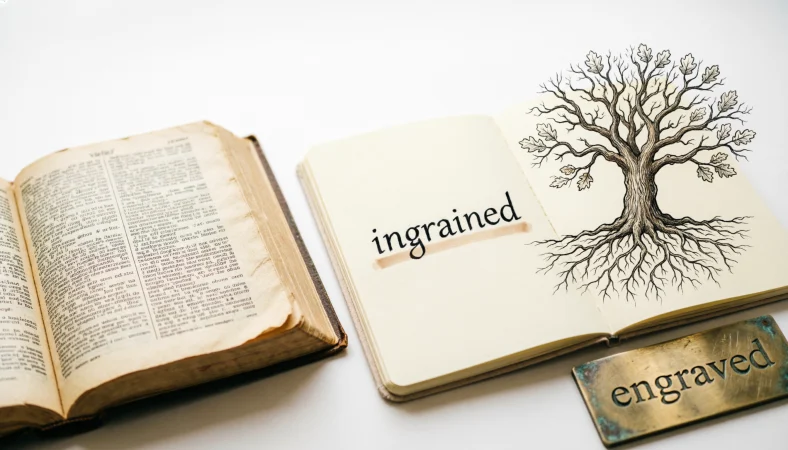
Ingrained is the standard and overwhelmingly preferred spelling when you mean something deeply fixed, established, or difficult to change. Engrained does appear in English, and some dictionaries recognize it as a variant, but it is much less common in modern usage. For formal, academic, professional, and edited writing, ingrained is the safer choice.
If you have ever wondered whether to write ingrained or engrained, you’re dealing with a spelling distinction that is more complicated than it first appears. Both forms can be found in English, and that makes the choice confusing even for experienced writers.
The word ingrained is an adjective meaning deeply established, firmly fixed, or so deeply embedded that it is difficult to change. For example, a person may have an ingrained habit of checking their phone before going to sleep.
Engrained can also be encountered, but it is far less common in contemporary English when used with the same meaning. In most contexts, especially formal writing, ingrained is the established choice.
This distinction matters because choosing the less familiar form can make otherwise polished writing look like it contains a spelling mistake. Understanding the difference helps you write more confidently in essays, reports, workplace communication, articles, and everyday English.
The important point is simple: when you mean deeply rooted or firmly established, use ingrained.
Ingrained or Engrained: What’s the Difference?
The two forms look almost identical, which explains much of the confusion. However, their modern usage is not equally common.
The distinction becomes clearer when you consider ordinary sentences.
Ingrained:
Her ingrained habit of arriving early made her a reliable employee.
Engrained:
The less common spelling may appear in edited or unedited sources, but it is generally not the preferred form for this meaning.
So, if you are writing an essay, business report, website article, academic paper, or formal email, ingrained is normally the right answer.
Quick recap
Ingrained is the standard modern spelling for something deeply established.
It commonly describes habits, beliefs, attitudes, behaviors, customs, and patterns.
Engrained exists in English usage, but it is considerably less common.
When you need the safest spelling, choose ingrained.
Is Ingrained or Engrained a Grammar, Vocabulary, or Usage Issue?
This is primarily a spelling and usage issue, rather than a grammar problem.
Grammar determines how a word functions in a sentence. In this case, both forms can function as adjectives. The more important question is which spelling is appropriate for the intended meaning and context.
Consider:
His fear of public speaking was ingrained.
Here, ingrained describes the condition of the fear. It means that the fear is deeply established.
You could also say:
She has an ingrained habit of double checking every document.
Again, the word describes something that has become firmly established over time.
The issue becomes more complicated because English contains words that begin with both in and en, and spelling patterns can sometimes suggest different origins or meanings.
For example, writers may naturally assume that engrained should be correct because the idea seems related to something being “engrained” into a person’s mind. However, the conventional spelling for the figurative sense is ingrained.
Are the two forms interchangeable?
In everyday modern writing, it is best not to treat them as equally interchangeable.
Ingrained is overwhelmingly more established for the meaning “deeply rooted” or “firmly fixed.”
Engrained may appear as a variant, but its lower frequency means that readers may interpret it as a misspelling of ingrained.
That difference matters in edited writing. Even when a less common form can be defended historically or lexicographically, the most recognizable form is usually the better choice when clarity is the goal.
Formal versus informal usage
In formal writing, use ingrained.
This includes:
Academic papers
Business reports
Professional correspondence
Government documents
News writing
Educational material
Published articles
In casual communication, you may occasionally encounter engrained, particularly because English speakers often spell words according to sound or analogy. That does not make it the preferred form.
Academic versus casual usage
Academic writing benefits from established vocabulary and conventional spelling. A sentence such as the following is natural:
Cultural assumptions can become ingrained through repeated social experiences.
Using ingrained here creates no distraction for the reader.
A less familiar spelling can cause the reader to pause and question whether the writer made an error. That is precisely what good editing tries to prevent.
How to Use Ingrained Correctly
The adjective ingrained is especially useful when describing something that has developed gradually and become difficult to change.
It commonly appears with abstract nouns such as:
habits
beliefs
attitudes
values
behaviors
customs
prejudices
expectations
patterns
assumptions
traditions
responses
Workplace example
Attention to detail was an ingrained part of her approach to project management.
The sentence suggests that attention to detail was not merely an occasional behavior. It had become a deeply established characteristic of her working style.
Another example is:
The company had an ingrained culture of regular customer feedback.
Here, the word describes a practice that has become deeply established within an organization.
Academic example
In some societies, gender expectations can become ingrained from an early age.
This usage is appropriate because the word describes beliefs or expectations that become deeply established through repeated experiences and social influences.
Technology example
Regularly updating software has become an ingrained part of the organization’s security routine.
The word works well because the practice is habitual and firmly established.
Usage recap
Use ingrained when something is deeply rooted or firmly established.
It works especially well with habits, beliefs, attitudes, practices, and social patterns.
The word often suggests that changing the thing in question will require considerable effort.
How Engrained Is Used
The spelling engrained is much less common in contemporary writing when it is used as an alternative to ingrained.
That does not mean every occurrence is automatically meaningless or impossible. English has a long history of variant forms, and dictionaries may record forms that are uncommon or context dependent.
The important distinction is between possible and preferred.
A word can exist in dictionaries or appear in published material without being the spelling most writers should choose in ordinary modern prose.
That is the situation here.
If your intended meaning is “deeply established,” writing engrained can attract unnecessary attention because many readers expect ingrained.
For example:
The belief was ingrained in the community.
This is immediately familiar.
By contrast:
The belief was engrained in the community.
A reader may understand the sentence perfectly, but some readers will wonder whether the writer has made a spelling error.
That is a strong reason to choose the conventional form.
When You Should NOT Use Ingrained or Engrained
There are several situations where writers commonly make the wrong choice.
1. Do not choose engrained simply because something seems physically pressed into a surface
If you are describing a physical mark, indentation, or engraving, words such as engraved, etched, or embedded may be more precise.
For example:
The initials were engraved on the metal.
That is different from:
The habit was ingrained in his personality.
2. Do not assume the prefix determines the spelling
English spelling is full of historical patterns that do not always behave logically. Choosing a spelling because it “sounds right” can lead to errors.
3. Do not use engrained in formal writing just because you have seen it online
Internet usage includes regional preferences, informal writing, errors, and copied material. Frequency alone does not establish the preferred standard.
4. Do not confuse ingrained with inherent
An ingrained characteristic has become deeply established. An inherent characteristic is naturally present as part of something.
Her ingrained habit of planning ahead developed over many years.
Flexibility is inherent in the design.
These meanings overlap in some contexts but are not identical.
5. Do not confuse ingrained with innate
Innate means naturally present from birth or inherent to a person or thing. Ingrained generally suggests development through repetition, experience, culture, or conditioning.
6. Do not use ingrained when you simply mean common
Something can be common without being deeply established.
“Ingrained” is stronger. It suggests persistence and depth.
7. Do not assume every occurrence of engrained is a typographical mistake
Some dictionaries and historical sources recognize the form. The better conclusion is that it is much less common and usually unnecessary when ingrained communicates the intended meaning clearly.
8. Do not replace ingrained with embedded automatically
Embedded can describe something physically inserted or deeply incorporated. Ingrained focuses more specifically on something becoming firmly established, especially an idea, habit, or attitude.
Common Mistakes and Decision Rules
The following examples show how the preferred spelling works in context.
Decision Rule
If you mean deeply established, firmly fixed, or difficult to change, use ingrained.
If you mean something physically carved, marked, or engraved, choose a more precise word such as engraved or etched.
This rule handles the vast majority of modern writing situations.
Ingrained or Engrained in Modern Technology and AI Tools
Modern technology makes spelling questions more visible because writers interact constantly with spell checkers, search engines, grammar software, and artificial intelligence tools.
Typing “engrained” into a writing application may not always produce an obvious warning. Different systems have different dictionaries, and some recognize variant forms. Likewise, search engines may return results containing both spellings.
This creates an important lesson: software recognition does not necessarily mean that two forms are equally preferred.
AI writing tools can also reproduce less common spellings when they encounter them in training material. If a user asks an AI system to choose between the forms, the context and intended meaning remain important.
For professional writing, human judgment still matters. The safest approach is to choose the established form that readers are most likely to recognize immediately.
In this case, that form is ingrained.
The Etymology of Ingrained
The history of the word helps explain why its spelling can seem unusual.
The word is connected with grain, which historically referred to a coloring substance or dye. The verb ingrain developed with the sense of dyeing something deeply or fixing something firmly.
The physical idea of color becoming deeply fixed provided a natural path toward the figurative meaning.
Over time, English speakers began using ingrained for ideas, habits, beliefs, and behaviors that seemed deeply fixed in the mind or character.
That gives us the modern sense:
deeply established and difficult to change
The connection between a substance being deeply fixed and an idea being deeply established is metaphorical, but it is perfectly natural English.
An expert style explanation
A useful way to think about the distinction is this:
“When the meaning is figurative and refers to something deeply established, ingrained is the clearest conventional spelling for modern English.”
That approach prioritizes meaning, established usage, and reader expectations rather than attempting to justify every variant encountered in historical or informal sources.
Two Practical Case Studies
Case Study 1: Professional editing
Imagine an editor reviewing a business article about workplace culture. The draft repeatedly uses the sentence:
Employees may develop engrained assumptions about leadership.
The editor changes the spelling to:
Employees may develop ingrained assumptions about leadership.
The meaning has not changed. The improvement comes from choosing the spelling that most readers expect in contemporary professional prose.
The concrete result is greater consistency and less risk of distracting readers with a spelling that may look accidental.
Case Study 2: Academic writing
Consider a student writing about social behavior:
Cultural attitudes can become engrained through repeated exposure.
An academic editor would normally change engrained to ingrained:
Cultural attitudes can become ingrained through repeated exposure.
Again, the grammatical structure remains unchanged. The improvement is lexical consistency with the standard form used for the intended figurative meaning.
These examples demonstrate an important editing principle: sometimes the strongest correction does not change an argument at all. It simply removes a distraction.
Error Prevention Checklist
Always use ingrained when:
- You mean deeply established.
- You are describing a habit that is difficult to change.
- You are discussing a deeply rooted belief.
- You are describing a firmly established attitude.
- You are writing an academic paper.
- You are preparing professional content.
- You are writing for publication.
- You want the most familiar modern spelling.
Be cautious with engrained when:
- You are writing formal content.
- The word means deeply established.
- You are unsure whether the variant is appropriate.
- Your audience expects conventional edited English.
- You want to avoid a spelling that readers may interpret as an error.
Why Ingrained Is Usually the Better Choice
One of the most useful principles in English usage is that dictionary recognition and practical preference are not always the same thing.
English contains many variant spellings. Some are regional, Some are historical. Some survive only in specialized contexts. Others are technically recognizable but uncommon.
When choosing between them, writers should consider three things: meaning, frequency, and audience expectations.
For the figurative sense of something being deeply established, ingrained performs well on all three measures.
It clearly communicates the intended meaning. It is widely recognized. And it is unlikely to distract readers.
That makes it the sensible choice for most contemporary writing.
Related Grammar Confusions You Should Master
If you are working on spelling and word choice, several other commonly confused pairs are worth learning.
- Complement or compliment
Complement means something that completes or enhances something else. Compliment means an expression of praise. - Principle or principal
Principle usually refers to a rule or belief. Principal can refer to a person in charge or something most important. - Preventive or preventative
Both forms are used, although preventive is often preferred in formal usage. - Benefited or benefitted
Both forms occur, with regional preferences affecting which spelling is more common. - Burned or burnt
Both can be correct, although their distribution differs by variety and context. - Labeling or labelling
The spelling depends largely on regional English conventions. - Color or colour
Color is standard American English, while colour is standard British English and many other varieties. - Empathic or empathetic
Both are established adjectives, although empathetic is often more common in contemporary general usage. - Naive or naïve
Both forms are found, with the diaeresis sometimes retained to clarify pronunciation. - Learned or learnt
Both forms are correct, with regional preferences playing an important role.
FAQs:
Is ingrained or engrained correct?
Ingrained is the standard and preferred spelling when you mean deeply established, firmly fixed, or difficult to change. Engrained can be encountered as a variant, but it is much less common and is generally not the best choice for formal modern writing.
Is engrained a real word?
Yes, engrained can be found in English usage and is recognized in some dictionaries as a variant. However, its existence does not mean it is equally common or equally preferred. When the intended meaning is deeply established, ingrained is normally the better choice.
Why is ingrained spelled with an i?
The spelling reflects the history of the word and its connection with the verb ingrain. The word originally carried a physical sense associated with dye becoming deeply fixed and later developed a figurative meaning involving ideas, habits, and characteristics becoming firmly established.
What does ingrained mean?
Ingrained means deeply established, firmly fixed, or difficult to change. It commonly describes habits, beliefs, attitudes, customs, behaviors, and assumptions that have become deeply rooted through repetition or experience.
Can I use engrained in an essay?
You may encounter engrained in English sources, but ingrained is the safer choice for an academic essay when you mean deeply established. Academic writing benefits from conventional vocabulary and spelling because unusual variants can distract readers.
Is ingrained an adjective?
Yes. Ingrained is commonly used as an adjective to describe something that has become deeply established. For example, “She has an ingrained habit of checking her work twice.”
What is the difference between ingrained and embedded?
Ingrained usually describes something deeply established, particularly a habit, belief, attitude, or behavior. Embedded can describe something physically inserted or something deeply incorporated into a larger system or structure.
Is ingrained the same as inherent?
No. Ingrained generally suggests that something became established over time. Inherent means naturally existing as a permanent or essential characteristic of something.
Is ingrained the same as innate?
No. Innate generally means naturally present from birth or inherent in a person or thing. Ingrained usually suggests development through experience, repetition, learning, culture, or conditioning.
How do you remember the spelling ingrained?
Connect the word with ingrain, meaning to establish something deeply. When describing a deeply rooted habit, belief, attitude, or behavior, think of something becoming fixed deeply rather than simply being marked or engraved.
Conclusion:
When deciding between ingrained or engrained, the safest answer for modern English is ingrained when you mean deeply established, firmly fixed, or difficult to change. Although engrained appears in some English sources and can be recognized as a variant, it is much less common. In professional, academic, and published writing, ingrained is the clear conventional choice.
Remember the central distinction: a habit can be ingrained, a belief can be ingrained, and an attitude can be ingrained. If you are describing something physically carved or marked, use a more precise word such as engraved or etched.
Choosing ingrained will almost always give your sentence the familiar, polished form readers expect.