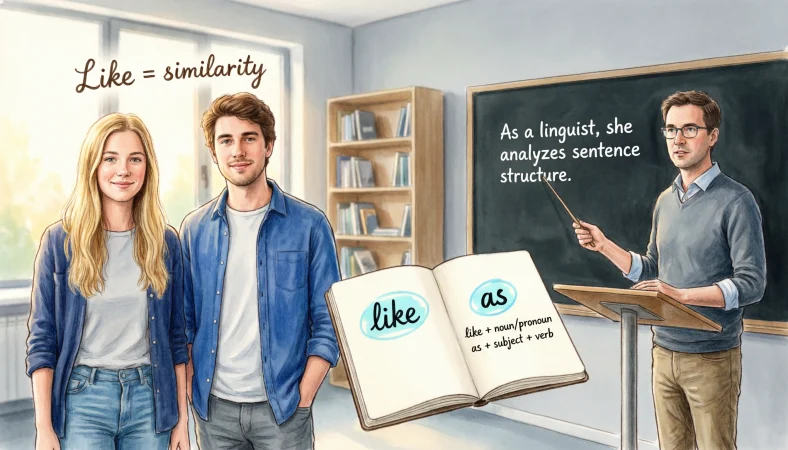
The choice between like or as depends mainly on whether you are making a comparison or introducing a clause that describes how something happens. Like usually functions as a preposition before a noun or pronoun, while as can function as a conjunction, preposition, adverb, or other grammatical element. Knowing the structure prevents common comparison and sentence construction errors.
The question of whether to use like or as looks simple, but it becomes surprisingly tricky in everyday English. Both words can express similarity, comparison, manner, or resemblance, yet they don’t always work in the same grammatical structures.
Consider these two sentences:
She runs like a professional athlete.
She runs as a professional athlete would.
The meanings are closely related, but the grammar is different. In the first sentence, like introduces a noun phrase. In the second, as introduces a clause containing a subject and verb.
This distinction matters because using the wrong word can make formal writing sound awkward or grammatically questionable. The confusion becomes even greater because everyday English sometimes uses like where traditional grammar expects as, particularly in informal speech.
The good news is that the basic rule is easier than it first appears. Once you look at what comes after the word, you can usually make the correct choice quickly.
Like vs As: What’s the Difference?
At its simplest, like is generally used to compare one person, thing, or action with another person, thing, or action. As is commonly used when the comparison involves a complete clause or when the meaning is related to a role, function, or manner.
| Word | Common grammatical role | Typical use | Example |
| Like | Preposition | Comparison with a noun or pronoun | She sings like her mother. |
| As | Conjunction | Introducing a clause | She sings as her mother does. |
| As | Preposition | Describing a role or function | He works as a teacher. |
| As | Adverb or conjunction | Describing manner or time | Do as I told you. |
The easiest distinction is structural.
If the word is followed by a noun or pronoun, like is often appropriate.
If the word is followed by a subject and verb, as is often appropriate.
Compare:
He looks like his father.
He looks as his father did.
The first comparison is between two people. The second describes a complete action or manner.
There are exceptions, especially in fixed expressions and informal English, so the rule should be treated as a strong guide rather than an absolute law.
Quick recap
Like commonly makes a direct comparison.
As commonly introduces a clause.
As also describes someone’s role or function.
Informal English sometimes uses like where formal English prefers as.
Looking at what follows the word is usually the fastest way to choose correctly.
Is Like or As a Grammar, Vocabulary, or Usage Issue?
This is primarily a grammar and usage issue, rather than a simple vocabulary problem. The two words have different grammatical functions, although their meanings can overlap.
The difficulty comes from the fact that English has changed over time. Traditional grammar rules generally distinguish between like as a preposition and as as a conjunction when introducing a clause. Modern spoken English, however, frequently uses like in structures that were once considered unacceptable in formal writing.
For example:
It looks like it’s going to rain.
This sentence is extremely common in contemporary English.
A more traditional formal construction is:
It looks as if it’s going to rain.
Both are widely understood. The second is generally more conservative and formal.
Are they interchangeable?
Not always.
Consider:
She works as a doctor.
Here, as means that she actually has the role of a doctor.
Now consider:
She works like a doctor.
This suggests that her behavior resembles that of a doctor. It does not necessarily mean that she is a doctor.
That difference can completely change the meaning.
Formal versus informal usage
In casual conversation, like is extremely flexible. Native speakers commonly use it before clauses:
It sounds like you need some rest.
Formal writing may instead use:
It sounds as though you need some rest.
Neither construction is likely to confuse a reader, but the second can sound more formal.
Academic versus casual English
Academic writing tends to favor precise structures such as as, as if, as though, and in the same way that when a clause follows.
Casual conversation is more comfortable with like.
For students, researchers, business writers, and professionals, the safest approach is to recognize both patterns and choose according to context.
How to Use Like Correctly
Like is commonly used as a preposition to introduce a noun or pronoun that serves as the basis of comparison.
Workplace example
The new manager communicates like an experienced consultant.
The phrase an experienced consultant is a noun phrase. The sentence says that the manager’s communication style resembles that of an experienced consultant.
Another example is:
Our new software works like the previous system.
Here, the writer is comparing one system with another.
Academic example
The pattern behaves like a recurring linguistic structure.
The comparison is between the pattern and a linguistic structure.
However, academic writers should be careful when like is followed by a full clause.
Less formal:
The results suggest that, like the previous study showed, the effect is significant.
More polished:
The results suggest, as the previous study showed, that the effect is significant.
Technology example
This application works like a digital notebook.
The application resembles a notebook in its function.
Notice how like does not necessarily mean that the two things are identical. It establishes a comparison.
Usage recap
Use like when you are comparing one thing with another noun or pronoun.
He looks like his brother.
It feels like plastic.
She moves like a dancer.
The comparison is direct and compact.
How to Use As Correctly
As has several grammatical functions, which makes it more versatile than like.
One important use is introducing a clause.
Workplace example
Please complete the report as I explained earlier.
The phrase I explained earlier contains a subject and a verb, so as is appropriate in this formal construction.
Another example:
The team performed as we expected.
The word as connects the main statement to a complete clause.
Academic example
The findings were interpreted as the researchers had predicted.
The phrase the researchers had predicted is a complete clause.
Academic writing often benefits from this kind of precise structure because it clearly shows the relationship between ideas.
Technology example
The program operates as the documentation describes.
The clause the documentation describes explains the manner in which the program operates.
As for roles and functions
There is another important use:
She works as a designer.
This means designing is her actual role.
Compare:
She works like a designer.
This means her behavior resembles that of a designer, but it does not necessarily identify her occupation.
That distinction is extremely useful in professional writing.
Usage recap
Use as when introducing a clause, describing manner, or identifying a genuine role or function.
Do as I say.
He works as an engineer.
Everything happened as we expected.
When You Should NOT Use Like or As
Knowing when to avoid each word can prevent several common mistakes.
1. Do not use like to identify an actual professional role
Incorrect:
She works like a lawyer.
If you mean that being a lawyer is her actual occupation, use:
She works as a lawyer.
2. Do not automatically use as for every comparison
Incorrect:
He runs as his brother.
If the intended meaning is simply that the two people run in a similar way, the sentence needs a different structure:
He runs like his brother.
Or:
He runs as his brother does.
3. Do not use like before a formal clause when a more precise structure is needed
Informal:
It looks like the company will expand.
More formal:
It looks as though the company will expand.
4. Do not confuse role with resemblance
She served as a leader.
This means she actually occupied the role.
She acted like a leader.
This describes behavior resembling that of a leader.
5. Do not assume spoken English and formal writing follow identical conventions
A structure that sounds perfectly natural in conversation may not be the best choice in an academic essay or formal report.
6. Do not change the meaning merely to follow a memorized rule
Grammar rules should help you communicate meaning, not obscure it. Always consider what you actually want the sentence to say.
7. Do not treat as if and as though as interchangeable with like in every formal context
They often express similarity or an imagined condition, but their structures differ.
He talks as if he knows everything.
This is different in structure from:
He talks like an expert.
Common Mistakes and Decision Rules
The following examples show how a small change can alter both grammar and meaning.
| Correct sentence | Incorrect or less suitable sentence | Explanation |
| She works as a nurse. | She works like a nurse. | Use as for an actual occupation. |
| He looks like his father. | He looks as his father. | Use like for a direct noun comparison. |
| Do as I instructed. | Do like I instructed. | Formal standard English favors as before the clause. |
| It feels like silk. | It feels as silk. | Like introduces the noun being compared. |
| She sings as her mother does. | She sings like her mother does. | Traditional formal grammar favors as before the clause. |
| He behaves like a child. | He behaves as a child. | Like expresses resemblance here. |
| Everything happened as expected. | Everything happened like expected. | Formal English uses as expected. |
Decision Rule Box
If you are comparing one person or thing with a noun or pronoun, use like.
If you are introducing a clause or describing an actual role or function, use as.
This rule solves a large percentage of everyday questions.
Like or As in Modern Technology and AI Tools
Modern digital writing creates an interesting environment for grammar.
Search engines, writing assistants, grammar checkers, and AI systems frequently encounter both traditional and contemporary English patterns. As a result, a sentence containing like before a clause isn’t necessarily meaningless or incomprehensible simply because it differs from a traditional grammar rule.
For example:
The tool looks like it is working correctly.
This is completely natural in contemporary English.
A more formal version is:
The tool appears as though it is working correctly.
For everyday technology documentation, the first version may actually be clearer. For a formal academic paper, the second structure may be more appropriate depending on the surrounding prose.
AI writing tools can also generate both constructions. The important skill is not blindly accepting one form as correct and the other as incorrect. Instead, evaluate grammar, meaning, register, and audience.
The History and Etymology of Like and As
The two words have long histories in English.
Like is related to Old English forms associated with similarity and likeness. Its central idea has remained remarkably stable: something resembles or corresponds to something else.
As has a more complicated history and developed from older expressions associated with manner, equality, and comparison. Over time, it gained several grammatical functions.
This historical development helps explain why the two words overlap in certain constructions while remaining grammatically distinct in others.
English is not a perfectly rigid system. Speakers continually develop new patterns, and some constructions that were once criticized eventually become ordinary parts of everyday language.
An Expert Style Rule for Remembering the Difference
A useful grammar principle is:
Look at the structure after the comparison word before deciding which form sounds right.
If a noun or pronoun follows, like is often the natural choice.
If a complete clause follows, as is often the traditional formal choice.
This structural approach is more reliable than trying to memorize dozens of isolated examples.
Two Practical Case Studies
Case Study 1: Describing an occupation
Imagine a company biography stating:
Maria works as a software engineer.
The sentence clearly identifies Maria’s occupation.
Now change the sentence:
Maria works like a software engineer.
The meaning changes. It now suggests that Maria’s behavior, methods, or work resemble those of a software engineer.
The concrete result is a difference in factual meaning. The first sentence identifies a role. The second describes resemblance.
Case Study 2: Describing behavior
Consider:
The child talks like an adult.
This compares the child’s speech with an adult’s speech.
Now consider:
The child talks as an adult would.
The second sentence introduces a complete clause through the implied comparison.
Both can communicate a similar idea, but their grammatical structures differ.
The practical result is greater flexibility. You can choose the shorter comparison when appropriate or use a complete clause when you want to make the relationship more explicit.
Error Prevention Checklist
Always use like when
- You are making a direct comparison with a noun.
- You are comparing someone’s appearance with another person.
- You are comparing an object’s characteristics with another object.
- You want to express resemblance.
Examples include:
It looks like glass.
He runs like his father.
She sounds like an expert.
Always consider as when
- A complete clause follows.
- You are describing an actual occupation or role.
- You are expressing manner through a clause.
- You are using expressions such as as if, as though, or as expected.
Examples include:
She works as a teacher.
Do as I asked.
He reacted as though he knew the answer.
Never rely only on sound
A sentence can sound natural while still being inappropriate for a particular formal context.
Never assume that every use of like before a clause is an error
Modern English frequently uses this construction, especially in conversation.
Related Grammar Confusions You Should Master
Understanding like or as becomes easier when you also understand other pairs that involve similar questions about structure and meaning.
- As if or as though: Both can introduce comparisons involving imagined or apparently true situations.
- Who or whom: This distinction depends on grammatical function.
- Fewer or less: The choice traditionally depends on whether the noun is countable.
- Between or among: The distinction concerns relationships involving separate entities.
- Further or farther: Traditional usage distinguishes abstract extension from physical distance.
- Affect or effect: These words differ in grammatical role and meaning.
- Lay or lie: The distinction depends on whether an object is involved.
- Then or than: One commonly relates to time or sequence, while the other introduces comparison.
- Good or well: Their grammatical functions differ even though they frequently appear in similar contexts.
- Who or that: Relative clause choices depend on the noun and the style of the sentence.
Mastering these distinctions improves both accuracy and confidence in formal English.
FAQs
Is like or as grammatically correct?
Both are grammatically correct, but they are not always interchangeable. Like commonly introduces a noun or pronoun in a comparison, while as can introduce a complete clause or identify a genuine role or function.
Should I say like me or as me?
In a direct comparison, like me is generally the natural choice.
She sings like me.
In a more formal construction involving a clause, you might say:
She sings as I do.
Is it correct to say as a teacher?
Yes. As a teacher is correct when someone actually has the role of teacher.
He works as a teacher.
The meaning is different from:
He talks like a teacher.
The second sentence describes resemblance rather than occupation.
Is it correct to say like a teacher?
Yes. Like a teacher is correct when you are comparing behavior, appearance, speech, or another characteristic with that of a teacher.
She explains the topic like a teacher.
This does not necessarily mean she is a teacher.
Should I use as or like in formal writing?
When a complete clause follows, formal writing generally favors as, as if, or as though depending on the meaning.
For example:
The results occurred as we expected.
However, like remains completely appropriate when it introduces a noun.
The material looks like glass.
Is like a conjunction?
Traditionally, like is classified primarily as a preposition when it introduces a noun phrase.
Modern English, especially informal speech, increasingly uses like in structures where traditional grammar would use a conjunction such as as. This difference is one reason usage discussions can become complicated.
What is the easiest way to remember like versus as?
Look at what follows the word. If you are comparing something with a noun or pronoun, like is often the right choice. If a complete clause follows, as is often the traditional formal choice.
Is like it is correct?
Yes. The construction like it is is extremely common in contemporary English.
It looks like it is raining.
In formal writing, alternatives such as as if or as though may sometimes be preferred.
What is the difference between like and as in a sentence?
Like commonly expresses resemblance, while as can express manner, introduce a clause, or identify a role. Compare He looks like his father with He works as a doctor. The first expresses similarity, while the second identifies an actual function.
Conclusion:
The difference between like or as becomes much clearer when you focus on sentence structure and meaning rather than trying to memorize isolated rules. Like commonly introduces a noun or pronoun when you are expressing resemblance. As is commonly used before a clause and when identifying an actual role or function.
The most useful distinction is simple: compare a thing with a noun and like will often be appropriate. Introduce a complete clause or describe a genuine role and as is often the better choice.
At the same time, remember that English changes. Modern speakers regularly use like before clauses, especially in informal conversation. That does not mean every traditional distinction has disappeared. In academic, professional, and carefully edited writing, choosing the structure that best matches your intended meaning and level of formality remains important.
When in doubt, look at the words that follow like or as. That small grammatical check can prevent many common errors.