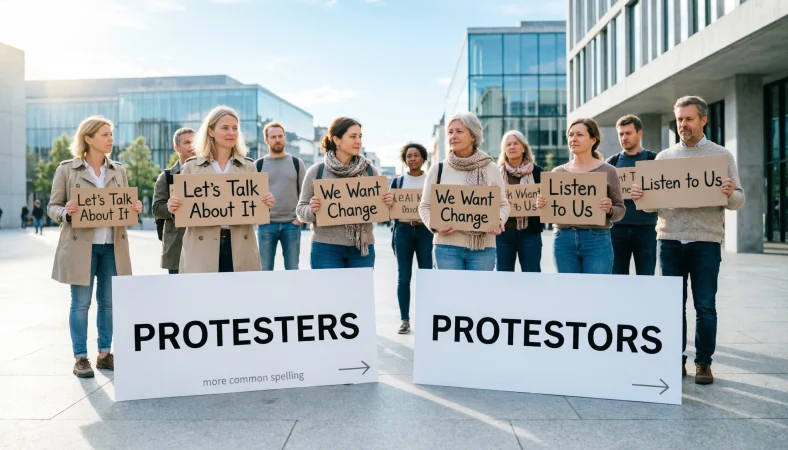
Both spellings are correct, but protesters is the more common and widely preferred form in contemporary English. Both words refer to people who participate in a protest or publicly express opposition to something. The difference is mainly one of spelling preference, regional usage, and frequency, not meaning or grammar.
If you have ever written a news report, school assignment, social media post, or formal article about a demonstration, you may have wondered whether protestors or protesters is the correct spelling. The two forms have exactly the same basic meaning: a person who protests.
A protester is a noun referring to someone who takes part in a protest or expresses opposition. Protestor is also a noun with the same meaning, but it is less common in modern general English. The confusion matters because choosing the less familiar form can make otherwise polished writing look unusual, particularly in journalism, academic writing, and professional communication.
The good news is that you don’t need to learn two different definitions. The real issue is understanding which spelling is more widely accepted and when one form may be preferable.
For most everyday and professional writing, protester is the safest choice. It is familiar to readers across major English speaking varieties and appears frequently in news reporting, political coverage, academic writing, and general nonfiction.
Protestors vs Protesters: What’s the Difference?
The simplest answer is that protester and protestor are nouns with essentially the same meaning. Both describe someone who protests.
| Word | Part of speech | Meaning | Usage | Recommended choice |
| Protester | Noun | A person who protests | Very common | Yes |
| Protestor | Noun | A person who protests | Less common variant | Acceptable |
| Protest | Noun | An organized expression of opposition | Very common | Yes |
| Protest | Verb | To express opposition | Very common | Yes |
| Protesting | Present participle | Taking part in or expressing protest | Common | Yes |
The distinction is therefore not comparable to pairs such as affect and effect, where the words have different functions and meanings.
Instead, this is primarily a spelling and usage variation.
Both forms can appear in sentences such as:
The protesters gathered outside the building.
Several protestors gathered outside the building.
The meaning remains unchanged.
The first version will generally sound more natural to a wider audience because protester is the more familiar form.
Quick recap
Protester and protestor are both nouns.
Both refer to someone who protests.
Protester is considerably more common in contemporary general usage.
Protestor is not normally considered a spelling error.
For most readers, writers, editors, and organizations, protester is the preferred default.
Is Protestors vs Protesters a Grammar, Vocabulary, or Usage Issue?
This is primarily a usage and spelling issue, rather than a grammar problem.
Grammar determines how words function within sentences. In this case, both protester and protestor can function as nouns. You can place either one after a determiner, adjective, or verb without changing the underlying grammatical structure.
For example:
The protester spoke to reporters.
The protestor spoke to reporters.
Both sentences are grammatically sound.
The difference becomes more noticeable when considering frequency and editorial preference. English contains many pairs in which two forms have developed from the same root but one has become more popular.
The ending er is particularly productive in English. We see it in words such as teacher, worker, runner, writer, and speaker. A person who performs an action is often described with an er ending.
That makes protester a very natural formation from the verb protest.
The or ending is also legitimate in English and appears in words such as actor, editor, operator, and administrator. It often occurs in words influenced by Latin or French vocabulary, although modern English does not follow a simple rule that determines whether a particular agent noun must end in er or or.
Formal versus informal usage
Neither word is inherently informal.
You can encounter protester in highly formal journalism, government reporting, academic research, and legal discussion. Likewise, protestor is not automatically casual or incorrect.
The important point is that protester has stronger mainstream usage.
If you’re writing a formal document and want the form least likely to distract your audience, protester is usually the better choice.
Academic versus casual usage
Academic writers generally benefit from choosing the form most familiar to their intended readership. Since protester is highly recognizable, it is usually the more straightforward option.
In casual writing, either form may appear, particularly if the writer has encountered protestor frequently in their reading.
How to Use Protester Correctly
Workplace example
Imagine that a communications employee is preparing a report about a public demonstration near an office building.
A natural sentence would be:
Several protesters gathered near the entrance during the afternoon.
Here, protesters clearly identifies the people involved in the demonstration.
Another example might appear in a security report:
Staff were advised to avoid the area while protesters remained outside the building.
The noun works naturally in professional communication because it identifies a group based on their participation in a protest.
Academic example
Academic writing often discusses protest movements, social movements, political participation, and public demonstrations.
For example:
Researchers interviewed protesters about their reasons for participating in the demonstration.
The word is precise without being unnecessarily complicated.
You could also write:
The study examined how protesters used public spaces to communicate political demands.
Again, protesters works naturally in formal academic prose.
Technology example
Technology companies may use the word when describing online activism, digital demonstrations, or events involving physical demonstrations that receive online coverage.
For example:
The platform introduced additional moderation tools after protesters used the service to coordinate public events.
The important point is that the technology context does not change the meaning of protester.
Usage recap
Use protester when you want the most familiar and widely accepted form.
- It works naturally in workplace communication.
- It fits academic writing.
- It is also appropriate for journalism, online content, and technology related discussions.
How to Use Protestor Correctly
Although protester is usually the stronger default, protestor is not meaningless or inherently ungrammatical.
You may encounter sentences such as:
The protestors remained outside the courthouse.
Or:
Police monitored the area as protestors gathered nearby.
Readers generally understand protestors immediately because its relationship to protest is obvious.
The main limitation is frequency. A reader who normally sees protester may perceive protestor as unusual even though the meaning is clear.
This distinction is important for SEO writers and publishers. A spelling can be technically acceptable while still being less natural for the majority of readers.
Workplace example
In a workplace document, you could technically write:
The protestors were asked to remain outside the designated area.
There is nothing inherently incomprehensible about the sentence.
However, if the organization follows a house style that consistently uses protester, changing between the two forms could create unnecessary inconsistency.
Academic example
An academic article might use:
The protestors represented several different social groups.
Again, the noun is understandable and grammatically functional.
However, consistency matters more than choosing an unusual variant simply because it is possible.
Technology example
In digital reporting, you might encounter:
The article included photographs of protestors gathered in the city center.
This is understandable, but protesters would generally be the safer choice for broad readership.
Usage recap
Protestor is a legitimate variant.
It has the same basic meaning as protester.
It is less common in general contemporary English.
If you have no specific reason to use it, protester is usually preferable.
When You Should NOT Use Protestors or Protesters
Understanding the difference between the two spellings is useful, but there are several situations where neither word is the best choice.
1. When you mean the organizers
Not every person involved in a protest is an organizer.
The protest organizers announced the meeting time.
This is more precise than calling every organizer a protester.
2. When you mean demonstrators in a specific context
Demonstrators can sometimes provide a more neutral alternative, especially in formal reporting.
Demonstrators gathered in the central square.
The choice depends on the intended tone and context.
3. When you mean activists generally
An activist may support a cause without participating in a particular protest.
The activists launched a public awareness campaign.
Calling everyone an activist a protester can therefore change the meaning.
4. When you mean someone who objects privately
A person can protest a decision without participating in a public demonstration.
She protested the decision during the meeting.
That does not necessarily make her a protester in the conventional public demonstration sense.
5. When precision matters in legal writing
Legal contexts may require more exact descriptions of what a person actually did.
Calling someone a protester may suggest participation in a demonstration when the evidence only shows that the person expressed disagreement.
6. When the context already identifies the group
Repetition can make writing clumsy.
Instead of repeatedly writing:
The protesters said this. The protesters said that. The protesters later left.
You can vary the structure:
The group later left the area.
7. When the person is not actually protesting
A journalist should avoid labeling someone a protester merely because they are present at a demonstration.
Presence and participation are not always identical.
8. When a more specific description is available
Precision usually improves professional writing.
Terms such as demonstrator, activist, organizer, participant, and campaigner can carry different meanings and should be selected according to the facts.
Common Mistakes and Decision Rules
| Correct sentence | Incorrect or less suitable sentence | Explanation |
| The protesters gathered outside. | The protestors gathered outside. | The second form is acceptable but less common. |
| Several protesters joined the march. | Several protester joined the march. | A plural noun needs the plural ending. |
| The protester spoke to reporters. | The protestor spoke to reporters. | Both are possible, but the first is the more familiar form. |
| The organizers planned the protest. | The organizers planned the protesters. | Protest and protesters have different meanings. |
| The protesters left peacefully. | The protestors left peacefully. | Both can work, but protesters is generally preferred. |
Decision Rule Box
If you mean a person participating in or expressing a protest, use “protester” as your default choice.
If you encounter “protestor,” understand it as an accepted variant rather than automatically treating it as a spelling error.
This rule is more accurate than saying that one spelling is absolutely right and the other is absolutely wrong.
Why Does English Have Both Spellings?
The variation comes from the way English creates nouns describing people who perform actions.
The verb protest comes through French and Latin sources and has a long history in English. Once the verb became established, English speakers could form an agent noun from it.
The form protester follows a highly productive English pattern:
teach → teacher
write → writer
work → worker
protest → protester
The alternative protestor follows another established pattern in English in which an or ending appears in an agent noun.
English has never developed a perfectly consistent rule that says every agent noun must use one ending. Historical borrowing, pronunciation, regional preference, and analogy all influence word formation.
That is why dictionaries can recognize both forms even when one is much more frequent.
Protestors and Protesters in Modern Technology and AI Tools
Modern technology makes spelling variation especially interesting.
Search engines, spell checkers, grammar assistants, content management systems, and AI writing tools may recognize both forms. Recognition, however, does not necessarily mean that the two forms have equal frequency.
An AI writing assistant may recommend protester because it is the more common form in contemporary English. A spell checker may accept protestor because it is a recognized variant.
This illustrates an important principle for writers: acceptability and preference are not always the same thing.
A word can be valid while another word is more natural.
For SEO content, the same principle applies. If the goal is broad readability, the common form usually deserves priority. If keyword research shows that people search for the less common spelling, however, a publisher may mention the alternative naturally rather than forcing it throughout the article.
Authority and Trust: What Should Editors Recommend?
A useful editorial principle is:
“When two forms have the same meaning, prefer the form that gives the largest audience the clearest and most familiar reading experience.”
For this pair, that principle strongly favors protester in most general purpose writing.
That does not mean protestor should be labeled wrong. Doing so would oversimplify the issue.
Practical case study: News writing
Consider an editorial team producing daily reports about public demonstrations. If half of the articles use protester and half use protestor, readers may notice an unnecessary inconsistency.
A simple style decision to use protester throughout creates a consistent editorial voice. The concrete result is improved consistency across headlines, captions, body copy, and archived articles.
This is an illustrative editorial case study rather than a claim about a specific publication.
Practical case study: Student writing
Imagine a student writing a research paper about social movements. The student uses protestor throughout because that spelling appeared in one source.
An instructor might not mark every instance as grammatically wrong, but may recommend protester for consistency with contemporary general usage.
The practical result is clearer terminology and less risk that readers interpret the unusual spelling as an accidental typo.
Again, this is an illustrative writing scenario rather than a report of a particular classroom study.
Author expertise
Author note: This explanation applies principles of English morphology, spelling variation, usage frequency, editorial style, and contemporary written communication to help readers make precise word choices.
Error Prevention Checklist
Always use protester when
- You want the most familiar general English form.
- You are writing for a broad international audience.
- You are preparing general educational content.
- You are writing professional reports or articles.
- You want to minimize the possibility that readers will mistake the spelling for an error.
- You are establishing a consistent editorial style.
Never assume protestor is wrong when
- You encounter it in published writing.
- A dictionary or style resource recognizes it.
- A quoted source uses that spelling.
- A particular publication consistently prefers that variant.
- The surrounding context clearly establishes the intended meaning.
The important distinction is between less common and incorrect. Those two concepts are not identical.
Protester vs Demonstrator: Are They the Same?
These words overlap, but they aren’t always perfect synonyms.
A protester is someone who protests. A demonstrator is someone who takes part in a demonstration.
For example:
Protesters gathered outside the building.
Demonstrators marched through the city.
Both sentences can describe the same people, but the second emphasizes participation in a demonstration.
There are also situations where someone may protest without attending a demonstration. That makes protester the broader term in certain contexts.
Protester vs Activist: What’s the Difference?
An activist is generally someone who actively supports a cause and works to bring about social or political change.
A protester participates in protest.
The two roles can overlap, but they are not identical.
Someone may be an activist who organizes campaigns, writes articles, raises funds, or works with community groups without attending every protest.
Similarly, someone can participate in a single protest without considering themselves an activist.
Choosing the right noun therefore depends on what the person actually did.
Related Grammar Confusions You Should Master
If you’re building strong English vocabulary and usage skills, these related distinctions are worth learning:
- Adviser or advisor
- Traveler or traveller
- Canceled or cancelled
- Labeled or labelled
- Center or centre
- Theater or theatre
- Practice or practise
- License or licence
- Program or programme
- Judgment or judgement
These examples show that English spelling often varies between major varieties, particularly British and American English. The correct choice can depend on geography, publication style, audience, and historical convention.
FAQs
Is protester or protestor the correct spelling?
Both forms can be used to describe a person who protests. However, protester is the more common and generally preferred spelling in contemporary general English. Protestor is best understood as a less common variant rather than automatically treating it as an error.
Is protestor a misspelling of protester?
No. Protestor is an established variant used to describe someone who protests. Nevertheless, it is considerably less common than protester, so readers may be more accustomed to the latter.
Which is more common, protester or protestor?
Protester is more common in general contemporary English. It is therefore the safer choice when writing for a broad audience or when following a conventional editorial style.
Should I use protester in formal writing?
Yes. Protester is completely appropriate for formal writing, including academic papers, professional reports, journalism, and educational materials.
Can protestor be used in academic writing?
Yes. The word can be grammatically acceptable in academic writing, although protester is generally the more familiar choice. Academic writers should prioritize consistency and the style requirements of their institution or publication.
What is the plural of protester?
The plural is protesters.
For example:
Thousands of protesters gathered in the square.
What is the plural of protestor?
The plural is protestors.
For example:
The protestors gathered outside the building.
The plural follows the normal English pattern of adding s.
Is a protester the same as a demonstrator?
Not always. The terms overlap, but demonstrator specifically emphasizes participation in a demonstration, while protester focuses on the act of protesting or expressing opposition.
Is a protester the same as an activist?
No. An activist actively supports a cause or seeks change, while a protester participates in protest. One person can be both, but the terms describe different aspects of participation.
Which spelling should I use for SEO content?
For general SEO content, protester is normally the better primary spelling because it is more familiar and widely used. If the alternative spelling is relevant to the search intent, mention protestor naturally as a variant rather than repeatedly replacing the common form.
Conclusion:
When deciding between protestors or protesters, the safest answer is simple: choose protesters for most modern English writing.
Both spellings refer to people who protest, and both can function grammatically as nouns. The main distinction is frequency and preference. Protester is much more familiar to general readers, making it the stronger choice for journalism, academic writing, professional communication, websites, and educational content.
Protestor should not automatically be treated as an error. It is a recognized variant, but its lower frequency means that some readers may perceive it as unusual.
If clarity, consistency, and broad readability are your priorities, protester is the practical winner. When you encounter protestor, understand it as an alternative spelling with the same core meaning rather than a completely different word.