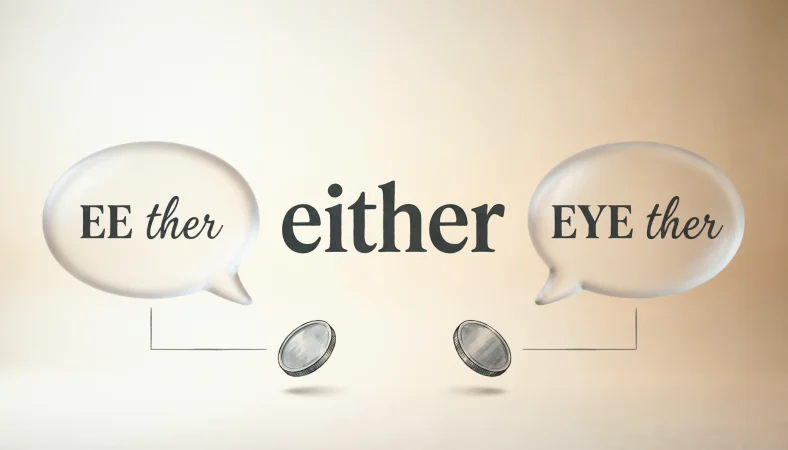
The phrase either or either refers to the same English word, not two different spellings. Either has two widely accepted pronunciations, commonly heard as “EE ther” and “EYE ther.” Both are standard in English, although pronunciation preferences can vary by region, speaker, and personal habit. The meaning depends on context.
If you have ever wondered whether you should say “EE ther” or “EYE ther,” you are not alone. The question of either or either is unusual because the written form does not change. Instead, English speakers use two accepted pronunciations of the same word.
Either can introduce a choice between two possibilities, as in “You can choose either option.” It can also appear in the familiar construction “either A or B,” such as “We can travel either Monday or Tuesday.” In negative sentences, either can mean “also,” as in “I do not like it either.”
This creates confusion because learners sometimes assume that one pronunciation must be correct while the other must be wrong. In reality, both pronunciations are established in standard English. The more important issue is understanding how either works grammatically and choosing a pronunciation that feels natural for your variety of English.
Either vs Either: What’s the Difference?
There is no spelling difference between the two forms. Both are written as either. The difference people usually notice is pronunciation.
One common pronunciation begins with the vowel sound in “see,” producing something like “EE ther.” Another begins with the vowel sound in “eye,” producing something like “EYE ther.” Neither pronunciation automatically changes the meaning.
| Feature | Either with EE sound | Either with EYE sound |
| Spelling | either | either |
| Word | either | either |
| Meaning | Same | Same |
| Pronunciation | EE ther | EYE ther |
| Grammar | Same | Same |
| Standard English | Yes | Yes |
| Formal writing | Either spelling | Either spelling |
| Common use | Choice, alternatives, negative agreement | Choice, alternatives, negative agreement |
The important distinction is therefore pronunciation rather than vocabulary.
Both forms are accepted in standard English.
Neither pronunciation is inherently incorrect.
Regional and personal preferences can influence which form a speaker chooses.
The written word remains exactly the same.
Is Either or Either a Grammar, Vocabulary, or Usage Issue?
The question is mainly a pronunciation and usage issue, not a spelling issue. There are not two separate words written as either and either. Instead, speakers may pronounce the same word differently.
From a grammatical perspective, either has several functions.
As a determiner, it can refer to one of two possibilities.
“Either answer is acceptable.”
As a pronoun, it can stand by itself.
“Either will work.”
As an adverb, it commonly appears in negative statements.
“I do not want it either.”
As part of a conjunction, it helps connect alternatives.
“You can either stay here or come with us.”
These grammatical roles remain unchanged regardless of pronunciation.
Are the Two Pronunciations Interchangeable?
Yes. In most ordinary situations, you can use either pronunciation without changing the meaning of the sentence.
A speaker might say:
“EE ther choice is fine.”
Another might say:
“EYE ther choice is fine.”
The listener normally understands the same message.
Formal Versus Informal Usage
Neither pronunciation is restricted to casual conversation. Both can occur in formal speech, professional communication, education, presentations, and everyday conversation.
The important point is that pronunciation and formality are separate issues.
You do not need to switch to one pronunciation simply because you are speaking in a professional setting.
Academic Versus Casual Usage
Students may encounter both pronunciations from teachers, lecturers, researchers, and other speakers. Academic writing does not normally require you to indicate pronunciation because the written form is simply either.
In spoken academic English, either pronunciation can be heard.
How to Pronounce Either Correctly
The two most recognized pronunciations can be represented approximately as:
EE ther
EYE ther
The exact vowel and final sound may vary depending on the speaker’s accent.
The first pronunciation begins with a long “ee” sound, similar to the vowel in “see.”
The second pronunciation begins with the vowel sound in “eye.”
Both are well established in English pronunciation.
For learners, the simplest approach is not to treat pronunciation as a right versus wrong competition. Listen to the English variety around you, notice which pronunciation is common, and use either form confidently.
If you are learning American English, British English, or another variety, exposure to native speakers will help you become comfortable with both.
How Either Works in Everyday English
Either is especially useful when discussing two choices.
For example:
“Either restaurant would be fine.”
This means that both restaurants are acceptable choices, and choosing one of them would satisfy the speaker.
It can also be used when presenting alternatives.
“You can either call me or send a message.”
Here, either works together with or to establish two alternatives.
Another important construction appears in negative sentences.
“I do not want coffee either.”
In this sentence, either means that the speaker also does not want coffee.
These meanings are related, but they should not be confused. Context determines which function either performs.
Either in Workplace English
In professional communication, either often helps express alternatives clearly.
Consider:
“You can either attend the meeting in person or join online.”
This sentence gives two options. The construction is concise and natural.
Another example is:
“Either department can handle the request.”
Here, either refers to one of two departments, with both presented as acceptable possibilities.
In workplace conversations, choosing between the two pronunciations does not normally affect clarity. What matters more is sentence structure and the intended meaning.
Workplace Usage Recap
Use either when referring to one of two possible choices or alternatives. In professional speech, both established pronunciations are acceptable. Focus on clear sentence structure rather than worrying that one pronunciation is automatically more formal.
Either in Academic English
Academic writing frequently uses either to compare two possibilities.
For example:
“Either explanation could account for the observed result.”
The sentence presents two explanations and says that either one could potentially explain the result.
Another example is:
“Students may choose either method for the experiment.”
Again, either introduces two available possibilities.
In spoken academic English, both common pronunciations may occur. In written academic English, pronunciation is irrelevant because the spelling remains unchanged.
Either can also appear in logical discussions.
“Either the first explanation is correct or the second explanation requires further examination.”
The construction makes the relationship between alternatives explicit.
Academic Usage Recap
Either is useful for presenting alternatives, discussing possibilities, and describing choices. Its pronunciation does not change its grammatical function or meaning.
Either in Technology and Digital Communication
Modern technology provides countless examples of either.
A software interface might say:
“You can either upload a file or paste the text.”
A technical guide might explain:
“Either option can be selected from the settings menu.”
A chatbot could respond:
“You can either continue with the current configuration or create a new one.”
These examples demonstrate why understanding the grammar of either matters more than worrying about pronunciation.
Voice assistants and speech recognition systems also encounter different pronunciations. Modern speech technology is designed to process natural variations in pronunciation, although individual systems can occasionally misinterpret unusual accents or unclear speech.
In text based communication, there is no pronunciation difference at all. Whether someone would say “EE ther” or “EYE ther,” the written word remains either.
When You Should NOT Use Either or Either
Because either has several meanings, learners sometimes use it where another construction would be clearer.
1. Do not use either when there are more than two choices in a strict two choice construction
The traditional use of either refers to two alternatives.
For example:
“You can choose either tea or coffee.”
If you are discussing several possibilities, another structure may be more appropriate.
2. Do not assume either means both
“Either option is acceptable” does not normally mean that both options must be selected. It means that one option or the other can satisfy the requirement.
3. Do not confuse either with neither
Either presents possibilities or alternatives.
Neither rejects both possibilities.
“You can choose either answer.”
“Neither answer is correct.”
4. Do not add unnecessary repetition
A sentence such as “You can either choose either option” is awkward because the two uses serve no useful purpose.
A clearer version is:
“You can choose either option.”
5. Do not treat pronunciation as spelling
The pronunciation “EYE ther” does not justify writing a different spelling.
The written form remains either.
6. Do not assume one pronunciation is universally superior
English pronunciation varies among speakers and regions. Treating one accepted pronunciation as the only possible form can create unnecessary confusion.
7. Do not use either when you actually mean both
“Either employee can complete the task” means one of the two employees can complete it.
If both employees need to complete it, use both.
8. Do not use either and neither interchangeably
They communicate opposite ideas in many contexts.
“Either answer could work” expresses possibility.
“Neither answer could work” expresses rejection of both choices.
Common Mistakes and Decision Rules
| Correct sentence | Incorrect sentence | Explanation |
| You can choose either option. | You can choose both either options. | Either already expresses a choice between two possibilities. |
| Either answer is acceptable. | Neither answer is acceptable. | Neither changes the meaning by rejecting both options. |
| I do not like it either. | I do not like it neither. | Either commonly follows a negative statement to mean also. |
| You can either call or email me. | You can either call nor email me. | Either normally pairs with or in this construction. |
| Either pronunciation is acceptable. | One pronunciation is always wrong. | Both established pronunciations are accepted. |
Decision Rule Box
- If you are discussing one of two possible choices, use either.
- If you are rejecting both choices, use neither.
- If you mean that two people or things are included together, use both.
- If you are deciding how to pronounce either, remember that both common pronunciations are accepted.
Either and Either in Modern Technology and AI Tools
Speech technology makes pronunciation differences particularly interesting.
A person may pronounce either using the initial “ee” sound, while another person may use the initial “eye” sound. Both can communicate the same word to a human listener.
AI systems that process speech must account for accents, pronunciation variation, speaking speed, background noise, and regional patterns. This means that a language model or speech recognition system should not treat pronunciation variation as evidence that the speaker has used a different English word.
Text based AI tools face a simpler situation. The spelling is always either, so there is no written distinction to resolve.
This illustrates a broader lesson in language technology: pronunciation, spelling, grammar, and meaning are connected, but they are not identical.
Where Did Either Come From?
Either has a long history in English and is related to older Germanic forms.
The word developed from Old English forms associated with ideas such as each of two or one of two. Over time, its grammatical functions expanded, allowing it to introduce alternatives, refer to one of two people or things, and appear in negative constructions.
The pronunciation variation is also not a recent development caused by modern informal speech. Different pronunciation patterns have existed within English for a long time.
That history helps explain why speakers can use different pronunciations while still using the same standard word.
What Linguists Teach Us About Pronunciation Variation
A useful principle from descriptive linguistics is that pronunciation variation does not automatically indicate incorrect English.
An expert style explanation would be:
“A pronunciation difference does not necessarily create a meaning difference when both forms belong to established usage.”
That principle is especially useful for words such as either. Speakers may have different preferences while still producing standard English.
The important question is whether a pronunciation is recognized and understood within the relevant variety of English, not whether every speaker uses it identically.
Two Practical Case Studies
Case Study 1: The Classroom Choice
Imagine a student writing:
“Students can choose either topic for the presentation.”
The student worries that the word sounds different when spoken by two teachers. One teacher uses the “ee” pronunciation, while another uses the “eye” pronunciation.
The concrete result is that the student’s written sentence does not need to change. Both teachers are using the same word with the same grammatical meaning.
The lesson is simple: pronunciation variation does not require a spelling change.
Case Study 2: The Workplace Decision
Consider a manager telling an employee:
“You can either submit the report today or send it tomorrow morning.”
The employee hears a pronunciation of either that differs from the one they normally use. The meaning remains clear because the surrounding construction establishes two alternatives.
The practical result is improved communication when the employee focuses on the sentence structure rather than assuming that pronunciation indicates a different word.
These are illustrative case studies rather than claims about a particular organization or measured experiment.
Error Prevention Checklist
Always use either when
- You are referring to one of two possibilities.
- You are presenting two alternatives.
- You are using the construction either A or B.
- You want to refer to one member of a pair without specifying which one.
- You are adding agreement to a negative statement, such as “I do not like it either.”
Never use either when
- You mean that both choices must be included.
- You are rejecting both alternatives and need neither.
- You are discussing several unrelated choices without a meaningful two choice relationship.
- You are trying to create a different spelling for the second pronunciation.
- You want to claim that one accepted pronunciation is universally incorrect.
Related Grammar Confusions You Should Master
Understanding either becomes easier when you also understand several closely related English distinctions.
Either vs Neither
Either allows one of two possibilities, while neither rejects both.
Either vs Both
Either generally selects one of two possibilities, while both includes the two together.
Either vs Any
Either commonly concerns two choices. Any can refer to one or more possibilities depending on context.
Neither vs None
Neither is normally used for two. None can refer to zero members of a larger group.
Or vs Nor
Or commonly connects alternatives. Nor commonly follows a negative construction.
Each vs Every
Each emphasizes individual members, while every generally considers members collectively as part of a group.
Both vs All
Both refers to two. All generally refers to three or more or to an entire group.
Choice vs Alternative
These words overlap but can behave differently depending on sentence structure and context.
Also vs Either
Also commonly appears in affirmative statements, while either frequently appears at the end of negative statements.
Pronunciation vs Spelling
A change in pronunciation does not necessarily create a new written form.
FAQs
What is the correct pronunciation of either?
Both “EE ther” and “EYE ther” are established pronunciations. Neither pronunciation automatically makes the speaker incorrect.
Is either pronounced EE ther or EYE ther?
It can be pronounced either way. Regional speech patterns and individual preferences influence which pronunciation a speaker uses.
Is one pronunciation of either more correct?
There is no general rule requiring one of the two common pronunciations in all varieties of standard English.
Why do people pronounce either differently?
English contains substantial regional and individual pronunciation variation. Either is one word where two pronunciation patterns are widely recognized.
Does the pronunciation of either change its meaning?
No. The common pronunciation differences do not normally change the meaning or grammatical function of the word.
Is either formal or informal English?
Either is standard English and can be used in formal, academic, professional, and casual communication.
What is the difference between either and neither?
Either generally presents one of two possibilities or alternatives. Neither generally means that not one of the two possibilities applies.
What is the difference between either and both?
Either normally refers to one of two choices or possibilities. Both refers to the two considered together.
Can I use either in academic writing?
Yes. Either is completely appropriate in academic writing when the sentence requires its meaning or grammatical function.
Does either always go with or?
No. The construction “either A or B” uses either with or, but either can also appear independently, as in “Either answer is acceptable,” or in negative statements such as “I do not agree either.”
Conclusion:
The main lesson behind either or either is that you are not choosing between two different spellings. You are choosing between two established pronunciations of the same English word. Both are widely accepted, and neither automatically makes your English incorrect.
The more important skill is understanding what either means in context. Use it when discussing one of two possibilities, presenting alternatives, or adding agreement to a negative statement. Remember the distinction between either, neither, and both, because those words express different relationships.
Once you understand the grammar, pronunciation becomes much less intimidating. Whether you say “EE ther” or “EYE ther,” clear context and correct sentence structure matter far more than forcing yourself to imitate one pronunciation.
In short, either pronunciation can be natural and correct. Use the form that fits your English variety and speak with confidence.