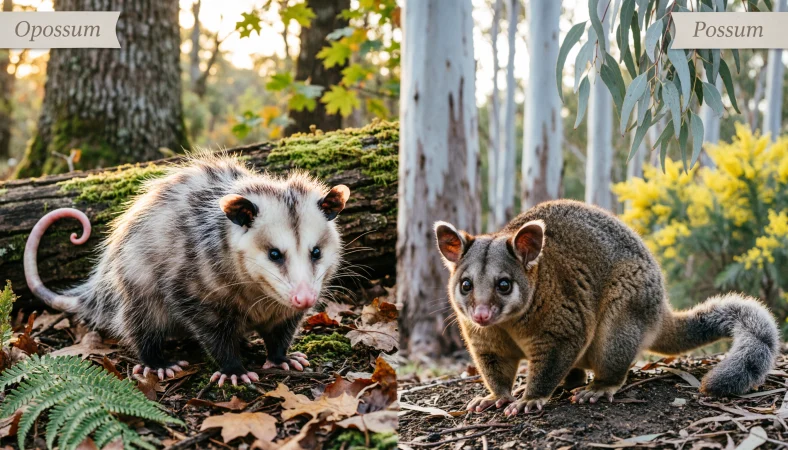
Both opossum or possum can be correct, but they do not always refer to the same animal. In North American English, opossum usually refers to the Virginia opossum, while possum can be a shorter form of opossum or the usual name for several Australian marsupials. Context and region determine the better choice.
The question opossum or possum often causes confusion because the two words look and sound closely related. In everyday American English, people commonly use possum as a shortened form of opossum. However, zoological and regional usage makes the distinction more important.
An opossum is a marsupial native to the Americas, with the Virginia opossum being the only species found naturally in the United States and Canada. Possums, in the strict zoological sense, are different marsupials native mainly to Australia and nearby regions.
This difference matters when you’re writing an article, school assignment, wildlife description, or educational resource. Calling an Australian possum an opossum can create a factual error, while treating every use of possum as incorrect would ignore normal informal American English.
The good news is that the distinction becomes simple once you understand geography, context, and standard usage.
Opossum vs Possum: What’s the Difference?
The main difference between opossum and possum concerns both regional usage and zoological classification.
Opossum is a noun that generally refers to a marsupial belonging to the order Didelphimorphia, especially the Virginia opossum commonly found in the United States.
Possum can have two meanings. In North American everyday speech, it often serves as a shortened form of opossum. In Australia and nearby regions, however, possum commonly refers to marsupials belonging to different groups.
| Word | Part of speech | Common meaning | Main regional use | Example |
| Opossum | Noun | A New World marsupial, especially the Virginia opossum | North America | We saw an opossum near the road. |
| Possum | Noun | A shortened form of opossum or an Australian marsupial | North America and Australia | A possum was sitting in the tree. |
| Opossum | Noun | A specific American marsupial | Formal and scientific contexts | The Virginia opossum is adaptable. |
| Possum | Noun | Various Australian marsupials | Australian English | The possum moved through the branches. |
The distinction becomes especially useful when accuracy matters.
- In North America, opossum is the safer precise term for the animal commonly seen around homes, roads, and wooded areas.
- In casual American speech, possum is widely understood as a shortened form of opossum.
- In Australia, possum normally refers to a different group of marsupials.
Therefore, neither spelling should automatically be labeled wrong.
Quick recap
Opossum is the precise term for the American animal.
Possum can be an informal shortened form of opossum in North America.
Australian possums are different animals from American opossums.
Your choice should depend on geography and the level of precision required.
Is Opossum vs Possum a Grammar, Vocabulary, or Usage Issue?
The difference between opossum and possum is primarily a vocabulary and usage issue, rather than a grammar problem.
Grammar determines how a word functions within a sentence. For example, both opossum and possum can function as nouns:
The opossum crossed the yard.
The possum crossed the yard.
Both sentences are grammatically formed.
The more important question is what animal the speaker or writer intends to identify.
In informal American conversation, possum is often used as a shortened form of opossum. Someone might say, “There’s a possum outside,” and everyone understands that they mean an American opossum.
In a scientific, educational, or formal context, opossum is usually the clearer choice when discussing an American species.
Australian English introduces another layer. There, possum is the normal word for animals such as the common brushtail possum and common ringtail possum. Calling these animals opossums would not simply be a casual variation. It could identify the wrong animal group.
This means the terms are sometimes interchangeable in everyday North American English but not universally interchangeable.
Formal versus informal usage
Consider these examples:
The opossum is active primarily at night.
This sounds precise and appropriate for educational writing.
We saw a possum in the backyard.
This sounds completely natural in casual American conversation.
Neither sentence has a grammar problem. The difference lies in tone, precision, and regional convention.
Academic versus casual usage
Academic writing should favor accuracy. If you’re discussing the Virginia opossum specifically, opossum is the better choice.
Casual writing can use possum when the North American context is already obvious.
For Australian wildlife, possum is normally the correct term regardless of whether the writing is casual or formal.
What Does Opossum Mean?
Opossum is a noun used for marsupials native to the Americas. When people in the United States commonly say “opossum,” they are often referring specifically to the Virginia opossum.
The Virginia opossum has a broad geographic range and is highly adaptable. It can live in forests, farmland, suburban areas, and urban environments. Its ability to eat many different foods helps it survive in changing habitats.
One of the best known characteristics of the opossum is its response to extreme danger. When seriously threatened, an opossum may enter a state of apparent unconsciousness. This behavior is the source of the expression “playing possum.”
The animal also has other distinctive traits. It has a long, mostly hairless tail, a pointed face, and numerous teeth. It is a marsupial, meaning females have a pouch in which young develop after birth.
Workplace example
A wildlife researcher might write:
The team documented an opossum population near the construction site.
The precise noun works well because the sentence appears in a professional context.
Academic example
A biology student might write:
The Virginia opossum is an adaptable marsupial found throughout much of the eastern United States.
Here, opossum clearly identifies the subject and avoids ambiguity.
Technology example
A wildlife application might display:
Opossum detected by the backyard camera.
The more precise term works well in an identification system because users may expect the label to represent a particular animal.
Usage recap
Use opossum when you want a clear and precise North American wildlife term. It is especially useful in educational, scientific, professional, and identification contexts.
What Does Possum Mean?
Possum has a broader usage history than many people realize.
In North American English, it can be an informal shortened form of opossum. This usage is extremely common in everyday speech.
For example:
There’s a possum under the porch.
An American listener will normally understand this as a reference to an opossum.
However, possum also has an important independent zoological meaning. In Australia, the word commonly refers to several kinds of arboreal marsupials.
Australian possums include animals such as the common brushtail possum and common ringtail possum. These animals belong to groups distinct from American opossums.
That geographical distinction is essential.
Workplace example
An Australian environmental report might say:
The project area provides habitat for several possum species.
In this context, possum is not merely a casual abbreviation. It is the normal regional term for the relevant Australian animals.
Academic example
A zoology textbook discussing Australian mammals could write:
Australian possums occupy a variety of forest habitats.
Here, possums identifies Australian marsupials rather than American opossums.
Technology example
A wildlife database used in Australia might classify an observation as:
Common brushtail possum.
Using opossum instead would be inaccurate because the database is identifying an Australian species.
Usage recap
Use possum naturally in casual North American speech when you mean an opossum. Use it as the standard term for Australian possums when discussing Australian wildlife.
When You Should NOT Use Opossum or Possum
Understanding when a word should not be used can prevent subtle factual mistakes.
1. Do not use opossum for an Australian possum
If you’re describing an Australian possum species, opossum is generally the wrong term.
2. Do not assume possum always means opossum
The shortened North American usage is common, but Australian English gives possum a distinct zoological meaning.
3. Do not call opossum an incorrect spelling
Opossum is the standard spelling of the North American animal’s name.
4. Do not insist that possum is always informal
In Australia, possum is a normal zoological and everyday term.
5. Do not use regional language without considering your audience
An American reader may understand possum as an abbreviation. An Australian reader may interpret it as a reference to a different group of animals.
6. Do not sacrifice precision in scientific writing
If the exact animal matters, use the appropriate common or scientific name.
7. Do not assume pronunciation determines spelling
People may pronounce the words differently depending on region and speech habits. Pronunciation does not change the underlying distinction.
8. Do not treat every usage difference as a grammar error
Most confusion here comes from vocabulary, regional English, and context rather than sentence structure.
Common Mistakes and Decision Rules
| Correct sentence | Incorrect sentence | Explanation |
| We saw an opossum in the backyard. | We saw an Australian opossum in the backyard. | If the animal is an Australian possum, the term is misleading. |
| The Virginia opossum is a marsupial. | The Virginia possum is a marsupial. | Opossum is the established common name. |
| There was a possum outside last night. | There was a opossum outside last night. | The article before opossum must be an. |
| Australian possums live in many habitats. | Australian opossums live in many habitats. | Possum is the standard common term for these Australian animals. |
| The researcher identified an opossum. | The researcher identified a possum. | Opossum offers greater precision in a North American research context. |
| We saw a possum near the house. | We saw a possum, meaning an Australian animal. | In casual American English, possum commonly means opossum. |
Decision Rule Box
- If you mean the North American animal, especially the Virginia opossum, use opossum when precision matters.
- If you are speaking casually in North America, possum can be a natural shortened form of opossum.
- If you mean an Australian marsupial commonly called a possum, use possum.
This rule is more accurate than simply treating one word as correct and the other as incorrect.
Opossum and Possum in Modern Technology and AI Tools
Modern technology has made animal names more visible than ever. Wildlife identification applications, image recognition systems, search engines, educational databases, and AI tools regularly process descriptions and photographs of animals.
This creates a need for contextual accuracy.
An AI system may identify an image as an opossum when the animal is a Virginia opossum. In an Australian setting, the same broad visual category could involve a possum.
The problem becomes more complicated when users provide only a short prompt such as:
What is this possum?
The system needs geographic and visual context to determine what the speaker means.
For content creators, this distinction also matters. An article about American backyard wildlife should generally use opossum when introducing the animal. A casual quote can retain possum if that reflects natural speech.
Technology does not eliminate regional vocabulary. Instead, it makes context more important because digital content reaches readers from many English speaking regions.
Why Do We Have Both Words?
The history of the two words explains much of the confusion.
The word opossum comes from an Indigenous American language, recorded by English speakers during early European contact with North America. English adopted the name for the unfamiliar marsupial.
Over time, speakers shortened opossum to possum in some varieties of English. This kind of shortening is common in everyday speech. People often remove an initial unstressed syllable from a word while preserving its meaning in familiar contexts.
Australia developed a separate use of possum for its own marsupials. Although the American and Australian animals are distinct, the names became connected in English because both groups are marsupials and share some superficial characteristics.
The result is a word pair that looks deceptively simple.
The history also explains why dictionaries may recognize both words while still giving them different definitions and regional labels.
An Expert Perspective on Opossum and Possum Usage
A useful principle for language learners is that correctness often depends on meaning and context rather than spelling alone.
“Regional vocabulary can change the meaning of an otherwise familiar word.”
That principle applies particularly well here. A North American speaker saying possum may simply be using a shortened form of opossum. An Australian speaker using possum may be naming an animal group that is not an American opossum at all.
For writers, the safest approach is not to memorize one word as correct and the other as incorrect. Instead, identify the animal and the audience first.
Two Practical Case Studies
Case Study One: American Wildlife Article
Imagine a website publishing an article about animals found around homes in the United States.
The writer repeatedly uses possum because that is what people commonly say in conversation. The content may still be understandable, but readers looking for accurate wildlife information may expect the more precise term opossum.
Changing the primary terminology to opossum immediately clarifies the subject. The writer can then explain that possum is a common informal shortening in American speech.
The result is better terminology without making ordinary speech seem incorrect.
Case Study Two: Australian Wildlife Guide
Now consider an educational guide about Australian mammals.
The guide discusses brushtail possums and ringtail possums. Replacing every instance of possum with opossum would introduce factual confusion because the guide is describing Australian animals.
Keeping possum preserves the established regional terminology and gives readers the correct common name.
The practical result is simple: geographic context prevents a terminology error before it reaches publication.
Error Prevention Checklist
Always use opossum when
- You are writing about the Virginia opossum.
- You are discussing North American wildlife in a formal context.
- You want maximum clarity for an international audience.
- You are writing scientific or educational material about an American opossum.
- You need to distinguish the animal from Australian possums.
Use possum when
- You are speaking casually in North American English.
- The context clearly indicates an American opossum.
- You are discussing Australian possums.
- You are using an established Australian species name.
Never use opossum when
- You are specifically identifying an Australian possum species.
- You are replacing the established name of an Australian species with an unrelated North American term.
Related Animal and Vocabulary Confusions You Should Master
Language learners often encounter similar problems where two terms appear interchangeable but have regional or contextual differences.
- Alligator or crocodile: Similar reptiles with important biological differences.
- Turtle or tortoise: Related animals distinguished by habitat and anatomy.
- Hare or rabbit: Similar animals with meaningful biological differences.
- Moth or butterfly: Related insects that can be distinguished through several characteristics.
- Coyote or wolf: Canids that differ in size, behavior, and classification.
- Porpoise or dolphin: Marine mammals that are often confused in everyday speech.
- Toad or frog: Amphibians with overlapping characteristics but different common usage.
- All right or alright: A common spelling and usage question.
- Toward or towards: Regional variations with the same basic meaning.
- Gray or grey: Standard regional spelling differences in English.
These comparisons reinforce an important lesson: English often contains words whose correctness depends on region, context, audience, or meaning.
FAQs
Is possum another word for opossum?
In North American English, possum is commonly used as a shortened form of opossum. However, possum also refers to several Australian marsupials, so the words are not universally interchangeable.
Is opossum the correct spelling?
Yes. Opossum is the standard spelling for the North American marsupial, especially the Virginia opossum.
Is possum grammatically correct?
Yes. Possum is a legitimate English noun. In North America it can be an informal shortening of opossum, while in Australia it commonly refers to a distinct group of marsupials.
Are possums and opossums the same animal?
Not always. In casual North American English, possum may mean an opossum. Australian possums, however, are different marsupials from American opossums.
Why do Americans call opossums possums?
Possum developed as a shortened form of opossum in North American English. The shortened version became common in everyday speech.
What is the difference between an opossum and an Australian possum?
An American opossum belongs to a different marsupial group from Australian possums. They are geographically and biologically distinct despite their similar names.
Should I say opossum or possum in formal writing?
For formal writing about a North American animal, opossum is usually the clearer choice. For Australian wildlife, possum is the appropriate common term.
Is a possum an Australian animal?
In zoological usage, yes, possum commonly refers to several Australian marsupials. The word is also used casually in North America as a shortened form of opossum.
Why is it called playing possum?
The expression comes from the behavior of opossums when they respond to severe danger by entering a state of apparent unconsciousness. The phrase later became a common expression for pretending to be unaware or inactive.
Conclusion:
The choice between opossum and possum depends on what you mean and where the word is being used. For the North American animal, especially the Virginia opossum, opossum is the clearest and most precise term. In casual American English, possum is a familiar shortened form.
In Australia, however, possum normally refers to a different group of marsupials. That regional distinction is the key to avoiding mistakes.
So, when deciding between opossum or possum, don’t simply ask which spelling is correct. Ask which animal you mean, which variety of English you’re using, and how precise your writing needs to be. Once you consider those three factors, the choice becomes straightforward.











5 thoughts on “Opossum Or Possum: Which Word Is Correct? Meaning, Differences & Usage For 2026”