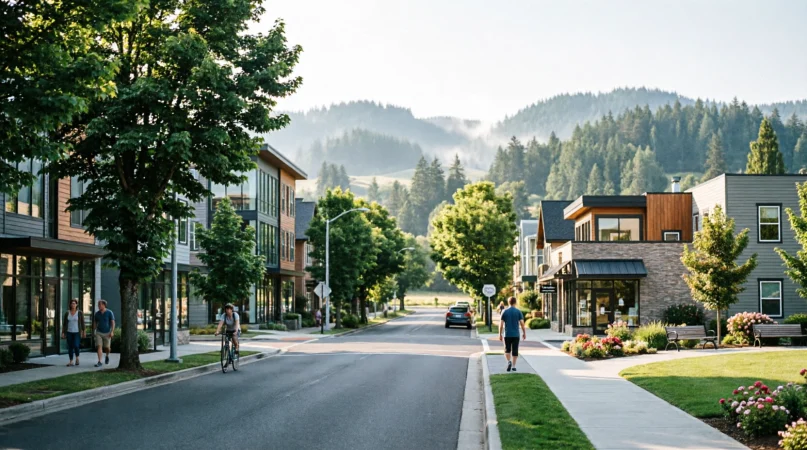
Beaverton is a city in Oregon, United States, located just west of Portland in Washington County. It is known for its suburban communities, parks, business centers, and convenient access to the greater Portland area.
The city offers a mix of residential neighborhoods, shopping areas, outdoor spaces, and employment opportunities, making it an important part of the Portland metropolitan region.
Wondering what Beaverton is known for or what makes it a popular place to live, work, or visit? Located near Portland, Beaverton combines suburban living with easy access to urban amenities, parks, restaurants, businesses, and recreational opportunities.
This guide provides a clear overview of the city, including its location, community, attractions, lifestyle, and practical information, helping readers understand what Beaverton has to offer.
Beaverton: What Is It Known For?
Beaverton is best known as a major suburban city in the Portland metropolitan area with a strong connection to technology, business, recreation, education, and multicultural communities.
The city sits west of Portland and has developed from a small agricultural settlement into a community of nearly 100,000 residents. Its location gives residents access to Portland while maintaining its own neighborhoods, commercial areas, parks, schools, restaurants, and community institutions.
For someone unfamiliar with the area, it can be useful to think of Beaverton as more than simply a suburb. It has its own identity, local government, history, employment centers, cultural communities, and recreational opportunities.
The city covers about 19.60 square miles of land according to recent Census data. Its population density is substantially higher than that of many smaller Oregon communities, reflecting its urban and suburban character.
Quick overview
Beaverton is in Washington County, Oregon.
It forms part of the Portland metropolitan area.
The city has a population close to 100,000.
It combines established neighborhoods with commercial and employment districts.
Its location makes Portland and other parts of the region relatively accessible.
Where Is Beaverton Located?
Beaverton is located in northwest Oregon, in Washington County, west of Portland.
Its position is one of the biggest reasons the city has attracted residents and businesses. People can live in Beaverton while remaining connected to employment, entertainment, education, and cultural opportunities throughout the Portland metropolitan area.
The surrounding region includes communities such as Hillsboro, Tigard, Aloha, and Portland. Together, these communities form a connected urban and suburban environment rather than isolated towns.
Beaverton’s location also places it near the Tualatin Valley, an area historically associated with agriculture and later suburban development.
For travelers, the city can serve as a convenient base for exploring the greater Portland region. For residents, the location provides access to a wide range of services without requiring every trip to take place in central Portland.
The city also benefits from transportation connections that link it with neighboring communities. This makes location one of Beaverton’s most important characteristics when considering housing, employment, education, or recreation.
Beaverton’s History and Development
Beaverton has a history that reaches back much further than its modern suburban appearance suggests.
The area developed from an agricultural community into an incorporated city and eventually became one of the largest cities in Washington County. The official city history resources describe Beaverton’s development through a collection of local stories, historical records, and community biographies.
Agriculture played an important role in the area’s earlier development. The fertile Tualatin Valley supported farming and helped shape the communities that eventually grew around the region.
Transportation also influenced Beaverton’s development. As roads, rail connections, and regional transportation improved, the community became increasingly connected to Portland and nearby population centers.
During the twentieth century, suburban growth accelerated. Residential neighborhoods expanded, businesses arrived, and the city gradually became part of the larger Portland metropolitan economy.
Technology and modern business development later became particularly important. The broader region attracted major employers, while Beaverton itself developed a mixture of offices, retail centers, residential communities, schools, parks, and public facilities.
This history explains why the city has such a varied physical character. Older areas can exist relatively close to newer commercial developments, while established neighborhoods sit alongside newer housing and redevelopment projects.
Beaverton Population and Community
Beaverton has experienced substantial population growth over the past several decades.
The 2010 Census recorded 89,803 residents, while the 2020 Census recorded 97,494. The Census Bureau’s 2025 estimate places the population at approximately 97,842.
The community is also notably diverse.
Recent Census information shows that about 19 percent of residents identify as Hispanic or Latino, while approximately 19 percent of residents are foreign born. About 26.9 percent of residents age five and older speak a language other than English at home.
That diversity is reflected in everyday life.
Residents can find restaurants representing many cuisines, cultural events, international grocery stores, community organizations, and neighborhoods with residents from a wide range of backgrounds.
This makes Beaverton different from the image some people may have of a conventional American suburb. Although much of the city has a suburban layout, its population and cultural life are considerably more diverse.
What Is It Like to Live in Beaverton?
Living in Beaverton offers a combination of suburban convenience and metropolitan access.
One of the city’s biggest advantages is its location. Residents can enjoy a quieter residential environment while remaining close to Portland and other communities in the region.
The city contains many different types of neighborhoods. Some areas have established single family homes and mature landscaping. Others feature apartments, townhomes, commercial development, or newer residential construction.
This variety means that the experience of living in Beaverton can differ considerably depending on the neighborhood.
Housing costs are an important consideration. Census data for 2020 through 2024 reports a median gross rent of $1,826 and a median value of owner occupied homes of $569,800. These figures show that Beaverton is not among Oregon’s lowest cost housing markets.
At the same time, household income is relatively strong. The median household income reported for the same period was $98,622 in 2024 dollars.
The result is a city where housing affordability can be an important factor for people considering a move.
Beaverton Neighborhoods and Local Character
Beaverton does not have one single neighborhood identity.
Different parts of the city provide different experiences. Some neighborhoods are primarily residential, while others are closer to major commercial areas, employment centers, parks, schools, or transportation routes.
Established residential areas often appeal to people who value mature trees, traditional homes, and a quieter atmosphere.
More recently developed areas may offer apartments, townhomes, modern amenities, and easier access to shopping and services.
For families, schools and parks can be major considerations. For professionals, proximity to employment centers and transportation may matter more. For younger residents, access to restaurants, entertainment, and regional transportation can influence the choice of neighborhood.
This variety is one reason a general description of Beaverton cannot accurately represent every part of the city.
Parks, Recreation, and Outdoor Activities
Beaverton has a strong connection to outdoor recreation.
The city’s parks and natural areas provide opportunities for walking, sports, family activities, community events, and relaxation.
The wider region also makes outdoor recreation particularly accessible. Residents are within reach of forests, rivers, hiking areas, and scenic destinations throughout northwest Oregon.
This is an important part of the lifestyle appeal of the Portland metropolitan area.
Someone can spend a weekday in an office or commercial district and then reach a trail, park, or natural area without traveling extremely far from the metropolitan core.
Beaverton’s own parks provide more convenient options for everyday recreation. Families may use playgrounds and sports fields, while walkers and runners can take advantage of local paths and green spaces.
The combination of urban services and nearby nature is a recurring feature of life in the region.
Shopping, Restaurants, and Local Culture
Beaverton has a substantial commercial sector, including shopping centers, independent businesses, restaurants, grocery stores, and services.
Its diverse population has also influenced its food culture.
Visitors can find a wide range of cuisines, including Asian, Latin American, Middle Eastern, European, and American options. International grocery shopping is another notable part of the city’s commercial landscape.
The presence of diverse food and retail businesses reflects the city’s changing population.
Rather than depending entirely on Portland for cultural and culinary experiences, Beaverton has developed its own collection of destinations.
For visitors, this makes the city worth exploring independently rather than treating it only as a place to stay outside Portland.
For residents, the availability of local services can reduce the need to travel into Portland for everyday shopping and dining.
Education in Beaverton
Education is another important part of the city’s community structure.
Beaverton is served by the Beaverton School District, one of the major school systems in the Portland metropolitan region.
The city also has access to higher education and professional training opportunities throughout the surrounding metropolitan area.
Educational attainment among adults is relatively high. Census data reports that 92.9 percent of residents age 25 and older have graduated from high school or obtained an equivalent qualification, while 50.1 percent hold a bachelor’s degree or higher.
These numbers help explain part of the city’s workforce profile.
A highly educated population can support industries that depend on professional, technical, managerial, and specialized workers.
For families considering the area, education can therefore be one of the major factors in evaluating different neighborhoods and housing options.
Jobs and the Beaverton Economy
Beaverton is closely connected to the broader Portland metropolitan economy.
The city’s workforce includes people employed in technology, retail, healthcare, education, professional services, hospitality, government, and other sectors.
The regional presence of major companies has also contributed to the area’s reputation as a technology and business center.
Employment is one reason people choose Beaverton even when they could theoretically live in another part of the metropolitan area. Living closer to work can reduce commuting demands and provide easier access to employment centers.
Census information reports that 69.5 percent of residents age 16 and older participated in the civilian labor force during the 2020 through 2024 period. The mean travel time to work was 24.1 minutes.
The local economy is also supported by retail and services. Census data reports billions of dollars in retail sales in the relevant reporting period, illustrating the scale of consumer activity in the city.
Beaverton vs Portland
People often compare Beaverton with Portland because the cities are closely connected.
The biggest difference is city character.
Portland has a larger population and a more urban core, while Beaverton generally has a suburban structure with its own commercial and employment centers.
Someone who wants dense urban neighborhoods, extensive city streets, cultural institutions, and downtown living may prefer Portland.
Someone who wants a suburban setting while remaining connected to Portland may find Beaverton more attractive.
The comparison is not simply about which city is better. It depends on lifestyle, work location, housing needs, transportation preferences, and budget.
Beaverton also has its own cultural identity, so describing it merely as a Portland suburb misses some of what makes the city distinctive.
Is Beaverton a Good Place to Visit?
Beaverton can be a good choice for visitors who want access to the Portland region without staying directly in the center of Portland.
It can work particularly well for travelers interested in food, shopping, local parks, suburban neighborhoods, and regional exploration.
The city is also useful as a starting point for exploring other destinations in northwest Oregon.
Visitors should remember that Beaverton is primarily a residential and commercial city rather than a traditional tourist destination. Its appeal comes from everyday community life, food, business, parks, and its position within the wider region.
For someone seeking a quiet base with metropolitan access, that can be an advantage.
When Beaverton May Not Be the Right Choice
Beaverton will not appeal equally to everyone.
Someone looking for a dense downtown experience may prefer central Portland.
Someone seeking a small rural community may find Beaverton too developed and populated.
Housing costs can also be a concern. The city’s housing figures are significantly higher than what many people associate with smaller Oregon communities.
Traffic and commuting can also influence the experience of living in the Portland metropolitan area.
The right decision therefore depends on priorities rather than on a simple ranking.
People considering a move should evaluate the specific neighborhood, commute, housing type, school considerations, access to services, and overall budget rather than judging the entire city from its reputation.
Beaverton in Modern Technology and Daily Life
Technology is deeply integrated into modern life in Beaverton.
The city’s highly connected households reflect the broader digital character of the community. Census data reports that 98.1 percent of households had a computer and 94.8 percent had a broadband internet subscription during the 2020 through 2024 period.
Technology also affects how people work, shop, communicate, study, and access public services.
For businesses, digital connectivity supports remote work, online commerce, professional services, and technology driven industries.
For residents, it contributes to flexible work arrangements and access to information and services.
The city’s connection to the larger Portland technology ecosystem further strengthens this role.
Two Practical Case Studies
Case Study 1: A Professional Moving to the Portland Region
Consider a professional who receives a job in the western Portland metropolitan area.
Living in central Portland might provide a stronger urban experience, but it could also create a longer daily commute.
Choosing Beaverton could provide closer access to western employment centers while maintaining access to Portland.
The practical result is a lifestyle that balances metropolitan opportunity with suburban housing and neighborhood environments.
Case Study 2: A Family Seeking Regional Access
Consider a family looking for schools, parks, shopping, restaurants, and residential neighborhoods.
A city such as Beaverton can provide these everyday services while keeping the family connected to the wider metropolitan region.
The advantage is convenience rather than a single landmark attraction.
The family can remain close to urban employment and cultural opportunities while maintaining a more residential daily environment.
What Makes Beaverton Different?
Several characteristics combine to define the city.
First, its location connects it closely with Portland.
Second, its population is large enough to support a substantial local economy and diverse commercial environment.
Third, its population is culturally diverse, which influences restaurants, businesses, schools, and community life.
Fourth, the city combines established suburban neighborhoods with modern development.
Finally, its proximity to both metropolitan services and Oregon’s natural environment gives residents a broad range of recreational possibilities.
The city therefore occupies an interesting position between traditional suburb and independent urban community.
Error Prevention Checklist for Understanding Beaverton
Always remember
- Beaverton is a city in Oregon.
- It is located in Washington County.
- It forms part of the Portland metropolitan area.
- It has a population of roughly 98,000 based on the latest Census estimate cited here.
- It has a diverse population and substantial economic activity.
- It has its own local government, neighborhoods, parks, businesses, and history.
Do not assume
Beaverton is simply another name for Portland.
Every neighborhood has the same character.
Housing is inexpensive compared with every other Oregon community.
Visitors need to stay in Portland to experience the wider metropolitan area.
The city is only residential and has no significant employment base.
Related Oregon Topics You Should Explore
Readers researching Beaverton often benefit from understanding nearby places and broader regional topics.
- Portland and its neighborhoods
- Washington County communities
- Hillsboro and its technology economy
- Tigard and suburban living
- Aloha and surrounding residential areas
- Tualatin Valley geography
- Oregon housing costs
- Portland metropolitan transportation
- Oregon outdoor recreation
- Northwest Oregon climate
These topics provide useful context because Beaverton’s identity is strongly connected to the larger region.
FAQs
Where is Beaverton located?
Beaverton is located in Washington County in northwest Oregon, west of Portland. It is part of the Portland metropolitan area.
Is Beaverton part of Portland?
No. Beaverton is a separate incorporated city. It is, however, part of the Portland metropolitan area and is closely connected to Portland economically and geographically.
What is Beaverton known for?
Beaverton is known for its suburban neighborhoods, technology and business connections, diverse population, parks, restaurants, shopping, and proximity to Portland.
How many people live in Beaverton?
The U.S. Census Bureau estimates that Beaverton had about 97,842 residents in July 2025.
Is Beaverton a good place to live?
For many people, yes. Its major advantages include metropolitan access, employment opportunities, diverse communities, parks, schools, shopping, and residential neighborhoods. Housing costs and commuting should also be considered.
Is Beaverton expensive?
Beaverton has relatively high housing costs compared with many smaller communities. Census data reports a median owner occupied home value of $569,800 and median gross rent of $1,826 for the 2020 through 2024 period.
What county is Beaverton in?
Beaverton is in Washington County, Oregon.
Is Beaverton close to Portland?
Yes. Beaverton is immediately west of Portland and is closely connected to the city through transportation, employment, commerce, and regional services.
What is Beaverton’s population diversity like?
Beaverton is a diverse community. Recent Census data reports that about 19 percent of residents are Hispanic or Latino and about 19 percent are foreign born.
Is Beaverton worth visiting?
Beaverton can be worth visiting for restaurants, shopping, parks, community events, and its convenient position within the Portland metropolitan area. It can also serve as a practical base for exploring northwest Oregon.
Final Takeaway
Beaverton is more than a suburban extension of Portland. It is an established Oregon city with its own history, neighborhoods, economy, parks, cultural diversity, and community identity.
Its location west of Portland gives residents and visitors convenient access to the wider metropolitan region, while its local businesses, restaurants, schools, employment centers, and recreational spaces provide reasons to spend time in the city itself.
With a population approaching 100,000, strong educational attainment, high household connectivity, diverse communities, and an important position in the regional economy, Beaverton has become one of the most significant communities in the Portland metropolitan area.
For people researching where to live, work, visit, or invest time in Oregon, understanding Beaverton means looking beyond the simple label of suburb. Its real character comes from the combination of metropolitan access and an increasingly independent local identity.