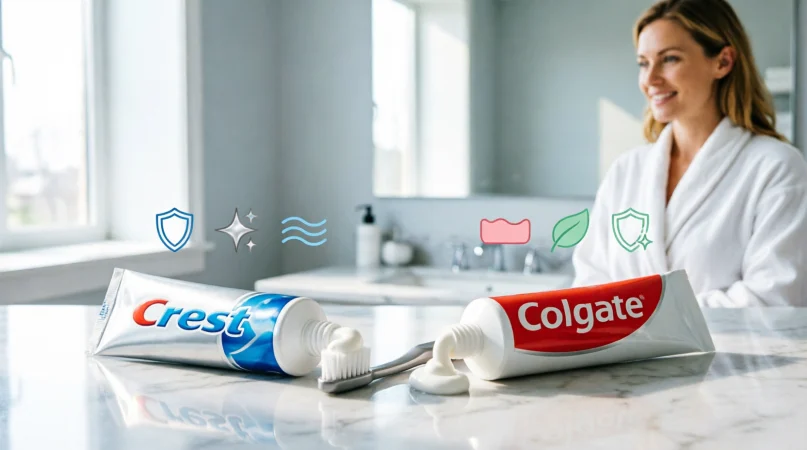
Crest and Colgate are two major toothpaste brands with products designed for everyday cleaning, cavity protection, whitening, sensitivity, gum care, tartar control, and fresh breath. The two brands are not identical, because individual formulas vary by product. Choosing between them should depend on the toothpaste formula and your specific oral care needs.
If you are searching for crest or colgate, you are probably trying to answer a simple question: which toothpaste should you use? The answer is more nuanced than choosing one brand name. Both companies offer multiple formulas, and different products within the same brand can have very different ingredients and purposes.
Crest is a major oral care brand owned by Procter and Gamble, while Colgate is the flagship oral care brand associated with Colgate Palmolive. Both brands have developed extensive toothpaste ranges covering common needs such as cavity prevention, whitening, sensitivity relief, gum care, plaque control, tartar management, and fresh breath.
This distinction matters because choosing toothpaste based only on the brand can lead to an unsuitable product. Someone with sensitive teeth may need a different formula from someone primarily interested in removing surface stains. Likewise, a person concerned about cavities should pay attention to fluoride rather than simply choosing whichever brand is more familiar.
Crest vs Colgate: What’s the Difference?
Crest and Colgate are brand names, not single toothpaste formulas. Each brand sells numerous products, and the ingredients and advertised benefits vary from one product to another.
Crest has products such as Pro Health, Cavity Protection, Gum and Enamel Repair, Gum Detoxify, and sensitivity focused formulas. Some Crest products use stannous fluoride, an ingredient that can provide cavity protection while also offering benefits related to plaque, gingivitis, and sensitivity.
Colgate similarly offers a broad selection. Its range includes cavity protection, Total, Sensitive, Optic White, tartar control, gum care, and other specialized formulas. Colgate describes its toothpaste range as addressing cavity protection, whitening, sensitivity relief, gum health, plaque, tartar, and fresh breath.
| Feature | Crest | Colgate |
| Brand owner | Procter and Gamble | Colgate Palmolive |
| Main category | Oral care | Oral care |
| Cavity protection | Available in multiple formulas | Available in multiple formulas |
| Whitening | Multiple whitening products | Multiple whitening products |
| Sensitivity care | Multiple sensitivity formulas | Multiple sensitivity formulas |
| Gum care | Available | Available |
| Tartar control | Available | Available |
| Fluoride formulas | Widely available | Widely available |
| Specialized products | Yes | Yes |
| Product selection | Broad | Broad |
The most important point is that there is no single Crest formula and no single Colgate formula.
A Crest sensitivity toothpaste can differ considerably from a Crest whitening toothpaste.
A Colgate Sensitive product can serve a different purpose from Colgate Total.
The actual formula matters more than the logo on the tube.
Is Crest vs Colgate a Brand, Formula, or Usage Issue?
Unlike spelling comparisons such as two commonly confused words, Crest and Colgate are competing commercial brands. The meaningful comparison therefore involves product formulation, intended benefit, ingredients, flavor, personal preference, and individual oral health requirements.
The brands are not interchangeable in a strict sense because a particular Crest product and a particular Colgate product may contain different active ingredients or concentrations. However, they can overlap heavily in purpose.
For example, both brands offer products designed for cavity protection. Both also sell products designed for whitening and sensitivity. This means you cannot accurately compare the brands without identifying the specific toothpaste.
The distinction between a brand and a formula is particularly important when reading product packaging. A label such as whitening tells you about the intended benefit, while the active ingredient tells you more about how the product is designed to provide that benefit.
For cavity prevention, fluoride is especially important. The American Dental Association recognizes qualifying fluoride toothpastes for cavity prevention, and individual products receive acceptance based on their safety and demonstrated efficacy.
In practical terms, consumers should compare products rather than assuming one entire brand is automatically better for every person.
Crest Toothpaste: What Does It Offer?
Crest has a broad range of toothpastes designed around different oral care concerns. Its Pro Health range, for example, includes products designed to address cavities, plaque, gingivitis, sensitivity, tartar buildup, and breath freshness. Certain Crest formulas use stabilized stannous fluoride.
Workplace Example
Imagine someone who works long hours and wants a toothpaste focused on general oral protection. A comprehensive formula may be more practical than choosing a product based exclusively on whitening.
For that person, the relevant questions are whether the toothpaste contains fluoride, whether it addresses the desired concern, and whether its flavor and texture make twice daily brushing comfortable.
Academic Example
A student researching toothpaste ingredients might encounter several different fluoride compounds. This is where reading the product label becomes more useful than simply comparing brand names.
Crest explains that stannous fluoride provides cavity protection and can also provide protection related to plaque, gingivitis, and sensitivity.
Technology Example
Modern toothpaste development increasingly relies on specialized formulations rather than a single basic cleaning formula. Products may be designed around sensitivity relief, enamel support, whitening, gum care, or multiple benefits in one product.
Crest’s current range illustrates this specialization, with different products targeting different oral care needs.
Crest Usage Recap
Crest is not one toothpaste formula.
Its range includes general protection and specialized options.
Some Crest formulas use stannous fluoride.
The right Crest product depends on the benefit you want.
Colgate Toothpaste: What Does It Offer?
Colgate also has a broad product portfolio. Its current toothpaste range includes products for cavities, sensitivity, whitening, gum health, tartar, plaque, enamel care, and fresh breath.
Colgate Total is one example of a comprehensive product line. Colgate describes Total formulas as addressing several oral concerns, including cavities, plaque, tartar, gingivitis, sensitivity, weak enamel, stains, and bad breath.
Workplace Example
Someone who spends much of the day speaking with customers or colleagues may place extra importance on freshness. In that situation, a toothpaste that provides cavity protection while also supporting fresh breath could fit the person’s routine.
The important point is not that every Colgate product provides the same benefits. Product selection still matters.
Academic Example
Colgate has a long history in toothpaste development. The company states that it began selling toothpaste in jars in 1873 and introduced toothpaste in collapsible tubes in 1896. Its history also records fluoride related toothpaste development during the twentieth century.
This history helps explain why Colgate has become so strongly associated with everyday toothpaste in many markets.
Technology Example
Modern Colgate products demonstrate how toothpaste has moved beyond basic cleaning. Its product range includes specialized sensitivity products, whitening formulas, cavity protection, gum care, and comprehensive formulas.
Colgate Usage Recap
Colgate offers many specialized toothpaste formulas.
Its range includes products for sensitivity and whitening.
Colgate Total focuses on broad oral care benefits.
The formula should be selected according to the user’s actual need.
When You Should NOT Choose Crest or Colgate Based Only on the Brand
There are several situations where brand recognition alone is a poor way to select toothpaste.
1. When You Have Sensitive Teeth
Do not assume every toothpaste is equally suitable for sensitivity. Whitening products, flavoring ingredients, and other formulation differences can matter.
If sensitivity results from decay, injury, a cracked tooth, or another dental problem, toothpaste may not address the underlying cause. Crest specifically advises people with sensitivity caused by injury or decay to seek professional dental care.
2. When You Only Compare Flavor
Flavor affects personal preference, but it does not tell you whether a toothpaste provides the specific oral care benefit you need.
3. When You Ignore Fluoride
If cavity prevention is your main goal, the presence and type of fluoride deserve attention.
4. When You Assume Whitening Means Bleaching
Many whitening toothpastes primarily target surface stains. They should not automatically be treated as equivalent to professional whitening procedures.
5. When You Buy the Same Formula for Everyone
Children, adults, people with sensitivity, and people with particular dental concerns may have different needs.
6. When You Ignore the Product Label
The same brand can sell formulas with substantially different purposes.
7. When You Treat Marketing Claims as a Diagnosis
A toothpaste can support oral hygiene, but persistent pain, bleeding, swelling, or other symptoms may require professional evaluation.
8. When You Assume More Features Always Mean Better Results
A toothpaste with many advertised benefits is not necessarily the appropriate choice for every individual.
Common Crest and Colgate Mistakes
| Correct approach | Incorrect assumption | Explanation |
| Compare the active ingredients | Choose only by brand | Formula determines many functional differences |
| Select fluoride toothpaste for cavity prevention | Assume all formulas are identical | Products can differ in active ingredients |
| Choose a sensitivity formula for sensitivity | Pick any whitening formula | Whitening and sensitivity goals can conflict |
| Read the product label | Rely on packaging color | Packaging does not explain every formulation detail |
| Compare similar products | Compare unrelated formulas | A sensitivity formula and a whitening formula serve different purposes |
| Ask a dentist about persistent symptoms | Keep changing toothpaste indefinitely | Underlying dental problems may require treatment |
Decision Rule Box
- If your goal is cavity protection, compare fluoride formulas and product claims.
- If your goal is sensitivity relief, look specifically for a toothpaste formulated for sensitive teeth.
- If your goal is whitening, compare the whitening technology and intended use.
- If your goal is gum care, look for a formula specifically designed around gum health.
- If you have persistent pain or another dental symptom, seek professional dental advice rather than relying only on toothpaste.
Crest and Colgate in Modern Technology and Oral Care
Toothpaste has become increasingly specialized. Instead of producing one general formula for everyone, major oral care companies now develop products for specific concerns.
Crest offers products based around stannous fluoride technology, sensitivity protection, gum care, enamel care, whitening, and cavity prevention.
Colgate has similarly expanded its portfolio into sensitivity care, whitening, comprehensive protection, gum health, tartar control, and enamel support.
This specialization changes how consumers should compare brands. The more useful question is not simply whether Crest is better than Colgate. Instead, ask which specific formula addresses the concern you are trying to manage.
The same principle applies to modern digital shopping. Product comparison tools, ingredient databases, and online product descriptions make it easier to compare individual formulas. However, marketing language still needs to be read carefully.
The History Behind Crest and Colgate
Colgate has an unusually long history in oral care. Colgate Palmolive traces its beginnings to William Colgate’s business in New York in 1806. The company began selling aromatic toothpaste in jars in 1873 and introduced toothpaste in collapsible tubes in 1896.
Crest emerged much later. The brand was introduced in the United States in 1955 and became part of Procter and Gamble’s oral care portfolio.
This historical difference is useful because it explains why both names became deeply established in the toothpaste market while developing different corporate histories.
An expert style summary would be:
“The meaningful comparison is not simply between two brand names. It is between the formulas, active ingredients, intended benefits, and individual oral care needs represented by those brands.”
That principle is especially useful when comparing everyday consumer health products.
Two Practical Product Comparison Case Studies
Case Study One: Cavity Protection
Consider a person whose main goal is routine cavity prevention.
The relevant comparison should begin with fluoride and the product’s accepted cavity protection claims. The ADA lists qualifying Crest fluoride products for cavity prevention, while Colgate also offers fluoride products specifically designed for cavity protection.
The practical result is that the consumer does not need to choose a brand solely because it is Crest or Colgate. Instead, they can compare comparable fluoride products and select one that fits their preferences and professional recommendations.
Case Study Two: Tooth Sensitivity
Now consider someone who experiences sensitivity when consuming cold drinks.
Both brands offer sensitivity focused products. Crest provides products designed specifically for sensitive teeth, while Colgate offers several Sensitive formulas.
The practical result is a different purchasing decision. Instead of comparing the two brands at the company level, the person should compare sensitivity formulas, active ingredients, directions, and professional recommendations.
If sensitivity continues or becomes painful, the underlying cause deserves attention rather than simply switching between brands.
Error Prevention Checklist
Always Do This
- Check the active ingredients.
- Look for fluoride when cavity prevention is the goal.
- Select a formula designed for your specific concern.
- Follow the product directions.
- Consider professional dental advice when symptoms persist.
- Compare similar products rather than unrelated formulas.
Never Do This
- Do not assume one brand is automatically superior.
- Do not treat every toothpaste from one brand as identical.
- Do not choose solely because of packaging.
- Do not assume whitening toothpaste will solve every type of discoloration.
- Do not ignore persistent dental pain.
Related Toothpaste Comparisons You Should Understand
Understanding Crest and Colgate becomes easier when you also understand related oral care comparisons.
- Fluoride toothpaste vs fluoride free toothpaste
- Whitening toothpaste vs regular toothpaste
- Sensitive toothpaste vs standard toothpaste
- Stannous fluoride vs sodium fluoride
- Toothpaste vs tooth powder
- Whitening toothpaste vs professional whitening
- Gel toothpaste vs paste toothpaste
- Tartar control vs standard toothpaste
- Gum care toothpaste vs regular toothpaste
- Enamel strengthening toothpaste vs whitening toothpaste
These comparisons are useful because they focus attention on formulation and purpose rather than brand recognition.
FAQs
Is Crest better than Colgate?
Neither brand is universally better. Both offer multiple toothpaste formulas, so the best choice depends on the specific product, ingredients, benefits, and your individual oral care needs.
Is Colgate better than Crest for cavities?
Both brands offer fluoride toothpastes that help prevent cavities. The best choice depends on the specific product and your individual oral care needs.
Is Crest or Colgate better for sensitive teeth?
Both Crest and Colgate offer toothpaste for sensitive teeth. The best choice depends on the formula and cause of sensitivity.
Is Crest or Colgate better for whitening?
Both brands offer whitening toothpaste. The best choice depends on the specific formula, with some focusing on surface stains and others using specialized whitening ingredients.
Does Crest have fluoride?
Yes. Crest offers multiple fluoride toothpaste formulas, including products designed for cavity protection and products using stannous fluoride.
Does Colgate have fluoride?
Yes. Colgate offers numerous fluoride toothpastes, including products specifically marketed for cavity protection and sensitive teeth.
Can you switch between Crest and Colgate?
Most people can switch between similar toothpastes easily, but those with specific dental concerns should check the active ingredients first.
Which toothpaste is best for gum health?
Both brands offer gum health products, but the right choice depends on the formula and individual needs. Persistent gum problems should be discussed with a dentist.
Should I use Crest or Colgate every day?
Either brand can work well for everyday use if the formula suits your oral care needs. The key is choosing the right product, not just the brand.
Crest or Colgate: Final Conclusion
The Crest or Colgate comparison does not have one universal answer because neither brand represents a single toothpaste formula. Both companies offer products for cavity prevention, whitening, sensitivity, gum care, tartar control, plaque management, and fresh breath.
For everyday use, focus first on your oral care goal. If cavity protection matters most, examine fluoride content and product claims. If you have sensitive teeth, look for a dedicated sensitivity formula. If whitening is your priority, compare the specific whitening technologies rather than relying on the brand name.
The biggest mistake is assuming that one brand is automatically right for everyone. A better approach is to compare similar products, read the active ingredients, understand the intended benefit, and follow professional dental advice when you have ongoing symptoms.
In other words, the smartest way to compare Crest and Colgate is to compare the toothpaste inside the tube, not simply the name printed on the package.