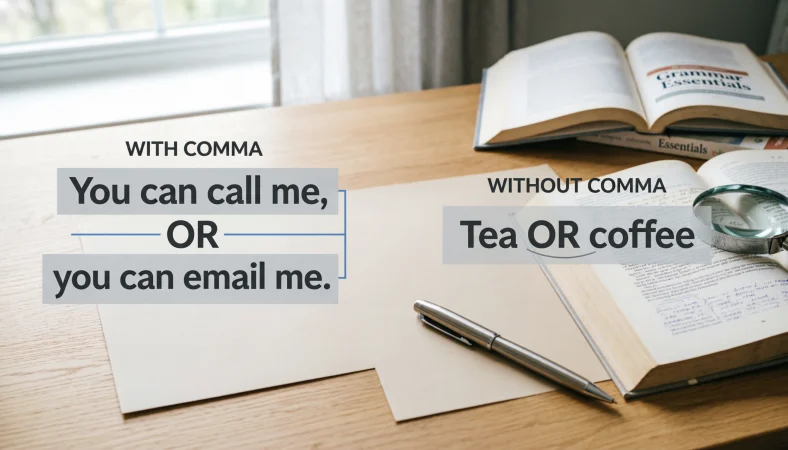
A comma before “or” is usually needed when “or” joins two independent clauses, as in “You can stay here, or you can come with us.” However, you generally don’t need a comma when “or” connects words, phrases, or short dependent parts of a sentence, such as “Would you like tea or coffee?” The choice depends on what “or” is connecting.
Wondering when to use a comma before or? This small punctuation choice can change the clarity and rhythm of a sentence, especially when “or” connects complete thoughts. Many writers either add commas where they aren’t needed or leave them out when grammar calls for one. This guide explains the rules with clear examples based on standard English punctuation conventions, helping you decide quickly and confidently when a comma belongs before “or.”
Comma Before Or: What’s the Difference?
The word or is a coordinating conjunction. It presents alternatives, choices, possibilities, or equivalent options.
A comma before or is determined mainly by the grammatical units on either side of it.
Compare these sentences:
Would you like tea or coffee?
There is no comma because or connects two nouns.
Now consider:
You can take the train, or you can drive.
Here, or connects two independent clauses. Each side contains a subject and a verb, so a comma is appropriate.
The distinction can be summarized as follows.
| Sentence structure | Example | Comma before or? | Reason |
| Two words | Choose red or blue. | No | Or connects words |
| Two phrases | We can meet today or tomorrow morning. | No | Or connects phrases |
| Two dependent clauses | If you hurry or if you wait, the result will differ. | Usually no | The clauses are not independent |
| Two independent clauses | Call me, or send an email. | Yes | Both sides can stand as sentences |
| Long or complicated alternatives | Review the figures carefully, or the final report may contain errors. | Yes | Or joins independent clauses |
| Short closely related clauses | Hurry or you will miss the bus. | Style dependent | A comma can improve clarity |
Mini recap
A comma is generally used before or when it joins two independent clauses.
No comma is normally needed when or connects individual words or phrases.
The grammatical structure matters more than the length of the sentence.
When in doubt, check whether both sides of or could stand alone as complete sentences.
Is Comma Before Or a Grammar, Vocabulary, or Usage Issue?
The comma before or question is primarily a punctuation and sentence structure issue.
It isn’t about changing the meaning of the word or. The conjunction keeps its normal function of presenting alternatives. The punctuation depends on what grammatical units or connects.
Is the comma always required before or?
No.
Consider:
Do you want pizza or pasta?
A comma would be unnecessary because or connects two nouns.
Now compare:
We can order pizza, or we can cook at home.
The comma helps separate two independent clauses.
Is the comma interchangeable with no comma?
Not always.
In some short sentences, especially when the second clause is closely connected to the first, writers may omit the comma in informal or certain stylistic contexts.
For example:
Hurry or you’ll miss the train.
This is widely accepted because the sentence is short and tightly connected.
However, the more complex the sentence becomes, the more useful the comma can be.
You should submit the application before Friday, or you may lose your opportunity to participate in the program.
The comma clearly separates the two independent clauses.
Formal versus informal usage
Formal writing generally benefits from following a consistent punctuation system.
In professional reports, academic essays, business communication, and published material, use the comma when or connects two independent clauses, especially when the clauses are long or contain internal punctuation.
Informal writing may occasionally omit a comma in short, closely connected constructions.
Academic versus casual usage
Academic writing requires particular attention to sentence structure because punctuation affects readability.
For example:
The researchers can repeat the experiment, or they can analyze the existing results.
The comma clearly separates the two alternatives.
In casual conversation, a shorter sentence may be written:
Hurry or we’ll be late.
The absence of the comma does not usually create confusion.
How to Use a Comma Before Or Between Independent Clauses
The most important rule is this:
When or joins two independent clauses, place a comma before it.
An independent clause contains a subject and a predicate and can function as a complete sentence.
Consider:
I can call you, or you can call me.
The first clause is:
I can call you.
The second clause is:
You can call me.
Each clause can stand independently. Because or joins them, the comma is appropriate.
Workplace example
We can schedule the meeting for Tuesday, or we can discuss the proposal by email.
Both sides contain their own subjects and verbs.
Academic example
Students can complete the assignment online, or they can submit a printed copy.
Again, two independent clauses are connected by or.
Technology example
You can reset your password, or you can contact technical support.
The comma makes the two complete alternatives easier to distinguish.
Usage recap
Use a comma before or when two independent clauses are connected.
A useful test is to temporarily replace or with a period. If both resulting parts can stand as complete sentences, a comma is usually appropriate.
How to Use Or Without a Comma
When or connects words or phrases rather than complete independent clauses, you normally don’t need a comma.
Examples include:
Would you like tea or coffee?
We can meet Monday or Tuesday.
She is traveling by train or bus.
You can choose the blue shirt or the green one.
In each case, or connects alternatives within the same grammatical structure.
Workplace example
Please send the document by email or through the company portal.
The alternatives are phrases, not independent clauses.
Academic example
The experiment can be conducted indoors or outdoors.
Again, no comma is needed.
Technology example
Users can log in with a password or a security key.
The conjunction connects two noun phrases.
Usage recap
Don’t insert a comma simply because or introduces another choice.
Ask what comes before and after the conjunction.
If it connects ordinary words or phrases within one clause, omit the comma in most cases.
When You Should NOT Use a Comma Before Or
Knowing when to leave the comma out is just as important as knowing when to include it.
- Do not use a comma between two ordinary nouns.
Incorrect:
Choose tea, or coffee.
Better:
Choose tea or coffee.
- Do not use a comma between two adjectives.
It was a difficult or complicated decision.
- Do not use a comma simply because the sentence contains a pause in speech.
Written punctuation follows grammatical structure rather than every natural speaking pause.
- Do not automatically place a comma before every coordinating conjunction.
Words such as and, but, and or follow structural rules.
- Do not use a comma when the second element is merely another part of the same phrase.
You can work remotely or from the office.
- Do not insert a comma because the sentence is long.
Length alone does not determine whether the comma is required.
- Do not treat every occurrence of or as connecting two clauses.
Sometimes it simply connects alternatives.
- Do not rely solely on pronunciation.
A spoken pause can help listeners process a sentence, but punctuation should be based primarily on grammatical structure and editorial convention.
Common Mistakes and Decision Rules
| Correct sentence | Incorrect sentence | Explanation |
| Would you like tea or coffee? | Would you like tea, or coffee? | Or connects two nouns |
| We can leave now, or we can wait. | We can leave now or we can wait. | The comma clearly separates two independent clauses |
| Choose the red or blue option. | Choose the red, or blue option. | Or connects adjectives |
| Call me, or send me a message. | Call me or send me a message. | The comma can separate the two complete alternatives |
| You can stay here or go home. | You can stay here, or go home. | Or connects verb phrases within one clause |
| Finish the report, or the manager may reject it. | Finish the report or the manager may reject it. | Two independent clauses are connected |
Decision Rule Box
- If or joins two independent clauses, use a comma before or.
- If or joins words or phrases within one clause, usually omit the comma.
- If both sides can stand alone as complete sentences, the comma is generally appropriate.
- If the second element cannot stand alone, the comma is usually unnecessary.
Comma Before Or in Short Sentences
Short sentences deserve special attention because writers often wonder whether a comma is necessary.
Consider:
Hurry or we’ll be late.
The second part, we’ll be late, is an independent clause. Under the standard rule for coordinating conjunctions joining independent clauses, a comma can be used:
Hurry, or we’ll be late.
The comma is grammatically defensible and can improve readability.
However, many style traditions allow flexibility in very short, closely connected constructions.
The important point is not to treat every short sentence as automatically requiring or forbidding a comma. Consider clarity, rhythm, and the style guide you’re following.
For formal writing, a comma is often the safer choice when two independent clauses are clearly connected.
Comma Before Or in Long Sentences
Longer sentences make the punctuation rule much more useful.
Compare:
You should review the contract carefully, or you may overlook an important condition that could affect the agreement later.
The first clause is:
You should review the contract carefully.
The second is:
You may overlook an important condition that could affect the agreement later.
Both are independent clauses.
The comma provides a visual boundary between the alternatives.
Without it, the sentence becomes harder to process:
You should review the contract carefully or you may overlook an important condition that could affect the agreement later.
The sentence isn’t necessarily incomprehensible, but the punctuation makes the structure easier to see.
Comma Before Or in Questions
Questions often contain or because they present alternatives.
When or simply joins options, don’t use a comma:
Would you prefer coffee or tea?
Are you going by car or train?
Should we meet today or tomorrow?
But when or connects independent clauses, a comma can be appropriate:
Should we leave now, or should we wait until the traffic clears?
Both sides have subjects and verbs.
This is a useful example because the sentence looks like a simple choice, yet its internal grammar determines the punctuation.
Comma Before Or in Academic Writing
Academic writers should pay particular attention to independent clauses.
Consider:
The study can be repeated with a larger sample, or the researchers can analyze the existing data further.
The comma separates two complete alternatives.
However:
The study can be repeated with a larger sample or a different population.
No comma is necessary because or connects two noun phrases.
This distinction can make academic prose more precise and easier to read.
A good editor doesn’t insert commas mechanically. Instead, the editor examines the structure of the sentence.
Comma Before Or in Business and Workplace Writing
Professional communication often uses or to present choices.
For example:
Please approve the request today, or the payment may be delayed.
Here, the comma separates two independent clauses.
But:
Please approve the request today or tomorrow.
No comma is needed because or connects two time expressions.
Another example:
You can contact the finance team or speak with your manager.
No comma is required because the alternatives form part of the same clause.
The practical goal is clarity. Workplace readers often scan messages quickly, so well placed punctuation can make alternatives easier to understand.
Comma Before Or in Modern Technology and AI Tools
Digital writing tools frequently evaluate commas by analyzing sentence structure.
Grammar checkers and AI writing assistants may flag missing or unnecessary commas before or, but automated suggestions aren’t always perfect.
The best approach is to understand the underlying syntax.
For example:
You can save the file or close the application.
There is no comma because or connects two verb phrases.
But:
You can save the file, or you can close the application.
Now there are two independent clauses, each with its own subject and verb.
AI systems can identify these patterns, but writers should still review automated suggestions in context. A tool may recommend a punctuation change based on a particular style preference rather than an absolute grammatical requirement.
Where Did the Comma Rule Come From?
The comma developed from a long history of punctuation systems designed to make written language easier to interpret.
Early writing often contained little punctuation. As texts became more complex, writers developed systems for indicating pauses, grammatical boundaries, and relationships between ideas.
Modern English punctuation is not based solely on how people pause when speaking. It also reflects grammatical structure, editorial conventions, and readability.
The comma before a coordinating conjunction became an established way of separating independent clauses.
This is why a sentence such as:
I wanted to go, but I was tired.
uses a comma before but.
The same structural principle applies to or:
I wanted to leave, or I could stay.
The punctuation helps readers recognize that two complete clauses are being connected.
Expert style quotation
The best comma rule is not “pause here.” It is “look at what the punctuation is separating.”
That principle is particularly valuable because spoken pauses don’t always correspond perfectly to written punctuation.
Two Practical Case Studies
Case Study 1: A professional email
Imagine a manager writing:
You can submit the report today, or you can request an extension.
The comma is useful because the sentence presents two complete alternatives.
Now compare:
You can submit the report today or tomorrow.
Here, no comma is needed because or connects two time expressions.
The concrete result is clearer workplace communication. The reader can immediately distinguish between two possible actions and two possible times.
Case Study 2: An academic paper
Suppose a researcher writes:
The participants completed the survey online, or they completed a paper version in the laboratory.
The comma separates two independent clauses.
If the researcher instead writes:
Participants completed the survey online or in the laboratory.
No comma is needed because the alternatives are integrated into one grammatical structure.
The concrete result is more efficient academic prose and punctuation that accurately reflects the sentence’s syntax.
Error Prevention Checklist
Always use a comma before or when
- Or connects two independent clauses.
- Both sides contain their own subject and verb.
- The sentence presents two complete alternatives.
- The comma improves clarity in a long sentence.
- Your chosen style guide recommends the comma for the construction.
Never use a comma before or when
- Or connects two nouns.
- Or connects two adjectives.
- Or connects two adverbs.
- Or connects two simple verb phrases.
- Or connects two short prepositional phrases within the same clause.
- The comma would unnecessarily split a single grammatical unit.
Check the sentence structure first
Before adding a comma, identify exactly what or connects.
Ask:
What comes before or?
Then ask:
What comes after or?
Finally ask:
Can both parts stand independently as complete sentences?
If the answer is yes, a comma is generally appropriate.
Comma Before Or Versus And and But
The same basic principle applies to other coordinating conjunctions.
Compare:
- I called her, and she answered.
- I called her, but she didn’t answer.
- I called her, or I sent her a message.
In all three examples, the conjunction connects independent clauses.
But compare:
I bought apples and oranges.
I wanted tea but not coffee.
You can choose apples or oranges.
Here, the conjunctions connect smaller grammatical units, so a comma isn’t normally required.
This pattern is worth learning as a general punctuation principle rather than memorizing isolated examples.
Related Grammar Confusions You Should Master
Once you understand the comma before or, several related punctuation questions become easier.
- Comma before and
- Comma before but
- Comma before so
- Comma before yet
- Comma before nor
- Comma between independent clauses
- Comma splice versus semicolon
- Commas in compound sentences
- Commas in compound predicates
- Oxford comma usage
These topics all involve understanding the relationship between sentence elements rather than simply inserting punctuation wherever a pause occurs.
FAQs
Do you put a comma before or?
Usually, you put a comma before or when it connects two independent clauses. You generally don’t use a comma when or connects individual words or phrases.
Should there be a comma before or in a sentence?
It depends on the sentence structure. In “You can stay, or you can leave,” the comma is appropriate because or joins two independent clauses. In “You can stay or leave,” no comma is needed.
Is a comma before or grammatically correct?
Yes, when or connects independent clauses. The comma helps separate the two complete grammatical units.
Do you need a comma before or in a list?
Usually, yes, when or separates the final items in a list: “Choose tea, coffee, or juice.” This final comma is called the Oxford comma and depends on the style you follow.
Should I use a comma before or in a question?
Use a comma before or when it joins two independent clauses, but not when it simply connects alternatives. For example, “Are you taking the train or the bus?” needs no comma, while “Are you taking the train, or are you driving?” does.
Is there always a comma before or?
No. This is one of the most common misconceptions. The presence of or does not automatically require a comma.
Do you put a comma before or after a phrase?
The answer depends on what or connects. If it joins independent clauses, a comma normally comes before or. If it connects words or phrases, no comma is usually required.
Is “Hurry, or you will be late” correct?
Yes. The comma is appropriate because or connects two independent clauses: “Hurry” and “you will be late.” The comma also helps communicate the relationship between the action and its consequence.
Should there be a comma before or in “either or” sentences?
Usually not when either and or connect parallel words or phrases. For example: “You can either stay or leave.” Longer structures may need punctuation for clarity.
What is the easiest way to know whether a comma goes before or?
Look at the material on both sides of or. If it connects two complete independent clauses, use a comma in standard formal writing. If it connects words or phrases within one clause, omit the comma.
Final Verdict:
The rule for a comma before or becomes much easier when you stop thinking about or as a punctuation trigger and start looking at sentence structure.
Use a comma when or joins two independent clauses:
You can call me, or you can send an email.
Don’t normally use one when or connects words or phrases:
You can call me or send an email.
The key question is simple: What is or connecting?
If it connects two complete sentences, a comma is generally appropriate. If it connects smaller parts of the same sentence, the comma is usually unnecessary.
Once you understand that distinction, you’ll be able to handle commas before or confidently in academic writing, workplace communication, online content, and everyday English.











1 thought on “Do You Put A Comma Before “Or”? Simple Grammar Rules & Examples For 2026”