A forester is a person who manages, protects, studies, or works with forests and woodland resources. A gatherer is a person who collects things, often from nature or from a particular place. The two words describe different roles, so choosing between them depends on whether the emphasis is forest management or collecting resources.
The question forester or gatherer can be confusing because both words may describe people who spend time outdoors and interact with natural resources. However, they are not interchangeable. A forester has a specialized relationship with forests, while a gatherer is defined by the act of collecting.
That distinction becomes especially important in historical writing, anthropology, ecology, fantasy settings, games, occupational descriptions, and discussions of traditional societies. Calling someone a gatherer emphasizes what the person collects. Calling someone a forester emphasizes their professional or practical relationship with woodland and forest management.
Understanding the difference also helps prevent a common vocabulary mistake: assuming that two words must be synonyms simply because they can describe people working in similar environments. Their meanings overlap in some situations, but their central ideas are different.
Forester vs Gatherer: What’s the Difference?
The simplest distinction is this: forester identifies a person’s relationship with forests, while gatherer identifies a person’s activity of collecting.
A forester is a noun referring to a person involved in managing, studying, protecting, cultivating, or otherwise working professionally with forests and woodland resources. The term can also have broader historical or occupational meanings.
A gatherer is a noun referring to someone who gathers or collects something. The object being collected could be food, plants, firewood, information, materials, or other resources.
| Word | Part of speech | Basic meaning | Main emphasis | Typical context |
| Forester | Noun | A person who works with or manages forests | Forests and woodland | Forestry, conservation, land management |
| Gatherer | Noun | A person who collects things | Collection or harvesting | Food gathering, natural resources, anthropology |
| Forestry | Noun | The science and practice of managing forests | Forest management | Environmental and professional contexts |
| Gathering | Noun | The act of collecting | Collection | Everyday, historical, and ecological contexts |
| Forest management | Noun phrase | Planned care and use of forest resources | Stewardship | Professional and environmental contexts |
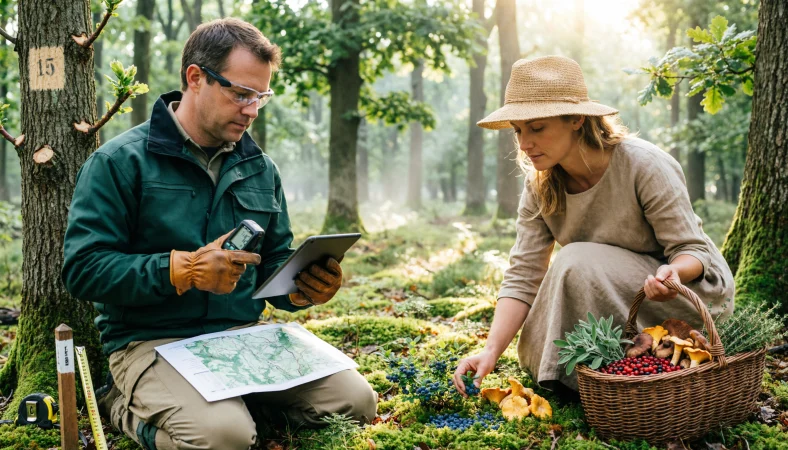
A forester might supervise the health of an entire woodland.
A gatherer might collect berries growing within that woodland.
A person could theoretically be both, but the words would describe different aspects of that person’s activity.
The key distinction is occupation or relationship versus activity.
Is Forester vs Gatherer a Grammar, Vocabulary, or Usage Issue?
This is primarily a vocabulary and meaning issue, rather than a grammar problem.
Both words are nouns, and both can refer to people. Their grammatical behavior is therefore similar. The difference lies in what each noun communicates.
Consider these sentences:
The forester inspected the woodland after the storm.
The sentence tells us something about the person’s role. The person is associated with forest management or forestry.
Now consider:
The gatherer collected mushrooms before sunset.
This sentence tells us what the person was doing. The defining action is collecting.
The words cannot normally be substituted without changing the meaning.
Are forester and gatherer interchangeable?
No. They are not generally interchangeable.
A forester can gather materials, but that does not make forester a synonym for gatherer.
Likewise, a gatherer could work in a forest, but that does not automatically make the person a forester.
Formal versus informal usage
Forester is often associated with a professional or specialized context. It appears in discussions of forestry, conservation, woodland management, environmental science, and land use.
Gatherer is more general. It can appear in ordinary descriptions, historical discussions, anthropology, archaeology, and descriptions of people collecting natural resources.
Academic versus casual usage
Academic writing often uses forester when discussing forest professionals or forest management.
For example:
The forester evaluated the effects of drought on the woodland.
A historical or anthropological discussion may use gatherer:
The community relied on hunters and gatherers for part of its food supply.
In casual writing, either word can be appropriate as long as the intended meaning is clear.
How to Use Forester Correctly
The word forester is most appropriate when the person has a meaningful professional, occupational, or specialized connection to forests.
A forester may assess tree health, develop management plans, monitor forest ecosystems, advise landowners, support conservation programs, or oversee sustainable timber production.
Workplace example
The forester prepared a management plan for the company’s woodland property.
Here, forester is clearly an occupation. The person has expertise in forest management.
Academic example
The researchers interviewed a forester about the long term effects of invasive species.
The word works because the discussion concerns specialized knowledge about forests.
Technology example
Modern forestry increasingly uses technology such as geographic information systems, satellite imagery, drones, remote sensing, and digital forest inventories.
For example:
The forester used satellite imagery to identify areas of declining tree health.
The technology does not change the definition of forester. Instead, it shows how the profession has evolved.
Usage recap
Use forester when the person is associated with forest management, forestry, conservation, woodland science, or a related profession. The word emphasizes expertise and relationship to forests rather than simple collection.
How to Use Gatherer Correctly
Gatherer focuses on collecting.
The word can describe someone who gathers natural food, plants, wood, materials, objects, or other resources. Its meaning is broader than forestry.
Workplace example
The mushroom gatherer supplied several restaurants with locally collected mushrooms.
The person’s defining activity is collecting mushrooms.
Academic example
Archaeologists have studied how early hunter gatherer communities obtained food.
Here, gatherer refers to a person who obtains resources through gathering rather than through hunting alone.
Technology example
Gathering can also happen in modern technological environments.
For example:
The data gatherer collected information from several databases.
The person does not need to work in a forest. The underlying concept remains collection.
Similarly, a digital system could be described informally as a data gatherer when it collects information from multiple sources, although technical documentation may use terms such as data collection system, data aggregator, or data collector instead.
Usage recap
Use gatherer when the central idea is collecting something. The thing being gathered determines the context, whether that involves food, plants, materials, information, or other resources.
When You Should NOT Use Forester or Gatherer
Knowing when not to use these words can prevent subtle vocabulary errors.
1. Do not use forester simply because someone enters a forest
A person hiking through a forest is not necessarily a forester.
Incorrect: The tourist was a forester because he walked through the woodland.
Being in a forest does not establish a forestry occupation.
2. Do not use gatherer when you mean a forestry professional
If someone manages woodland resources professionally, forester is usually more precise.
The forester assessed the condition of the trees.
Calling that person merely a gatherer would remove the professional meaning.
3. Do not assume every person collecting plants is a forester
A person collecting herbs in a woodland may be a gatherer, forager, botanist, researcher, or another type of worker.
The correct word depends on the person’s role.
4. Do not use gatherer to describe forest management
Gathering wood is one activity. Managing a forest is much broader.
A forester may make decisions about regeneration, conservation, harvesting, biodiversity, and long term forest health.
5. Do not treat the words as exact synonyms
Their meanings overlap only in particular circumstances.
Someone can gather forest products without being a forester.
6. Do not use forester as a general word for outdoor worker
Outdoor workers have many different occupations. A person might be a park ranger, ecologist, arborist, logger, conservation worker, or forester.
7. Do not use gatherer when the collection is incidental
If a forester collects leaves during a scientific survey, the person’s principal role may still be that of a forester.
The context determines which characteristic deserves emphasis.
Common Mistakes and Decision Rules
| Correct sentence | Incorrect sentence | Explanation |
| The forester managed the woodland. | The gatherer managed the woodland. | Forest management is associated with forestry. |
| The gatherer collected wild berries. | The forester collected wild berries. | The second sentence changes the emphasis unless the person is actually a forester. |
| The forester studied tree health. | The gatherer studied tree health. | Tree health research can be part of forestry. |
| The gatherer collected edible plants. | The forester collected edible plants. | Gathering is the central activity. |
| The forester developed a conservation plan. | The gatherer developed a conservation plan. | Conservation planning is consistent with professional forestry. |
| The gatherer collected firewood. | The forester collected firewood. | The latter is possible but does not communicate the same role. |
Decision Rule Box
If you mean a person whose role involves managing, studying, protecting, or working professionally with forests, use forester.
If you mean a person whose defining activity is collecting something, use gatherer.
A useful mental shortcut is:
Forester equals forest role.
Gatherer equals collecting role.
Forester and Gatherer in Modern Technology and AI Tools
Modern technology has made both concepts broader in practical application.
Foresters increasingly work with digital mapping, satellite observations, geographic information systems, aerial imagery, environmental sensors, and predictive models. These technologies help professionals monitor forest conditions across large areas.
Gathering has also become a major concept in information technology. Software can gather data from multiple sources, while researchers can gather evidence from databases, surveys, sensors, and online resources.
Artificial intelligence adds another layer. An AI system may gather information from documents or databases, but describing the system as a gatherer is usually metaphorical or informal unless the technical context defines the term.
The important distinction remains unchanged. Technology changes how people perform their work, but it does not erase the basic semantic difference between the words.
The Etymology of Forester and Gatherer
Understanding word origins can make the distinction easier to remember.
Forester is related to the word forest, which ultimately traces back through Old French forest and Medieval Latin forestis. The historical development of the word is connected with wooded land and areas outside settled or cultivated territory.
The suffix er commonly forms nouns describing people associated with an activity or occupation. Thus, forester developed as a word for someone associated with forests.
Gatherer comes from the verb gather, an old Germanic word with the basic sense of bringing things together or collecting them. Adding er creates a noun referring to someone who performs the action.
The word structures themselves therefore provide a useful memory aid.
Forest + er = person associated with forests.
Gather + er = person who gathers.
A Linguistic Perspective on the Difference
A useful way to understand these words is to ask what information the noun foregrounds.
Forester foregrounds a domain.
Gatherer foregrounds an activity.
This is similar to many English occupational nouns. A farmer is associated with farming. A teacher is associated with teaching. A collector is associated with collecting.
The important point is that nouns ending in er do not always describe exactly the same type of relationship. Sometimes the noun identifies a profession, while in other cases it describes someone performing a particular action.
That is why context matters.
A person who gathers mushrooms in a forest is a gatherer because gathering is the relevant activity. If that person is also a professional responsible for managing the woodland, forester may describe another part of their role.
The two labels can therefore coexist without being synonyms.
Two Practical Case Studies
Case Study 1: Forest management
Imagine a woodland organization responsible for maintaining thousands of acres of forest. Its staff inspect trees, monitor disease, plan harvesting, protect biodiversity, and evaluate regeneration.
The appropriate occupational term is forester.
Even if employees occasionally collect samples, seeds, or fallen material, those activities do not redefine their profession.
The central responsibility is forest management.
Case Study 2: Wild food collection
Now imagine a person who walks through woodland collecting mushrooms, berries, nuts, and edible plants for personal use.
The central activity is gathering.
Calling this person a gatherer is therefore appropriate. Calling the person a forester would suggest a professional relationship with forest management that the description does not establish.
These examples show why choosing the right noun requires attention to the person’s primary role rather than simply their physical location.
Error Prevention Checklist
Always use forester when
- The person manages forests.
- The person studies forest ecosystems professionally.
- The person works in forestry.
- The person develops woodland management plans.
- The person specializes in forest conservation.
- The person’s occupation centers on woodland resources and management.
Always use gatherer when
- The person collects natural resources.
- The person collects food from the wild.
- The person gathers plants or berries.
- The person’s primary activity is collecting materials.
- The context describes gathering as an economic or subsistence activity.
- The person collects information or objects in a broader nonforestry context.
Never assume
- Never assume that someone is a forester merely because they work outdoors.
- Never assume that someone is a gatherer merely because they collect something occasionally.
- Never treat the two words as exact synonyms.
Always consider what role or activity the sentence is emphasizing.
Related Vocabulary Confusions You Should Master
If you’re building stronger vocabulary skills, these comparisons are useful alongside forester or gatherer:
- Forester or arborist
- Forester or logger
- Gatherer or collector
- Gatherer or forager
- Hunter or gatherer
- Forest or woodland
- Conservationist or environmentalist
- Botanist or horticulturist
- Logger or lumberjack
- Collector or curator
These pairs illustrate an important principle in English vocabulary: words can occupy similar semantic territory without having identical meanings.
FAQs
What is the difference between a forester and a gatherer?
A forester works with forest management, conservation, or forestry, while a gatherer collects things. A person can be both, but the terms emphasize different roles.
Is a forester the same as a gatherer?
No. A forester and a gatherer are not synonyms. A forester is defined by a relationship with forests and forestry, while a gatherer is defined by the activity of collecting.
What does a forester do?
A forester may manage forests, assess tree health, plan woodland use, support conservation, monitor ecosystems, advise landowners, and oversee sustainable forest practices.
What does a gatherer do?
A gatherer collects resources or materials. Depending on context, this may include berries, mushrooms, plants, firewood, food, objects, or information.
Can a forester also be a gatherer?
Yes. A forester may gather samples, seeds, plants, or other materials as part of their work. However, forester describes the person’s professional relationship with forestry, while gatherer describes the collection activity.
Is gatherer a professional term?
It can be. The word may describe an occupation or economic activity, particularly in historical, anthropological, ecological, and natural resource contexts. In other situations, it can simply describe someone who collects something.
What is another word for forester?
Depending on context, related terms include forestry professional, forest manager, woodland manager, or forestry specialist. These terms are not always exact substitutes because each can emphasize a slightly different responsibility.
What is another word for gatherer?
Depending on context, possible alternatives include collector, forager, picker, or harvester. The appropriate alternative depends on what is being collected and why.
Is a person who collects plants a forester?
Not necessarily. A person who collects plants could be a gatherer, forager, botanist, researcher, herbalist, or another specialist. The word forester requires a meaningful connection to forestry or forest management.
Which word should I use in a historical context?
Use gatherer for people collecting food or natural resources, and forester for people responsible for forests, woodland resources, or forest management.
Conclusion:
The difference between forester or gatherer becomes straightforward once you focus on what each noun emphasizes. Forester describes a person whose role, profession, or expertise is connected with forests and their management. Gatherer describes a person whose defining activity is collecting something.
A forester may gather resources, but gathering is not what makes someone a forester. A gatherer may work in a forest, but being in a forest does not make someone a forester.
When you’re unsure, ask one simple question: Is the sentence emphasizing the person’s relationship with forests, or what the person is collecting? If the focus is forestry, choose forester. If the focus is collection, choose gatherer.
That small distinction makes your writing more precise, especially in academic, historical, environmental, and professional contexts.