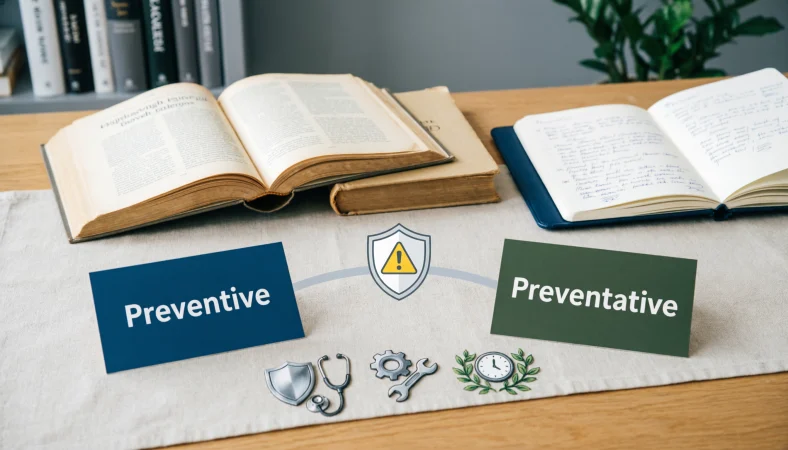
Preventive and preventative are both correct English adjectives meaning intended to stop something undesirable before it happens. Preventive is generally shorter and more common, especially in American English, while preventative is also standard and widely used. The choice is usually a matter of style, regional preference, and established usage rather than grammatical correctness.
If you have ever wondered whether to write “preventive care” or “preventative care,” you’re dealing with a genuine English usage question. Both forms describe something designed to prevent a problem, disease, accident, or other unwanted event before it occurs.
The confusion matters because word choice can affect tone, consistency, and perceived professionalism. In medical writing, workplace documents, academic papers, and public information, writers often want the form that sounds natural to their intended audience.
The short answer is straightforward: both forms are correct. However, they aren’t equally common in every context. Preventive is especially common in American English and appears frequently in established expressions such as preventive medicine and preventive maintenance. Preventative is also legitimate English, and many speakers use it naturally.
Understanding the difference helps you make a deliberate choice instead of treating one form as a spelling mistake.
Preventive or Preventative: What’s the Difference?
Both words function primarily as adjectives. They describe something intended to prevent an undesirable event or condition.
| Feature | Preventive | Preventative |
| Part of speech | Adjective | Adjective |
| Basic meaning | Intended to prevent something | Intended to prevent something |
| Grammatical status | Correct | Correct |
| Meaning | Essentially the same | Essentially the same |
| Common in American English | Very common | Less common |
| Common in British English | Common | Also established |
| Typical examples | Preventive care, preventive measures | Preventative care, preventative measures |
| Formal writing | Fully acceptable | Fully acceptable |
The central point is that neither form is inherently wrong.
Preventive is the more economical form.
Preventative has an additional syllable but follows a familiar pattern in English.
In ordinary usage, the two words generally communicate the same idea.
Your choice can therefore depend on audience, region, house style, and the expression you’re using.
Is Preventive or Preventative a Grammar, Vocabulary, or Usage Issue?
This is primarily a vocabulary and usage issue, not a grammar problem.
A grammar error occurs when a word is used in a way that violates the grammatical structure of a language. That isn’t what happens here. Both preventive and preventative can function correctly as adjectives.
The difference is more closely related to usage frequency and stylistic preference.
Are Preventive and Preventative Interchangeable?
In most situations, yes.
Consider these sentences:
The doctor recommended preventive treatment.
The doctor recommended preventative treatment.
Both sentences communicate essentially the same idea.
Likewise:
Regular inspections are an important preventive measure.
Regular inspections are an important preventative measure.
Again, the meaning remains virtually unchanged.
There can be differences in frequency depending on the variety of English and the particular expression. Some phrases have become especially conventional with preventive.
For example, preventive maintenance is a very established technical expression. Replacing it with preventative maintenance isn’t necessarily incorrect, but preventive may sound more familiar to many readers.
Formal Versus Informal Usage
Neither word is restricted to informal English.
Preventive is common in professional, medical, technical, and academic writing. Preventative can also appear in formal writing and isn’t automatically considered conversational or incorrect.
The important distinction is consistency.
If an organization consistently uses preventive in its documents, switching randomly between preventive and preventative can make the writing feel less polished.
Academic Versus Casual Usage
Academic writers often favor preventive because it is concise and widely established in technical terminology.
That doesn’t make preventative unsuitable for academic writing. A researcher can use preventative correctly, particularly if the term is common within a particular field or regional variety.
When writing for an international audience, preventive may be the safer default because it is concise and broadly recognizable.
How to Use Preventive Correctly
Preventive is the shorter and often more frequently preferred form.
It describes actions, measures, treatments, systems, or strategies designed to stop something before it happens.
Workplace Example
The company introduced preventive maintenance procedures for all production equipment.
Here, preventive describes maintenance performed to reduce the likelihood of equipment failure.
Another example is:
Managers received training on preventive safety measures.
The measures are intended to stop accidents or other problems before they occur.
Academic Example
The study examined the effectiveness of preventive interventions in reducing infection rates.
The adjective describes interventions intended to prevent infections.
Technology Example
The software uses preventive security controls to reduce the risk of unauthorized access.
The controls are implemented before a security problem occurs.
Usage Recap
Use preventive when you want a concise, conventional adjective meaning intended to prevent something.
It is particularly natural in established expressions such as preventive care, preventive medicine, preventive maintenance, and preventive measures.
How to Use Preventative Correctly
Preventative is also a standard adjective. It has the same fundamental meaning as preventive.
The additional syllable doesn’t make it grammatically incorrect.
Workplace Example
The company developed preventative procedures to reduce workplace accidents.
The procedures are designed to address potential problems before they happen.
Academic Example
Researchers evaluated several preventative strategies for reducing long term health risks.
The word describes strategies that have a preventive purpose.
Technology Example
The system includes preventative controls designed to identify problems before they affect users.
The adjective is grammatically sound and understandable in a technical context.
Usage Recap
Preventative is perfectly acceptable when it fits the writer’s preferred variety of English or the terminology used by an organization.
It shouldn’t be treated as a misspelling of preventive.
When You Should NOT Use Preventive or Preventative
There are situations where choosing either word may be inappropriate because the intended meaning is different.
1. When Something Happens After the Problem
If an action is taken after damage has already occurred, preventive may not be the right description.
For example:
The technician repaired the damaged machine.
Calling the repair preventive would be misleading because the repair addresses an existing problem.
2. When You Mean Detection Rather Than Prevention
Detection and prevention aren’t identical.
A monitoring system may detect a problem without actually preventing it.
The sensor detects overheating.
This doesn’t necessarily mean the sensor prevents overheating.
3. When You Mean Treatment of an Existing Condition
A treatment can address an existing condition rather than prevent one.
The context matters, particularly in healthcare.
4. When You Mean a Result Rather Than an Intention
Preventive and preventative describe purpose.
They don’t simply mean that something happened successfully.
5. When a Technical Term Has an Established Form
Some industries strongly favor particular expressions.
If your organization’s technical documentation consistently uses preventive maintenance, follow that established terminology.
6. When Consistency Matters More Than Personal Preference
Don’t alternate between preventive and preventative without a reason.
A consistent style generally looks more professional.
7. When the Sentence Needs a Different Part of Speech
Neither word should be forced into a noun or verb role.
For example, write:
Prevention is important.
rather than attempting to use preventive as a noun.
8. When You Actually Mean Preventing a Specific Action
Sometimes the clearer construction is simply designed to prevent.
For example:
The policy is designed to prevent data loss.
This may be clearer than choosing between preventive and preventative.
Common Mistakes and Decision Rules
| Correct sentence | Incorrect sentence | Explanation |
| The patient received preventive care. | The patient received prevention care. | Preventive correctly modifies care. |
| The company scheduled preventive maintenance. | The company scheduled prevent maintenance. | Preventive is the adjective form. |
| The policy contains preventative measures. | The policy contains preventative measure. | The plural noun requires the appropriate plural form. |
| Preventive action can reduce risk. | Preventative action can reduces risk. | The adjective is not responsible for verb agreement. |
| The system uses preventive controls. | The system uses preventive controlled. | Controls is the noun being modified. |
| The program focuses on prevention. | The program focuses on preventive. | Prevention is the noun needed here. |
Decision Rule Box
- If you mean something intended to stop a problem before it happens, either preventive or preventative can work.
- If you need the shorter, widely established form, choose preventive.
- If preventative fits your regional or organizational style, it is also correct.
Preventive or Preventative in Modern Technology and AI Tools
Modern technology has expanded the contexts in which these words appear.
Cybersecurity teams discuss preventive controls, preventive security measures, and preventive monitoring. Software systems may attempt to identify risks before they develop into failures.
Artificial intelligence introduces similar concepts. An AI system might be used for predictive maintenance, fraud prevention, automated risk assessment, or anomaly detection.
It’s useful to distinguish predictive from preventive.
Predictive systems attempt to forecast what might happen. Preventive systems or measures are concerned with stopping an undesirable event.
For example:
The AI model predicts equipment failure.
This describes prediction.
The maintenance team takes preventive action.
This describes intervention intended to avoid the failure.
AI tools can therefore support preventive strategies without making preventive and predictive synonyms.
The Etymology of Preventive and Preventative
Both forms are connected to the verb prevent, which ultimately traces back through French to Latin roots associated with coming before.
Prevent entered English with the idea of acting before something else. That underlying concept remains central to modern meanings.
Preventive developed naturally as an adjective meaning intended to prevent.
Preventative developed as a longer variant, influenced by the familiar pattern of words ending in “ative.” English has many cases in which alternative adjective forms coexist.
The existence of the longer form doesn’t make it a modern invention or an accidental spelling error. Preventative has a long history of use in English.
What Experts Mean When They Prefer Preventive
A useful way to think about the distinction is:
“The important difference is usually not meaning but convention.”
That principle is valuable for editors and professional writers. When two forms have the same meaning and both are grammatically established, frequency and context can matter more than a simplistic right or wrong judgment.
A professional editor might therefore choose preventive for a medical article intended for a broad American audience while retaining preventative if it matches an organization’s established terminology.
Two Practical Case Studies
Case Study 1: Medical Communication
Imagine a healthcare organization preparing patient information for an American audience.
The organization has repeatedly used expressions such as preventive care, preventive screening, and preventive medicine across its website and printed materials.
Choosing preventive throughout creates terminology consistency.
If individual pages alternate between preventive and preventative, readers won’t necessarily misunderstand the information, but the organization’s editorial voice becomes less consistent.
The concrete result is a cleaner terminology system and easier editorial management.
Case Study 2: Industrial Maintenance
Consider a manufacturing company documenting equipment maintenance procedures.
Its maintenance manual uses the established phrase preventive maintenance throughout.
If a later section suddenly changes to preventative maintenance, the technical meaning remains clear. However, terminology consistency has been lost.
Standardizing the manual on preventive maintenance gives engineers, technicians, editors, and translators one consistent expression to follow.
The result is clearer documentation and fewer unnecessary style decisions.
Authoritative Usage: What Really Matters
The most important lesson isn’t that one word is correct and the other is wrong.
It is that preventive and preventative are both legitimate adjectives.
Preventive is often the better default when you want concise, widely recognized wording. Preventative remains acceptable when it fits your regional preference, institutional style, or established terminology.
Good editing isn’t about eliminating every variation. It’s about choosing deliberately.
Error Prevention Checklist
Always use preventive when
- You want the concise form.
- You are writing for a broad American audience.
- You are using an established expression such as preventive maintenance.
- You want straightforward technical or professional wording.
- Your organization’s style guide prefers it.
Never treat preventative as automatically wrong when
A British or international audience uses it naturally.
A speaker or writer has selected it as a legitimate variant.
An established organizational style uses it.
The context is formal and the word accurately means intended to prevent something.
The important rule is simple: don’t mark preventative as an error merely because preventive is more familiar to you.
Related Grammar Confusions You Should Master
Understanding preventive and preventative becomes easier when you recognize similar English variation.
Here are several useful comparisons to study:
- Toward or towards
- Forward or forwards
- Backward or backwards
- Among or amongst
- While or whilst
- Learned or learnt
- Burned or burnt
- Labeled or labelled
- Catalog or catalogue
- Specially or especially
These pairs often involve regional preference, historical development, frequency, or differences in style rather than a simple correct versus incorrect distinction.
FAQs
Is preventive or preventative correct?
Both are correct. They are adjectives meaning intended to prevent something before it happens. Preventive is often more common, particularly in American English, while preventative is also a legitimate and established form.
Is preventative a real word?
Yes. Preventative is a genuine English adjective with a long history of usage. It should not automatically be classified as a misspelling of preventive.
Is preventive more correct than preventative?
No. Preventive is often preferred because it is shorter and highly conventional, but preventative is not grammatically incorrect.
Which is more common, preventive or preventative?
Preventive is generally more common in many modern contexts, particularly American professional and medical writing. Usage can vary by region, field, and individual preference.
Should I write preventive care or preventative care?
Both expressions are grammatically possible. Preventive care is a particularly well established expression and is often the safest choice for concise professional writing.
Should I write preventive maintenance or preventative maintenance?
Both can be understood correctly, but preventive maintenance is an especially established technical expression. If you are following an existing technical style, use the form already adopted by your organization.
Is preventative British English?
Preventative is used in British English, but it isn’t exclusively British. It also appears in American and other varieties of English. The form has broad historical usage.
Is preventive more formal than preventative?
Not necessarily. Both can appear in formal writing. Preventive may sound more concise and conventional in professional contexts, but preventative is not inherently informal.
Can preventive and preventative be used interchangeably?
In most ordinary contexts, yes. Both describe something intended to prevent an undesirable event. Certain established expressions may strongly favor one form in particular varieties or professional fields.
How do I remember which one to use?
Think about your audience and the expression you’re writing. If you want a concise default, choose preventive. If preventative is the established form in your organization or regional variety, it can be used confidently.
Conclusion:
The debate over preventive and preventative is much less complicated once you separate grammar from usage. Both words are valid adjectives, and both mean something intended to prevent a problem before it occurs.
Preventive is usually the strongest default because it is concise, common, and firmly established in professional expressions such as preventive care and preventive maintenance. Preventative is also correct and may be preferred in certain regional or organizational contexts.
So, when deciding between preventive or preventative, don’t ask only which word is “right.” Ask which form best fits your audience, field, regional variety, and established style. That approach produces clearer and more confident writing.