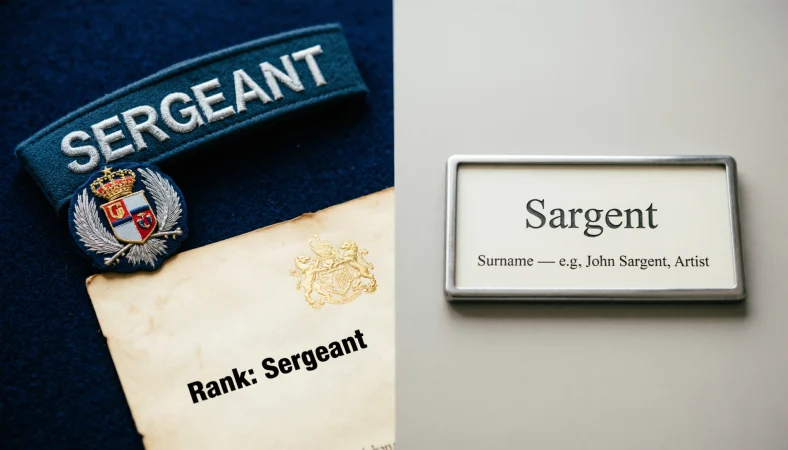
Sargent or sergeant is a common spelling confusion involving a military and law enforcement rank. The correct spelling for the rank is sergeant, pronounced roughly “SAR jint.” Sargent is generally an incorrect spelling when referring to the rank, although Sargent can appear as a legitimate surname. Knowing the difference helps prevent errors in formal writing.
If you have ever wondered whether the correct spelling is sargent or sergeant, the answer is straightforward: sergeant is the standard spelling for the military, police, or organizational rank. Sargent is usually a misspelling in that context, although it can be a genuine family name.
This confusion is understandable because the pronunciation of sergeant does not closely match its spelling. The word contains an unusual vowel pattern, and its pronunciation can make sargent seem perfectly reasonable. That is especially true for people encountering the word primarily through conversation rather than reading.
X vs Y: What’s the Difference?
The key distinction between sergeant and Sargent is their status and meaning. Sergeant is a common noun used for a rank or title. Sargent is usually a proper surname. When you’re talking about a member of the military or police who holds the rank, sergeant is the correct spelling.
| Word | Part of speech | Meaning | Typical use | Correct for the rank? |
| sergeant | Noun | A military, police, or organizational rank | Military, police, formal writing | Yes |
| Sargent | Proper noun | A family name | Personal names and surnames | No |
Consider these examples:
- Correct: The army sergeant addressed the recruits.
- Correct: The police sergeant arrived at the scene.
- Correct: Sergeant Davis reviewed the report.
- Correct: Ms. Sargent submitted the application.
Incorrect for the rank: The army sargent addressed the recruits.
The important point is that the two spellings aren’t simply alternative versions of the same word. They belong to different categories.
Why Does “Sergeant” Look So Different From How It Sounds?
English spelling contains many words whose written forms preserve historical pronunciations, foreign influences, or older forms of the language. Sergeant is one of them.
In modern English, the word is commonly pronounced something like SAR jint. The spelling, however, retains letters that don’t make the pronunciation immediately obvious to many learners.
This is why people sometimes write sargent. They’re often spelling the word according to how they hear it.
Quick Recap
Sergeant is the correct spelling for the rank.
Sargent is generally a surname rather than the name of a rank.
The pronunciation of sergeant makes its spelling unusually difficult.
In military and police writing, use sergeant.
Is X vs Y a Grammar, Vocabulary, or Usage Issue?
The confusion between sargent and sergeant is primarily a spelling and vocabulary issue, rather than a grammar issue.
Grammar determines how words function in sentences. Here, the main problem is choosing the correct written form of a particular word. Someone can understand the meaning perfectly and still spell sergeant incorrectly.
The two forms are therefore not interchangeable.
If you are writing about a military rank, police rank, or similar position, use sergeant. If you are referring to someone whose surname is Sargent, then Sargent may be correct because it is that person’s family name.
Formal vs Informal Usage
There is no informal version of the military rank spelled sargent. In casual writing, texting, or conversation, people may make the spelling mistake, but that does not make it an accepted variant.
For example:
The sergeant called everyone into the room.
The spelling remains sergeant, whether the sentence appears in a formal report, a text message, a novel, or casual correspondence.
Academic vs Casual Usage
Academic writing should always use sergeant when referring to the rank. The same applies to journalism, legal documents, historical writing, biographies, military records, and professional correspondence.
Casual writing may contain spelling mistakes, but sargent should not be treated as a standard alternative spelling.
How to Use “Sergeant” Correctly
The word sergeant is used primarily as a noun. It identifies a rank or someone holding that rank.
The exact responsibilities of a sergeant vary depending on the organization. Military organizations, police departments, and other uniformed services can use the title in different ways.
Workplace Example
Imagine a police department where a supervisor holds the rank of sergeant.
Correct:
The sergeant reviewed the officers’ reports before the meeting.
Here, sergeant identifies the person’s professional rank.
A similar sentence could appear in an organizational setting:
The senior sergeant coordinated the team’s daily assignments.
The spelling remains unchanged.
Academic Example
Historical and academic writing frequently discusses military ranks.
Example:
The sergeant played an important role in training the new recruits.
A history paper might also say:
The study examines how the responsibilities of a sergeant changed during the twentieth century.
In both cases, sergeant is the appropriate spelling.
Technology Example
Technology does not change the spelling of the rank.
Suppose a personnel management system contains an employee’s position:
Rank: Sergeant
Or a database stores:
Position: Police Sergeant
The correct form is still sergeant.
Automated systems, search engines, writing applications, and AI tools may recognize sargent as a likely misspelling, but they should not be used as a substitute for understanding the underlying distinction.
Usage Recap
Use sergeant when referring to the rank.
Use Sargent when it is someone’s actual surname.
Do not use sargent as an informal spelling of the rank.
How to Use “Sargent” Correctly
Although sargent is normally incorrect as a spelling of the rank, Sargent can be perfectly legitimate as a proper name.
A surname is different from a common noun. If someone’s family name is Sargent, changing it to Sergeant would be an error.
Workplace Example
Mr. Sargent will attend the meeting this afternoon.
Here, Sargent is a person’s surname.
Academic Example
The Sargent family has a long history in the region.
Again, Sargent functions as a proper noun.
Technology Example
A computer system might contain:
Account holder: James Sargent
The spelling should remain exactly as the person’s name is written.
This distinction is particularly important in official documents. Names should not be automatically corrected merely because they resemble misspellings of other words.
Usage Recap
Sargent can be correct when it is a person’s surname.
It is not the standard spelling of the military or police rank.
Always consider whether you’re naming a person or describing a position.
When You Should NOT Use Sargent or Sergeant
Knowing when not to use each form can make the distinction much easier.
1. Do Not Write “Sargent” for a Military Rank
If you mean the rank, write:
The sergeant spoke to the soldiers.
Not:
The sargent spoke to the soldiers.
2. Do Not Change Someone’s Surname
If someone’s name is Sargent, don’t automatically change it to Sergeant.
Dr. Sargent published the study.
This is perfectly acceptable if Sargent is the person’s actual surname.
3. Do Not Treat “Sargent” as a Casual Variant
You may encounter the spelling sargent online, but frequent use does not make it a standard spelling for the rank.
4. Do Not Assume Pronunciation Determines Spelling
The pronunciation of sergeant can encourage phonetic spelling. English contains many words where pronunciation alone isn’t enough to determine the written form.
5. Do Not Use “Sergeant” as a Person’s Name Without Evidence
If someone is named Sargent, preserve the surname. Don’t replace it simply because you think the person meant the rank.
6. Do Not Ignore Capitalization
When sergeant is used generically, it is normally lowercase:
The sergeant entered the room.
When it forms part of a formal title before a person’s name, capitalization may be appropriate depending on the style and context:
Sergeant Miller gave the briefing.
7. Do Not Assume Every Similar Looking Word Is Related
A spelling similarity does not necessarily mean two forms have the same grammatical function or history.
Common Mistakes and Decision Rules
| Correct sentence | Incorrect sentence | Explanation |
| The sergeant inspected the equipment. | The sargent inspected the equipment. | The rank is spelled sergeant. |
| Sergeant Brown led the briefing. | Sargent Brown led the briefing. | The military or police title uses sergeant. |
| Ms. Sargent called the office. | Ms. Sergeant called the office. | Sargent may be a legitimate surname. |
| The police sergeant filed the report. | The police sargent filed the report. | The rank requires the spelling sergeant. |
| Mr. Sargent teaches history. | Mr. Sergeant teaches history. | A person’s surname should not be altered. |
| The sergeant trained the recruits. | The sargent trained the recruits. | Sargent is not the standard spelling of the rank. |
Decision Rule Box
If you mean the military, police, or organizational rank, use “sergeant.”
If you mean a person’s family name, use “Sargent” only when that is the person’s actual surname.
A useful memory trick is to connect sergeant with service. Both words begin with the letters ser. The trick isn’t an etymological rule, but it can help reinforce the correct spelling.
Pronunciation of “Sergeant”
One reason this spelling is so troublesome is pronunciation.
In many varieties of English, sergeant is pronounced approximately SAR jint. The first part sounds similar to “sar,” while the ending resembles “jint.”
This creates a large gap between spelling and pronunciation.
You might hear:
“SAR jint”
and naturally wonder why the word isn’t written sargent.
The answer is historical spelling. English has absorbed vocabulary from several languages, and pronunciation and spelling have changed at different rates. As a result, some familiar English words have spellings that cannot be reliably predicted from their sounds.
Etymology of “Sergeant”
The history of sergeant helps explain why its spelling is unusual.
The word ultimately traces back through French forms associated with a servant or attendant and further back to Latin serviens, meaning “serving” or “servant.” Over time, the word became associated with military and administrative roles.
The modern English spelling reflects its historical development rather than a simple phonetic representation.
That history also explains why trying to spell the word purely from pronunciation can be misleading.
Is “Sargent” Ever Correct?
Yes, but context matters.
Sargent can be a legitimate surname. It has been used as a family name by numerous people.
For example:
John Sargent attended the conference.
If John Sargent is the person’s actual name, the spelling is correct.
However:
John was promoted to sargent.
would normally be incorrect if the intended rank is sergeant.
The same sentence should be:
John was promoted to sergeant.
This distinction is especially important for editors, teachers, journalists, researchers, and anyone working with databases containing personal names.
“Sergeant” in Military and Police Contexts
The word is most strongly associated with structured organizations such as military and law enforcement institutions.
The exact duties and authority of a sergeant depend on the organization. A military sergeant may supervise personnel, assist with training, enforce procedures, or carry out operational responsibilities. A police sergeant may supervise officers, coordinate activities, review reports, or manage incidents.
The word therefore describes a position within a hierarchy rather than a general description of someone’s personality or behavior.
For example:
The sergeant supervised the officers during the operation.
The rank is clearly identified, so sergeant is required.
“Sergeant” in Titles and Names
Capitalization can sometimes create another point of confusion.
When a rank is used directly before a person’s name as a formal title, capitalization is commonly used:
Sergeant Wilson addressed the group.
When the word is used generically, lowercase is generally appropriate:
The sergeant addressed the group.
The important distinction is between spelling and capitalization. Neither capitalization nor sentence position changes the spelling from sergeant to sargent.
“Sargent” and Search Engines
Search engines may return results for both spellings because people frequently type sargent when searching for information about the rank.
That doesn’t mean the two forms have equal status.
Search engines are designed to understand queries, including misspellings and variations. If you search for sargent rank, a search engine may understand that you mean sergeant. This is useful for information retrieval, but it should not be interpreted as evidence that sargent is an accepted spelling of the rank.
The same principle applies to dictionaries and spell checking tools. A system may recognize a word as a name even when it flags the same spelling in another context.
“Sargent” or “Sergeant” in Modern Technology and AI Tools
Modern writing software can help detect this particular spelling error, especially when the context clearly refers to a military or police rank.
For example, an AI writing assistant might suggest changing:
The sargent reviewed the report.
to:
The sergeant reviewed the report.
However, context remains essential.
Consider:
Sarah Sargent reviewed the report.
Changing Sargent to Sergeant would be wrong if Sargent is Sarah’s surname.
This illustrates an important limitation of automated correction. Spell checking is strongest when the system understands context. Proper names can look like ordinary spelling errors, while legitimate words can appear unusual in isolation.
For professional writing, the best approach is to combine automated tools with human judgment.
Two Practical Case Studies
Case Study 1: Military Reporting
Imagine an editor preparing a historical article about military personnel. The draft repeatedly uses sargent when describing a rank.
Changing every instance to sergeant fixes the spelling problem and makes the article conform to standard English usage.
The concrete improvement is straightforward: every reference to the rank becomes consistent, reducing ambiguity and eliminating a recurring spelling error.
Case Study 2: Personal Names
Now consider a school database containing a student named Emma Sargent.
An automated spelling system might flag Sargent because it resembles the misspelled rank. If an editor changes the surname to Sergeant, the database now contains an incorrect legal or personal name.
The correct editorial decision is therefore to preserve Sargent because it identifies a person rather than a rank.
These examples demonstrate why context matters more than visual similarity.
Expert Style Guidance
“When spelling and pronunciation seem to disagree, check the word’s established dictionary form rather than relying on sound alone.”
This principle is particularly useful with words such as sergeant, where pronunciation gives few reliable clues about the written form.
Error Prevention Checklist
Always use “sergeant” when:
- You are referring to a military rank.
- You are referring to a police rank.
- You are describing someone who holds that rank.
- You are writing a formal report about the rank.
- You are discussing the rank in an academic or historical context.
- You are addressing someone by the title Sergeant.
Never use “sargent” when:
- You mean the standard English spelling of the rank.
- You are writing a professional document about military personnel.
- You are preparing academic material about military ranks.
- You are describing a police sergeant.
- You are correcting a sentence that clearly refers to the rank.
Use “Sargent” when:
- It is someone’s actual surname.
- It appears in a person’s official name.
- You are discussing a family or historical name spelled Sargent.
- A source specifically identifies the person’s name as Sargent.
Related Spelling Confusions You Should Master
If you’re working on commonly confused English words, these pairs are worth learning alongside sargent and sergeant:
- principal or principle
- compliment or complement
- affect or effect
- stationary or stationery
- advice or advise
- practice or practise
- license or licence
- accept or except
- weather or whether
- their or there
These pairs share an important characteristic: pronunciation, spelling, meaning, or regional usage can make the correct choice difficult.
FAQs
Is “sargent” the correct spelling?
No. If you mean the military or police rank, the standard spelling is sergeant. Sargent can be correct as a surname, but it is not the standard spelling of the rank.
Why is sergeant spelled differently from how it sounds?
The spelling reflects the word’s historical development rather than modern pronunciation. English has retained spellings that can look unusual compared with the sounds people hear today.
Is “Sargent” a real word?
Yes. Sargent can be a legitimate surname. It should not automatically be treated as a spelling mistake when it appears as someone’s family name.
How do you spell the military rank sergeant?
The correct spelling is sergeant. The word is commonly pronounced approximately like “SAR jint,” which is one reason its spelling can be difficult to remember.
Is “sargent” an accepted spelling of sergeant?
No. Sargent is not the standard spelling of the military or police rank. It may appear frequently because it is a common phonetic misspelling.
Why do people spell sergeant as sargent?
The most obvious reason is pronunciation. When people hear sergeant pronounced, the sound does not clearly reveal its written form, so sargent can seem like a logical phonetic spelling.
Should sergeant be capitalized?
It depends on how it is used. A rank used generically is normally lowercase, as in “the sergeant arrived.” When used as a formal title directly before a name, it is commonly capitalized, as in “Sergeant Miller.”
Can Sargent be a last name?
Yes. Sargent is a legitimate surname. If a person’s name is Sargent, that spelling should be preserved rather than changed to Sergeant.
What is the easiest way to remember sergeant?
Remember that the rank is spelled sergeant, even though it sounds very different from its written form. Connecting the word with the idea of military or police service can also help reinforce the spelling.
Is sergeant only a military word?
No. The word is strongly associated with military organizations, but it is also widely used for ranks in police and other structured organizations. The exact responsibilities depend on the institution.
Conclusion:
The correct spelling of the rank is sergeant, not sargent. The unusual spelling is largely a consequence of the word’s history and its pronunciation. Sargent can still be correct when it is someone’s surname, so context matters. When you’re describing a military or police rank, choose sergeant every time. When you’re writing a person’s name, preserve the documented spelling of that name.
The simplest rule is worth remembering: rank means sergeant; surname may be Sargent. Once you separate the title from the family name, the spelling becomes much easier to get right.