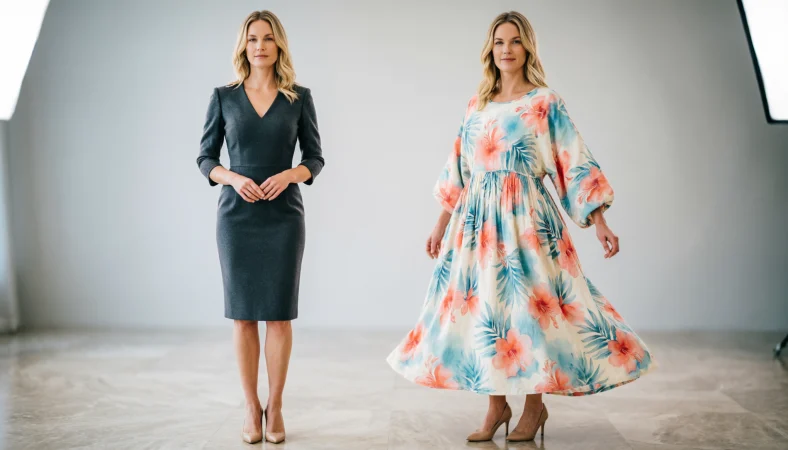
Sheath or muumuu refers to two very different dress styles. A sheath dress is a fitted garment with a narrow, streamlined silhouette that typically follows the body from the shoulders toward the hem. A muumuu is a loose, flowing dress associated strongly with Hawaiian and Polynesian clothing traditions. They differ in fit, structure, history, fabric, and intended appearance.
If you’ve encountered the terms sheath or muumuu while shopping for clothing, researching fashion terminology, or comparing dress silhouettes, the confusion is understandable. Both describe dresses, but they represent almost opposite approaches to design.
A sheath dress emphasizes shape and structure, while a muumuu emphasizes looseness, comfort, and movement. Knowing the distinction helps you choose the right garment, describe clothing accurately, and understand fashion descriptions without relying on guesswork.
Sheath vs Muumuu: What’s the Difference?
The simplest distinction is this: a sheath is a noun used for a particular close fitting dress style, while muumuu is a noun referring to a loose, flowing dress traditionally associated with Hawaii.
Although both are types of dresses, they aren’t interchangeable terms. Calling a fitted sheath dress a muumuu would give the wrong impression about its silhouette, just as calling a loose muumuu a sheath dress would incorrectly suggest a close fitting design.
| Feature | Sheath Dress | Muumuu |
| Part of speech | Noun | Noun |
| Basic meaning | A close fitting, streamlined dress | A loose, flowing dress |
| Typical silhouette | Narrow and fitted | Relaxed and spacious |
| Waist definition | Often visible or shaped | Usually minimal or absent |
| Structure | Relatively structured | Generally loose and flowing |
| Historical association | Western fashion | Hawaiian and Polynesian clothing traditions |
| Common fabrics | Wool, cotton, crepe, jersey, blends | Cotton, rayon, lightweight printed fabrics |
| Typical visual effect | Polished and streamlined | Relaxed, colorful, and comfortable |
| Common settings | Office, formal occasions, social events | Casual wear, warm weather, home wear, cultural settings |
| Main design principle | Follows the body | Allows the body considerable freedom |
A sheath dress generally creates a clean vertical line. It may be sleeveless, short sleeved, or long sleeved, and its hem can fall at different lengths. The defining characteristic is the relatively close silhouette rather than one particular sleeve or neckline.
A muumuu, by contrast, is designed with generous fabric. It commonly hangs loosely from the shoulders or upper body and creates a flowing silhouette. Traditional and modern versions can vary considerably in neckline, sleeve length, decoration, and construction.
Quick recap
A sheath dress is fitted and streamlined.
A muumuu is loose and flowing.
The two terms describe different silhouettes rather than alternative spellings.
Neither word is a substitute for the other.
Is Sheath vs Muumuu a Grammar, Vocabulary, or Usage Issue?
This is primarily a vocabulary and usage issue, not a grammar problem.
Grammar determines how words function in sentences. Vocabulary determines what words mean. Usage concerns whether a particular word is appropriate in a particular context. Here, the important question is understanding what each clothing term refers to.
The words are grammatically straightforward. Both sheath and muumuu can function as nouns.
For example:
She wore a black sheath dress to the meeting.
Here, sheath dress identifies the type of garment.
She wore a colorful muumuu at the beach.
Here, muumuu identifies a loose dress.
Neither sentence has a grammatical problem. The distinction comes from meaning.
Formal versus informal usage
Both terms can appear in ordinary conversation, fashion writing, retail descriptions, and historical discussions. However, the context can influence how much explanation is helpful.
A fashion editor might write:
The designer introduced a collection centered on the classic sheath silhouette.
A casual speaker might simply say:
I bought a fitted black dress.
Likewise, someone familiar with Hawaiian clothing might use muumuu naturally, while another speaker might describe it more generally as a loose Hawaiian style dress.
Academic versus casual usage
In academic writing, especially when discussing clothing history or cultural traditions, precise terminology is valuable. A researcher may need to distinguish a muumuu from other Hawaiian garments and explain its cultural development.
In casual conversation, precision may be less important. Someone might say, “She wore a really loose summer dress,” without identifying it as a muumuu.
The key point is that neither word is inherently more grammatically correct. They simply identify different things.
What Is a Sheath Dress?
A sheath dress is a dress with a relatively narrow, body following silhouette. It typically has a simple vertical shape, although modern designs can include darts, seams, waist shaping, pleats, panels, stretch fabrics, or other construction details.
The word sheath originally refers to a covering designed to fit closely around an object, particularly a protective covering for a blade. In clothing terminology, the comparison makes sense because the dress creates a close, enveloping shape around the body.
The sheath silhouette became especially influential in twentieth century Western fashion. Designers and fashion houses developed versions suitable for professional clothing, cocktail wear, evening clothing, and everyday fashion.
Workplace example
A sheath dress can work particularly well in professional environments because its clean silhouette often creates a polished appearance.
For example:
Maria chose a navy sheath dress for her presentation because its simple silhouette looked professional without being overly formal.
The dress doesn’t have to be extremely tight. A sheath design can be comfortable and modest while still maintaining a relatively narrow outline.
Academic example
In fashion history, the term can be used to identify a particular silhouette:
The exhibition includes several mid twentieth century dresses that demonstrate the popularity of the sheath silhouette.
Here, sheath is useful because it communicates a specific design characteristic rather than merely saying dress.
Technology example
Technology doesn’t change the meaning of sheath, but online shopping has made the term especially common in product descriptions. Retail websites may use phrases such as sheath dress, stretch sheath dress, or sleeveless sheath dress to describe a garment’s shape.
A clothing recommendation system might therefore classify a dress by silhouette, fabric, neckline, sleeve type, and length. In that context, sheath functions as a specific style category.
Sheath dress usage recap
Use sheath dress when you mean a relatively fitted, streamlined dress.
The defining feature is the silhouette, not a particular color, fabric, sleeve, or neckline.
A sheath dress can be casual, professional, or formal depending on its design.
What Is a Muumuu?
A muumuu is a loose, flowing dress strongly associated with Hawaii. The garment is generally characterized by its relaxed construction and generous use of fabric.
The spelling muumuu is common in English, although you may encounter variant spellings in historical or informal material. The word has become widely recognized outside Hawaii, particularly in descriptions of loose tropical dresses.
The cultural history of the muumuu is more complicated than simply calling it a “Hawaiian dress.” Its development is connected to the history of clothing in Hawaii, including the influence of introduced Western garments and local adaptation.
Traditional and contemporary muumuus can feature vivid floral patterns, tropical motifs, flowing sleeves, wide bodies, and comfortable silhouettes. However, not every muumuu looks exactly the same.
Workplace example
A traditional muumuu would generally not be the first choice for a conventional corporate office dress code, but workplace expectations vary by culture, industry, and location.
For example:
The hotel staff wore locally inspired muumuus as part of the resort’s cultural presentation.
Here, the garment may serve not merely as clothing but also as part of the visual identity of a Hawaiian setting.
Academic example
A cultural studies paper might use the term more precisely:
The muumuu illustrates how clothing can develop through cultural exchange while acquiring a distinctive local identity.
This kind of discussion requires more than treating the garment as a generic tropical dress.
Technology example
Online fashion stores frequently use muumuu as a search and product classification term. Someone searching for a loose summer dress may encounter muumuus alongside kaftans, house dresses, tunics, and other relaxed garments.
Artificial intelligence systems can also distinguish clothing categories based on descriptions and visual characteristics. A product description mentioning a loose body, flowing fabric, tropical print, and Hawaiian inspiration provides several signals that can distinguish a muumuu from a sheath dress.
Muumuu usage recap
Use muumuu for the distinctive loose dress style associated with Hawaii.
The garment is generally spacious and flowing rather than close fitting.
Modern versions can vary substantially in fabric, pattern, neckline, sleeve design, and length.
When You Should NOT Use Sheath or Muumuu
Because these terms describe specific clothing styles, using them as generic synonyms for “dress” can create confusion.
Here are several situations where accuracy matters.
1. Don’t call every fitted dress a sheath
A fitted dress may belong to another silhouette category. Bodycon, pencil, wrap, mermaid, and other designs can have different structural characteristics.
2. Don’t call every loose dress a muumuu
A loose dress isn’t automatically a muumuu. Kaftans, tent dresses, smocks, house dresses, and other relaxed styles can have very different origins and constructions.
3. Don’t treat muumuu as merely a synonym for Hawaiian clothing
The term identifies a particular garment. Hawaiian clothing includes many different styles, traditions, and historical influences.
4. Don’t assume sheath means extremely tight
A sheath dress follows the body’s general shape, but it doesn’t necessarily have to be skin tight.
5. Don’t assume every muumuu is brightly patterned
Floral and tropical prints are common, but color and decoration aren’t what define the garment.
6. Don’t use the terms interchangeably in fashion writing
A product description needs accurate terminology because customers use style names to find specific silhouettes.
7. Don’t judge the style solely by sleeve length
Sleeveless, short sleeved, and long sleeved versions of both broad dress categories can exist. Silhouette matters more than sleeve length.
8. Don’t confuse cultural terminology with generic fashion labels
When discussing a garment with cultural significance, context matters. Precise terminology helps avoid reducing a culturally specific garment to a generic fashion category.
Common Mistakes and Decision Rules
| Correct sentence | Incorrect sentence | Explanation |
| She wore a fitted sheath dress. | She wore a fitted muumuu. | A sheath is associated with a close fitting silhouette. |
| She bought a colorful muumuu. | She bought a colorful sheath. | A muumuu is a garment, while sheath normally describes a dress silhouette. |
| The sheath dress created a streamlined look. | The muumuu created a streamlined look. | A muumuu generally creates a loose silhouette. |
| The store sells Hawaiian style muumuus. | The store sells Hawaiian style sheaths. | The terms identify different garment types. |
| The designer used a sheath silhouette. | The designer used a muumuu silhouette. | Sheath is commonly used to describe a particular fitted silhouette. |
Decision rule box
If you mean a relatively close, streamlined dress silhouette, use “sheath.”
If you mean a loose, flowing dress associated with Hawaiian clothing traditions, use “muumuu.”
This rule is more useful than trying to memorize superficial features such as color, sleeve length, or fabric.
Sheath and Muumuu in Modern Technology and AI Tools
Fashion terminology has become increasingly important in digital commerce. Online stores depend on precise product descriptions to help shoppers filter and discover clothing.
A modern clothing database might assign attributes such as silhouette, garment type, neckline, sleeve length, fabric, pattern, occasion, and cultural association. Sheath can appear as a silhouette classification, while muumuu can function as a garment category or style term.
AI image recognition introduces another layer. A system analyzing a photograph may estimate whether a dress has a narrow or loose silhouette, but visual classification isn’t always enough to establish cultural terminology. A loose floral dress may resemble a muumuu without necessarily having the historical or cultural characteristics implied by the term.
That distinction matters for AI generated product descriptions. Visual similarity should not automatically be treated as proof of cultural identity.
The Etymology Behind Sheath and Muumuu
The history of sheath reaches back to Old English sceath, referring to a protective covering or case. The word became associated with close coverings and eventually acquired metaphorical uses in clothing terminology.
In fashion, the idea is straightforward. A sheath dress is named for its close, enveloping shape.
Muumuu has a different linguistic and cultural history. The term is associated with Hawaiian clothing and became established in English through the development and popularization of the garment in Hawaii. Its history reflects cultural contact, adaptation, and the evolution of local dress.
The two words therefore differ not only in meaning but also in cultural background.
An Expert Style Explanation
A useful way to remember the distinction is:
“Think of a sheath as a silhouette and a muumuu as a garment associated with a specific cultural clothing tradition.”
This isn’t a formal quotation from a named authority. It is a concise teaching principle designed to make the distinction easier to remember.
The most reliable test is visual and contextual. Ask whether the dress is primarily being described by its close silhouette or by its loose construction and Hawaiian cultural association.
Two Practical Case Studies
Case Study 1: Online clothing search
Imagine a shopper searching for a professional dress for an office presentation. She wants something fitted but not extremely tight.
A product described as a sheath dress immediately communicates the intended silhouette. The shopper can then evaluate fabric, sleeve length, neckline, and hemline.
If the product were labeled a muumuu, the shopper would probably expect a much looser design and could reject the product before examining its other qualities.
The practical result is simple: accurate terminology improves search relevance and reduces misunderstanding.
Case Study 2: Cultural fashion description
Now imagine a museum creating a digital description for a Hawaiian clothing exhibit.
Calling every loose dress a muumuu would flatten important distinctions between garments and potentially obscure cultural history. A precise description can identify the garment while explaining its construction and context.
In this setting, terminology isn’t just about fashion accuracy. It helps preserve useful historical information for readers, students, researchers, and visitors.
Error Prevention Checklist
Always use sheath when:
- You are describing a relatively fitted dress silhouette.
- The garment has a narrow, streamlined outline.
- You’re discussing professional or formal dress styles with a close silhouette.
- You are writing a product description where silhouette is an important search attribute.
- You are discussing the history of fitted Western dress styles.
Always use muumuu when:
- You are referring to the loose dress associated with Hawaiian clothing.
- The garment’s relaxed construction is central to its identity.
- You are discussing Hawaiian fashion history or cultural clothing.
- A product is specifically marketed as a muumuu.
Never use sheath when:
- You simply mean any dress.
- The garment is loose solely because it is oversized.
- You’re describing a completely different silhouette category.
Never use muumuu when:
- You simply mean any loose summer dress.
- You are describing a fitted dress.
- You are using the word only because the garment has a floral print.
Why People Confuse Sheath and Muumuu
The confusion usually comes from treating clothing terminology as though every dress word describes the same type of feature.
Some terms describe silhouette. Others describe construction, occasion, culture, fabric, or historical origin.
Sheath is strongly associated with silhouette. Muumuu identifies a recognizable loose garment with Hawaiian cultural associations.
This is similar to the difference between describing a vehicle as a sedan and describing it by color. One term identifies a structural category, while another characteristic tells you something different about the object.
Understanding what category a fashion term belongs to makes vocabulary much easier.
Related Fashion Terms You Should Master
If you’re learning clothing vocabulary, these related distinctions are worth knowing:
- Sheath vs bodycon: Both can be fitted, but bodycon generally emphasizes an especially close body hugging effect.
- Muumuu vs kaftan: Both can be loose and flowing, but they have different histories and design traditions.
- Dress vs gown: These terms overlap, but gown often suggests a more formal garment.
- A line vs sheath: An A line silhouette widens toward the hem, while a sheath remains relatively narrow.
- Shift vs sheath: A shift is generally loose and straight rather than shaped closely around the waist and hips.
- Tunics vs dresses: A tunic may resemble a short dress but is often intended to be worn with another garment.
- Wrap dress vs sheath dress: A wrap dress is defined by its wrapping construction, while sheath primarily describes silhouette.
- House dress vs muumuu: These categories can overlap in comfort and looseness, but their cultural and historical associations differ.
- Kaftan vs muumuu: Both may use flowing fabric, yet they represent distinct clothing traditions.
- Silhouette vs garment type: A silhouette describes shape, while a garment type identifies a particular category of clothing.
FAQs
Is a sheath dress the same as a muumuu?
No. A sheath dress is generally fitted and streamlined, while a muumuu is loose and flowing. They represent distinctly different dress styles.
What is the main difference between a sheath dress and a muumuu?
The main difference is silhouette and construction. A sheath dress follows the body relatively closely, while a muumuu uses a generous amount of fabric to create a relaxed shape.
Is a muumuu considered a Hawaiian dress?
A muumuu is strongly associated with Hawaii and Hawaiian clothing traditions. However, it is more precise to identify it as a particular loose dress rather than using “Hawaiian dress” as though all Hawaiian garments are muumuus.
Why is it called a sheath dress?
The term sheath refers to a covering that fits closely around an object. The clothing term reflects the dress’s close, streamlined shape around the body.
Is a sheath dress supposed to be tight?
Not necessarily. A sheath dress is generally close fitting or body following, but it doesn’t have to be extremely tight. Fabric, tailoring, and stretch can affect how closely it fits.
Are muumuus still fashionable?
Yes. Muumuus continue to appear in modern clothing, particularly in Hawaii and in warm weather fashion. Contemporary versions may use updated fabrics, colors, prints, and silhouettes while retaining the garment’s characteristic looseness.
Can a loose dress be called a muumuu?
Not automatically. A loose dress may be a kaftan, tunic, tent dress, house dress, or another style. The term muumuu has a more specific cultural and clothing meaning.
Which is more formal, a sheath dress or a muumuu?
A sheath dress is generally more adaptable to formal and professional settings because its streamlined construction works well with tailored styling. A muumuu is more commonly associated with relaxed, casual, warm weather, or culturally specific settings.
What should I wear if I want a streamlined silhouette?
A sheath dress is a natural choice when the goal is a clean, relatively close silhouette. Other fitted dress styles can also create a streamlined appearance, depending on their construction.
Does a muumuu have to be floral?
No. Floral and tropical prints are common, but a muumuu can come in many colors, patterns, and fabrics. Its loose construction and cultural identity are more important than a particular print.
Conclusion:
Understanding sheath or muumuu becomes much easier once you separate silhouette from garment identity. A sheath dress is characterized primarily by its relatively fitted, streamlined shape. A muumuu is a loose, flowing dress associated strongly with Hawaii and its clothing traditions.
They aren’t interchangeable terms, even though both refer to dresses. When describing clothing, shopping online, studying fashion history, or writing product content, using the correct word gives readers a much clearer picture. If the garment follows the body in a narrow silhouette, sheath is usually the appropriate term. If it is a spacious, flowing dress associated with Hawaiian clothing traditions, muumuu is the more precise choice.