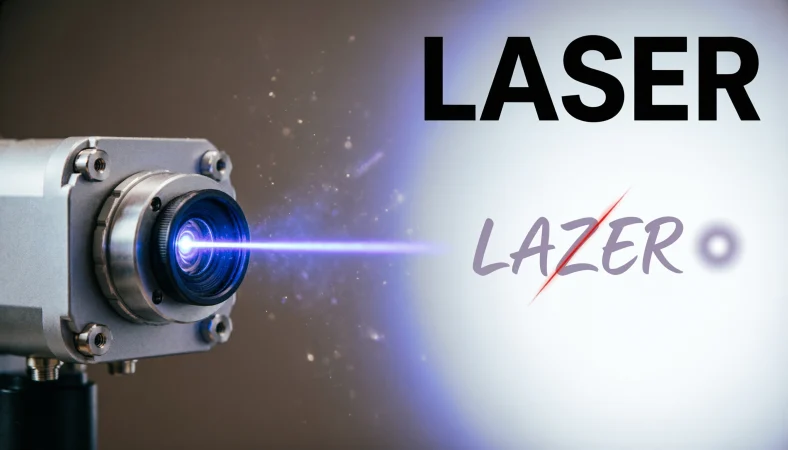
The correct spelling is lazer or laser? In standard English, laser is the correct spelling for the device and the beam of light it produces. Lazer is generally a misspelling, although it may appear in brand names, usernames, informal writing, or creative contexts. For professional, academic, and technical writing, always use laser.
If you have ever typed lazer and wondered whether it was simply an alternative spelling of laser, you’re not alone. The two forms look almost identical, and their pronunciation is essentially the same. However, they do not have equal status in standard English.
Laser is the established spelling for a device that produces a concentrated beam of coherent light, while lazer is normally considered an incorrect spelling of that word. This distinction matters because spelling errors can affect professional documents, academic assignments, technical writing, product searches, and online communication. Understanding why lazer or laser causes confusion makes it much easier to choose the correct form every time.
Laser vs Lazer: What’s the Difference?
The difference is primarily a matter of standard spelling and accepted usage, rather than pronunciation or meaning.
Laser is a noun that refers to a device producing an intense, highly focused beam of light. The word can also function attributively before another noun, as in laser printer, laser treatment, or laser technology.
Lazer, by contrast, is not the standard spelling of this scientific term. In ordinary English writing, it is generally treated as a misspelling of laser. It can occasionally appear intentionally in names, branding, entertainment, usernames, or other creative contexts, but those specialized uses do not make it the standard spelling.
| Feature | Laser | Lazer |
| Standard English spelling | Yes | No |
| Common dictionary word | Yes | Generally no as the standard scientific term |
| Pronunciation | Usually pronounced with a long A sound | Usually intended to sound the same |
| Scientific writing | Correct | Incorrect |
| Academic writing | Correct | Incorrect |
| Professional writing | Correct | Incorrect |
| Informal creative use | Common | Sometimes used intentionally |
| Meaning | A device or beam of concentrated light | Usually an intended spelling of laser |
Quick recap
Laser is the correct standard spelling.
Lazer is normally a spelling mistake.
The two forms are usually pronounced the same way.
Use laser in school, business, science, medicine, technology, and formal writing.
A creative brand or name may deliberately use Lazer, but that is an exception rather than the normal spelling.
Is Lazer vs Laser a Grammar, Vocabulary, or Usage Issue?
The distinction between lazer and laser is primarily a spelling and vocabulary issue. It is not a question of choosing between two grammatical forms with different functions.
For example, English contains many pairs where two spellings are both legitimate. Color and colour are both standard forms, depending on the variety of English being used. Theater and theatre are also accepted variants.
Laser and lazer are different. Standard English recognizes laser as the established spelling of the scientific term. There is no general British versus American spelling distinction that makes lazer correct in one variety and laser correct in another.
Are laser and lazer interchangeable?
No, not in standard writing.
If you are writing:
The technician used a laser to measure the surface.
The spelling laser is appropriate.
Writing:
The technician used a lazer to measure the surface.
would normally be regarded as a spelling error.
The exception is a proper name. A company, product, username, fictional character, or creative project could intentionally use Lazer. In that situation, you are reproducing a chosen name rather than applying the ordinary spelling of the scientific word.
Formal versus informal usage
In formal writing, laser should always be preferred.
That includes scientific papers, medical information, business reports, instruction manuals, news articles, educational materials, and professional correspondence.
In informal online communication, people sometimes make spelling mistakes without realizing it. Search engines and spell checkers may recognize the intended meaning, but that does not turn lazer into the standard spelling.
Academic versus casual usage
Academic writing requires greater precision. If you are discussing optics, physics, medicine, engineering, manufacturing, communications, or computing, use laser.
Casual writing may contain lazer because people often spell unfamiliar words according to how they sound. The pronunciation of laser can make the spelling especially easy to misremember.
How to Use Laser Correctly
The word laser has become extremely common because laser technology is used across many industries. Its applications range from optical communications and manufacturing to medicine, entertainment, surveying, and consumer electronics.
Workplace example
A technical report might say:
The laser scanner produced a detailed three dimensional image of the component.
A manufacturing document could state:
The operator adjusted the laser before beginning the cutting process.
In both examples, laser functions naturally as a noun and as a modifier.
Academic example
A physics student might write:
A laser produces light with properties that distinguish it from ordinary sources of light.
A medical research paper could say:
The study examined the effectiveness of laser treatment for the selected condition.
The spelling should remain laser regardless of the academic field.
Technology example
You may encounter phrases such as:
- laser printer
- laser scanner
- laser sensor
- laser pointer
- laser cutting
- laser communication
- laser measurement
These established compounds all use laser, not lazer.
Usage recap
Use laser when referring to the scientific device, its beam, or technology based on it. The word works comfortably in everyday language as well as specialized technical writing.
How Lazer Is Sometimes Used
Although lazer is not the standard spelling of the scientific term, you may still encounter it online.
One reason is simple phonetic confusion. Someone who hears the word but has never seen it written may reasonably guess that it is spelled lazer. English contains many words where pronunciation provides an imperfect guide to spelling.
A second reason is branding. Businesses sometimes alter familiar words to create distinctive names. A company might choose Lazer because it looks different from the standard spelling or because the name is memorable.
A third reason is entertainment and internet culture. Creative projects, fictional characters, usernames, songs, games, and other forms of media may intentionally use unusual spellings.
Workplace example
If a company officially calls a product Lazer Pro, you should preserve that spelling when referring to the product by its proper name.
However, if you are describing the technology itself, write:
The product uses laser technology.
Academic example
A student should not change laser to lazer simply because a source, username, or informal website uses the alternative form.
The correct sentence is:
The experiment used a laser to produce a concentrated beam of light.
Technology example
A search for Lazer printer might still lead to relevant results because search systems often understand spelling variations. Nevertheless, the standard technical term remains laser printer.
Usage recap
Lazer can exist as an intentional name or creative spelling, but it should not replace laser in ordinary standard English.
Why Do People Spell Laser as Lazer?
The confusion is understandable because English spelling does not always follow pronunciation perfectly.
When people hear laser, they hear a sound that can easily suggest the spelling lazer. The letter combination aser is not necessarily obvious to someone encountering the word for the first time.
There is also a common spelling pattern behind the mistake. English contains words where a pronounced Z sound is represented by the letter z. Someone unfamiliar with the origin of laser may therefore instinctively write lazer.
Another factor is visual familiarity. People encounter laser frequently, but online content can expose readers to misspellings often enough that the incorrect form begins to look familiar.
This is an important lesson in spelling: familiarity does not always equal correctness.
When You Should NOT Use Lazer or Laser
Knowing when not to use a spelling can be just as useful as knowing the correct form.
1. Do not write lazer in scientific assignments
If you are discussing optics, light, physics, or engineering, use laser.
2. Do not use lazer in medical writing
Terms such as laser surgery, laser treatment, and laser therapy use the standard spelling laser.
3. Do not use lazer in technical manuals
Instructional and technical documents require consistent terminology. The standard term is laser.
4. Do not assume lazer is an American spelling
It is not the normal American alternative to laser. American English uses laser.
5. Do not assume lazer is a British spelling
British English also uses laser.
6. Do not replace laser with lazer because of pronunciation
The pronunciation does not determine the spelling.
7. Do not change an official brand name
If a company deliberately uses Lazer in its official name, preserve that spelling when identifying the brand.
8. Do not treat search engine results as proof of standard spelling
A search engine may understand misspellings and return useful results. That does not make every spelling variation grammatically or lexically standard.
Common Mistakes and Decision Rules
| Correct sentence | Incorrect sentence | Explanation |
| The surgeon used a laser. | The surgeon used a lazer. | The scientific term is spelled laser. |
| The laser beam was carefully aligned. | The lazer beam was carefully aligned. | Laser is the standard spelling. |
| She bought a laser printer. | She bought a lazer printer. | The established technology term uses laser. |
| The experiment involved a laser. | The experiment involved a lazer. | Academic writing requires the standard form. |
| The company developed laser sensors. | The company developed lazer sensors. | Laser is the accepted technical spelling. |
| The product is called Lazer Pro. | The product is called Laser Pro. | A proper product name may intentionally use Lazer. |
Decision Rule Box
If you mean the scientific device, the beam, or the technology, use laser.
If you see Lazer as part of an official name, brand, username, or creative title, preserve that spelling only when it is intentionally used as a name.
This rule handles nearly every situation.
Laser in Modern Technology and AI Tools
Laser technology remains important in modern computing and communications, even though many everyday digital experiences hide the underlying hardware.
As Laser based systems can be used in optical communication, scanning, sensing, manufacturing, measurement, printing, storage technologies, and scientific instruments.
The connection with modern computing is particularly interesting. Optical systems can transmit information using light, while laser based sensors can help machines detect distance, position, surfaces, and objects.
AI systems can also work with data captured by laser based sensing technologies. For example, autonomous systems may use laser based ranging equipment to gather environmental information. The AI model then interprets that information for tasks such as mapping, object recognition, or navigation.
The spelling remains unchanged regardless of how advanced the technology becomes. Whether you are discussing a simple laser pointer or a sophisticated optical sensing system, the standard word is laser.
The Etymology of Laser
The spelling laser comes from the initial letters of the phrase light amplification by stimulated emission of radiation.
This makes laser an acronym that became a normal English noun. Over time, the word became so established that most speakers no longer think of it primarily as an acronym. It is now used naturally in expressions such as laser beam, laser printer, and laser surgery.
Its history also explains why the spelling is not simply based on the sound. The established form developed from the acronym itself.
The word entered wider scientific and public usage during the twentieth century as researchers developed practical laser technology. As the technology spread into medicine, manufacturing, communications, entertainment, and consumer products, the word became part of everyday English.
An Expert Perspective on Laser Spelling
A useful principle for technical language is:
Established terminology should follow the recognized spelling used by the relevant field.
That principle is especially important with scientific words. Technical vocabulary often develops through specific historical processes, including acronyms, scientific names, abbreviations, and borrowed terminology. Once a form becomes established, changing its spelling based solely on pronunciation can create unnecessary ambiguity.
For laser, the standard spelling is firmly established across major varieties of English.
Two Practical Case Studies
Case Study 1: Academic writing
Imagine a university student preparing a report about optical technology. The student repeatedly writes lazer because that spelling seems intuitive.
Even if the scientific explanation is otherwise excellent, the repeated spelling error can make the work appear less polished and can distract the reader from the underlying argument.
Replacing every instance with laser immediately improves terminology consistency and aligns the report with standard scientific usage.
The practical result is straightforward: the reader can focus on the student’s scientific explanation rather than questioning the spelling of a basic technical term.
Case Study 2: Professional technical communication
Consider a technical company preparing documentation for a product that contains a laser sensor.
If the documentation alternates between laser and lazer, readers may wonder whether the two forms refer to different components. Standardizing the terminology as laser eliminates that unnecessary uncertainty.
The concrete result is improved consistency. One technical concept receives one standard name throughout the document.
These examples demonstrate an important principle of professional writing: consistency is not merely cosmetic. Clear terminology reduces the possibility of misunderstanding.
Error Prevention Checklist
Always use laser when
- You mean a device that produces laser light.
- You are discussing a laser beam.
- You are writing about laser technology.
- You are preparing an academic paper.
- You are writing a medical document.
- You are creating technical documentation.
- You are describing laser scanning or measurement.
- You are referring to laser printing or manufacturing.
Never use lazer when
- You are simply trying to spell the standard scientific term.
- You are writing formal English.
- You are preparing a school or university assignment.
- You are writing professional technical content.
- You are describing ordinary laser equipment.
- You are discussing laser based medical procedures.
- You are writing for a general audience that expects standard English.
The main exception is an intentional name. If a company, product, character, or creative work officially uses Lazer, reproduce that name accurately.
Related Spelling Confusions You Should Master
Once you understand lazer or laser, several other spelling questions become easier to recognize.
- advisor or adviser: Both forms can be accepted, although usage varies by context and style guide.
- practice or practise: The distinction is particularly important in British English.
- license or licence: American and British usage differ.
- color or colour: Both are standard forms associated with different English varieties.
- theater or theatre: Both spellings are established.
- gray or grey: Both forms are accepted, with regional preferences.
- center or centre: The preferred form varies between American and British English.
- catalog or catalogue: Both forms are used in standard English.
- labeled or labelled: Both forms are associated with different spelling conventions.
- canceled or cancelled: Regional spelling conventions influence the preferred form.
The key lesson is to distinguish genuine spelling variants from simple misspellings. Unlike color and colour, laser and lazer are not ordinary American and British alternatives.
FAQs
Is laser the correct spelling?
Yes. Laser is the standard spelling of the word referring to a device that produces a concentrated beam of light. It is the form used in scientific, medical, technical, academic, and general English.
Is lazer a word?
Lazer may appear as a name, brand, username, or intentional creative spelling. However, it is not the standard spelling of the scientific term. If you mean the technology, laser is the correct choice.
Why do people spell laser as lazer?
The main reason is likely pronunciation. The word laser is pronounced in a way that can make lazer seem like a logical spelling, particularly to someone who has heard the word but has not seen it written.
Is lazer an American spelling of laser?
No. American English uses laser as the standard spelling. Lazer is not the normal American alternative.
Is lazer a British spelling of laser?
No. British English also uses laser. The difference between American and British spelling does not explain lazer.
How do you spell laser correctly?
The standard spelling is laser, with an S rather than a Z. For example, write laser beam, laser printer, and laser treatment.
What does laser stand for?
Laser comes from the initial letters of light amplification by stimulated emission of radiation. The acronym became established as an ordinary English noun.
Should I use laser or lazer in academic writing?
Use laser. Academic writing should use the established spelling of technical terminology. Lazer would normally be considered a spelling error unless it is part of a proper name.
Can a company use the spelling Lazer?
Yes. A company or product can intentionally choose Lazer as a distinctive name. In that case, the spelling functions as part of the proper name. It does not change the standard spelling of the scientific word.
Is laser a noun or an adjective?
Laser is primarily a noun, but it is frequently used attributively before another noun. For example, laser printer and laser technology use laser to modify another noun.
Conclusion:
When choosing between lazer or laser, the answer is clear: laser is the correct standard spelling for the scientific and technological term. Lazer is normally a misspelling, although it can appear intentionally in brands, usernames, fictional names, and creative projects. Unlike genuine regional spelling differences such as color and colour, lazer is not an American or British alternative to laser. For academic, professional, medical, technical, and everyday writing, choose laser.
The easiest rule to remember is simple: if you mean the concentrated beam of light or the device that produces it, spell it laser.