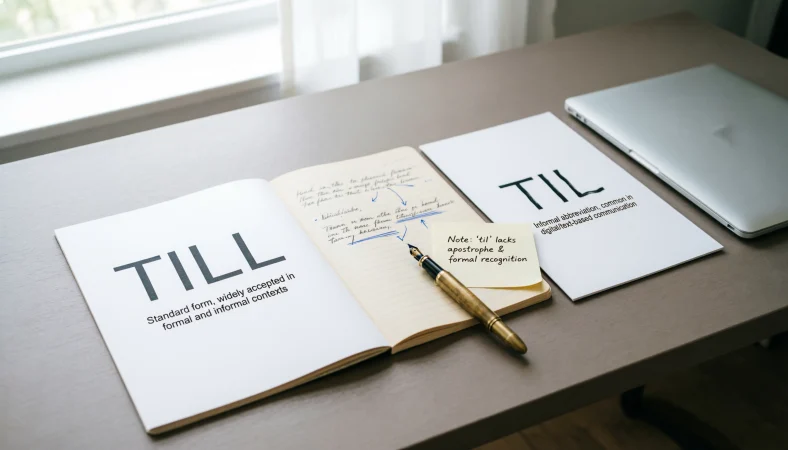
Till or til can both appear in writing when someone means “until,” but they are not equally appropriate in every context. Till is the established standard form and works in formal and informal writing, while til is generally treated as an informal or nonstandard spelling. For polished writing, till or until is the safer choice.
If you have ever wondered whether you should write “wait till tomorrow” or “wait til tomorrow,” the confusion is understandable. The words look almost identical, and both are commonly used to express a point in time. However, spelling conventions and register matter, especially in academic, professional, and edited writing.
The key distinction is simple. Till is a standard English word that can function as a preposition or conjunction meaning “until.” Til is widely encountered as a shortened or informal spelling, particularly in casual digital communication. This difference can cause real mistakes when informal spelling is carried into resumes, essays, business correspondence, reports, or other situations where conventional English is expected.
The good news is that you don’t need to memorize a complicated rule. Once you understand where each form belongs, choosing the right spelling becomes straightforward.
Till vs Til: What’s the Difference?
The biggest difference between till and til is not meaning but standard usage. In ordinary modern English, both forms are often intended to communicate the idea of “until,” but till has a long established place in standard dictionaries and edited writing.
Till can be used as a preposition or conjunction. It identifies the time up to which something happens.
Examples include:
We stayed till midnight.
Please wait till I return.
The store is open till nine.
She worked till the project was finished.
In each example, till introduces either a time or an event that marks the endpoint of an action.
Til, by contrast, is commonly used as an informal spelling of “till” or “until.” You may see it in text messages, social media posts, song titles, casual writing, or other contexts where strict spelling conventions are less important.
| Form | Part of speech | Meaning | Standard usage | Best context |
| till | Preposition or conjunction | Up to a specified time or event | Standard | Formal and informal writing |
| til | Informal spelling | Usually intended to mean until | Informal or nonstandard in edited prose | Casual communication |
| until | Preposition or conjunction | Up to a specified time or event | Standard | Formal, academic, and general writing |
Quick recap
Till is a standard English form meaning “until.”
Til is commonly encountered as an informal spelling.
Until is the most universally safe choice in formal writing.
If you’re writing something that will be edited or evaluated, choose till or until rather than til.
Is Till vs Til a Grammar, Vocabulary, or Usage Issue?
The distinction between till and til is primarily a spelling and usage issue rather than a difference in grammatical meaning.
When someone writes “I’ll wait til Friday,” readers generally understand exactly what they mean. The intended meaning is the same as “I’ll wait till Friday” or “I’ll wait until Friday.” The problem is not comprehension. The issue is whether the spelling fits the context.
Are till and til interchangeable?
They can be interchangeable in casual communication when the writer intends “until,” but they are not equally suitable in all contexts.
Consider these sentences:
I’ll see you till Friday.
I’ll see you til Friday.
The first uses a standard word. The second uses a spelling that readers may recognize as informal.
For everyday texting, the distinction may not matter much. In an academic essay, however, til can look like a spelling error or an unnecessarily casual form.
There is another important point. Till and until are both standard. They can generally be used in the same grammatical positions.
We waited till noon.
We waited until noon.
Both sentences are grammatical.
Formal versus informal usage
Formal writing favors established standard forms. This includes academic papers, business reports, professional emails, applications, official documents, and published content.
In those settings, til is best avoided.
Casual writing has more flexibility. A person texting a friend might write:
Can’t wait til Saturday!
The sentence is perfectly understandable and reflects the relaxed nature of digital communication. However, if the same sentence appeared in a formal announcement, until would be a more polished choice.
Academic versus casual writing
Academic writing generally values consistency, precision, and conventional spelling. Therefore, until is often preferable, although till is also grammatically correct.
Casual writing has fewer restrictions. Writers may intentionally use shortened spellings, slang, abbreviations, and conversational forms.
This means the right question isn’t simply “Is til understandable?” It clearly is. The better question is “Is til appropriate for this type of writing?”
That distinction is central to understanding standard English.
How to Use Till Correctly
Till is a standard word that can indicate the endpoint of a period of time. It is especially common in conversational English, but it isn’t restricted to casual speech.
Workplace example
The office will remain open till 6 p.m.
This sentence is grammatical. In a highly formal notice, until might sound slightly more polished:
The office will remain open until 6 p.m.
Both are standard. The choice is mainly stylistic.
Academic example
The researchers monitored the participants till the end of the observation period.
This is grammatically acceptable, although many academic writers would choose until because it has a slightly more formal tone.
The researchers monitored the participants until the end of the observation period.
Technology example
The software will continue running till the scheduled maintenance begins.
Again, till is standard and clear.
You may also see till in technical instructions:
Keep the device connected till the update is complete.
There is no grammatical problem with this construction.
Till as a noun
There is another meaning of till that is completely unrelated to “until.” In British English, till can refer to a cash register or the place where money is handled in a store.
For example:
She waited at the till.
This meaning is especially common in British English.
That distinction matters because til cannot simply replace every occurrence of till. If till means a cash register, writing til would change the spelling of a different word and may create an error.
Usage recap
Use till when you mean “until.”
Use it freely in standard English, including everyday and professional contexts.
Remember that till can also mean a cash register in British English.
How to Use Til Correctly
The safest way to understand til is to treat it as an informal spelling encountered in casual communication rather than as the preferred standard form for polished writing.
You might see it in messages such as:
I’ll be here til you get back.
Stay up til midnight.
Only three days til vacation!
These examples are easy to understand, and many English speakers encounter this spelling regularly online.
However, the fact that a form is common in informal communication does not automatically make it the preferred form in formal English.
Workplace example
Imagine a coworker sends you a quick message:
I’ll finish it til lunch.
In an informal internal chat, this may pass without attracting attention. But if you’re writing a client email, a better version would be:
I’ll finish it by lunch.
Or:
I’ll finish it before lunch.
If you specifically mean continuing up to a time, you can write:
I’ll work on it until lunch.
Academic example
In an academic essay, avoid writing:
The experiment continued til the temperature stabilized.
Use:
The experiment continued until the temperature stabilized.
This isn’t because the reader cannot understand til. It is because academic writing normally follows standard spelling conventions.
Technology example
Casual technology discussions often contain informal spellings:
The server won’t restart til the update finishes.
For documentation, however, write:
The server won’t restart until the update finishes.
The second version is more appropriate for technical documentation because it follows conventional written English.
Usage recap
Til is recognizable and common in informal digital communication.
It is best avoided in academic, professional, and edited writing.
When in doubt, replace til with until.
When You Should NOT Use Till or Til
Understanding when not to use these forms can prevent subtle writing problems.
1. Don’t use til in formal academic work
A university assignment is not the place for casual spelling unless you’re deliberately discussing informal language.
Write:
The study continued until 2025.
Rather than:
The study continued til 2025.
2. Don’t assume til is the standard spelling
Frequency on social media does not determine standard written usage. A word can be extremely common online and still be inappropriate in formal prose.
3. Don’t replace every occurrence of till with til
If till means a cash register, til is not an appropriate replacement.
She went to the till.
This is a completely different use from “until.”
4. Don’t choose til for professional documents
Resumes, cover letters, reports, proposals, formal emails, and official notices benefit from conventional spelling.
5. Don’t confuse till with by
These words can express different relationships with time.
Wait till five.
means continue waiting up to five.
Finish it by five.
means have it completed no later than five.
6. Don’t assume until is less correct than till
Both are standard. Until is not merely a formal version of an incorrect word. It is an established English word in its own right.
7. Don’t use informal spelling simply because it is shorter
Saving two letters isn’t usually worthwhile when clarity and professionalism matter.
8. Don’t treat pronunciation as a spelling rule
English spelling isn’t always determined by pronunciation. The fact that till and til sound similar doesn’t mean they have identical status in written English.
Common Mistakes and Decision Rules
| Correct sentence | Incorrect or less suitable sentence | Explanation |
| I’ll wait until tomorrow. | I’ll wait til tomorrow. | Until is the safest standard choice. |
| We stayed till midnight. | We stayed til midnight. | Till is standard, while til is informal. |
| The store is open till six. | The store is open til six. | Till is appropriate in standard writing. |
| The study continued until June. | The study continued til June. | Academic writing favors standard forms. |
| She paid at the till. | She paid at the til. | Here till means a cash register. |
| Please wait till I arrive. | Please wait til I arrive. | Till is the established standard form. |
Decision Rule Box
- If you mean “up to a particular time or event,” use until or till.
- If you’re writing casually and intentionally using informal spelling, til may appear, but it is not the safest choice for formal prose.
- If you mean a cash register in British English, use till.
This rule is more accurate for till or til than a simple action versus person distinction because the real issue is spelling, register, and meaning.
Till or Til in Modern Technology and AI Tools
Digital communication has made informal spelling more visible than ever. Messaging apps, social platforms, gaming communities, forums, and AI generated text frequently contain conversational expressions that would be unusual in formal prose.
A search engine or language model can easily recognize til as an intended form of “until.” However, recognition does not mean recommendation.
Modern writing tools often distinguish between grammatical acceptability and stylistic appropriateness. A sentence can be understandable while still being unsuitable for professional publication.
For example:
I’ll be online til 8.
A casual messaging environment may accept this naturally.
A software manual would normally use:
The service will remain active until 8.
The difference illustrates an important principle in modern writing: digital familiarity and editorial standardization are not always the same thing.
AI tools also encounter informal language in their training data and generated responses. For users who need polished writing, the safest instruction is to request standard English and specify the desired level of formality.
The Etymology and History of Till and Until
The history of till helps explain why it should not be treated as a modern abbreviation.
Till is an old English word with roots going back centuries. It developed as a word expressing the endpoint of an action or period. Until also has a long history in English and became a standard way of expressing the same basic temporal relationship.
The spelling til is often understood in modern usage as an informal shortening or simplified spelling associated with casual writing. Its visibility has increased considerably through texting and online communication.
This history explains an important misconception. Some writers assume that til is simply a shorter version of until that is equally standard everywhere. In practice, conventional edited English generally prefers until or till.
An expert style perspective
A useful editorial principle is:
“Standard spelling should follow the demands of the context, not merely the habits of casual conversation.”
That principle applies well beyond this particular pair. English contains many forms that are perfectly understandable in speech or informal messaging but less suitable for formal writing.
Two Practical Case Studies: Till, Til, and Real World Writing
Case Study 1: A university essay
Consider a student writing:
The researchers observed the participants til the final stage.
The intended meaning is clear. Nevertheless, an instructor may mark til as an informal spelling or style problem.
Changing it to:
The researchers observed the participants until the final stage.
removes the issue without changing the meaning.
The concrete improvement is simple: the sentence now follows conventional academic spelling and is less likely to distract the reader from the research itself.
Case Study 2: A customer service message
Imagine a business representative writes:
Your account will remain active til Friday.
A customer can understand the message immediately. Still, a polished version would be:
Your account will remain active until Friday.
The revised sentence uses standard written English and creates a more professional impression.
These examples show why context matters more than mere comprehension. Neither reader is likely to misunderstand til, but professional communication has standards beyond basic intelligibility.
Author expertise: This guide is written from a professional English usage and SEO perspective, combining grammatical analysis with practical editorial conventions for modern digital writing.
Error Prevention Checklist
Always use till when
- You mean “until” and want a standard form.
- You are writing conversational or professional English.
- You are referring to a cash register in British English.
- You want a concise alternative to “until.”
Always use until when
- You are writing academic content.
- You are preparing a formal business document.
- You are writing technical documentation.
- You want the most universally recognized formal choice.
Never use til when
- You are writing an academic paper.
- You are preparing a resume or professional application.
- You are writing formal business correspondence.
- You are producing edited or published content.
- You are unsure whether the audience will accept informal spelling.
In those situations, until is usually the simplest solution.
Related Grammar Confusions You Should Master
Once you’ve understood till or til, several other spelling and usage pairs are worth learning because they create similar problems.
1. Alright or all right
Both appear in modern English, but their levels of acceptance and stylistic preference can vary.
2. Everyday or every day
Everyday is an adjective, while every day is an adverbial phrase referring to each day.
3. Anyway or anyways
Anyway is the standard form in most contexts, while anyways is more conversational.
4. Alot or a lot
A lot is the standard expression. Alot is generally considered an error.
5. Cannot or can not
Cannot is normally written as one word, although can not can occur in particular constructions.
6. Toward or towards
Both forms are standard, with regional preferences influencing which one appears more often.
7. Among or amongst
Both are established forms, although amongst may sound more formal or traditional in some varieties of English.
8. While or whilst
Both can be correct, but whilst is more strongly associated with British English and formal or literary styles.
9. Practice or practise
In standard British English, practice is generally the noun and practise the verb. American English normally uses practice for both.
10. License or licence
American English generally uses license for both noun and verb, while British English distinguishes licence as a noun and license as a verb.
Learning these pairs builds broader awareness of English spelling, regional variation, register, and context.
FAQs:
Is till or til correct?
Till is the standard spelling when you mean “until.” Til is commonly used informally, especially online and in casual messages, but it is not the preferred spelling for formal or edited writing.
Is til a real word?
Til is encountered in English, particularly as an informal spelling meaning “until.” However, writers should not automatically treat it as interchangeable with the standard forms till and until in every context.
Is till grammatically correct?
Yes. Till is a grammatically correct English word. It can function as a preposition or conjunction expressing a point up to which something happens.
Is till formal English?
Till is standard English and is not grammatically incorrect in formal writing. However, until is often preferred in highly formal or academic prose because it can sound slightly more polished.
Can I use til in an essay?
It is better to avoid til in an academic essay. Use until or till instead. Until is usually the safest choice when you want a clearly formal style.
Is till the same as until?
When till is used as a time word, it generally has the same meaning as until. For example, “wait till noon” and “wait until noon” communicate the same basic idea.
Why do people write til instead of till?
People often write til because it is a short, casual spelling that is common in texting, social media, and informal online communication. Its popularity does not make it the preferred form for formal writing.
Which is better, till or until?
Both are standard. Until is usually the safest choice for formal, academic, and professional writing, while till is completely acceptable in standard English and common in everyday communication.
Is till or til better for texting?
In casual texting, either may be understood, but til is more informal. If you want standard spelling even in a text message, till or until is preferable.
Final Verdict:
The difference between till and til is mainly a matter of standard spelling and register. Till is an established English word meaning “until,” and it can be used in both casual and formal contexts. Until is equally standard and is often the preferred choice for academic and professional writing.
Til is familiar because it appears frequently in texting, social media, informal messages, and other conversational environments. It usually communicates the intended meaning successfully, but it is best regarded as an informal spelling rather than the safest standard form for edited prose.
If you’re unsure which spelling to choose, use until. If you prefer the shorter standard form, till is also correct. Save til for contexts where informal spelling is intentional.
In short, standard English gives you two reliable choices: till and until. For polished writing, those are the forms to reach for.