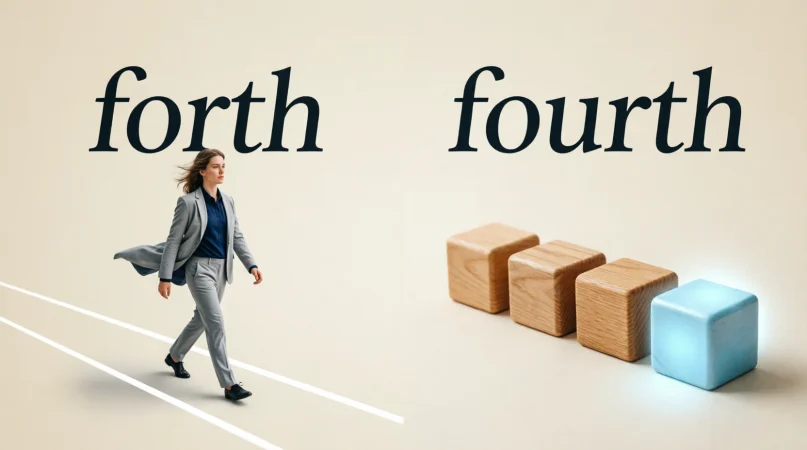
Forth or fourth are different English words with different meanings and grammatical roles. Forth usually means onward, forward, or out into view, while fourth means number four in a sequence. They sound alike, but confusing them can change the meaning of a sentence and create noticeable spelling errors in writing.
The question “forth or fourth” usually appears when two words sound exactly alike but perform completely different jobs in a sentence. This is a classic example of a homophone problem. Homophones share the same pronunciation while having different spellings and meanings.
Forth generally describes movement, continuation, or something coming into view. For example, someone might say, “She stepped forth to accept the award.” It can also appear in the expression “and so forth,” which means that a list continues.
Fourth, on the other hand, relates directly to the number four. It is the ordinal form of four, so it identifies something that comes after the third item. You might write, “Today is the fourth day of the course.”
The confusion matters because these words cannot normally replace each other. Writing “the forth chapter” when you mean chapter number four creates a spelling mistake. Likewise, writing “come fourth” when you mean move forward uses the wrong word.
Although the difference seems simple once explained, the words are easy to confuse because pronunciation gives you no useful clue. The correct choice depends on meaning and context.
Forth vs Fourth: What’s the Difference?
The simplest way to distinguish these words is to connect forth with movement or continuation and fourth with the number four.
| Word | Part of speech | Main meaning | Example |
| Forth | Adverb | Forward, onward, or outward | She stepped forth confidently. |
| Forth | Adverb | Into view or into action | The truth finally came forth. |
| Fourth | Adjective | Coming after third | This is the fourth chapter. |
| Fourth | Noun | Number four in a sequence | She finished fourth. |
| Fourth | Adverb | In the fourth position | He ranked fourth. |
What does forth mean?
Forth is primarily an adverb. It describes movement onward, forward, outward, or into a visible or active state.
Consider these examples:
“Please come forth and introduce yourself.”
“The evidence finally came forth.”
“She went forth to begin her journey.”
In each sentence, forth expresses some idea of moving forward, emerging, or proceeding.
The word also appears in established expressions. “And so forth” means that a list or sequence continues. “Back and forth” describes movement in opposite directions.
What does fourth mean?
Fourth is connected to the number four. It is most commonly used as an ordinal number, which means it identifies position in an ordered sequence.
For example:
“She finished fourth in the competition.”
“This is the fourth time I have visited.”
“Read the fourth paragraph carefully.”
Here, fourth does not describe movement. It tells you where something appears in relation to other things.
The distinction becomes particularly important in formal writing because ordinal numbers frequently appear in dates, rankings, instructions, academic documents, chapters, lists, and schedules.
Mini recap
Forth means onward, forward, outward, or into view.
Fourth refers to the number four or the fourth position.
The two words sound alike but have different spellings and meanings.
Use the surrounding context to determine which word belongs in your sentence.
Is Forth vs Fourth a Grammar, Vocabulary, or Usage Issue?
The difference between these words is primarily a vocabulary and spelling issue, although grammar helps you determine how each word functions in a sentence.
They are not interchangeable. A sentence referring to movement requires a word with the meaning of onward or forward. A sentence referring to position in a sequence requires an ordinal number.
For example:
“She stepped forth.”
“She stepped fourth.”
The first sentence can make sense if the person moved forward or appeared before others. The second sentence generally sounds incomplete or unnatural because fourth identifies position rather than movement.
The same principle applies in formal writing. Academic work often uses fourth when discussing an ordered argument, chapter, stage, or result. Forth appears in expressions, literary writing, descriptions of movement, and formal phrases such as “forthwith” and “and so forth.”
In casual writing, people may rely heavily on sound and type whichever spelling comes to mind. That is precisely why proofreading matters.
A useful strategy is to ignore pronunciation and ask what the word means.
If you mean number four, choose fourth.
If you mean forward, onward, outward, or continuing, choose forth.
How to Use Forth Correctly
Forth is generally used when something moves forward, emerges, proceeds, or comes into view. It can have a slightly formal or literary tone depending on the sentence.
Workplace example
A manager might write:
“Please step forth when your name is called.”
Here, forth communicates movement forward or into a particular position.
Another example is:
“The team moved forth with the implementation.”
This construction is understandable, although “moved forward” is more natural in ordinary modern business writing. This illustrates an important point: a word can be grammatically possible while still sounding less natural than a common alternative.
Academic example
An academic writer might use forth in a historical or literary context:
“The author puts forth a compelling argument.”
The expression put forth is established English. It means to present, offer, or propose something.
For example:
“The researchers put forth several possible explanations.”
This is much more natural than trying to use fourth in the same position.
Technology example
Technology documentation can also use forth when describing movement or continuation:
“The system sends the request forth to the next processing stage.”
However, modern technical writing would often choose “forward” instead. Forth tends to appear more naturally in established expressions than in everyday technical instructions.
Common expressions with forth
Several familiar expressions make the meaning easier to remember.
And so forth means that a list continues.
Example:
“The package includes cables, adapters, instructions, and so forth.”
Back and forth describes repeated movement between two directions.
Example:
“The data moves back and forth between the devices.”
Put forth means to present or offer something.
Example:
“She put forth a reasonable proposal.”
Come forth means to emerge, appear, or become known.
Example:
“New evidence came forth during the investigation.”
Usage recap
Use forth when the meaning involves movement, continuation, emergence, or established expressions such as “and so forth.”
If you are referring to position number four, forth is not the correct spelling.
How to Use Fourth Correctly
Fourth is the ordinal form of the number four. It tells readers that something occupies position four in an ordered sequence.
Workplace example
Imagine a company reviewing four proposals:
“The fourth proposal received the most attention.”
The word fourth identifies the proposal that appears after the first, second, and third proposals.
Another example is:
“This is our fourth quarterly meeting.”
The meeting is number four in a sequence.
Academic example
Academic writing frequently uses fourth when organizing information.
“For the fourth point, the author examines social consequences.”
Here, fourth tells the reader exactly where the point appears in the sequence.
You might also write:
“The fourth chapter discusses the study methodology.”
Because chapter four follows chapters one, two, and three, fourth is the correct choice.
Technology example
Technical instructions may contain numbered stages:
“During the fourth step, enter your verification code.”
Again, the word refers to sequence rather than movement.
It can also describe ranking:
“The device placed fourth in the performance test.”
The device occupies position four.
Dates and special expressions
Fourth also appears in dates and names of events.
For example:
“July Fourth” refers to the fourth day of July.
The expression Fourth of July is especially familiar in American English because it refers to the United States Independence Day holiday.
Usage recap
Use fourth whenever you mean position number four.
It can function as an adjective, noun, or adverb depending on the sentence.
Remember that fourth always connects naturally to the idea of four, sequence, rank, or position.
When You Should NOT Use Forth or Fourth
Understanding when not to use each word can prevent many common errors.
1. Do not use forth for number four
Incorrect:
“She lives on the forth floor.”
Correct:
“She lives on the fourth floor.”
The floor has a numerical position, so fourth is required.
2. Do not use fourth for forward movement
Incorrect:
“The soldiers marched fourth.”
If the intended meaning is that they marched forward, forth or, more naturally, forward is needed.
3. Do not use forth for an ordinal ranking
Incorrect:
“He finished forth in the race.”
Correct:
“He finished fourth in the race.”
The sentence identifies a position, so fourth is correct.
4. Do not use fourth in “and so forth”
Incorrect:
“We discussed prices, schedules, locations, and so fourth.”
Correct:
“We discussed prices, schedules, locations, and so forth.”
This expression always uses forth.
5. Do not confuse “back and forth” with numerical sequence
The expression “back and forth” describes repeated movement.
Correct:
“They walked back and forth.”
Writing “back and fourth” is a common spelling error.
6. Do not use forth when describing a fourth item
Incorrect:
“Open the forth file.”
Correct:
“Open the fourth file.”
The file has position four.
7. Do not assume pronunciation determines spelling
Because the two words sound alike, listening to a sentence won’t tell you which spelling is correct.
Meaning must determine the spelling.
8. Do not treat the words as interchangeable
They are homophones, not synonyms. Their shared pronunciation does not make them substitutes for one another.
Common Mistakes and Decision Rules
| Correct sentence | Incorrect sentence | Explanation |
| This is the fourth chapter. | This is the forth chapter. | Chapter position four requires fourth. |
| She came forth to speak. | She came fourth to speak. | Came forth means appeared or moved forward. |
| We went back and forth. | We went back and fourth. | The established expression uses forth. |
| He finished fourth. | He finished forth. | Ranking uses the ordinal form fourth. |
| They put forth a proposal. | They put fourth a proposal. | Put forth is an established expression meaning presented or offered. |
| Read the fourth section. | Read the forth section. | The section occupies position four. |
| The evidence came forth. | The evidence came fourth. | Came forth means emerged or became available. |
| The fourth student answered correctly. | The forth student answered correctly. | The student is number four in sequence. |
Decision Rule Box
If you mean forward, onward, outward, or continuing, use FORTH.
If you mean position number four, use FOURTH.
A second useful test is to replace the word mentally.
If you can replace it with forward or onward, forth may be appropriate.
If you can replace it with number four in sequence, choose fourth.
Forth and Fourth in Modern Technology and AI Tools
Modern technology does not change the fundamental meanings of these words, but digital communication has made homophone mistakes easier to produce.
Autocomplete, predictive typing, speech recognition, and voice assistants often interpret words according to sound and surrounding context. When context is limited, a speech recognition system may occasionally select an unintended spelling.
For example, someone dictating “the fourth stage” should receive fourth, because the intended meaning concerns sequence. If the phrase is “and so forth,” the correct transcription should contain forth.
AI writing tools can also encounter this distinction. A language model generally uses context to determine the intended word, but unusual sentences, incomplete prompts, or poor surrounding context can create ambiguity.
For human writers, the best approach remains simple: identify the meaning before choosing the spelling.
Technology can assist with proofreading, but understanding the distinction gives you a reliable first line of defense.
The Etymology of Forth and Fourth
The histories of forth and fourth help explain why they look somewhat related while serving different purposes.
Forth is an old English word associated with movement forward or onward. It has remained in English through centuries of linguistic development and survives today in expressions such as “go forth,” “come forth,” “back and forth,” and “and so forth.”
Fourth developed from the ordinal form associated with the number four. Its relationship to four is direct. When people count first, second, third, fourth, they are identifying successive positions.
The words therefore belong to different semantic categories even though their modern pronunciation has converged.
Their history also illustrates why English spelling can be difficult. English contains many words whose pronunciation changed over time while their traditional spellings remained.
An Expert Style Perspective on Forth and Fourth
A useful way to remember the distinction is:
“Sound tells you how a word is spoken, but meaning tells you which spelling belongs on the page.”
This principle applies particularly well to homophones. When two words sound identical, pronunciation cannot reliably guide spelling. Context, meaning, and grammatical function become the deciding factors.
For forth and fourth, the numerical connection is especially useful. If you can connect the sentence to four, sequence, position, or ranking, fourth is usually the answer. If the sentence describes movement, continuation, emergence, or a familiar expression such as “and so forth,” forth is the appropriate word.
Practical Case Studies
Case Study 1: Workplace document
Consider a workplace report containing this sentence:
“The forth stage of the project will begin next month.”
The writer intends to describe stage number four. The problem is not grammar. The sentence structure is perfectly understandable. The problem is word selection.
The corrected version is:
“The fourth stage of the project will begin next month.”
The correction changes one spelling but restores the numerical meaning.
This kind of error can appear in schedules, reports, presentations, instructions, and meeting documents because writers often type according to pronunciation.
Case Study 2: Formal expression
Consider this sentence:
“The report covers costs, staffing, equipment, and so fourth.”
The writer has again chosen the spelling associated with the number four. However, the expression is and so forth, meaning that the list continues.
The corrected sentence is:
“The report covers costs, staffing, equipment, and so forth.”
This example demonstrates why memorizing common expressions can be useful. Some phrases have fixed or strongly established forms that should not be reconstructed based on sound.
Error Prevention Checklist
Always use Forth when:
- You mean forward or onward.
- Something emerges or comes into view.
- You use the expression “and so forth.”
- You describe repeated movement in “back and forth.”
- You use the expression “put forth.”
Always use Fourth when:
- You mean number four in a sequence.
- You describe the fourth chapter or section.
- You describe fourth place in a competition.
- You identify the fourth item in a list.
- You refer to July Fourth.
Never use Fourth when:
- You mean forward movement.
- You mean onward movement.
- You are writing “and so forth.”
- You are writing “back and forth.”
Never use Forth when:
- You mean the number four.
- You mean fourth place.
- You mean the fourth item.
- You mean the fourth stage of a process.
Related Grammar Confusions You Should Master
Learning forth and fourth is part of mastering English homophones and commonly confused words. Once you understand this pair, several related distinctions are worth studying.
1. There or Their
There usually refers to a place or introduces a statement, while their shows possession.
2. They’re or Their
They’re is a contraction of “they are.” Their indicates possession.
3. To or Too
To commonly marks direction or forms an infinitive. Too generally means also or excessively.
4. Your or You’re
Your indicates possession. You’re means “you are.”
5. Its or It’s
Its indicates possession. It’s means “it is” or “it has.”
6. Then or Than
Then commonly relates to time or sequence. Than is used mainly in comparisons.
7. Principal or Principle
Principal commonly refers to a person, organization leader, or something primary. Principle refers to a rule, belief, or guiding idea.
8. Stationary or Stationery
Stationary means not moving. Stationery refers to writing materials.
9. Advice or Advise
Advice is a noun meaning guidance. Advise is a verb meaning to give guidance.
10. Complement or Compliment
A complement completes or enhances something. A compliment is an expression of praise.
Understanding these distinctions improves spelling accuracy because they require the writer to focus on meaning rather than sound alone.
FAQs.
What is the difference between forth and fourth?
Forth generally means forward, onward, outward, or into view. Fourth refers to number four or the fourth position in a sequence. They sound alike but have different meanings and spellings.
Is forth the same as fourth?
No. Forth and fourth are homophones, meaning they have the same pronunciation but different meanings and spellings. They should not be treated as interchangeable.
Is it forth or fourth floor?
The correct phrase is fourth floor because the floor has position number four in the building’s sequence.
Is it and so forth or and so fourth?
The correct expression is and so forth. It means that a list continues beyond the items already mentioned.
Is it back and forth or back and fourth?
The correct expression is back and forth. It describes movement repeatedly going in one direction and then the opposite direction.
What does forth mean in a sentence?
Forth can mean forward, onward, outward, or into view. It also appears in established expressions such as “come forth,” “put forth,” and “and so forth.”
What does fourth mean in a sentence?
Fourth identifies something associated with number four or occupying position four. Examples include “the fourth chapter,” “fourth place,” and “the fourth day.”
How can I remember forth versus fourth?
Connect fourth directly with four. If the sentence concerns number four, position, sequence, or ranking, use fourth. If it concerns movement or continuation, consider forth.
Is forth formal English?
Forth is a standard English word, although some uses can sound formal or literary. Everyday English often uses “forward” instead. Expressions such as “and so forth” remain common and natural.
Why do forth and fourth sound the same?
English pronunciation has changed over time, and these words eventually developed the same or nearly identical pronunciation in modern standard English. Their spelling remained different because their meanings and histories are different.
Conclusion:
The difference between forth and fourth becomes straightforward once you focus on meaning rather than pronunciation. Forth relates to movement, continuation, emergence, and expressions such as “back and forth” and “and so forth.” Fourth relates to number four, sequence, ranking, and position.
When you see a sentence containing one of these words, ask a simple question: Am I talking about movement or about the number four? If the meaning is forward or onward, forth is the natural choice. If the meaning is position four, use fourth.
This small distinction can prevent surprisingly common spelling mistakes in academic writing, workplace documents, online communication, and everyday English.