Definition: The word de is a preposition, meaning it connects words and shows relationships between people, objects, places, or ideas.
Unlike English, which often uses several different prepositions, Spanish frequently relies on de to express many meanings.
If you’re learning Spanish or have heard native speakers in conversations, songs, or movies, you’ve likely encountered the tiny but powerful word de. Although it consists of only two letters, de is one of the most common and essential words in the Spanish language.
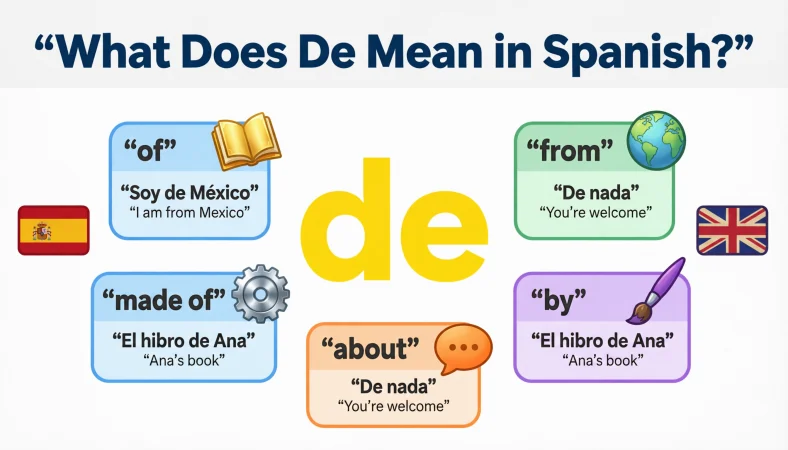
So, what does de mean in Spanish? Unlike many vocabulary words that have a single definition, de has multiple meanings depending on the context. It can translate to of, from, about, made of, belonging to, regarding, since, by, and several other English prepositions. Because of its versatility, mastering de is crucial for speaking and understanding Spanish naturally.
In this comprehensive guide, you’ll learn exactly what de means, where it comes from, how it’s used in everyday conversation, common expressions, grammar rules, practical examples, and mistakes to avoid.
De is a Spanish preposition that most commonly means “of” or “from” in English. Depending on context, it can also mean “about,” “made of,” “belonging to,” “since,” “by,” or indicate possession, origin, material, cause, and relationships. It is one of the most frequently used words in Spanish and appears in countless everyday expressions.
Here’s a quick overview:
| Spanish | Common English Meaning | Example |
| de | of | El libro de Juan. (Juan’s book.) |
| de | from | Soy de México. (I’m from Mexico.) |
| de | about | Hablamos de fútbol. (We talked about soccer.) |
| de | made of | Mesa de madera. (Wooden table.) |
| de | belonging to | La casa de Ana. (Ana’s house.) |
| de | by | Un poema de Neruda. (A poem by Neruda.) |
| de | since | De niño… (Since childhood…) |
The exact meaning depends entirely on the sentence.
Origin
The Spanish preposition de comes directly from the Latin word dē, which was widely used in Classical Latin.
Originally, dē expressed ideas such as:
- Down from
- Concerning
- About
- From
- Of
As Latin evolved into Spanish, de retained many of these meanings and became one of the language’s most versatile grammatical words.
Today, it is considered a foundational building block of Spanish grammar and is taught in beginner-level language courses around the world.
Popularity
The word de is one of the most frequently used words in Spanish.
You’ll find it in:
- Everyday conversations
- Books
- Newspapers
- Songs
- TV shows
- Movies
- Social media posts
- Academic writing
- Professional emails
- Legal documents
Native speakers use de dozens of times every day because it links nouns, indicates possession, describes materials, and expresses relationships.
Whether you’re speaking with someone from Spain, Mexico, Argentina, Colombia, Peru, or another Spanish-speaking country, de is indispensable.
How It Is Used
Because de has many meanings, understanding its most common uses is essential.
To Show Possession
One of the most common uses is expressing ownership.
Examples:
- El coche de Carlos.
- La mochila de María.
- Los juguetes del niño.
English:
- Carlos’s car.
- Maria’s backpack.
- The child’s toys.
Instead of using an apostrophe (‘s), Spanish uses de.
To Show Origin
Examples:
- Soy de España.
- Ella es de Chile.
- Somos de Colombia.
English:
- I’m from Spain.
- She’s from Chile.
- We’re from Colombia.
To Describe Material
Examples:
- Una mesa de madera.
- Un anillo de oro.
- Una camisa de algodón.
English:
- A wooden table.
- A gold ring.
- A cotton shirt.
To Talk About Topics
Examples:
- Hablamos de música.
- Leí un libro de historia.
- Pensé de eso.
English:
- We talked about music.
- I read a history book.
- I thought about that.
To Identify Authors
Examples:
- Un libro de Gabriel García Márquez.
- Una pintura de Picasso.
- Una canción de Shakira.
English:
- A book by Gabriel García Márquez.
- A painting by Picasso.
- A song by Shakira.
In Common Expressions
Spanish contains many everyday expressions with de.
Examples:
- De nada.
- De acuerdo.
- De repente.
- De vez en cuando.
- De verdad.
- De inmediato.
These phrases are used naturally by native speakers.
Examples
Friendly Examples
These examples are common in casual conversations.
- Soy de México. 😊
- ¿De dónde eres?
- Gracias. De nada.
- Hablamos de películas.
- Me gusta el café de Colombia.
- La bicicleta es de mi hermano.
- Ese regalo es de mamá.
Professional Examples
Formal communication also uses de frequently.
- El informe de ventas está listo.
- El director de la empresa asistirá a la reunión.
- Recibimos una carta de la universidad.
- El departamento de recursos humanos responderá pronto.
- Este documento fue preparado por el equipo de investigación.
Funny Examples
Spanish speakers often use de in humorous expressions.
😂 De lunes otra vez…
😅 De vacaciones… solo en mis sueños.
🤣 De dieta… hasta que vi el pastel.
🏖️ De trabajo, pero pensando en la playa.
☕ De café en café sobrevivo los lunes.
These playful examples highlight how naturally de appears in everyday speech.
Comparison with Similar Terms
Spanish learners often confuse de with other common prepositions.
| Word | Meaning | Example |
| De | Of, from | Soy de Perú. |
| Desde | From, since | Desde ayer. |
| En | In, on | Estoy en casa. |
| Por | By, through, because of | Viajo por tren. |
| Para | For, to | Es para ti. |
| Con | With | Voy con amigos. |
| Sin | Without | Café sin azúcar. |
De vs Desde
De often indicates origin.
- Soy de Argentina.
Desde emphasizes a starting point.
- Vivo aquí desde 2020.
De vs Por
De usually expresses possession or origin.
- El libro de Ana.
Por often indicates cause, movement, or means.
- Gracias por venir.
De vs Para
De
Indicates ownership.
- El coche de Luis.
Para
Indicates purpose or destination.
- Este regalo es para Luis.
Alternate Meanings
Besides its primary translations, de appears in many fixed expressions.
| Expression | Meaning |
| De nada | You’re welcome |
| De acuerdo | Agreed / Okay |
| De verdad | Really / Truly |
| De repente | Suddenly |
| De vez en cuando | From time to time |
| De inmediato | Immediately |
| De hecho | In fact |
| De memoria | From memory |
These expressions should be learned as complete phrases because their meanings aren’t always literal.
Professional or Polite Alternatives
Since de is a grammatical preposition rather than a conversational expression, there are no direct substitutes in most cases. However, some phrases containing de have more formal alternatives.
| Everyday Expression | Professional Alternative |
| De acuerdo | Estoy de acuerdo. |
| De inmediato | Lo antes posible. |
| De verdad | En efecto. |
| De pronto | Repentinamente. |
| De nada | Con mucho gusto. |
These alternatives are common in business communication, academic writing, and formal settings.
Common Mistakes
Many Spanish learners make predictable errors when using de.
Forgetting “de” After Certain Verbs
Some Spanish verbs require de.
Correct:
- Hablar de algo.
- Acordarse de algo.
- Depender de alguien.
Incorrect:
- Hablar algo.
- Acordarse algo.
Confusing De with Desde
Incorrect:
- Vivo aquí de 2018.
Correct:
- Vivo aquí desde 2018.
Omitting De in Possession
Incorrect:
- El libro Juan.
Correct:
- El libro de Juan.
Translating Every “Of” Literally
English and Spanish don’t always match perfectly.
Instead of translating word-for-word, learn common Spanish phrases naturally.
Forgetting Contractions
When de comes before el, they combine.
Correct:
- del profesor
Incorrect:
- de el profesor
Remember:
- de + el = del
However:
- de + ella = de ella
- de + ellos = de ellos
No contraction occurs except with el.
Quick Tips
Keep these practical tips in mind:
- Think of de as a relationship word.
- Learn common expressions instead of translating word-for-word.
- Remember that de + el = del.
- Use de to show possession instead of an apostrophe.
- Practice reading Spanish books to recognize common patterns.
- Memorize phrases like de nada and de acuerdo.
- Pay attention to verbs that require de.
- Listen to native speakers to understand natural usage.
- Don’t assume de always means “of.”
- Context always determines the correct translation.
FAQ
1. What does de mean in Spanish?
De usually means “of” or “from,” but it can also mean “about,” “made of,” “by,” “since,” or indicate possession, origin, or material.
2. Is de one of the most common Spanish words?
Yes. De is one of the most frequently used words in Spanish and appears in nearly every type of conversation and writing.
3. What is the difference between de and desde?
De often expresses origin or possession, while desde means “from” or “since” when referring to a starting point in time or place.
4. Why does de have so many meanings?
Spanish uses de as a versatile preposition that expresses many relationships, which English often conveys with different words.
5. What does “de nada” mean?
De nada means “You’re welcome.” It is a common response after someone says “Gracias.”
6. Why does de become del?
Spanish combines de and el into the contraction del. This contraction is mandatory whenever de is immediately followed by the masculine singular article el.
7. Can de mean “by” in Spanish?
Yes. When referring to an author, artist, or creator, de often translates as “by.” For example, Una novela de Isabel Allende means A novel by Isabel Allende.
8. How can I learn to use de correctly?
Practice reading, listening, and speaking Spanish regularly. Focus on common phrases, pay attention to context, and learn verbs and expressions that naturally use de.
Conclusion
Understanding what does de mean in Spanish is essential because this small word carries enormous importance in everyday communication. Whether you’re expressing possession, describing where someone is from, talking about a topic, identifying materials, or using common expressions like de nada and de acuerdo, de connects ideas throughout the Spanish language.
Rather than memorizing a single translation, think of de as a flexible preposition whose meaning depends on context. The more Spanish you read, hear, and speak, the more naturally you’ll recognize its many uses. By mastering de, you’ll improve your grammar, comprehension, and confidence in both casual conversations and professional communication.