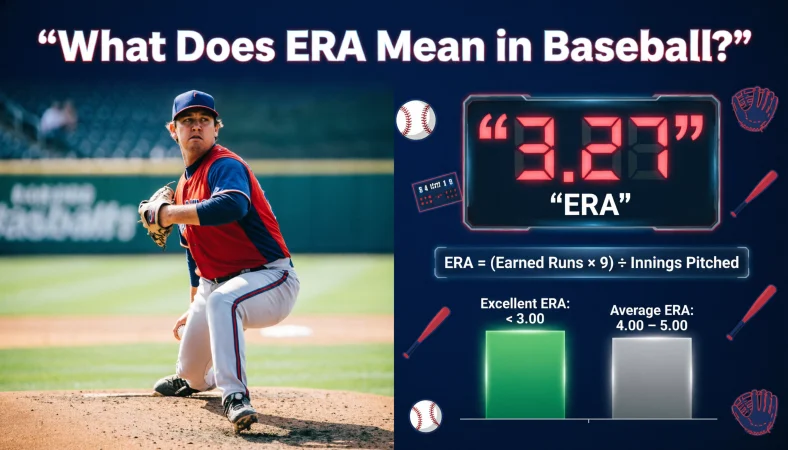
Definition: ERA stands for Earned Run Average in baseball. It is a pitching statistic that measures the average number of earned runs a pitcher allows per nine innings pitched. ERA helps evaluate a pitcher’s effectiveness by showing how well they prevent runs that are considered the pitcher’s responsibility.
If you’ve ever watched a baseball game, followed Major League Baseball (MLB), or checked a pitcher’s statistics, you’ve probably seen the abbreviation ERA. Alongside wins, strikeouts, and WHIP, ERA is one of the most important pitching statistics in baseball. Broadcasters mention it during games, analysts use it to evaluate pitchers, and fantasy baseball managers rely on it when building their teams.
But what does ERA mean in baseball, and why is it such an important number?
At its core, ERA helps measure how effective a pitcher is at preventing the opposing team from scoring. A lower ERA generally indicates better pitching performance, but understanding how ERA is calculated and its strengths and limitations can give you a much deeper appreciation of the game.
In this comprehensive guide, you’ll learn exactly what ERA means, how it’s calculated, where it originated, how it’s used today, how to interpret ERA values, common mistakes to avoid, and how it compares with other pitching statistics.
The official formula is:
ERA = (Earned Runs Allowed × 9) ÷ Innings Pitched
For example:
- Earned Runs Allowed: 20
- Innings Pitched: 90
ERA = (20 × 9) ÷ 90 = 2.00
This means the pitcher would allow an average of 2 earned runs every nine innings.
What Is an Earned Run?
An earned run is a run that scores without the aid of a defensive error or passed ball. If poor fielding contributes to a run scoring, that run may be classified as unearned and won’t count toward the pitcher’s ERA.
Origin
ERA has been part of baseball for more than a century.
The statistic became popular in the late 19th and early 20th centuries as baseball evolved and teams sought better ways to evaluate pitching performance. Before ERA, pitchers were often judged primarily by wins and losses. However, wins can depend heavily on a team’s offense and defense, making them an imperfect measure of individual performance.
By focusing only on earned runs, ERA offered a fairer assessment of a pitcher’s ability to prevent scoring.
Over time, Earned Run Average became one of the standard pitching statistics used in professional baseball, college baseball, youth leagues, and fantasy baseball.
Popularity
ERA remains one of the most recognized statistics in baseball.
You’ll encounter it in:
- MLB broadcasts
- Baseball scoreboards
- Sports websites
- Fantasy baseball leagues
- Baseball video games
- Player profiles
- Contract negotiations
- Hall of Fame discussions
- Analytics reports
Although modern advanced metrics like FIP, xERA, and WAR have become increasingly popular, ERA continues to be one of the first numbers fans look at when evaluating pitchers.
Its simplicity makes it easy for both beginners and experienced baseball fans to understand.
How It Is Used
ERA plays an important role in evaluating pitching performance throughout the baseball season.
Measuring Pitching Effectiveness
A lower ERA usually means a pitcher allows fewer earned runs and performs more effectively.
General guidelines include:
| ERA | Performance Level |
| Below 2.00 | Elite |
| 2.00–2.99 | Excellent |
| 3.00–3.49 | Very Good |
| 3.50–3.99 | Above Average |
| 4.00–4.49 | Average |
| 4.50–4.99 | Below Average |
| 5.00+ | Poor |
These benchmarks can vary slightly depending on the league and offensive environment.
Comparing Pitchers
ERA allows fans and analysts to compare pitchers.
Example:
| Pitcher | ERA |
| Pitcher A | 2.48 |
| Pitcher B | 4.37 |
All else being equal, Pitcher A has prevented earned runs much more effectively.
Fantasy Baseball
Fantasy baseball leagues often include ERA as one of the main pitching categories.
Managers aim to draft pitchers with consistently low ERAs because they contribute positively to team scoring.
Awards and Recognition
ERA is considered during voting for awards such as:
- Cy Young Award
- Most Valuable Player (MVP)
- All-Star selections
Pitchers who lead the league in ERA are often viewed as among the season’s best performers.
Team Strategy
Managers also use ERA when deciding:
- Starting rotations
- Bullpen roles
- Playoff matchups
- Pitching changes
A pitcher with a consistently low ERA is more likely to start important games.
Examples
Friendly Examples
Here are common conversations among baseball fans.
- “His ERA dropped below 3.00!”
- “She’s been pitching lights out with a 2.15 ERA.”
- “That’s an impressive ERA for a rookie.”
- “His ERA improved after the All-Star break.”
- “I’m drafting him in fantasy because of his low ERA.”
Professional Examples
Sports analysts frequently reference ERA.
Examples include:
- “The pitcher enters tonight’s game with a 2.84 ERA.”
- “His ERA ranks among the top five in the American League.”
- “Despite limited run support, he maintains an outstanding ERA.”
- “The bullpen has lowered its collective ERA this month.”
These examples are common during broadcasts, articles, and statistical analyses.
Funny Examples
Baseball fans often joke about ERA.
⚾ “My fantasy team’s ERA is higher than my GPA.”
😂 “Every time I watch my favorite pitcher, his ERA mysteriously goes up.”
🤣 “One bad inning turned my beautiful ERA into a horror story.”
😅 “ERA: Everyone Regrets April… after Opening Day disasters.”
While humorous, these jokes highlight how closely fans follow pitching statistics.
Comparison with Similar Terms
ERA is just one of many pitching metrics.
| Statistic | Meaning | Primary Purpose |
| ERA | Earned Run Average | Measures earned runs allowed per nine innings |
| WHIP | Walks plus Hits per Inning Pitched | Measures baserunners allowed |
| FIP | Fielding Independent Pitching | Evaluates pitching without defensive influence |
| xERA | Expected Earned Run Average | Estimates ERA using quality-of-contact data |
| WAR | Wins Above Replacement | Measures overall player value |
| Strikeout Rate (K/9) | Strikeouts per nine innings | Measures strikeout ability |
| Saves | Games finished with a lead | Evaluates relief pitchers |
ERA vs WHIP
ERA measures runs allowed.
WHIP measures how many baserunners a pitcher allows through hits and walks.
A pitcher may have:
- Low WHIP but average ERA
- High WHIP but low ERA
Each statistic tells a different story.
ERA vs FIP
ERA includes the effects of team defense.
FIP attempts to isolate only the pitcher’s performance by focusing on:
- Strikeouts
- Walks
- Hit batters
- Home runs
Many analysts compare both metrics together.
ERA vs xERA
Expected ERA (xERA) uses advanced tracking technology to estimate what a pitcher’s ERA should be based on contact quality.
It helps identify pitchers who may have been lucky or unlucky.
Alternate Meanings
Outside baseball, ERA has several other meanings.
| Field | Meaning |
| Baseball | Earned Run Average |
| History | Historical period or age |
| Economics | Economic Recovery Administration (historical) |
| Government | Equal Rights Amendment |
| Technology | Electronic Remittance Advice |
| Education | Education Reform Act (varies by country) |
Context determines the intended meaning. In baseball discussions, ERA almost always refers to Earned Run Average.
Professional or Polite Alternatives
Sports writers sometimes spell out ERA for readers who may not be familiar with baseball terminology.
Examples include:
- Earned Run Average
- Pitcher’s earned run average
- Average earned runs allowed per nine innings
- Pitching run-prevention statistic
- Standard pitching metric
Using the full term on first reference improves clarity, especially in educational content.
Common Mistakes
Many new baseball fans misunderstand ERA.
Thinking Lower ERA Is Worse
In baseball:
- Lower ERA = Better pitching
- Higher ERA = More earned runs allowed
This is the opposite of many offensive statistics where higher numbers are better.
Ignoring Innings Pitched
A pitcher with a 1.80 ERA over 15 innings hasn’t necessarily been better than someone with a 2.40 ERA over 200 innings.
Sample size matters.
Confusing Earned and Unearned Runs
Only earned runs count toward ERA.
Runs caused primarily by fielding errors are considered unearned and are excluded.
Judging Pitchers Only by ERA
ERA is valuable but shouldn’t be used alone.
Consider additional metrics like:
- WHIP
- Strikeouts
- Walk rate
- FIP
- xERA
- Innings pitched
A complete evaluation requires multiple statistics.
Assuming ERA Is Always Fair
Defense, ballpark dimensions, weather, and official scoring decisions can all influence ERA.
Advanced metrics help provide additional context.
Quick Tips
Use these tips to better understand ERA:
- Remember that lower ERA is generally better.
- Compare pitchers with similar workloads.
- Don’t judge a pitcher based on one game.
- Consider ERA alongside WHIP and FIP.
- Watch for trends over the course of a season.
- Understand the difference between earned and unearned runs.
- Check league averages for better context.
- Use ERA as one tool not the only one for evaluating pitchers.
- Fantasy baseball managers should balance ERA with strikeouts and wins.
- Keep an eye on advanced metrics to gain a fuller picture of pitching performance.
FAQ
1. What does ERA mean in baseball?
ERA stands for Earned Run Average, a statistic showing the average number of earned runs a pitcher allows per nine innings pitched.
2. How is ERA calculated?
The formula is:
ERA = (Earned Runs × 9) ÷ Innings Pitched
This standardizes pitching performance over a full nine-inning game.
3. What is considered a good ERA?
Generally:
- Below 3.00 = Excellent
- Around 3.50 = Very Good
- Around 4.00 = Average
- Above 5.00 = Poor
League averages can vary from season to season.
4. Why are unearned runs excluded from ERA?
Unearned runs result primarily from defensive mistakes, so they are not considered the pitcher’s responsibility.
5. Is a lower ERA better?
Yes. A lower ERA means the pitcher allows fewer earned runs, indicating stronger run prevention.
6. Does ERA matter in fantasy baseball?
Absolutely. Many fantasy baseball leagues use ERA as one of the core pitching categories when scoring teams.
7. What are the limitations of ERA?
ERA doesn’t fully account for defensive support, ballpark effects, or luck. Advanced metrics such as FIP and xERA provide additional insight.
8. What’s the difference between ERA and WHIP?
ERA measures earned runs allowed, while WHIP measures how many baserunners a pitcher allows through hits and walks. Both are valuable but evaluate different aspects of pitching.
Conclusion
Understanding what does ERA mean in baseball is essential for anyone who wants to better appreciate the game. Earned Run Average remains one of the most trusted and recognizable pitching statistics because it provides a simple way to evaluate how effectively a pitcher prevents earned runs over nine innings.
While ERA has its limitations and should be considered alongside modern metrics like WHIP, FIP, and xERA, it continues to serve as a cornerstone of baseball analysis. Whether you’re watching an MLB game, drafting a fantasy baseball team, or learning the sport for the first time, knowing how to interpret ERA will help you understand pitching performance with greater confidence and insight.