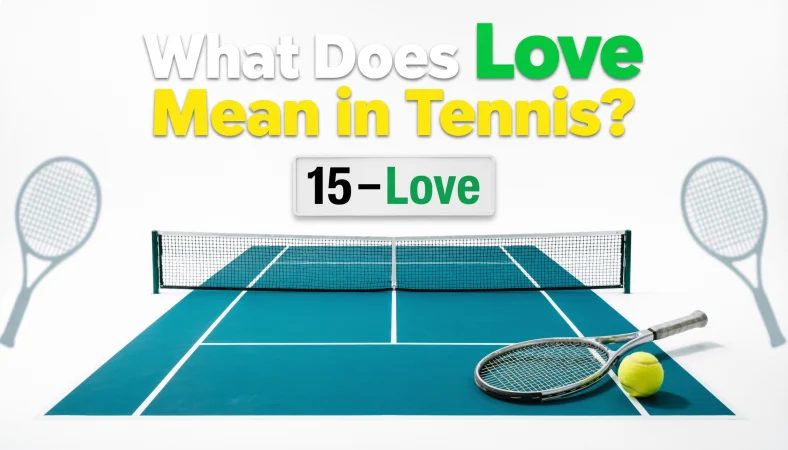
Definition: In tennis, “love” means a score of zero. It is used when a player has not yet won any points in a game. For example, “15-love” means one player has 15 points while the other has zero.
If you’ve ever watched a tennis match, you’ve probably heard the umpire announce scores like “15-love,” “30-love,” or even “love-all.” For many beginners, this raises an obvious question: what does love mean in tennis? After all, the word “love” usually refers to affection or romance not sports scoring.
In tennis, however, love has a completely different meaning. It simply represents a score of zero. While the term may sound unusual, it has been part of tennis vocabulary for centuries and remains one of the sport’s most distinctive traditions.
Understanding why tennis uses “love” instead of “zero” not only makes following matches easier but also provides insight into the fascinating history of one of the world’s most popular sports. In this comprehensive guide, you’ll learn the meaning of love in tennis, its possible origins, how it’s used during matches, common scoring examples, comparisons with other tennis terms, and answers to frequently asked questions.
Here are a few examples:
- 15-love = 15–0
- 30-love = 30–0
- 40-love = 40–0
- Love-all = 0–0 at the beginning of a game
Unlike most sports, tennis does not use the word “zero” when announcing scores. Instead, players, officials, commentators, and fans use love as part of the traditional tennis scoring system.
Origin
The exact origin of the word love in tennis is uncertain, but historians have proposed several well-known theories.
Theory 1: The French “L’œuf” Theory
The most widely accepted explanation is that the term comes from the French word “l’œuf,” meaning “the egg.”
An egg resembles the shape of the numeral 0, so French players may have used “l’œuf” to represent zero. Over time, English speakers are believed to have adapted the pronunciation into love.
Although no definitive historical evidence proves this theory, it remains the explanation most often cited by tennis historians.
Theory 2: Playing for the Love of the Game
Another popular theory suggests that players who had zero points were still playing “for the love of the game.”
According to this interpretation:
- A player with zero points was competing for enjoyment rather than prize money.
- The term “love” reflected sportsmanship rather than scoring.
While this explanation is appealing, historians generally consider it less likely than the French “l’œuf” theory.
Theory 3: Historical Language Evolution
Some researchers believe the term developed gradually as tennis spread across Europe, combining influences from French, English, and traditional sporting language.
Although the exact origin remains debated, the use of love for zero has become firmly established in modern tennis.
Popularity
The term love is recognized by millions of tennis fans worldwide.
You’ll hear it used during:
- Grand Slam tournaments
- ATP Tour events
- WTA Tour matches
- Davis Cup competitions
- Billie Jean King Cup matches
- Olympic tennis
- College tennis
- Local club matches
- Recreational games
Television commentators, chair umpires, coaches, and players all use the term consistently, making it one of the most recognizable words in tennis.
Even people who rarely watch tennis often recognize phrases such as “15-love” or “love-all.”
How It Is Used
The word love appears throughout tennis scoring.
1. Beginning of Every Game
When neither player has scored:
Love-all
Meaning:
0–0
2. One Player Scores First
If Player A wins the opening point:
15-love
Meaning:
15–0
3. One-Sided Games
Examples include:
- 30-love
- 40-love
- Game
These indicate one player is dominating the game.
4. Match Commentary
Commentators frequently say:
- “She’s serving at 30-love.”
- “He’s behind love-40.”
- “The opening game starts at love-all.”
5. Official Umpire Announcements
Chair umpires always announce scores using the official terminology.
For example:
“Thirty-love.”
instead of
“Thirty-zero.”
Examples
The following table explains common tennis scores involving love.
| Tennis Score | Numeric Score | Meaning |
| Love-all | 0–0 | Start of game |
| 15-love | 15–0 | Server wins first point |
| Love-15 | 0–15 | Receiver wins first point |
| 30-love | 30–0 | Two consecutive points |
| Love-30 | 0–30 | Opponent leads |
| 40-love | 40–0 | Three straight points |
| Love-40 | 0–40 | Triple break point |
| Game | Four points with required margin | Game won |
Friendly Examples
These examples help beginners understand tennis conversations.
- “The match starts at love-all. 🎾”
- “She quickly went up 30-love.”
- “He recovered after falling behind love-30.”
- “They were tied at love-all before an exciting rally.”
Professional Examples
Sports broadcasters and officials often say:
- “The server leads 40-love.”
- “He faces break point at love-40.”
- “The second set begins at love-all.”
- “She held serve after leading 30-love.”
Funny Examples
Fans sometimes joke using tennis scoring.
Examples include:
- “My cooking score today? Love-40. 🍳😂”
- “I’m losing this board game love-40 already!”
- “Monday morning energy: love-all until coffee. ☕”
- “My wallet after shopping? Love.”
These humorous examples borrow tennis terminology for everyday situations.
Comparison with Similar Terms
Understanding love becomes easier when compared with other tennis scoring terms.
| Tennis Term | Meaning | Difference from Love |
| Love | Zero points | Starting score or no points |
| 15 | First point | One point won |
| 30 | Second point | Two points won |
| 40 | Third point | Three points won |
| Deuce | 40–40 | Players tied near game point |
| Advantage | One-point lead after deuce | Temporary lead |
| Game | Four points won with margin | Ends the game |
| Set | Collection of games | Higher scoring unit |
| Match | Collection of sets | Determines winner |
Love vs Zero
There is no numerical difference.
- Love = 0
The only distinction is that tennis tradition uses “love” instead of “zero.”
Love vs Love-All
- Love = One player’s score is zero.
- Love-all = Both players have zero points.
Example:
- Love-15 = 0–15
- Love-all = 0–0
Alternate Meanings
Outside of tennis, love has many different meanings.
Romantic Affection
The most common meaning refers to deep emotional attachment.
Example:
“I love my family.”
Strong Enjoyment
Love can describe enthusiasm.
Example:
“I love pizza.”
Closing Phrase
People often sign letters with:
“Love, Sarah”
Score of Zero in Tennis
Within tennis, however, love always refers to zero points, not emotion.
Understanding the context makes the intended meaning clear.
Professional or Polite Alternatives
Unlike internet slang, love is the official term used in tennis scoring. However, when explaining the sport to beginners, commentators or coaches may clarify the score using more familiar language.
| Tennis Announcement | Beginner-Friendly Alternative |
| Love-all | Zero-all |
| 15-love | Fifteen to zero |
| Love-30 | Zero to thirty |
| 40-love | Forty to zero |
In coaching, instructors may say both versions to help new players learn the scoring system.
Common Mistakes
Many beginners misunderstand tennis scoring.
Mistake 1: Thinking Love Means Winning
Some assume “love” represents a positive score because of its everyday meaning.
In tennis, it simply means zero.
Mistake 2: Saying “Zero”
Official matches use:
- Love
instead of
- Zero
Although casual players may occasionally say “zero,” official scoring uses “love.”
Mistake 3: Confusing Games with Points
Example:
40-love refers to points within a game, not games within a set.
Mistake 4: Mixing Up Love-All and Deuce
Love-all = 0–0
Deuce = 40–40
These situations occur at completely different stages of a game.
Mistake 5: Assuming the Origin Is Certain
Many people believe the French “l’œuf” explanation is proven fact.
In reality, it remains the most widely accepted theory, but historians have not reached complete agreement on its exact origin.
Quick Tips
- Love always means zero in tennis.
- Love-all means both players have zero points.
- Official umpires never announce “zero.”
- Learn the sequence: Love, 15, 30, 40, Game.
- Remember that tennis scoring is based on tradition rather than simple arithmetic.
- Don’t confuse love with the everyday meaning of affection.
- Watching professional matches is one of the best ways to become familiar with tennis scoring.
- Practice calling scores aloud to become comfortable with the terminology.
FAQs
1. What does love mean in tennis?
Love means zero points in a tennis game.
2. Why is zero called love in tennis?
The exact origin is uncertain, but the most widely accepted theory is that it comes from the French word l’œuf, meaning “egg,” because an egg resembles the shape of the number zero.
3. What does love-all mean?
Love-all means both players have zero points, which is how every tennis game begins.
4. Is love used in professional tennis?
Yes. Love is the official scoring term used in professional, amateur, and recreational tennis around the world.
5. Does love mean losing?
Not necessarily. It simply indicates that a player has not yet scored in the current game. A player at love can still win the game, set, or match.
6. Why doesn’t tennis use zero?
Tennis follows a traditional scoring system that has been preserved for centuries, and “love” has become the accepted term for zero.
7. Is love used in table tennis or badminton?
No. Sports such as table tennis and badminton typically use standard numerical scoring rather than the term “love.”
8. What comes after love in tennis scoring?
After love (0), the sequence is 15, 30, 40, and then game, provided the player wins by the required margin.
Conclusion
If you’ve ever wondered what does love mean in tennis, the answer is straightforward: love is the official tennis term for a score of zero. Whether it’s “love-all” at the start of a game or “40-love” during a dominant service game, the term has been an essential part of tennis vocabulary for generations.
Although its exact origin remains uncertain, the French l’œuf theory remains the most widely accepted explanation for why tennis adopted this unique scoring term. Today, love is recognized by players, coaches, officials, commentators, and fans around the world, making it one of the sport’s most iconic traditions.
Understanding tennis scoring from love to deuce and advantage will help you enjoy matches more, follow live commentary with confidence, and appreciate the rich history behind one of the world’s most popular sports.