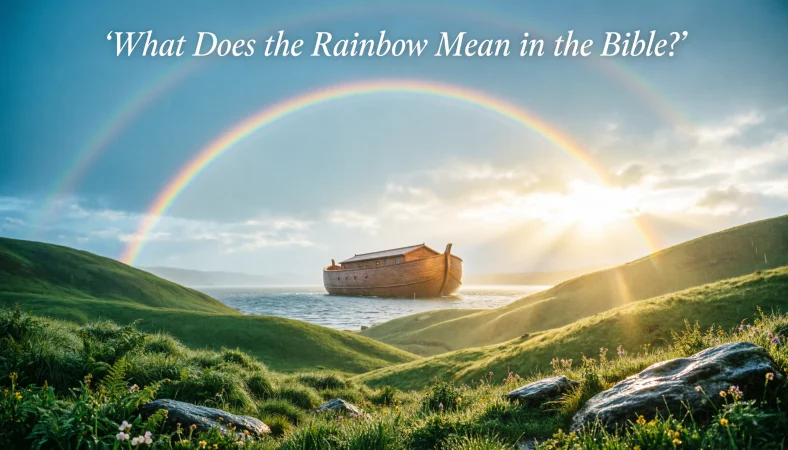
Definition: In the Bible, the rainbow is primarily a symbol of God’s covenant, faithfulness, mercy, and promise. It first appears in Genesis 9:12–17, where God places the rainbow in the sky as a sign of His covenant with Noah, promising never again to destroy all life on Earth by a worldwide flood. Throughout Scripture, the rainbow also represents God’s glory, hope, and divine presence.
If you’ve ever asked, “What does the rainbow mean in the Bible?”, the simplest answer is that the rainbow symbolizes God’s covenant with humanity after the Flood. It serves as a visible reminder of His promise, faithfulness, and enduring mercy.
According to the Book of Genesis, after Noah, his family, and the animals left the ark, God established a covenant with all living creatures. As a sign of that covenant, He placed the rainbow in the clouds.
The biblical rainbow is commonly associated with:
- 🌈 God’s covenant with Noah
- 🙏 Faithfulness and trustworthiness
- ❤️ Mercy instead of judgment
- 🌎 Hope for humanity
- ✨ Divine promises
- 👑 God’s glory and majesty
While rainbows naturally occur because sunlight is refracted through water droplets, the Bible gives the rainbow additional spiritual significance as a symbol chosen by God.
Key Biblical Themes of the Rainbow
The rainbow represents several important biblical themes:
- God’s faithfulness never changes.
- His promises can be trusted.
- Mercy triumphs after judgment.
- Hope follows difficult seasons.
- God remembers His covenant with creation.
These themes have made the rainbow one of the most recognizable biblical symbols across Christian traditions.
Few natural wonders inspire as much awe as a rainbow stretching across the sky after a storm. For many Christians, it is more than a beautiful display of colors, it is a reminder of one of the Bible’s most powerful promises.
The rainbow first appears after one of Scripture’s most dramatic events: the Great Flood. After the floodwaters receded, God made a covenant with Noah, promising that He would never again destroy all living creatures with a worldwide flood. To confirm this everlasting covenant, He chose the rainbow as its visible sign.
Over time, the rainbow has become a symbol of hope, renewal, grace, and God’s faithfulness. It reminds believers that even after seasons of judgment, suffering, or uncertainty, God’s promises remain secure.
Today, many people encounter the rainbow in different cultural, artistic, and social contexts. However, understanding its biblical meaning helps readers appreciate its original significance within Scripture and its continuing role in Christian faith and teaching.
Origin
The biblical origin of the rainbow is found in Genesis 9:12–17, immediately following the account of Noah’s Ark and the Great Flood.
According to the Bible, after Noah offered a sacrifice to God, God established an everlasting covenant with Noah, his descendants, and every living creature on Earth.
God declared:
- Never again would a worldwide flood destroy all life.
- The covenant would remain for future generations.
- The rainbow would serve as the visible sign of this promise.
Unlike many biblical symbols that develop gradually throughout Scripture, the rainbow receives a clear explanation when it is first introduced.
The Covenant with Noah
The covenant made with Noah is unique because it extends beyond one individual or nation.
It includes:
- Noah and his family
- Every future generation
- Every living creature
- The entire Earth
Because of this universal scope, the rainbow symbolizes God’s care not only for humanity but for all creation.
Other Biblical References
Although Genesis contains the primary explanation of the rainbow, similar imagery appears elsewhere in the Bible.
For example:
- Ezekiel 1:28 compares the appearance of God’s glory to the brilliance of a rainbow.
- Revelation 4:3 describes a rainbow surrounding God’s heavenly throne.
- Revelation 10:1 portrays a mighty angel with a rainbow above his head.
In these passages, the rainbow symbolizes God’s majesty, holiness, and glorious presence rather than His covenant with Noah alone.
Popularity
The biblical meaning of the rainbow remains one of the most widely recognized symbols in Christianity.
Its popularity comes from several factors:
- It appears early in the Bible.
- Children often learn the story of Noah’s Ark.
- Churches frequently include rainbow imagery in educational materials.
- Christian artwork has depicted the rainbow for centuries.
- It symbolizes hope, making it meaningful during difficult times.
The rainbow is commonly featured in:
- Sunday school lessons
- Christian children’s books
- Church murals
- Religious artwork
- Bible studies
- Sermons
- Inspirational devotionals
Because the rainbow combines natural beauty with deep spiritual meaning, it continues to resonate with believers of all ages.
Biblical References at a Glance
| Bible Passage | Meaning of the Rainbow |
| Genesis 9:12–17 | God’s covenant with Noah and all living creatures |
| Ezekiel 1:28 | The glory and brilliance of God’s presence |
| Revelation 4:3 | God’s heavenly throne surrounded by glory |
| Revelation 10:1 | Divine authority and heavenly majesty |
These passages show that while the rainbow first symbolizes God’s covenant, it later becomes associated with His glory and holiness.
How It Is Used
The rainbow continues to be used in Christian teaching, worship, and personal reflection as a reminder of God’s promises.
As a Symbol of God’s Faithfulness
Many Christians view a rainbow after rainfall as a reminder that God keeps His promises.
It encourages believers to trust God’s faithfulness, even during life’s storms.
In Bible Teaching
Pastors and Bible teachers often use the rainbow to explain:
- God’s covenant
- Mercy after judgment
- The importance of faith
- God’s love for creation
- Hope during difficult circumstances
Because the symbolism is easy to understand, it is especially effective when teaching children.
In Christian Art
Artists frequently include rainbows in paintings depicting:
- Noah’s Ark
- The Great Flood
- Heavenly scenes
- God’s throne
- Angels
- Creation
These artistic representations emphasize hope, beauty, and divine promise.
In Personal Devotion
Some believers use the rainbow as a personal reminder to:
- Pray with confidence.
- Remember God’s promises.
- Remain hopeful during hardships.
- Trust God’s timing.
- Reflect on His mercy and grace.
While Christians may interpret personal experiences differently, many find that the biblical symbolism of the rainbow encourages gratitude and faith.
Examples
Understanding the rainbow’s biblical meaning becomes easier through practical examples.
Example Table
| Situation | Biblical Meaning |
| Seeing a rainbow after heavy rain | A reminder of God’s covenant and faithfulness |
| Reading Genesis 9 | Learning about God’s promise to Noah |
| Studying Revelation | Seeing the rainbow connected to God’s heavenly glory |
| Teaching children about Noah’s Ark | Explaining God’s mercy and everlasting promise |
Friendly Examples
These examples reflect everyday conversations among Christians.
- “Every time I see a rainbow, I’m reminded of God’s promise to Noah. 🌈”
- “The rainbow reminds me that hope comes after difficult seasons.”
- “Our Bible study discussed how the rainbow represents God’s faithfulness.”
- “Seeing a rainbow after the storm encouraged me to trust God’s plan.”
Professional Examples
Teachers, pastors, and Christian writers often explain the symbol using more formal language.
- “In biblical theology, the rainbow functions as the visible sign of God’s covenant with creation.”
- “Genesis presents the rainbow as a symbol of divine mercy following judgment.”
- “The imagery of the rainbow in Revelation emphasizes God’s majesty and heavenly glory.”
- “Throughout Scripture, the rainbow represents faithfulness, covenant, and hope.”
Funny Examples
Although the rainbow carries deep spiritual meaning, lighthearted examples can help make discussions more memorable.
- “No, Noah didn’t invent the rainbow.it was God’s idea! 🌈😄”
- “Every rainbow reminds me that God keeps promises better than my weather app predicts sunshine.”
- “The rainbow is proof that even after a storm, something beautiful can appear.”
These examples show how the rainbow’s biblical symbolism can be discussed in educational, devotional, and conversational settings while maintaining respect for its significance.
Comparison with Similar Terms
The rainbow is one of several important biblical symbols that represent God’s relationship with humanity. Although these symbols share themes such as faith, hope, and redemption, each has a unique purpose and meaning in Scripture.
| Biblical Symbol | Primary Meaning | Key Bible Reference |
| Rainbow | God’s covenant, mercy, and faithfulness | Genesis 9:12–17 |
| Ark | Salvation, protection, and obedience | Genesis 6–8 |
| Olive Branch | Peace, renewal, and the end of the Flood | Genesis 8:11 |
| Cross | Jesus’ sacrifice and redemption | Matthew 27; John 19 |
| Lamb | Innocence, sacrifice, and Christ as the Lamb of God | John 1:29 |
| Dove | Peace, hope, and the Holy Spirit | Genesis 8:8–12; Matthew 3:16 |
Rainbow vs. Olive Branch
These two symbols are often connected because both appear in the story of Noah.
| Rainbow | Olive Branch |
| Symbolizes God’s everlasting covenant | Symbolizes the floodwaters receding and the return of peace |
| Given directly by God as a sign | Brought back by the dove as evidence of renewal |
| Represents divine promise | Represents hope and restoration |
While both symbolize hope, the rainbow specifically points to God’s covenant, whereas the olive branch represents the end of judgment and the beginning of a new chapter.
Alternate Meanings
Although this article focuses on the Bible, the rainbow has several meanings across different cultures and contexts.
Scientific Meaning
Scientifically, a rainbow forms when sunlight is refracted, reflected, and dispersed through water droplets, creating a spectrum of colors.
Cultural Symbol
Many cultures throughout history have viewed rainbows as symbols of hope, peace, beauty, or a bridge between heaven and earth.
Modern Symbolism
In contemporary society, the rainbow is used in various movements, organizations, and artistic expressions. Depending on the context, it may represent diversity, inclusion, celebration, or hope.
Because the rainbow has multiple meanings today, it’s helpful to distinguish its biblical symbolism from its use in other cultural or social settings.
Professional or Polite Alternatives
When discussing the rainbow in academic, religious, or interfaith settings, using precise language helps communicate respectfully and clearly.
Instead of making broad statements, consider phrases such as:
- “According to the Bible, the rainbow symbolizes God’s covenant with Noah.”
- “In Christian theology, the rainbow is understood as a sign of God’s faithfulness.”
- “The biblical account presents the rainbow as a reminder of God’s promise.”
- “Many Christians interpret the rainbow as a symbol of mercy and hope.”
- “Scripture associates the rainbow with God’s covenant and divine glory.”
These alternatives acknowledge the biblical context while respecting readers from different backgrounds and beliefs.
Common Mistakes
When exploring what the rainbow means in the Bible, people sometimes misunderstand its purpose or symbolism.
1. Thinking the Rainbow Represents Only Beauty
Although rainbows are visually stunning, the Bible gives them a much deeper meaning. They primarily symbolize God’s covenant and faithfulness, not simply beauty.
2. Ignoring the Context of Genesis
The rainbow appears after the Flood and is directly connected to God’s promise to Noah. Reading the passage in context helps clarify its significance.
3. Confusing Biblical and Modern Meanings
Because the rainbow has many uses today, it’s important not to assume every appearance of a rainbow refers to the biblical covenant. Context always matters.
4. Treating the Rainbow as a Good-Luck Charm
The Bible does not describe the rainbow as a magical object or a guarantee of personal success. Instead, it serves as a reminder of God’s promises and character.
5. Overlooking Later Biblical References
Many readers know the story in Genesis but forget that the rainbow also appears in Ezekiel and Revelation, where it symbolizes God’s glory and majesty.
Quick Tips
Keep these key points in mind when studying the biblical meaning of the rainbow:
- 🌈 Read Genesis 9:12–17 to understand its original meaning.
- 📖 Remember that the rainbow represents God’s covenant, not merely a natural phenomenon.
- 🙏 Reflect on themes of hope, mercy, and faithfulness.
- ✨ Explore later references in Ezekiel and Revelation for additional symbolism.
- 🕊️ Distinguish biblical symbolism from cultural or modern interpretations.
- 📚 Study the rainbow alongside related biblical symbols such as the ark, dove, and olive branch.
- ❤️ Focus on what the rainbow reveals about God’s character and promises.
FAQs
1. What does the rainbow mean in the Bible?
The rainbow is a sign of God’s covenant with Noah and all living creatures, symbolizing His promise never to destroy the earth again with a worldwide flood. It also represents God’s mercy, faithfulness, and hope.
2. Where is the rainbow first mentioned in the Bible?
The rainbow first appears in Genesis 9:12–17, immediately after the Flood, when God establishes His covenant with Noah.
3. Why did God choose the rainbow?
According to Scripture, God chose the rainbow as the visible sign of His everlasting covenant with humanity and every living creature. The Bible does not explain why this particular sign was chosen, but it clearly identifies its purpose.
4. Does the rainbow symbolize God’s promise?
Yes. In the Bible, the rainbow is one of the clearest symbols of God’s promise, reminding believers of His faithfulness and commitment to His covenant.
5. Is the rainbow mentioned anywhere besides Genesis?
Yes. Rainbow imagery also appears in Ezekiel 1:28, Revelation 4:3, and Revelation 10:1, where it is associated with God’s glory, majesty, and heavenly presence.
6. What can Christians learn from the rainbow?
The rainbow reminds Christians to trust God’s promises, remember His mercy, remain hopeful during difficult times, and appreciate His faithfulness throughout history.
7. Is the rainbow only important to Christians?
The story of Noah and the rainbow is also significant in Judaism, as it is part of the Hebrew Bible. Beyond religion, the rainbow holds different meanings in many cultures around the world.
8. How should I interpret the rainbow today?
For Christians, the rainbow can serve as a reminder of God’s covenant and enduring faithfulness. At the same time, recognizing that it also has scientific and cultural meanings can help foster respectful conversations in diverse settings.
Conclusion
If you’ve been asking, “What does the rainbow mean in the Bible?”, the answer begins with God’s covenant in Genesis 9 and extends throughout Scripture as a symbol of faithfulness, mercy, hope, and divine glory. After the Flood, God chose the rainbow as a visible reminder of His promise to Noah, his descendants, and every living creature that He would never again destroy the earth with a worldwide flood.
Later biblical passages in Ezekiel and Revelation deepen this symbolism by connecting the rainbow with God’s majestic presence and heavenly throne. Together, these references show that the rainbow is more than a beautiful natural phenomenon. It is a powerful biblical reminder of God’s unchanging character and enduring promises.
Whether you encounter the rainbow while reading the Bible, attending church, or seeing one after a storm, its biblical message encourages trust, gratitude, and hope. By understanding its original context and broader significance, believers can appreciate one of Scripture’s most meaningful and enduring symbols.
Read More Articles About:
- What Is a Redshirt In College Football? Complete NCAA Guide for 2026
- What Does Grace Mean in the Bible? A Complete Biblical Guide In 2026
- What Does ADP Stand For In Fantasy Football? Beginner’s Guide For 2026
- What Does N Mean In Statistics? Difference Between N and n,Explained In 2026