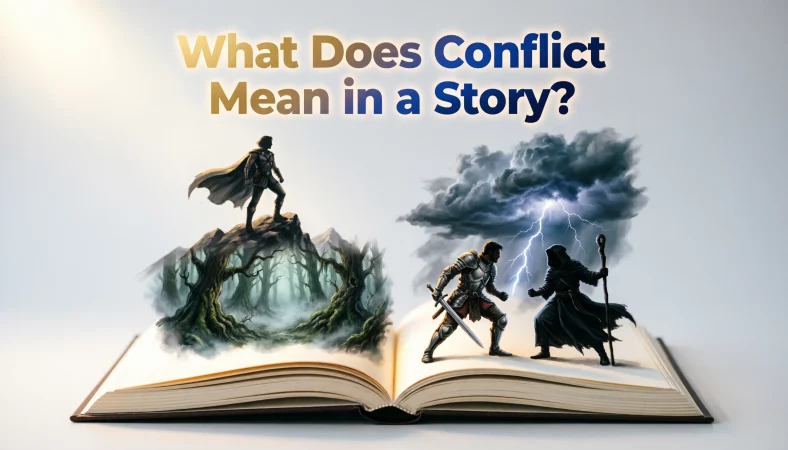
Definition: Conflict in a story is the struggle, challenge, or opposition that a character faces while trying to achieve a goal. It creates tension, drives the plot forward, develops characters, and keeps readers or viewers engaged. Without conflict, most stories would lack excitement, purpose, and emotional impact.
If you’ve ever wondered “what does conflict mean in a story?”, the simple answer is that conflict is the central problem or obstacle that a character must overcome. It is one of the most important elements of storytelling because it creates suspense, motivates characters, and gives readers a reason to keep turning the pages.
Conflict can take many forms. Sometimes it’s a disagreement between two characters, while other times it’s an internal struggle within a character’s mind. A story may also involve challenges from society, nature, or even technology.
In literature and creative writing, conflict is not always about fighting or arguing. Instead, it refers to any force that prevents the protagonist from reaching their goal.
Key Characteristics of Story Conflict
- Creates challenges for the main character
- Moves the plot forward
- Builds suspense and curiosity
- Reveals character growth
- Leads to important decisions
- Creates emotional engagement
- Usually reaches a climax before being resolved
Why Conflict Matters
Imagine reading a story where everything goes perfectly. The main character gets exactly what they want without any obstacles or difficult decisions. Most readers would quickly lose interest.
Conflict gives stories purpose. It creates questions such as:
- Will the hero succeed?
- Can the relationship survive?
- Will the mystery be solved?
- How will the character change?
These questions keep readers emotionally invested until the story reaches its conclusion.
Every memorable story from classic novels and blockbuster movies to fairy tales and television series has one thing in common: conflict.
Whether Harry Potter faces Voldemort, Sherlock Holmes solves a mystery, or a young entrepreneur struggles to build a successful business, conflict is the force that makes the story meaningful.
Many new writers mistakenly believe conflict only means physical battles or heated arguments. In reality, the most powerful conflicts are often emotional, psychological, or moral. A character deciding whether to forgive someone, choosing between two dreams, or overcoming self-doubt can be just as compelling as an action-packed adventure.
Understanding what conflict means in a story is essential for students, writers, teachers, and anyone interested in literature. Once you recognize how conflict works, you’ll begin noticing it in almost every book, movie, television show, and even real-life storytelling.
Origin
The concept of conflict in storytelling dates back thousands of years.
Ancient myths, legends, and epic poems often centered around heroes overcoming enormous obstacles. Early storytellers understood that audiences connected more deeply with characters who faced meaningful challenges.
One of the earliest discussions of dramatic conflict comes from the ancient Greek philosopher Aristotle, whose work Poetics explained how stories should contain action, tension, and resolution. Although he didn’t use modern storytelling terminology exactly as we do today, his ideas laid the foundation for understanding plot and dramatic structure.
Over time, literary scholars and writers expanded these ideas, identifying different types of conflict that appear across novels, plays, films, and short stories.
Today, conflict is considered one of the core building blocks of fiction and narrative writing taught in schools, universities, and creative writing courses around the world.
Popularity
Conflict is one of the most widely discussed concepts in literature because it appears in virtually every genre.
You’ll find conflict in:
- Adventure novels
- Romance stories
- Science fiction
- Fantasy books
- Mystery novels
- Horror stories
- Historical fiction
- Children’s literature
- Movies
- Television series
- Video games
Its popularity has grown alongside storytelling itself because readers naturally enjoy watching characters solve problems and overcome adversity.
Writers, teachers, and literary critics frequently discuss conflict when analyzing famous works because it explains why certain stories feel exciting, emotional, or unforgettable.
Common Types of Conflict
| Conflict Type | Description | Example |
| Character vs. Character | Two characters oppose each other | A detective chasing a criminal |
| Character vs. Self | Internal emotional struggle | Overcoming fear or guilt |
| Character vs. Nature | Battling natural forces | Surviving a hurricane |
| Character vs. Society | Challenging social rules | Fighting injustice |
| Character vs. Technology | Facing advanced machines or AI | Humans versus robots |
| Character vs. Fate/Supernatural | Fighting destiny or magical forces | Breaking an ancient curse |
These categories help readers and writers understand the source of a story’s tension.
How It Is Used
Conflict is used throughout a story to create interest, reveal character, and shape the narrative from beginning to end.
At the Beginning
The conflict is usually introduced early to establish the protagonist’s goal and the obstacle standing in their way.
For example:
- A student wants to win a scholarship but struggles with self-confidence.
- A detective is assigned a difficult murder case.
- A young athlete dreams of competing nationally after an injury.
Introducing conflict early gives readers a reason to continue reading.
During the Story
As the story progresses, the conflict becomes more challenging.
Characters may experience:
- Unexpected setbacks
- Difficult choices
- Emotional struggles
- New enemies
- Changing relationships
- Moral dilemmas
Each obstacle increases tension and helps develop both the plot and the characters.
At the Climax
The climax is the moment when the conflict reaches its highest point.
This is where the protagonist must face their greatest challenge.
Examples include:
- The final courtroom verdict
- The championship match
- A life-changing confession
- The confrontation with the villain
The climax often determines whether the character succeeds or fails.
During the Resolution
After the climax, the conflict is resolved.
The ending may be:
- Happy
- Sad
- Bittersweet
- Hopeful
- Open-ended
The resolution shows how the conflict changed the characters and what they learned from their experiences.
Examples
Understanding conflict becomes easier when you see it in different contexts.
Story Conflict Examples
| Story Idea | Main Conflict |
| A girl wants to become a pilot | She must overcome financial and personal obstacles. |
| A detective investigates a crime | The criminal keeps staying one step ahead. |
| Two best friends fall in love with the same person | Their friendship is tested. |
| A family survives after a flood | They battle the forces of nature. |
| A teenager struggles with anxiety before giving a speech | Internal fear becomes the biggest obstacle. |
Friendly Examples
These examples use simple, everyday language suitable for classrooms or casual discussions.
- “The conflict begins when the main character loses the treasure map.”
- “Her biggest conflict isn’t the dragon it’s believing in herself.”
- “The story becomes exciting because the hero faces one challenge after another.”
- “Even a simple misunderstanding can create conflict in a story.”
Professional Examples
Teachers, authors, editors, and literary critics often describe conflict in more formal terms.
- “The novel’s central conflict drives both the narrative structure and character development.”
- “Internal conflict reveals the protagonist’s emotional complexity.”
- “External conflict establishes the primary obstacles within the plot.”
- “The resolution effectively resolves the central dramatic conflict while reinforcing the story’s theme.”
Funny Examples
Learning literary terms doesn’t have to be boring!
- “The hero’s greatest conflict? Trying to save the world before their phone battery dies. 📱😂”
- “The dragon wasn’t the problem the hero forgot the sword at home!”
- “His biggest internal conflict was choosing between pizza and tacos for dinner. 🌮🍕”
These humorous examples show that conflict simply means facing an obstacle, whether serious or lighthearted.
Comparison with Similar Terms
Students and new writers often confuse conflict with other storytelling elements such as plot, theme, or climax. While these concepts are closely related, each serves a different purpose in a narrative.
| Term | Meaning | How It Differs from Conflict |
| Conflict | The struggle or obstacle a character faces | Drives the story by creating tension and challenges |
| Plot | The sequence of events in a story | Conflict is a key part of the plot but not the entire plot |
| Theme | The central message or lesson | Theme explains what the story means, while conflict creates the journey |
| Climax | The most intense moment in the story | The climax is where the main conflict reaches its peak |
| Resolution | The ending where problems are solved | Resolves the conflict and shows the outcome |
| Character Development | How a character changes throughout the story | Conflict often causes or influences that growth |
Conflict vs. Plot
A common misconception is that conflict and plot are the same thing. In reality, the plot is the story’s roadmap, while conflict is the engine that keeps it moving.
For example:
- Plot: A young explorer searches for a lost city.
- Conflict: Dangerous terrain, rival explorers, and self-doubt threaten the mission.
Without conflict, the plot would have little excitement or purpose.
Alternate Meanings
Although this article focuses on conflict in storytelling, the word conflict has several meanings depending on the context.
Personal Conflict
A disagreement or argument between individuals.
Example:
“The conflict between the two friends ended after an honest conversation.”
Workplace Conflict
Differences in opinions, goals, or communication styles among colleagues.
Example:
“The manager resolved the conflict through mediation.”
Military Conflict
A large-scale armed struggle between countries or groups.
Example:
“The documentary explored the causes of the international conflict.”
Internal Conflict
An emotional or psychological struggle within a person.
While commonly discussed in literature, internal conflict also exists in real life when people face difficult decisions or conflicting emotions.
Understanding the context helps determine which meaning of conflict is being used.
Professional or Polite Alternatives
Depending on your audience, you may prefer more formal or specific terms instead of repeatedly using the word conflict.
Some useful alternatives include:
- Challenge
- Obstacle
- Struggle
- Opposition
- Dilemma
- Tension
- Complication
- Disagreement
- Rivalry
- Confrontation
- Problem
- Difficulty
Choosing the Right Alternative
| Alternative | Best Used When |
| Challenge | Referring to a difficult task or situation |
| Obstacle | Describing something blocking progress |
| Dilemma | Explaining a difficult decision between options |
| Tension | Highlighting emotional or dramatic pressure |
| Complication | Introducing a new problem in the plot |
| Struggle | Focusing on emotional or physical hardship |
Using varied vocabulary makes writing more engaging while maintaining clarity.
Common Mistakes
Even experienced writers occasionally misuse or misunderstand conflict. Here are some of the most common mistakes.
1. Thinking Conflict Means Fighting
Conflict does not always involve physical violence or loud arguments.
A character silently questioning their life choices can create just as much tension as a dramatic confrontation.
2. Creating Weak Stakes
Readers care about conflict when something meaningful is at risk.
Instead of giving characters minor inconveniences, give them obstacles that affect their dreams, relationships, values, or future.
3. Resolving Conflict Too Quickly
A story becomes less satisfying if major problems disappear without effort.
Strong narratives allow characters to struggle, make mistakes, learn, and earn their success.
4. Using Only External Conflict
Many memorable stories combine external conflict with internal conflict.
For example, a firefighter may battle a wildfire while also struggling with fear after a previous accident.
5. Forgetting Character Growth
Conflict should change the protagonist.
Ask yourself:
- What did the character learn?
- How did they grow?
- What choices shaped the ending?
If nothing changes, the conflict may feel unnecessary.
Quick Tips
Whether you’re reading literature or writing your own story, these tips can help you understand and create stronger conflict.
- 🎯 Give your protagonist a clear goal.
- 🚧 Introduce believable obstacles.
- ❤️ Include emotional consequences, not just physical challenges.
- 📈 Increase the difficulty as the story progresses.
- 🤔 Mix internal and external conflict whenever possible.
- 💬 Use dialogue to reveal disagreements naturally.
- 📚 Study successful novels and films to see conflict in action.
- ✍️ Ensure the resolution feels earned rather than rushed.
FAQ
1. What does conflict mean in a story?
Conflict is the central struggle, problem, or obstacle that prevents a character from achieving their goal. It creates tension and drives the plot forward.
2. Why is conflict important in storytelling?
Conflict keeps readers interested, develops characters, builds suspense, and gives the story direction. Without conflict, most narratives would feel flat and predictable.
3. What are the main types of conflict?
The most common types are:
- Character vs. Character
- Character vs. Self
- Character vs. Nature
- Character vs. Society
- Character vs. Technology
- Character vs. Fate or the Supernatural
4. Can a story have more than one conflict?
Yes. Many stories include several conflicts. A protagonist may face an external challenge while also dealing with internal doubts or emotional struggles.
5. What is the difference between internal and external conflict?
Internal conflict happens within a character’s mind or emotions, while external conflict involves outside forces such as other people, nature, society, or technology.
6. Is every story required to have conflict?
Most stories include some form of conflict because it creates interest and movement. Even quiet, character-driven stories typically feature emotional or personal struggles.
7. How does conflict affect character development?
Conflict forces characters to make decisions, face consequences, and adapt to challenges. These experiences often shape their personalities, beliefs, and relationships.
8. What is an example of conflict in a story?
A young athlete recovering from an injury while trying to qualify for a championship is an example of both external and internal conflict. The injury creates a physical obstacle, while self-doubt adds emotional tension.
Conclusion
Understanding what conflict means in a story is essential for anyone who enjoys reading, writing, or studying literature. Conflict is far more than an argument or a battle. it is the force that challenges characters, creates suspense, and keeps readers emotionally invested from beginning to end.
Whether the struggle is between two characters, within a person’s mind, or against society, nature, or technology, conflict gives every story purpose. It pushes characters to grow, influences important decisions, and ultimately shapes the plot and theme.
As you read books or create your own stories, pay close attention to the conflicts your characters face. Strong, believable conflict makes narratives more engaging, memorable, and meaningful. By balancing compelling challenges with realistic character growth, you can craft stories that resonate with readers long after the final page.
Read More Articles About:
- What Does Sigma Mean? Slang Definition, History & Online Trends In 2026
- What Does Grace Mean in the Bible? A Complete Biblical Guide In 2026
- What Does ADP Stand For In Fantasy Football? Beginner’s Guide For 2026





3 thoughts on “What Is Conflict In A Story? Meaning, Types, Examples & Why It Matters In 2026”