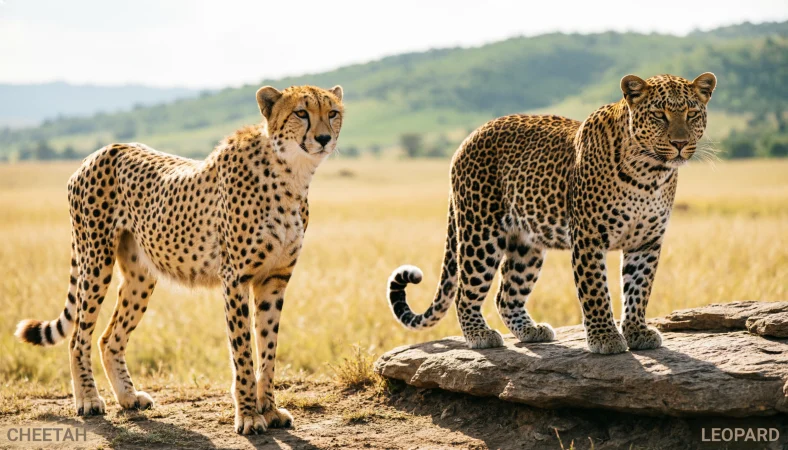
Cheetah and leopard are both correct words, but they refer to two different big cats with distinct physical features and hunting styles. A cheetah is known for its slim body, black tear marks running from its eyes to its mouth, and exceptional running speed. A leopard has a stronger, more muscular build and distinctive rosette-shaped spots, making it an excellent climber.
Understanding the difference between cheetah or leopard helps you identify these animals by their appearance, behavior, and natural abilities.
Have you ever wondered how to tell a cheetah or leopard apart? At first glance, these spotted big cats may look similar, but their body shapes, markings, and behaviors reveal important differences.
Cheetahs are built for speed and chase prey across open grasslands, while leopards rely on strength, stealth, and climbing ability to hunt and protect their food. Recognizing these characteristics makes it easier to understand what separates the two animals.
In this guide, you will learn the key differences between cheetahs and leopards, including their appearance, speed, habitats, hunting techniques, and typical behavior.
Through clear explanations and practical comparisons, you will discover how to identify each cat and understand how its physical adaptations support its survival in the wild.
Cheetah vs Leopard: What’s the Difference?
The main difference between a cheetah and a leopard is their physical build and hunting strategy. Cheetahs are built for speed across open ground, while leopards rely on strength, stealth, and climbing skills to catch prey in a variety of habitats.
Both belong to the cat family, Felidae, but they are different species with distinct adaptations.
What Is a Cheetah?
A cheetah (Acinonyx jubatus) is a large carnivorous mammal famous for its speed. It has a lightweight body, long legs, a deep chest, a flexible spine, and a long tail that helps it balance during sharp turns.
Its coat is usually tan or golden with separate, solid black spots. One of its most recognizable features is the pair of dark lines running from the inner corners of its eyes down toward the sides of its mouth. These are often called tear marks.
Cheetahs generally hunt by stalking prey before launching a rapid chase. They commonly pursue gazelles and other medium sized animals in open grasslands and savannas, where they can use their acceleration and speed.
Although cheetahs are fast, they cannot maintain their highest speeds for long. A chase requires substantial energy, and a cheetah needs time to recover afterward.
What Is a Leopard?
A leopard (Panthera pardus) is a large carnivorous mammal known for its muscular build, rosette shaped coat markings, and ability to adapt to different environments.
Unlike the cheetah’s mostly solid spots, a leopard’s coat usually features dark markings arranged in clusters that resemble roses. These rosettes often contain lighter centers, although their appearance varies across the body.
Leopards have strong shoulders, powerful jaws, retractable claws, and excellent climbing ability. They can drag prey into trees in some circumstances, helping protect a meal from scavengers and competing predators.
Leopards inhabit a wide range of environments, including forests, savannas, woodlands, mountains, and some dry regions. Their ability to live in varied habitats makes them highly adaptable predators.
Cheetah vs Leopard Comparison Table
| Feature | Cheetah | Leopard |
| Scientific name | Acinonyx jubatus | Panthera pardus |
| Body shape | Slim and aerodynamic | Muscular and robust |
| Coat pattern | Mostly solid black spots | Rosettes, often with lighter centers |
| Facial markings | Distinct dark tear marks | Usually lacks the same prominent tear marks |
| Main adaptation | Acceleration and high speed | Strength, stealth, and climbing |
| Typical hunting method | Chase across open ground | Ambush and short pursuit |
| Climbing ability | Can climb to a limited extent | Excellent climber |
| Common habitats | Open grasslands and savannas | Forests, woodlands, savannas, and mountains |
| Tail | Long, useful for balance at speed | Long, useful for balance while climbing and moving |
| Roaring | Cannot roar like the big cats in genus Panthera | Can roar |
| Geographic range | Mainly Africa, with a small Asian population in Iran | Africa and parts of Asia |
Quick recap: A cheetah has solid spots and dark tear marks, while a leopard usually has rosette shaped markings.
Cheetahs are specialized for high speed, whereas leopards combine strength, stealth, and climbing ability.
Both are predators, but they differ in body structure, hunting methods, and preferred habitats.
Is Cheetah vs Leopard a Grammar, Vocabulary, or Usage Issue?
The difference between cheetah and leopard is a biological and vocabulary distinction, not a spelling or grammar dispute. Both words are correct English nouns, but each identifies a different animal species.
Are Cheetahs and Leopards Interchangeable?
No. A cheetah and a leopard are separate species with different physical traits and behaviors. Calling a leopard a cheetah is a factual error, even if both animals have spotted coats.
For example:
- Correct: The cheetah has solid black spots.
- Correct: The leopard has rosette shaped markings.
- Incorrect: A leopard is simply another name for a cheetah.
The animals share a family, but that does not make their names interchangeable.
Formal vs Informal Usage
Both terms are suitable for formal and informal writing. Scientific reports, school assignments, wildlife documentaries, news articles, and everyday conversations all use cheetah and leopard.
In casual speech, someone might say, “That cat looks like a leopard.” In a wildlife report, a researcher would identify the species using physical evidence and, when appropriate, scientific terminology.
The difference lies in the precision required by the situation.
Academic vs Casual Usage
Academic writing should distinguish the species accurately and avoid treating visual similarity as proof of identity.
For example:
The cheetah’s slender build supports rapid acceleration, while the leopard’s muscular body supports ambush hunting and climbing.
In casual conversation, a shorter explanation may be enough:
Cheetahs are built for speed, and leopards are built for strength and stealth.
Both sentences communicate the distinction, but the academic version provides more detail.
How to Identify a Cheetah Correctly
A cheetah is easiest to recognize by its solid black spots, slender build, long legs, and dark facial tear marks. These features distinguish it from other spotted cats.
Workplace Example
A wildlife conservation employee preparing an educational presentation might write:
The cheetah’s body is adapted for rapid acceleration during a hunt.
The sentence connects the animal’s physical structure with its behavior. It is useful when explaining why protecting open habitats matters for a species that depends on chasing prey.
Academic Example
A biology student might write:
Cheetahs use speed and maneuverability to catch prey in open environments.
This description explains the relationship between the animal’s anatomy and its hunting strategy. A more detailed assignment could discuss its flexible spine, long limbs, and tail.
Technology Example
A wildlife identification application may use photographs to help users distinguish a cheetah from a leopard. Solid spots and tear marks can provide useful clues, but image quality, viewing angle, and lighting affect identification.
A responsible identification system should avoid relying on a single feature when several visible traits can be evaluated together.
Additional Identification Clues
- Look for small, separate black spots rather than prominent rosettes.
- Check for dark tear marks running down the face.
- Notice the slim body and long legs.
- Consider whether the animal appears adapted for running across open ground.
- Avoid identifying a species from coat color alone.
Usage recap: Use cheetah when referring to Acinonyx jubatus. Its solid spots, facial tear marks, and slender build are useful identification clues.
How to Identify a Leopard Correctly
A leopard is generally recognizable by its muscular body, rosette shaped markings, and powerful climbing ability. Its appearance varies by region, age, and individual, so identification should consider several characteristics together.
Workplace Example
A wildlife educator might write:
The leopard can use trees to rest, conceal itself, or protect a captured meal from other animals.
The example highlights a behavior associated with the leopard’s strength and climbing skills. It also helps explain why a leopard may be difficult to observe in dense vegetation.
Academic Example
A biology student could write:
Leopards use camouflage and ambush tactics to approach prey without being detected.
This describes the relationship between their coat pattern and hunting behavior. Rosettes help break up the outline of the animal in many natural environments, although camouflage effectiveness depends on the surroundings.
Technology Example
A camera trap used in wildlife research may capture a leopard moving through a forest or across a savanna. Researchers can study its markings, movement patterns, and repeated appearances to help monitor the species.
Automated image recognition may assist with identification, but experts still need to consider image quality, location, and the possibility of confusing similar looking animals.
Additional Identification Clues
- Look for clusters of dark markings forming rosettes.
- Notice the strong shoulders and muscular frame.
- Consider whether the animal is climbing or resting in a tree.
- Remember that leopards can inhabit many different environments.
- Do not assume that every spotted big cat is a leopard.
Usage recap: Use leopard when referring to Panthera pardus. Rosette shaped markings, a muscular body, and strong climbing ability are useful clues.
When You Should NOT Confuse a Cheetah or Leopard
Although both animals have spotted coats, several common assumptions can lead to incorrect identification. These six situations are especially important to understand.
When You Identify an Animal by Spots Alone
Both species have spotted coats, but their patterns differ.
A cheetah usually has separate, solid black spots. A leopard generally has rosettes, which are clusters of dark markings that often surround lighter centers.
Coat patterns are more useful than the general observation that an animal looks spotted.
When You Assume the Fastest Cat Is the Strongest
Cheetahs are famous for their speed, but speed does not automatically mean greater strength.
Leopards have powerful bodies that support climbing, carrying prey, and ambush hunting. Each species has evolved traits suited to its own hunting strategy.
When You Assume Both Animals Hunt the Same Way
Cheetahs commonly rely on a chase, especially in open terrain. Leopards usually depend more on stealth and ambush, approaching prey before making a short attack.
These are broad tendencies, not absolute rules. Hunting behavior changes according to prey, habitat, and individual circumstances.
When You Assume Both Cats Climb Equally Well
Leopards are excellent climbers and may carry prey into trees. Cheetahs can climb in some circumstances, particularly when young, but they are not adapted for climbing in the same way.
Do not treat the two species as equally skilled at moving through trees.
When You Identify a Cat Only by Its Habitat
Cheetahs are associated with open grasslands and savannas, but habitat alone is not a reliable identification method. Leopards also live in savannas and open woodland, as well as forests and mountainous regions.
A spotted cat in grassland is not automatically a cheetah.
When You Assume Every Cheetah Lives in Africa
Most wild cheetahs live in Africa, but a critically endangered population of Asiatic cheetahs survives in Iran. Their geographic distribution is much more restricted than it was historically.
Leopards have a broad distribution across parts of Africa and Asia, although their range has also declined in many areas.
Common Mistakes and Decision Rules
Understanding the difference between these animals becomes easier when you compare their defining characteristics instead of relying on one general impression.
| Correct statement | Incorrect statement | Explanation |
| A cheetah has mostly solid black spots. | A cheetah is identified by large rosettes. | Rosettes are characteristic of leopards, not typical cheetah coats. |
| A leopard is a strong climber. | A leopard is built mainly for high speed chases. | Leopards rely heavily on stealth, strength, and ambush. |
| Cheetahs have prominent facial tear marks. | All spotted cats have identical facial markings. | Tear marks are a distinctive feature of cheetahs. |
| Leopards can live in forests and savannas. | Leopards live only in forests. | Leopards occupy a wide range of habitats. |
| Cheetahs are specialized for speed. | Cheetahs can maintain their fastest speed indefinitely. | Their highest speed is sustainable only briefly. |
| Cheetahs and leopards are different species. | Cheetah and leopard are two names for the same animal. | They have distinct scientific classifications and physical traits. |
The Simple Decision Rule
If you see solid spots, dark tear marks, and a slender body, consider a cheetah.
If you see rosette shaped markings, a muscular body, and strong climbing behavior, consider a leopard.
Always compare several features rather than relying on one clue.
This rule is useful for general wildlife identification, but photographs may not show every distinguishing feature. A clear image of the face and coat pattern can make identification easier.
Cheetahs and Leopards in Modern Technology and AI Tools
Modern wildlife research uses camera traps, satellite tracking, geographic information systems, and image recognition software to study cheetahs and leopards.
Camera traps capture animals as they move through natural habitats. Researchers can compare images over time, record locations, and examine activity patterns without needing to observe every animal directly.
Artificial intelligence can help classify wildlife photographs by recognizing coat patterns, body shapes, and other visible traits. In some projects, computer vision systems also help researchers distinguish individual animals by their unique markings.
However, automated identification is not infallible. Blurry photographs, poor lighting, partial views, and unusual angles can cause errors. A system may also struggle when two spotted species appear in similar environments.
Reliable identification therefore combines image analysis with ecological information and expert review. This matters for conservation because inaccurate records can affect estimates of species distribution, population size, and habitat use.
For readers using a wildlife identification app, the best approach is to treat its result as a helpful clue rather than unquestionable proof.
The Etymology of Cheetah and Leopard
The word cheetah entered English through Hindi and Urdu forms related to the word chita, associated with the animal’s spotted appearance. The name reflects one of its most recognizable physical characteristics.
Leopard has a much older history in European languages. It developed through Latin and Greek forms associated with a traditional compound meaning a lion and a panther. Historically, the name reflected an old belief about the animal’s ancestry rather than its modern scientific classification.
Today, the two names refer to separate species. The cheetah belongs to the genus Acinonyx, while the leopard belongs to the genus Panthera.
Scientific names help remove ambiguity across languages. Someone may use different common names in different regions, but Acinonyx jubatus and Panthera pardus identify the species precisely.
An Expert Perspective on Cheetah vs Leopard Identification
A useful wildlife identification principle is:
Identify an animal through a combination of physical features, behavior, and habitat rather than relying on appearance alone.
A spotted coat can suggest several kinds of wild cats. Looking at the shape of the markings, facial features, body proportions, and movement provides a stronger basis for identification.
For example, solid spots and dark tear marks point toward a cheetah, while rosettes and a muscular body are typical leopard clues. If the photograph is unclear, it is better to describe the identification as uncertain than to make a confident claim from limited evidence.
This approach is valuable for wildlife education, conservation reporting, school assignments, and nature photography.
Case Study One: Identifying a Spotted Cat on Safari
Consider an illustrative safari scenario. A visitor photographs a spotted cat crossing open grassland and initially assumes it is a leopard.
The guide examines the photograph more carefully. The animal has a slender frame, long legs, distinct solid spots, and dark tear marks running down its face. These features are more consistent with a cheetah.
The visitor updates the photo caption from “Leopard in the grassland” to “Cheetah crossing open grassland.”
Result: The caption identifies the animal more accurately because it relies on several physical clues rather than the presence of spots alone.
The lesson is to inspect the coat pattern, facial markings, and body shape together before identifying a wild cat.
Case Study Two: Improving Wildlife Image Classification
Imagine a conservation team reviewing thousands of camera trap images from several habitats. The team needs to separate photographs of cheetahs from photographs of leopards.
At first, the team categorizes images mainly by coat color and general body shape. This creates confusion when photographs are dark, incomplete, or taken from a distance.
The team improves its review process by recording several features: solid spots or rosettes, facial tear marks, body proportions, and location. An image recognition tool helps sort likely matches, while trained reviewers examine uncertain cases.
Result: The team has a more consistent classification process and a clearer record of uncertain photographs. The example illustrates a workflow improvement, not a measured result from a published study.
The lesson is that combining automated tools with expert review is more reliable than depending on one visual feature.
Error Prevention Checklist
Use this checklist when identifying or writing about cheetahs and leopards.
Always Identify a Cheetah When
- The animal has mostly solid black spots.
- Distinct dark tear marks run from the eyes toward the mouth.
- Its body is slender, with long legs adapted for speed.
- Several visible features support the identification.
Always Identify a Leopard When
- The coat has prominent rosettes.
- The animal has a muscular build suited to stealth and strength.
- It shows strong climbing behavior characteristic of leopards.
- Its physical features support the species identification.
Never Assume
- Every spotted wild cat is a leopard.
- Every fast running wild cat is a cheetah.
- Both animals hunt in exactly the same way.
- Habitat alone confirms a species.
- An AI identification result is always correct.
Related Animal Confusions You Should Master
Cheetahs and leopards are not the only animals people confuse. These comparisons are useful for learning how to distinguish similar species.
- Jaguar vs leopard: Compare their build, coat rosettes, geographic range, and typical habitats.
- Cougar vs cheetah: Learn the difference between a plain coated cougar and a spotted cheetah.
- Leopard vs jaguarundi: Understand the difference between a large spotted cat and a smaller, mostly plain coated wild cat.
- Lion vs tiger: Compare body markings, social behavior, and physical appearance.
- Alligator vs crocodile: Learn to compare snout shape, teeth visibility, and habitat.
- Llama vs alpaca: Compare body size, ears, face shape, and common uses.
- Hare vs rabbit: Understand differences in body proportions, development, and behavior.
- Moth vs butterfly: Compare antennae, resting posture, and activity patterns.
- Seal vs sea lion: Look at external ears, movement on land, and flipper structure.
- Tortoise vs turtle: Learn how their habitats, limbs, and shells relate to their lifestyles.
The key lesson is to compare specific identifying features rather than relying on general resemblance.
FAQs
What is the main difference between a cheetah and a leopard?
Cheetahs have slender bodies, solid black spots, and facial tear marks, while leopards are more muscular, with rosette patterns, and rely on stealth, strength, and climbing.
Is a cheetah faster than a leopard?
Cheetahs are the fastest land animals, built for short bursts of speed, while leopards rely more on stealth, ambush, and strength when hunting.
How can you tell a cheetah from a leopard by its spots?
Cheetahs usually have separate, solid black spots. Leopards typically have clusters of dark markings called rosettes, often with lighter centers. Cheetahs also have prominent dark tear marks on their faces.
Are cheetahs and leopards the same species?
No. The cheetah is Acinonyx jubatus, while the leopard is Panthera pardus. They belong to the same biological family but are distinct species with different anatomy, behavior, and evolutionary histories.
Can a leopard climb trees better than a cheetah?
Leopards are excellent climbers that use trees for resting and hiding prey, while cheetahs are primarily built for running across open ground.
Do cheetahs and leopards live in the same habitat?
Cheetahs prefer open grasslands for high speed chases, while leopards thrive in diverse habitats, including forests, mountains, and savannas.
Which is stronger, a cheetah or a leopard?
Leopards are generally stronger and more muscular, while cheetahs are built for speed and acceleration, so the advantage depends on the physical task.
Do cheetahs have rosettes like leopards?
No. Cheetahs typically have solid black spots rather than the prominent rosettes seen on leopards. This coat pattern is one of the most useful visual clues for distinguishing the species.
Which animal is more dangerous to humans, a cheetah or a leopard?
Leopards are powerful ambush predators, while cheetahs generally avoid larger threats, but both are wild animals that people should never approach, feed, or handle.
Conclusion:
The difference between a cheetah or leopard becomes clear when you examine their markings, body shape, and behavior. Cheetahs have solid black spots, distinctive facial tear marks, and a slender build adapted for speed. Leopards have rosette shaped markings, stronger bodies, and excellent climbing ability.
Although both are spotted wild cats, they are different species with different hunting strategies and habitat preferences. Use several physical and behavioral clues when identifying either animal, and avoid relying on coat color alone.
The simplest rule is this: solid spots and tear marks suggest a cheetah, while rosettes and a muscular build suggest a leopard.