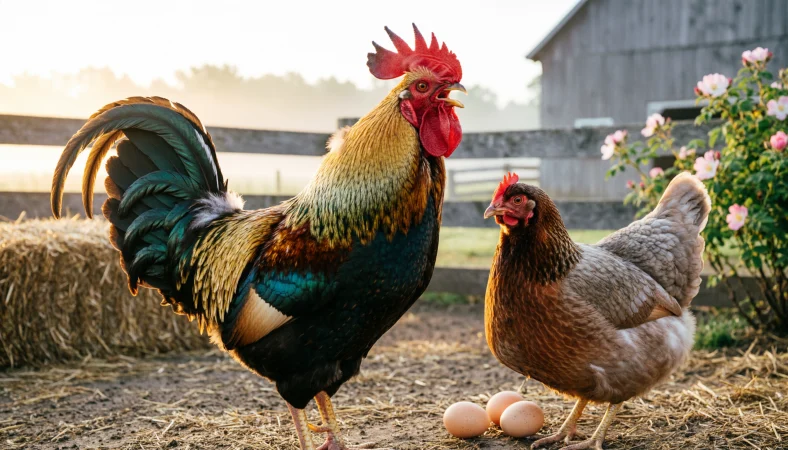
A rooster and a hen are both adult chickens, but they differ by sex. A rooster is an adult male chicken, while a hen is an adult female chicken. Roosters typically have larger combs, louder calls, and may be more protective, while hens can lay eggs. These terms are used specifically for adult chickens.
Have you ever wondered about the difference between a rooster or hen? Both are adult chickens, but the terms identify different sexes and can describe birds with different physical features and behaviors. Knowing the distinction is useful for farmers, backyard chicken keepers, bird enthusiasts, and anyone learning basic poultry terminology.
This guide explains rooster and hen in simple, beginner friendly language, covering their definitions, physical differences, typical behaviors, roles in a flock, and common terminology. Clear examples will help you quickly identify which term fits the chicken you are describing.
Rooster vs Hen: What’s the Difference?
The basic distinction between a rooster and a hen is biological sex. Both are chickens belonging to the same species, but they develop different physical characteristics and behaviors as they mature.
A rooster is an adult male chicken. In British English, the term cock is also commonly used for an adult male chicken, although rooster is often preferred in American English because it avoids another meaning associated with the word cock.
A hen is an adult female chicken. The word specifically refers to a mature female chicken, especially when discussing poultry, egg production, breeding, or farming.
Young chickens have different terminology. A young male is commonly called a cockerel, while a young female is called a pullet. These terms can vary somewhat according to age and context, but they help distinguish young birds from mature adults.
| Feature | Rooster | Hen |
| Sex | Male | Female |
| Species | Chicken | Chicken |
| Adult term | Rooster | Hen |
| Young term | Cockerel | Pullet |
| Produces eggs | No | Yes |
| Fertilizes eggs | Yes | No |
| Typical crowing | Common | Uncommon |
| Comb and wattles | Often larger and more prominent | Often smaller |
| Tail feathers | Often longer and more curved | Usually shorter and less ornate |
| Main reproductive role | Mating and fertilization | Producing eggs and raising offspring |
The distinction is straightforward once the terms are understood.
A rooster is a mature male chicken.
A hen is a mature female chicken.
Both belong to the same species.
Their physical appearance, behavior, and reproductive roles often differ.
Is Rooster vs Hen a Grammar, Vocabulary, or Usage Issue?
The difference between these words is primarily a vocabulary issue, not a grammar problem.
Grammar determines how a word functions in a sentence. Vocabulary determines what a word means. Since rooster and hen refer to different sexes of the same bird, choosing between them depends on what you are describing.
They are therefore not interchangeable.
Consider these two sentences:
“The rooster crowed before sunrise.”
“The hen laid an egg.”
Both sentences are grammatically correct, but replacing one noun with the other changes the meaning.
Saying “The rooster laid an egg” would normally be factually incorrect because roosters are male and do not produce eggs.
Similarly, saying “The hen fertilized the eggs” would incorrectly assign the reproductive role of the male bird to the female.
Formal and Informal Usage
Rooster is a standard term and is especially common in American English.
Hen is also standard English and is widely used in both everyday and formal contexts.
In agricultural writing, poultry science, animal husbandry, and educational materials, these terms are useful because they provide precise descriptions.
In casual conversation, people may simply say “male chicken” or “female chicken” when they want maximum clarity.
Academic Usage
Scientific and agricultural writing may use additional terminology based on the bird’s age and reproductive status.
For example, a researcher discussing young birds may use cockerel and pullet instead of rooster and hen.
That distinction matters because rooster and hen generally describe mature birds, while cockerel and pullet refer to younger birds.
How to Identify a Rooster
A mature rooster often develops several physical characteristics that distinguish him from a hen.
One of the most recognizable features is the comb, the fleshy structure on top of the chicken’s head. Roosters often develop larger and more prominent combs than hens, although appearance varies among breeds.
Roosters may also have larger wattles beneath the beak. Their tail and saddle feathers can become longer and more curved, creating a more ornamental appearance.
Behavior can provide another clue.
Roosters commonly crow, particularly around sunrise, although they can crow at other times as well. They may also display territorial or mating behaviors.
However, these characteristics aren’t equally obvious in every breed.
Workplace Example
Imagine an agricultural workplace where an employee needs to record the number of mature male and female birds in a flock.
The employee might report:
“The flock contains five roosters and thirty hens.”
That wording is more precise than simply reporting the number of chickens because it communicates the sex of the adult birds.
Academic Example
A biology student studying sexual differences in chickens might describe differences in plumage, reproductive anatomy, behavior, and development between roosters and hens.
The word rooster therefore functions as a specific biological and agricultural term rather than simply another word for chicken.
Technology Example
Modern poultry management systems can record information about individual birds, including sex, age, breed, health information, and production data.
In such a system, identifying a bird as a rooster rather than a hen can matter because male and female chickens have different reproductive and management roles.
Usage Recap
Use rooster for an adult male chicken.
Physical features can help identify a rooster, but breed and age affect appearance.
Crowing is common among roosters but isn’t an absolute identification test.
How to Identify a Hen
A hen is an adult female chicken.
One of the clearest practical indicators is reproductive behavior. Mature hens can lay eggs, regardless of whether a rooster is present.
However, an important distinction is often overlooked.
A hen can lay an egg without a rooster.
The egg will simply not be fertilized.
If a rooster mates with a hen and fertilization occurs, the resulting fertile egg can potentially develop into a chick under suitable incubation conditions.
Hens also tend to have less prominent ornamental feathers than many roosters, although appearance varies considerably among breeds.
Workplace Example
On a poultry farm, workers may monitor hens for egg production.
A record might state:
“Twenty hens are currently producing eggs.”
The word hen provides useful information because it identifies mature female chickens.
Academic Example
In an educational discussion about reproduction, students may learn that hens produce ova that become part of eggs and that fertilization requires sperm from a male chicken.
This is why the terms hen and rooster are useful when explaining chicken reproduction.
Technology Example
Automated poultry systems can monitor laying patterns, flock activity, feeding behavior, and environmental conditions.
When records distinguish hens from roosters, production data can be interpreted more accurately because egg production is associated with female birds.
Usage Recap
Use hen for an adult female chicken.
Hens can lay eggs without a rooster.
A rooster is needed for fertilization when fertile eggs are required for reproduction.
When You Should NOT Use Rooster or Hen
Knowing when not to use these terms can prevent several common mistakes.
1. Do Not Use Rooster for Every Chicken
Chicken is the general term for the bird. Rooster specifically identifies a mature male.
2. Do Not Use Hen for a Young Female Automatically
A young female chicken is commonly called a pullet. Hen generally refers to a mature female.
3. Do Not Assume Every Chicken That Lays an Egg Needs a Rooster
A hen can produce unfertilized eggs without mating with a rooster.
4. Do Not Use Rooster and Hen as Species Names
They describe sex and maturity, not separate species.
5. Do Not Assume Appearance Is Always Conclusive
Some breeds have unusual plumage, smaller combs, or other characteristics that make visual identification difficult.
6. Do Not Assume Crowing Is an Absolute Test
Roosters commonly crow, but occasional crowing behavior can occur in hens as well.
7. Do Not Confuse Cockerel With Rooster
Cockerel generally refers to a young male chicken rather than a fully mature male.
8. Do Not Confuse Pullet With Hen
Pullet generally refers to a young female chicken before full maturity.
Common Mistakes and Decision Rules
| Correct sentence | Incorrect sentence | Explanation |
| The rooster crowed early this morning. | The hen crowed because it was male. | Rooster identifies an adult male chicken. |
| The hen laid several eggs. | The rooster laid several eggs. | Egg production is associated with female chickens. |
| The farmer separated the roosters from the hens. | The farmer separated the roosters from the chicken. | Roosters and hens are both chickens. |
| The hen can lay unfertilized eggs. | A hen always needs a rooster to lay eggs. | Egg laying does not require mating. |
| The young male is a cockerel. | Every young male is already a rooster. | Cockerel generally describes a younger male. |
| The young female is a pullet. | Every young female is automatically a mature hen. | Pullet refers to a younger female. |
Decision Rule Box
- If you mean an adult male chicken, use “rooster.”
- If you mean an adult female chicken, use “hen.”
- If you mean the bird generally, use “chicken.”
- If you are describing a young male or female, consider “cockerel” or “pullet.”
Rooster and Hen in Modern Technology and AI Tools
Technology has changed how poultry farmers identify, monitor, and manage chickens.
Automated systems can use cameras, sensors, weight measurements, and behavioral data to monitor birds. Some research systems use computer vision to identify individual birds or detect characteristics associated with sex, breed, health, and behavior.
Artificial intelligence can also help process large amounts of poultry data.
For example, a computer vision system might analyze images to identify physical characteristics associated with male and female chickens. Such systems can be particularly useful in large scale poultry operations where manually examining every bird would be time consuming.
AI generated explanations can also help students understand terminology such as rooster, hen, cockerel, pullet, chick, and chicken.
However, automated identification isn’t always perfect. Breed differences, lighting, bird age, image quality, and unusual physical characteristics can affect classification.
For everyday language, the simplest rule remains reliable: rooster means adult male chicken, while hen means adult female chicken.
Etymology and History of the Terms
The word hen is an old English term. It comes from Old English hen, referring to a female chicken or other female bird.
The word rooster developed much later as a polite term for a male chicken. It is related to the bird’s characteristic crowing and became widely established in American English.
The older term cock remains common in British English and in agricultural contexts. However, rooster has become especially familiar in American English because it provides an unambiguous everyday term for a male chicken.
These differences illustrate how vocabulary can evolve because of regional preferences and changes in social usage.
The underlying biological distinction remains the same regardless of the regional term.
An Expert Perspective on Roosters and Hens
“Rooster and hen are sex specific terms for mature chickens, while chicken is the broader term for the species and individual bird.”
This distinction is useful because it prevents a common vocabulary mistake: treating rooster and hen as separate kinds of birds rather than male and female members of the same species.
The words also provide more information than simply saying “chicken.” When discussing reproduction, flock management, breeding, or egg production, the distinction becomes especially important.
Two Practical Case Studies
Case Study 1: Identifying a Backyard Flock
Imagine someone has six adult chickens in a backyard flock.
Two birds have prominent combs, long curved tail feathers, and regularly crow. Four birds lay eggs and have generally less ornate plumage.
The owner records two roosters and four hens.
Concrete result: Using sex specific terminology makes the flock description immediately clearer. Instead of saying “six chickens,” the owner can explain the composition of the flock accurately.
Case Study 2: Egg Production
Consider a small poultry operation that keeps thirty adult female chickens and two adult male chickens.
The farmer records the birds as thirty hens and two roosters.
The hens are responsible for egg production, while the roosters can contribute to reproduction through mating.
Concrete result: Separating the terms makes flock records more useful for tracking egg production and breeding activity.
These examples illustrate terminology and flock management rather than universal production outcomes. Actual poultry behavior and productivity vary according to breed, age, nutrition, environment, and management.
Error Prevention Checklist
Always use rooster when:
☐ You mean an adult male chicken.
☐ You are discussing a mature male in a flock.
☐ You are describing male reproductive behavior.
☐ You are distinguishing mature males from hens.
Always use hen when:
☐ You mean an adult female chicken.
☐ You are discussing a mature female.
☐ You are describing egg production.
☐ You are distinguishing mature females from roosters.
Never use rooster when:
☐ You simply mean chicken in general.
☐ You mean an adult female.
☐ You mean a young male and need age specific terminology.
Never use hen when:
☐ You mean an adult male.
☐ You mean a rooster.
☐ You specifically need to describe a young female as a pullet.
Related Animal and Grammar Terms You Should Master
Understanding rooster and hen becomes easier when you know several related poultry terms.
Chicken
The broad everyday term for the bird.
Chick
A young chicken, usually before sex specific adult terminology becomes appropriate.
Cockerel
A young male chicken.
Pullet
A young female chicken.
Cock
A traditional term for an adult male chicken, especially common in British English.
Broody Hen
A hen displaying a strong tendency to sit on eggs and incubate them.
Flock
A group of chickens or other birds kept or living together.
Roost
A place or structure where chickens rest or sleep.
Breed
A recognized group of chickens with particular inherited characteristics.
Poultry
A broader category referring to domesticated birds raised for eggs, meat, or other purposes.
FAQs
What is the difference between a rooster and a hen?
A rooster is an adult male chicken, while a hen is an adult female chicken. They belong to the same species but differ in sex, reproductive roles, and often physical appearance and behavior.
Is a rooster male or female?
A rooster is male. The term specifically refers to an adult male chicken.
Is a hen male or female?
A hen is female. The term generally refers to an adult female chicken.
Can a hen lay eggs without a rooster?
Yes. A hen can lay eggs without a rooster. However, without mating and fertilization, those eggs will not develop into chicks.
Does a rooster lay eggs?
No. Roosters are male chickens and do not produce eggs.
What is a young male chicken called?
A young male chicken is commonly called a cockerel. As it matures, it may be called a rooster.
What is a young female chicken called?
A young female chicken is commonly called a pullet. Once mature, it is generally called a hen.
Can a hen crow like a rooster?
Although crowing is strongly associated with roosters, hens can occasionally display crowing behavior. Therefore, crowing alone should not always be treated as an absolute identification method.
Are rooster and cock the same thing?
In poultry terminology, rooster and cock can both refer to an adult male chicken. Rooster is particularly common in American English, while cock remains widely used in British English and agricultural contexts.
Is a rooster a chicken?
Yes. A rooster is a male chicken. Chicken is the broader term, while rooster specifies an adult male.
Conclusion:
Understanding rooster or hen is simple once the basic distinction is clear. A rooster is an adult male chicken, while a hen is an adult female chicken. They are not separate species, but sex specific terms used to describe mature chickens.
The distinction becomes especially important when discussing breeding, egg production, flock management, poultry farming, and animal biology.
A chicken is the general term. A rooster identifies an adult male. A hen identifies an adult female. Young birds have additional terms, including cockerel for a young male and pullet for a young female.
When you’re unsure which word to use, focus first on the bird’s sex and maturity. If it is a mature male, rooster is appropriate. If it is a mature female, hen is appropriate. If you are referring to the bird generally, chicken is the safer broad term.
That simple vocabulary distinction can make descriptions of poultry much more precise and easier to understand.











1 thought on “Rooster Or Hen: Meaning, Differences, Uses And How To Tell Them Apart In 2026”