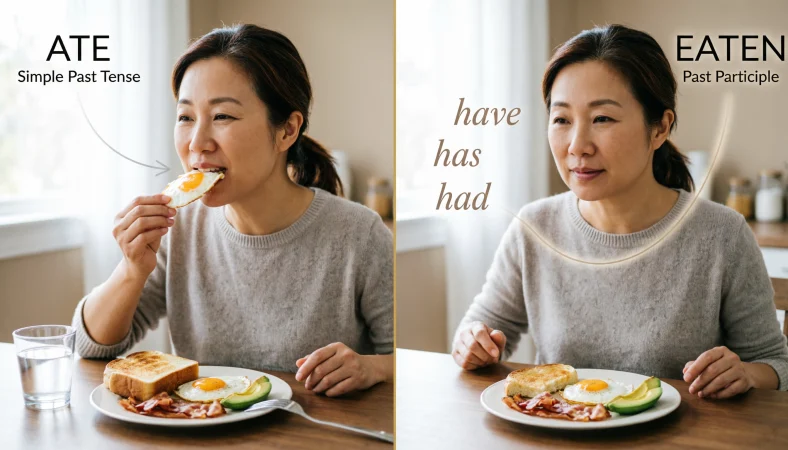
“Ate” is the simple past tense of the verb “eat,” while “eaten” is its past participle. Use “ate” for a completed action in the simple past, but use “eaten” with an auxiliary verb such as “have,” “has,” or “had.” Choosing between them depends on the tense and sentence structure.
If you have ever wondered whether to say “I ate breakfast” or “I have eaten breakfast,” you’re dealing with one of the most common English verb confusions. Eaten or ate can seem interchangeable because both forms come from the verb eat, but they perform different grammatical jobs. Using the wrong form can make an otherwise clear sentence grammatically incorrect, especially when speaking about completed actions, experiences, or events that happened before another event.
Eaten vs Ate: What’s the Difference?
The basic distinction is simple once you understand verb forms.
Ate is the simple past form of the irregular verb eat. It describes an action that happened and finished in the past.
Eaten is the past participle of eat. It normally needs an auxiliary verb such as have, has, or had when it appears in perfect tenses. It can also occur in passive constructions in certain contexts.
The three principal forms of the verb are:
| Verb form | Word | Main use | Example |
| Base form | eat | Present or infinitive | I eat breakfast early. |
| Simple past | ate | Completed past action | I ate breakfast at eight. |
| Past participle | eaten | Perfect tenses and certain passive constructions | I have eaten breakfast. |
The most important rule is that ate can stand as the main past tense verb by itself, whereas eaten normally requires an auxiliary verb when used as a past participle.
Mini recap
Use ate for a completed action in the simple past.
Use eaten after forms of have when creating perfect tenses.
- “I ate” is correct.
- “I have eaten” is correct.
- “I have ate” is incorrect in standard English.
Is Eaten vs Ate a Grammar, Vocabulary, or Usage Issue?
The difference is primarily a grammar issue involving verb tense and verb forms.
These words aren’t simply two vocabulary alternatives. They are different grammatical forms of the same irregular verb.
Consider these examples:
I ate lunch at noon.
I have eaten lunch already.
The first sentence uses the simple past. The second uses the present perfect.
You cannot normally exchange the two forms without changing or breaking the grammatical structure.
Are ate and eaten interchangeable?
No. They are related, but they aren’t interchangeable in standard English.
You can say:
She ate the cake.
You can also say:
She has eaten the cake.
But you cannot normally say:
She has ate the cake.
The auxiliary has requires the past participle eaten, not the simple past ate.
Likewise, you wouldn’t normally say:
Yesterday, I eaten pizza.
The correct sentence is:
Yesterday, I ate pizza.
Formal versus informal usage
The distinction remains important in both formal and informal English.
In casual conversation, native speakers may speak quickly or use nonstandard forms in certain dialects. However, standard written English maintains the distinction.
For professional emails, school assignments, academic writing, applications, reports, and published content, use ate and eaten according to their grammatical functions.
Academic versus casual usage
Academic writing frequently uses perfect constructions when the timing of an action matters.
For example:
Researchers have eaten meals under controlled conditions during the study.
In a narrative describing a specific past event, simple past is more natural:
The researchers ate lunch before the experiment began.
The choice depends on the relationship between the action and the time being discussed.
How to Use Ate Correctly
Ate is the simple past form of eat.
Use it when describing an action that happened at a definite or understood time in the past.
For example:
I ate breakfast at seven.
We ate dinner last night.
She ate the entire sandwich.
They ate before the meeting.
Notice that ate doesn’t require have, has, or had.
Workplace example
Imagine someone discussing a business meeting:
I ate lunch before the client arrived.
The action happened in the past, and the sentence presents it as a completed event.
Another example is:
We ate at the restaurant after the meeting.
The simple past works because the speaker is describing a finished event.
Academic example
An academic researcher might write:
Participants ate a standardized meal before completing the test.
The action occurred during a particular stage of the study, so the simple past is appropriate.
Technology example
A food tracking application might record:
The user ate 650 calories at lunch.
This wording describes a completed event.
A notification could also say:
You ate your planned lunch.
Again, ate functions as the simple past.
Usage recap
Use ate when the sentence describes a completed past action.
It commonly appears with expressions such as yesterday, last night, this morning when the morning is finished, two hours ago, and when I was young.
Remember the central pattern:
Subject + ate + object.
For example:
I ate an apple.
How to Use Eaten Correctly
Eaten is the past participle of eat.
Unlike ate, it generally does not function as the simple past by itself.
It is commonly used with have, has, or had.
Examples include:
I have eaten breakfast.
She has eaten already.
They had eaten before we arrived.
These constructions are examples of perfect tenses.
Present perfect
Use have eaten or has eaten when talking about a past action that has a connection to the present or when discussing an experience without focusing on a finished past time.
I have eaten at that restaurant before.
The sentence communicates past experience.
Past perfect
Use had eaten when one past action happened before another past action.
We had eaten dinner before the movie started.
The eating happened first. The movie started afterward.
Workplace example
A manager might say:
I have eaten lunch, so I’m ready for the meeting.
The action is connected to the present situation.
Another example:
The team had eaten before the presentation began.
The earlier action is placed before another past event.
Academic example
A research report could state:
Participants had eaten before the testing session began.
The past perfect establishes the sequence between two past events.
Technology example
A health application might display:
You have eaten 80 percent of your planned daily calories.
Here, have eaten connects the completed consumption with the user’s current daily progress.
Usage recap
Use eaten when the grammar requires a past participle.
The most common structures are:
have eaten
has eaten
had eaten
The word eaten is not normally used alone to express a simple past action.
When You Should NOT Use Ate or Eaten
Understanding when not to use each form can prevent several common mistakes.
- Do not use ate after have.
Incorrect:
I have ate breakfast.
Correct:
I have eaten breakfast.
- Do not use eaten as a simple past verb.
Incorrect:
Yesterday I eaten pizza.
Correct:
Yesterday I ate pizza.
- Do not use ate after has.
Incorrect:
She has ate already.
Correct:
She has eaten already.
- Do not use ate after had.
Incorrect:
They had ate before us.
Correct:
They had eaten before us.
- Do not choose eaten simply because the action happened in the past.
Past time alone doesn’t automatically require the past participle.
- Do not choose ate when another verb requires a past participle.
After have, has, or had, use eaten.
- Do not assume longer forms are more formal.
Eaten isn’t a more sophisticated version of ate. It has a different grammatical function.
- Do not memorize the forms without learning the sentence patterns.
Understanding the grammar is more useful than memorizing isolated words.
Common Mistakes and Decision Rules
| Correct sentence | Incorrect sentence | Explanation |
| I ate breakfast. | I eaten breakfast. | Simple past requires ate. |
| I have eaten breakfast. | I have ate breakfast. | Have requires the past participle eaten. |
| She ate lunch yesterday. | She eaten lunch yesterday. | A completed past event uses ate. |
| She has eaten lunch. | She has ate lunch. | Has requires eaten. |
| They had eaten before we arrived. | They had ate before we arrived. | Had requires the past participle. |
| We ate at six. | We eaten at six. | A specific completed past action uses ate. |
Decision Rule Box
If the sentence describes a completed past action by itself, use “ate.”
If the sentence uses have, has, or had, use “eaten.”
A quick mental test can help:
Yesterday I ___ breakfast.
The answer is ate.
I have ___ breakfast.
The answer is eaten.
This simple substitution test solves many everyday mistakes.
Eaten and Ate in Modern Technology and AI Tools
Digital writing tools increasingly identify grammatical differences between simple past and past participle forms.
Grammar checkers, word processors, educational applications, translation systems, and AI writing assistants can often identify constructions such as “I have ate” as incorrect and suggest “I have eaten.”
However, automated tools don’t eliminate the need to understand the underlying rule.
AI systems generate text based on patterns and context. When a sentence is unusual, informal, dialectal, or incomplete, an automated system may not always interpret the intended meaning perfectly.
For language learners, the better approach is to understand why the correction works.
If the sentence contains have, has, or had as the auxiliary verb, the past participle is generally required:
have eaten
has eaten
had eaten
This is one of the most reliable patterns for distinguishing the two forms.
The Etymology of Eat, Ate, and Eaten
The verb eat is one of the oldest and most deeply established verbs in the English language.
It comes from Old English etan, which was related to similar words in other Germanic languages. Because the verb has existed for such a long time, its irregular forms became firmly established in English.
That explains why modern English uses:
eat
ate
eaten
rather than a regular pattern such as:
eat
eated
eated
English contains many irregular verbs whose forms developed historically rather than through modern grammatical rules. Other familiar examples include go, went, gone and see, saw, seen.
Expert style quotation
The easiest way to master irregular verbs is to learn the grammatical job of each form, not merely the spelling of the word.
That principle is especially useful with eat, because the difference between ate and eaten becomes much clearer when you identify the tense first.
Two Practical Case Studies
Case Study 1: Everyday conversation
Suppose someone asks:
What did you eat for breakfast?
A natural answer is:
I ate eggs and toast.
The question uses did, which already marks the past tense. The main verb therefore returns to its base form in the question, while the answer naturally uses the simple past ate.
Now imagine a different question:
Have you eaten breakfast?
A natural response is:
Yes, I have eaten breakfast.
The presence of have requires the past participle eaten.
The concrete result is that recognizing the auxiliary verb immediately tells you which form to choose.
Case Study 2: Workplace communication
Imagine a colleague asks whether you have already had lunch before an afternoon meeting.
You might say:
I have eaten, so I’m ready for the meeting.
The present perfect connects the earlier meal with your current state.
If you’re describing the event later, you could say:
I ate lunch before the meeting.
Both sentences refer to eating, but they frame the event differently.
The first emphasizes the connection with the present. The second simply reports a completed past action.
This distinction is valuable in professional communication because tense can subtly change how information is understood.
Author expertise
This guide applies standard English grammar principles while considering practical usage, language learning, editorial consistency, and search focused explanations.
Error Prevention Checklist
Always use ate when
- You’re describing a completed action in the simple past.
- The sentence includes a specific past time.
- You’re narrating a finished event.
- You aren’t using have, has, or had as an auxiliary.
- You want to state what someone consumed at a past point in time.
Never use eaten when
- You are trying to form a simple past sentence.
- The sentence says “Yesterday I eaten.”
- No auxiliary verb supports the past participle.
- You are describing a straightforward completed event with no perfect construction.
Always use eaten when
- The sentence contains have eaten.
- The sentence contains has eaten.
- The sentence contains had eaten.
- You are using the past participle in a grammatical construction that requires it.
Eaten or Ate in Questions
Questions can make this distinction easier to understand because auxiliary verbs often reveal the required form.
Consider:
Did you eat lunch?
After did, use the base form eat, not ate.
You should not say:
Did you ate lunch?
The auxiliary did already carries the past tense.
Now compare:
Have you eaten lunch?
Here, have requires the past participle eaten.
These three structures demonstrate an important pattern:
Did + eat
Have + eaten
Ate without an auxiliary
Learning these patterns is more useful than memorizing a single rule.
Eaten or Ate in Negative Sentences
Negative sentences follow the same principles.
With simple past:
I did not eat breakfast.
Notice that the sentence doesn’t use ate. After did not, the main verb returns to its base form.
With present perfect:
I have not eaten breakfast.
Here, have is the auxiliary, so eaten is required.
Compare:
I didn’t eat.
I haven’t eaten.
The first refers to the simple past. The second uses the present perfect.
Related Grammar Confusions You Should Master
Once you understand ate and eaten, several other irregular verb pairs become easier.
- Go, went, and gone
- See, saw, and seen
- Write, wrote, and written
- Take, took, and taken
- Give, gave, and given
- Drink, drank, and drunk
- Begin, began, and begun
- Speak, spoke, and spoken
- Break, broke, and broken
- Choose, chose, and chosen
The same basic concept applies repeatedly. The simple past and past participle are different forms, and auxiliary verbs often determine which one belongs in a sentence.
FAQs
When should I use ate instead of eaten?
Use ate when describing a completed action in the simple past. For example, “I ate lunch at noon” is correct because the sentence reports a finished event.
When should I use eaten instead of ate?
Use eaten when the grammar requires a past participle, especially after have, has, or had. For example, “I have eaten lunch” is correct.
Is “I have ate” grammatically correct?
No. In standard English, “I have ate” is incorrect. The auxiliary have must be followed by the past participle, so the correct sentence is “I have eaten.”
Is “I ate” grammatically correct?
Yes. “I ate” is the simple past form of eat. It can function as a complete past tense statement, although an object or additional information may be added.
Is “I have eaten” correct English?
Yes. “I have eaten” uses the present perfect tense. The auxiliary have is followed by the past participle eaten.
Is “I had ate” correct?
No. The standard form is “I had eaten.” The auxiliary had requires the past participle.
What is the past tense of eat?
The simple past tense of eat is ate. The past participle is eaten.
What is the difference between “I ate” and “I have eaten”?
“I ate” uses the simple past and generally presents an event as completed in the past. “I have eaten” uses the present perfect and commonly connects a past action with the present or describes past experience without emphasizing a finished past time.
Should I say “Did you eat” or “Did you ate”?
The correct form is “Did you eat?” After the auxiliary did, use the base form eat. The past tense is already expressed by did.
Why is ate not used after have?
Because have functions as an auxiliary in perfect tenses and requires the past participle. The correct sequence is have eaten, not have ate.
Final Thoughts:
The difference between eaten or ate becomes straightforward once you identify the grammatical structure of the sentence. Ate is the simple past form of eat, while eaten is the past participle.
Use ate for a completed past action:
I ate breakfast.
Use eaten with perfect constructions:
I have eaten breakfast.
The most useful rule is simple: if have, has, or had is functioning as the auxiliary, choose eaten. If you’re simply reporting a completed past event, ate is usually the correct form.
Once you learn that pattern, this common English confusion becomes much easier to avoid.