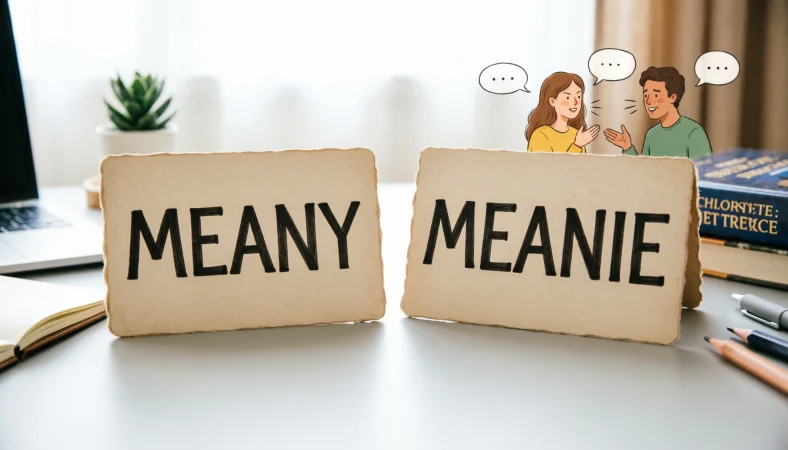
Meanie is the more common and widely recognized spelling for an informal noun meaning a mean or unkind person. Meany can also appear as an informal variant, but it is much less common. In standard modern writing, especially when clarity matters, meanie is usually the safer choice.
If you have ever wondered about meany or meanie, the confusion is understandable because both spellings can be encountered in informal English. The two forms are closely related in meaning, and both can describe someone who behaves in a mean, unkind, or unpleasant way. The main difference is not a major change in meaning but the level of familiarity and conventional spelling associated with each form.
Meanie is the spelling most readers will recognize immediately. It is an informal noun commonly used for a person who is being mean. For example, someone might say, “Don’t be a meanie” when speaking playfully to a friend or child. Meany can serve a similar purpose, but it is considerably less familiar.
This small spelling difference can create real mistakes in texts, captions, schoolwork, messages, and online conversations. A writer may choose meany because it appears to follow the pronunciation, while another may choose meanie because the ending feels more familiar. Understanding how each form works makes the choice much easier.
Meany or Meanie: What’s the Difference?
The words meany and meanie can both function as nouns referring to a person who is mean or unkind. However, they are not equally common in contemporary English.
The spelling meanie is the more established informal form. It commonly appears in expressions such as “You’re such a meanie” or “Don’t be a meanie.” The word usually carries a playful, childish, teasing, or lighthearted tone rather than the serious force of words such as cruel person or bully.
The form meany can also be used with essentially the same intended meaning. However, many English speakers are more familiar with meanie, so meany may look unusual or may be interpreted as a spelling mistake.
The difference is therefore mainly one of conventional spelling, familiarity, and usage rather than a sharp difference in definition.
Quick recap
Meanie is the spelling most readers expect.
Meany can express a similar meaning but is less familiar.
Both forms are informal nouns rather than formal descriptions.
For general writing, meanie provides the clearest and most recognizable choice.
Neither word is normally appropriate for highly formal or technical writing.
Is Meany or Meanie a Grammar, Vocabulary, or Usage Issue?
The difference between meany and meanie is primarily a vocabulary and spelling usage issue, not a major grammar problem.
Both forms are intended to describe a person who behaves in a mean way. The words can therefore occupy the same grammatical position in a sentence.
For example:
“She called her brother a meanie.”
“He was acting like a meany.”
The important distinction is that meanie has stronger recognition in contemporary informal English. When a word has multiple informal spellings, one form can become more conventional even when another remains understandable.
Are meany and meanie interchangeable?
In casual contexts, they can communicate essentially the same idea. However, interchangeable does not necessarily mean equally appropriate.
A reader who sees “meanie” is unlikely to question the spelling. A reader who sees “meany” may understand the intended meaning but may wonder whether the writer made a spelling error.
That difference matters when writing for a broad audience.
Formal versus informal usage
Both terms are informal. They are usually used in friendly conversations, playful arguments, children’s speech, social media posts, entertainment, and casual messages.
Neither word would normally be the preferred choice in a formal report.
Instead of writing:
“The employee was a meanie toward the customer.”
A formal report would be more precise with wording such as:
“The employee behaved discourteously toward the customer.”
The informal word communicates attitude and personality, while the formal wording identifies behavior more precisely.
Academic versus casual usage
In an academic essay, meany and meanie are generally unnecessary unless the writer is discussing informal language itself.
In casual communication, however, meanie can sound natural:
“You ate the last cookie. You’re such a meanie.”
The sentence sounds playful rather than seriously accusatory.
How to Use Meanie Correctly
Meanie is an informal noun used for someone who is being mean, unkind, or unpleasant. Its tone depends heavily on context.
A child might call someone a meanie after being teased. Adults may also use the word jokingly with friends, partners, relatives, or children.
Workplace example
Imagine two coworkers are joking after one person refuses to share a snack:
“Come on, don’t be a meanie. I only wanted one.”
This sentence is casual and humorous. It would not normally belong in an official workplace complaint.
A formal workplace document would use more specific language:
“The employee responded in an unnecessarily rude manner.”
The difference shows why context matters. Meanie expresses an informal personal reaction, while formal workplace writing usually requires objective language.
Academic example
In academic writing, meanie would rarely be appropriate when describing a person’s behavior.
For example, this sentence sounds too casual for a research paper:
“The character is a meanie who treats everyone badly.”
A more suitable academic sentence would be:
“The character repeatedly demonstrates selfish and hostile behavior toward others.”
However, an academic discussion about children’s language, informal vocabulary, or popular culture could legitimately mention the word.
Technology example
Online communication creates many situations where meanie sounds natural.
A person might post:
“You changed the group settings without telling anyone. What a meanie.”
The expression works because social media, gaming chats, messaging platforms, and online communities often encourage conversational language.
Usage recap
Use meanie when you want an informal noun for a mean or unkind person.
It works especially well in playful or conversational contexts.
It is usually unsuitable for formal professional descriptions.
Context determines whether the word sounds humorous, childish, affectionate, or mildly critical.
How to Use Meany Correctly
Meany can also be encountered as an informal noun for a mean person. Its meaning is closely connected to meanie.
For example:
“Stop being such a meany.”
The intended meaning is clear to many readers. However, the spelling is less familiar than meanie, which means it can attract attention in situations where the writer wants conventional spelling.
Workplace example
A casual conversation between coworkers might include:
“You’re a meany for hiding the coffee.”
The expression is understandable, but it has a deliberately playful tone.
In formal workplace communication, a more precise description would be preferable.
Academic example
A student discussing informal language could mention meany as an example of a casual formation based on the adjective mean.
Outside that type of linguistic discussion, however, the word would usually sound too informal for academic prose.
Technology example
Online spaces can make unusual spellings more visible. Users sometimes create playful spellings, shorten words, or modify familiar expressions. Meany can therefore appear in chats, comments, usernames, captions, and casual posts.
The fact that a spelling appears online does not automatically make it the preferred standard form.
Usage recap
Meany can communicate the intended idea.
It is less familiar than meanie for many readers.
It may look like a spelling variation or error.
When you want the most immediately recognizable informal spelling, meanie is generally the clearer choice.
When You Should NOT Use Meany or Meanie
There are several situations where neither word is a good choice.
1. Formal complaints
Avoid calling someone a meanie in an official complaint. Describe the actual behavior instead.
2. Academic arguments
Do not use meanie as a substitute for precise analytical vocabulary in a serious academic paper.
3. Professional evaluations
Employee evaluations should focus on observable behavior rather than informal labels.
4. Legal documents
Legal writing requires specific descriptions of conduct, not playful labels such as meanie.
5. Medical or psychological descriptions
These words do not provide professional information about behavior, personality, or mental health.
6. Serious allegations
Calling someone a meanie can make a serious situation sound trivial. Choose language that accurately reflects what happened.
7. Technical writing
Technical documents need precise terminology. Meany and meanie generally add no useful technical information.
8. Situations requiring neutral language
If the goal is objective reporting, describe the person’s action rather than attaching an informal label.
Common Mistakes and Decision Rules
The most common mistake is assuming that every spelling that sounds natural is equally conventional.
Decision Rule Box
- If you mean an informal word for a person who is being mean, meany and meanie can express the intended idea.
- If you want the spelling most readers will recognize immediately, choose meanie.
- If you are writing formally, avoid both and describe the person’s behavior more precisely.
Meany and Meanie in Modern Technology and AI Tools
Digital communication has changed how informal vocabulary spreads.
Messaging applications, social platforms, online games, comment sections, and AI generated text can all reproduce conversational expressions. Words that once appeared mainly in spoken language may now appear thousands of times in written form.
This creates an important distinction between visibility and standard usage.
An unusual spelling can become visible because users intentionally type it that way. It can also spread through repeated informal communication. An AI system may generate a less common variant because language models encounter multiple forms in their training data.
That does not mean every generated or frequently encountered spelling is equally conventional.
For writers, the practical lesson is simple. If the audience is broad and clarity matters, use the spelling that readers are most likely to recognize. In this case, meanie is generally the safer informal choice.
Etymology and Word Formation
The word meanie is formed from the adjective mean, combined with the informal noun forming ending associated with words used to describe people.
English frequently creates informal nouns by modifying familiar adjectives or adding expressive endings. The resulting words often carry emotional or conversational force.
Meanie fits this pattern because it turns the idea of being mean into a label for a person who behaves that way.
The spelling meany is also understandable because English spelling often permits variation in informal word formation. However, familiarity matters. A form that follows a possible spelling pattern does not necessarily become the conventional form used by most writers.
This is why recognizing word formation alone is not enough. Writers also need to consider established usage.
What Does Meanie Mean?
Meanie means an unkind, unpleasant, or mean person. The word is informal and often carries a playful or mildly teasing tone.
For example:
“You’re a meanie for eating all the chocolate.”
The speaker may not be making a serious accusation. The word can soften criticism and make it sound humorous.
The meaning changes slightly with context. Between close friends, meanie can be affectionate teasing. In a conflict, it can express genuine annoyance. With children, it is often used as a mild alternative to stronger insults.
What Does Meany Mean?
Meany can be used informally with essentially the same intended meaning as meanie.
For example:
“Why are you being such a meany?”
The reader can normally understand the intended meaning from context.
The important point is that meany is less familiar than meanie. Because of this, some readers may interpret it as an unconventional spelling.
If your goal is natural and immediately recognizable informal English, meanie is generally the stronger spelling choice.
Two Practical Case Studies
Case Study One: Casual Conversation
Imagine a parent speaking to a child who refuses to share a toy.
“You’re being a meanie. Let your sister have a turn.”
The word works well because the situation is informal, emotional, and conversational. It communicates mild disapproval without sounding excessively harsh.
Replacing meanie with a formal term such as unkind individual would make the sentence unnecessarily stiff.
The result is a good example of how register affects word choice.
Case Study Two: Formal Workplace Communication
Consider a manager documenting an employee disagreement.
Writing “John was a meanie to his coworker” would provide very little useful information. It does not explain what happened, who was affected, or what behavior caused concern.
A stronger sentence would identify the specific conduct:
“John repeatedly interrupted his coworker during the meeting and responded in a dismissive manner.”
The second version provides concrete information that can be understood and evaluated independently of the writer’s emotional judgment.
The practical result is greater clarity and professionalism.
Expert Style Explanation
A useful way to understand this distinction is to treat spelling, meaning, and register as separate questions.
“A word can be understandable without being the most conventional choice for every audience.”
That principle applies particularly well to informal vocabulary. Meany may be understood, but meanie is more immediately recognizable to many readers.
Error Prevention Checklist
Always use meanie when
- You want the most familiar informal spelling.
- You are writing a casual message.
- You are playfully describing someone who is being unkind.
- Your audience includes readers from different English backgrounds.
- You want to avoid making the spelling look uncertain.
Be cautious with meany when
- You are writing for a broad audience.
- The text needs conventional spelling.
- You are preparing published content.
- The reader may interpret the form as a typographical mistake.
- The context requires polished informal English.
Avoid both when
- The writing is formal.
- You are preparing an academic paper.
- You are writing a professional report.
- You need objective descriptions of behavior.
- You are discussing a serious allegation.
Related Grammar Confusions You Should Master
Learning the difference between meany and meanie is also useful because English contains many spelling and vocabulary pairs that differ by only a few letters.
- Everyday or every day
Everyday is usually an adjective, while every day refers to each day.
- Alot or a lot
A lot is the standard expression. Alot is generally treated as an incorrect spelling.
- Definitely or definately
Definitely is the standard spelling.
- Separate or seperate
Separate is the correct standard spelling.
- Receive or recieve
Receive follows the conventional spelling pattern used in standard English.
- Affect or effect
Affect is commonly used as a verb, while effect is commonly used as a noun, although both words have additional uses.
- Advice or advise
Advice is generally a noun, while advise is generally a verb.
- Your or you’re
Your indicates possession, while you’re is a contraction of you are.
- Than or then
Than is generally used for comparison, while then commonly refers to time, sequence, or consequence.
- Their or there
Their indicates possession, while there refers to a place or introduces certain statements.
FAQs.
What is the correct spelling, meany or meanie?
Meanie is the more familiar and widely recognized informal spelling. Meany can also be encountered with the same intended meaning, but it is less common and may appear unusual to some readers.
Is meany a real word?
Meany can be used as an informal noun referring to a mean or unkind person. However, it is less familiar than meanie, which is the more recognizable spelling for general informal writing.
Is meanie a proper word?
Yes. Meanie is an informal noun used to describe someone who is being mean, unkind, or unpleasant. It often has a playful, teasing, or mildly critical tone.
What does meanie mean in slang?
Meanie is an informal expression for a person who is acting mean or unkind. It can be serious in context, but it is often used playfully, especially between friends or when speaking to children.
How do you spell meanie correctly?
The commonly recognized spelling is meanie, with the letters m, e, a, n, i, e. This is the spelling most suitable when you want an immediately familiar informal expression.
Can I use meany instead of meanie?
Meany can communicate the same general idea, but it is less familiar. If clarity and conventional informal spelling are important, meanie is generally the better choice.
Is meanie formal English?
No. Meanie is informal English. It works naturally in casual conversation, messages, playful comments, and other relaxed contexts but is not normally suitable for formal reports or academic writing.
What is another word for meanie?
Depending on the context, alternatives include an unkind person, rude person, unpleasant person, bully, or cruel person. The best alternative depends on the specific behavior being described.
Why do people spell meanie as meany?
The variation can arise because the pronunciation may encourage writers to use a simpler spelling. Informal language also allows spelling variation, especially in casual online communication.
Should I use meanie in an essay?
Usually not. In formal academic writing, a precise description of the person’s behavior is more appropriate.
Conclusion:
When deciding between meany or meanie, the main issue is conventional usage rather than a major difference in meaning. Both forms can refer informally to a person who behaves in a mean or unkind way, but they do not have the same level of familiarity.
Meanie is the more recognizable choice for most casual writing. It works naturally in conversations, messages, playful comments, children’s language, and informal online communication. Meany can communicate a similar meaning, but its less familiar spelling may make some readers pause or wonder whether it is intentional.
For formal writing, neither word is ideal. Instead, describe the actual behavior with precise language.
The simplest practical rule is this: when you want the familiar informal word for someone who is being mean, choose meanie. When precision and professionalism matter, skip both forms and explain the behavior directly.