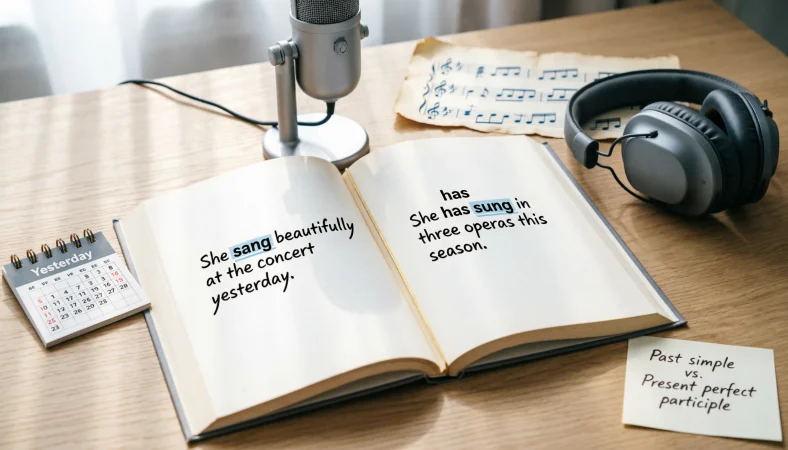
Sang or sung are both correct forms of the irregular verb sing, but they are used in different grammatical situations. Sang is the simple past tense, while sung is the past participle and normally appears with helping verbs such as have, has, had, or was. Choosing the right form depends on the sentence structure and tense.
Have you ever wondered whether you should write “I sang a song” or “I have sung a song”? The confusion between sang or sung is common because both words come from the same verb, sing, and both refer to singing in the past. However, they aren’t interchangeable.
Sang is the simple past form, while sung is the past participle. Using the wrong form can create a grammatical error even when the meaning is obvious. The distinction becomes especially important in academic writing, professional communication, storytelling, and everyday English.
Once you understand how the three principal forms of sing work together, choosing between sang and sung becomes much easier.
Sang vs Sung: What’s the Difference?
The simplest way to understand the difference is to look at the verb forms of sing.
The three principal forms are:
Sing → sang → sung
These forms are irregular because the past forms aren’t created by simply adding ed.
Sang is the simple past tense of sing. It describes an action that happened in the past.
For example:
She sang beautifully at the concert.
Sung is the past participle of sing. It usually needs a helping verb.
For example:
She has sung at several concerts.
The two forms describe singing in the past, but their grammatical jobs are different.
Quick recap
Sang is the simple past form of sing.
Sung is the past participle.
Use sang when describing a completed past action without a perfect auxiliary.
Use sung with helping verbs such as have, has, and had.
The correct choice depends on the grammatical structure, not simply on whether the singing happened in the past.
Is Sang vs Sung a Grammar, Vocabulary, or Usage Issue?
The distinction between sang and sung is primarily a grammar issue involving irregular verb forms.
Both words are legitimate English words. Neither one is a misspelling of the other. The problem occurs when one form is placed in a sentence where the other is grammatically required.
Compare these examples:
I sang at the wedding.
I have sung at many weddings.
Both sentences are correct.
Now consider:
I have sang at many weddings.
This sentence is incorrect in standard English because have requires the past participle sung, not the simple past sang.
The reverse mistake can happen too:
I sung at the wedding yesterday.
In standard English, this should be:
I sang at the wedding yesterday.
The difference is therefore grammatical rather than merely stylistic.
Are sang and sung interchangeable?
No. They aren’t interchangeable in standard English.
Sang functions as the simple past form.
Sung functions as the past participle.
This distinction is similar to other irregular verb patterns such as:
Go, went, gone
Write, wrote, written
Drink, drank, drunk
Begin, began, begun
English learners often find these forms difficult because the patterns must usually be learned individually.
Formal versus informal usage
The distinction remains important in both formal and informal English.
In casual conversation, people sometimes use the wrong form, especially when speaking quickly. However, standard written English maintains the distinction.
Professional writing should therefore use:
She sang at the event.
rather than:
She sung at the event.
When a perfect construction is required, use:
She has sung at the event before.
Academic versus casual usage
Academic writing benefits from precise verb forms.
For example:
The participants sang the selected material during the first session.
If discussing an experience that occurred before another past event, you might write:
The participants had sung the material before the instructor arrived.
Using the correct form makes the sequence of events easier to understand.
When to Use Sang
Use sang when you are describing a completed action in the simple past.
The basic structure is:
Subject + sang + object or additional information
For example:
I sang a song.
She sang at the ceremony.
They sang together.
He sang beautifully.
We sang the national anthem.
The action happened in the past, and the sentence doesn’t require a perfect auxiliary.
Workplace example
Imagine an employee describing a company event:
Maria sang at the annual company celebration.
The sentence describes a completed event. There is no need for has, have, or had.
Another example:
James sang during the presentation yesterday.
The word yesterday clearly establishes a completed past time.
Academic example
A researcher describing an experiment might write:
The participants sang the assigned melody during the first trial.
The action is presented as a completed event in the past.
Technology example
A technology article might describe an earlier event:
The singer sang into a microphone connected to the recording system.
Again, sang is correct because the sentence uses the simple past.
Usage recap
Use sang for a completed past action.
It normally stands alone as the main past tense verb.
Words such as yesterday, last night, earlier, and in 2025 commonly appear with simple past sentences.
When to Use Sung
Use sung when sing appears as a past participle.
Unlike sang, sung commonly needs a helping verb.
The most familiar helping verbs are:
have
has
had
For example:
I have sung this song before.
She has sung in several competitions.
They had sung together before the concert.
Here, sung works with the auxiliary verb to create a perfect tense.
Workplace example
A manager might say:
She has sung at several corporate events.
The phrase has sung indicates experience accumulated up to the present.
Another example:
The employee had sung the opening song before the guests arrived.
The phrase had sung places the singing before another past event.
Academic example
An academic discussion could state:
Researchers have studied how children respond after they have sung in groups.
Here, have sung is the correct perfect construction.
Technology example
A recording engineer might explain:
The artist has sung several versions of the chorus.
The word has requires the past participle sung.
Usage recap
Use sung after appropriate helping verbs in perfect constructions.
Common patterns include has sung, have sung, and had sung.
Sung can also appear in passive constructions, such as:
The song was sung by the choir.
Sang and Sung in Different Tenses
Understanding tense is the easiest way to eliminate most mistakes.
Consider the following sequence.
Present
I sing every day.
The base form sing is used for the present.
Simple past
I sang yesterday.
The simple past form sang is used.
Present perfect
I have sung this song before.
The past participle sung follows have.
Past perfect
I had sung the song before the audience arrived.
The past participle sung follows had.
Future perfect
By tomorrow, I will have sung the song three times.
Again, sung follows have.
This pattern gives you a practical test.
If the sentence contains have, has, or had as a perfect auxiliary, sung is usually the form you need.
Sang and Sung in Passive Constructions
Sung also appears in passive constructions.
For example:
The song was sung by the choir.
Here, sung follows was.
Another example is:
The anthem was sung by thousands of people.
The sentence focuses on the song or anthem rather than the person performing the action.
This is an important distinction because learners sometimes assume that sung is only used with have, has, or had. It isn’t.
The past participle can appear in several grammatical constructions, including passive voice.
Compare:
She sang the song.
with:
The song was sung by her.
The first sentence is active. The second is passive.
When You Should NOT Use Sang or Sung
There are several situations where choosing the wrong form is especially common.
1. Don’t use sang after have
Incorrect:
I have sang this song before.
Correct:
I have sung this song before.
2. Don’t use sang after has
Incorrect:
She has sang at the event.
Correct:
She has sung at the event.
3. Don’t use sang after had
Incorrect:
They had sang together before.
Correct:
They had sung together before.
4. Don’t use sung as ordinary simple past
Incorrect:
I sung yesterday.
Correct:
I sang yesterday.
5. Don’t choose based only on whether the action happened in the past
Both forms can refer to past singing, but their grammatical functions differ.
6. Don’t assume spoken English always follows standard written grammar
Informal speech can contain nonstandard forms. Formal writing should maintain the distinction.
7. Don’t treat sung as a synonym for sang
They share the same basic meaning but have different grammatical functions.
8. Don’t forget passive constructions
Sung can correctly appear with forms of be in passive sentences.
Common Mistakes and Decision Rules
The most useful strategy is to examine the word immediately before the verb.
Decision Rule
If you mean a completed past action and there is no perfect or passive construction requiring a past participle, use SANG.
If you need the past participle after have, has, had, or in a passive construction, use SUNG.
A quick mental test can help:
Yesterday? Think sang.
Have, has, or had? Think sung.
Passive construction? Think sung.
This isn’t an absolute substitute for understanding sentence structure, but it works remarkably well in everyday writing.
Why Is Sing an Irregular Verb?
The verb sing belongs to a group of irregular English verbs that change their internal vowel rather than taking the regular ed ending.
The historical pattern is related to older Germanic verb patterns known as strong verbs. English inherited many of these patterns from earlier stages of the language.
The result is the familiar sequence:
sing
sang
sung
The vowel changes are part of the verb’s history.
Similar patterns appear in:
drink, drank, drunk
ring, rang, rung
begin, began, begun
swim, swam, swum
These aren’t random mistakes in modern English. They reflect older patterns that survived as English developed.
Sang and Sung in Modern Technology and AI Tools
Digital communication has created more situations in which accurate verb forms matter.
Voice assistants, transcription software, grammar tools, educational platforms, and AI writing systems frequently process sentences involving irregular verbs.
For example, a transcription system might turn spoken language into:
She sang beautifully last night.
A writing assistant might need to distinguish that sentence from:
She has sung beautifully many times.
The surrounding words provide the grammatical information.
AI systems can generate fluent sentences, but grammatical accuracy still depends on context. A system that focuses only on the meaning of singing in the past could theoretically confuse sang and sung. A stronger language model considers tense, auxiliary verbs, voice, and sentence structure.
For writers, the same principle applies. Don’t decide between sang and sung by meaning alone. Look at the grammar surrounding the verb.
Authority and Trust: Understanding the Verb Pattern
English learners often memorize individual forms without understanding how they fit together. That approach can work for simple examples, but it becomes less reliable when sentences become more complicated.
A better method is to learn the complete pattern:
Sing, sang, sung
Then associate each form with its grammatical function.
A useful expert style rule is:
“Learn irregular verbs as complete patterns, then identify the tense before choosing the form.”
That approach is more reliable than trying to decide which word sounds natural.
Case study 1: Simple past
Consider a student writing:
Last Saturday, I sung at my sister’s wedding.
The intended meaning is clear, but last Saturday establishes a completed simple past event. The standard correction is:
Last Saturday, I sang at my sister’s wedding.
The concrete improvement is grammatical accuracy because sang correctly marks the simple past.
Case study 2: Present perfect
Now consider:
I sang at three weddings this year.
Depending on the intended meaning and variety of English, this may be possible when treating the events as completed. But when emphasizing an experience or an unfinished time period, a writer may use:
I have sung at three weddings this year.
Here, have sung correctly forms the present perfect.
The important lesson is that tense and context determine the appropriate form.
Author expertise
This article applies established principles of English morphology, tense, aspect, auxiliary verbs, irregular verb formation, and standard written usage to explain the distinction between sang and sung.
Error Prevention Checklist
Always use Sang when
- The sentence describes a completed action in the simple past.
- You are using a clear past time expression such as yesterday.
- The verb is the main past tense verb without a perfect auxiliary.
- You are telling a story about a completed singing event.
- You are describing something that happened at a particular past moment.
Always use Sung when
- It follows have in a perfect construction.
- It follows has in a perfect construction.
- It follows had in a past perfect construction.
- It appears in a passive construction.
- The grammatical structure requires a past participle.
Never use Sang when
- Have, has, or had requires a past participle.
- You are forming a passive construction requiring sung.
Never use Sung when
- You are simply describing a completed past action in the simple past.
- There is no grammatical reason for a past participle.
Related Grammar Confusions You Should Master
Learning sang versus sung can make other irregular verb patterns easier to understand.
1. Drink or drank or drunk
Drink is the base form, drank is simple past, and drunk is the past participle.
2. Ring or rang or rung
The same vowel pattern appears in this irregular verb.
3. Begin or began or begun
Began is simple past, while begun is the past participle.
4. Write or wrote or written
This is another common example in which the past and past participle differ.
5. Go or went or gone
The forms are especially irregular because went comes historically from another verb.
6. Eat or ate or eaten
Eat is present, ate is simple past, and eaten is the past participle.
7. See or saw or seen
The distinction follows the same basic grammatical principle.
8. Take or took or taken
Took is simple past, while taken is the past participle.
9. Drive or drove or driven
Drove describes simple past action, while driven is used as the past participle.
10. Swim or swam or swum
This is another useful example of the vowel change pattern.
FAQs
Is sang or sung correct?
Both sang and sung are correct, but they have different grammatical functions. Sang is the simple past form of sing, while sung is the past participle.
Is sang the past tense of sing?
Yes. Sang is the simple past tense of sing.
For example:
She sang at the concert last night.
Is sung the past tense of sing?
No. Sung is the past participle, not the simple past tense.
For example:
She has sung at several concerts.
Should I say I sang or I sung?
Say I sang when describing a completed past action.
For example:
I sang at the wedding yesterday.
Say I have sung when using the present perfect.
Is it I have sang or I have sung?
The correct form is:
I have sung.
The auxiliary have is followed by the past participle sung.
Is it I had sang or I had sung?
The standard form is:
I had sung.
The auxiliary had requires the past participle sung.
Can sung be used without have?
Yes. Sung can appear in passive constructions.
For example:
The song was sung by the choir.
Why is sang correct but sung wrong in some sentences?
Sang and sung serve different grammatical functions. Sang is simple past, while sung is the past participle. The surrounding sentence determines which form is required.
What is the easiest way to remember sang and sung?
Remember the sequence:
Sing, sang, sung.
Then associate sang with simple past and sung with past participles used after forms such as have, has, and had.
Is “I sung a song” grammatically correct?
In standard English, I sang a song is correct for a simple past statement. I sung a song is nonstandard in this context.
Conclusion:
The choice between sang or sung becomes straightforward once you understand their grammatical roles. Sang is the simple past form of sing, while sung is the past participle.
Use sang when describing a completed past action:
I sang at the concert yesterday.
Use sung when the sentence requires a past participle:
I have sung at the concert before.
You can also use sung in passive constructions:
The song was sung by the choir.
The most useful memory pattern is sing, sang, sung. Think of sang as the simple past form and sung as the form used with perfect auxiliaries or passive constructions.
Once you pay attention to the words surrounding the verb, the distinction becomes much easier. Instead of asking only whether the singing happened in the past, ask what grammatical structure the sentence requires. That small habit will help you choose the correct form consistently in everyday conversation, academic writing, professional communication, and polished online content.










1 thought on “Sang vs. Sung: Which Word Is Correct? Meaning, Difference & Usage For 2026”