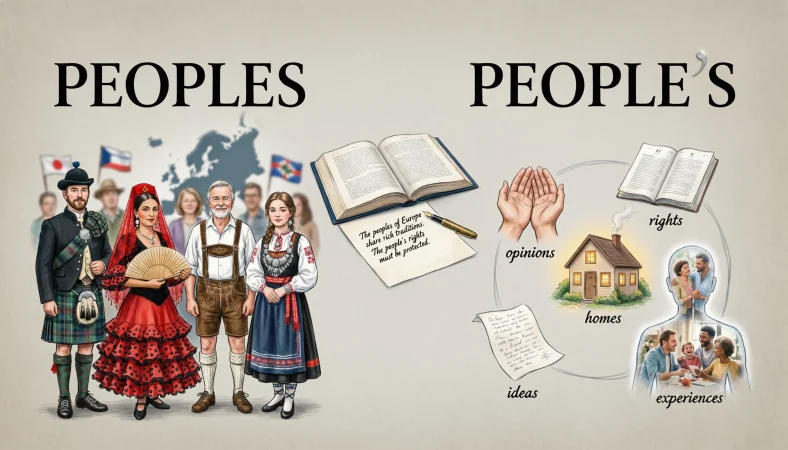
People’s and peoples are both correct, but they serve different grammatical purposes. People’s is the possessive form of “people,” used to show ownership or association, such as “people’s rights.” Peoples is the plural form of “people” when referring to distinct groups, communities, or ethnic populations, such as “the indigenous peoples of the region.”
Have you ever wondered whether to write peoples or people’s? The difference is easy to miss because both forms look almost identical, but the apostrophe changes the grammatical meaning. People’s usually indicates possession or association, while peoples refers to separate or distinct groups of people.
This guide explains peoples and people’s in simple, beginner friendly language, with clear definitions, grammar rules, and practical examples. By understanding how the plural and possessive forms work, you can avoid common punctuation mistakes and choose the correct form based on the meaning of your sentence.
Peoples or People’s: What’s the Difference?
The easiest way to understand peoples and people’s is to look at what the sentence is trying to express. Although the two forms look very similar, the apostrophe changes the grammatical function.
Peoples is a plural noun. It is used when referring to multiple distinct groups of people, especially when those groups have separate cultures, ethnic identities, national identities, or historical traditions.
For example:
“Many peoples have lived in this region throughout history.”
Here, peoples refers to several distinct populations or cultural groups.
People’s, on the other hand, is a possessive form. It indicates that something belongs to people or is associated with people.
For example:
“People’s opinions can change over time.”
Here, people’s shows that the opinions belong to or are held by people.
| Form | Part of Speech | Main Function | Meaning | Example |
| Peoples | Plural noun | Refers to distinct groups | Multiple populations or cultural groups | Several peoples lived in the region. |
| People’s | Possessive noun form | Shows association or ownership | Belonging to or associated with people | People’s opinions differ. |
Mini Recap
Peoples means multiple distinct groups of people.
People’s shows possession or association.
The apostrophe in people’s is grammatically important.
Use peoples when discussing separate populations, cultures, or communities.
Use people’s when something belongs to or concerns people.
The distinction becomes particularly important in academic writing, history, anthropology, politics, sociology, and formal discussions about communities.
Is Peoples or People’s a Grammar, Vocabulary, or Usage Issue?
The difference between peoples or people’s is primarily a grammar and usage issue. The words look almost identical, but the apostrophe changes their function.
The word peoples is a plural noun. It is less common than the ordinary plural people, because people already refers to more than one person. However, peoples has a specialized meaning when writers need to distinguish several different groups.
Consider:
“The people gathered in the square.”
Here, people simply means multiple individuals.
Now consider:
“The indigenous peoples of the region have diverse traditions.”
Here, peoples refers to multiple distinct communities.
The possessive form people’s works differently.
“The people’s decision surprised everyone.”
The apostrophe indicates possession or association. The decision belongs to, was made by, or is associated with the people.
Are They Interchangeable?
No. Peoples and people’s are not interchangeable.
Replacing one with the other can create a grammatical error or change the intended meaning.
For example:
“Different peoples have different traditions.”
This discusses separate groups.
“Different people’s traditions vary.”
This discusses traditions belonging to different individuals or groups of people.
The meaning changes because the grammatical structure changes.
Formal Versus Informal Usage
Both forms can appear in formal and informal English, but peoples appears more frequently in specialized contexts.
You may encounter it in historical, cultural, anthropological, legal, political, and academic writing.
People’s is extremely common in ordinary English.
Examples include:
- “People’s rights matter.”
- “People’s choices differ.”
- “People’s expectations have changed.”
In casual writing, speakers often use people without thinking about the possessive structure. However, written English requires careful placement of the apostrophe.
Academic Versus Casual Usage
Academic writing frequently uses peoples when discussing distinct populations.
For example:
“Ancient peoples developed different systems of agriculture.”
In contrast, academic writers may use people’s when referring to the beliefs, behavior, experiences, or rights of individuals or communities.
For example:
“Researchers examined people’s attitudes toward education.”
Both forms are standard. The appropriate choice depends entirely on meaning.
How to Use Peoples Correctly
Peoples is used when you are referring to two or more distinct groups of people.
This use is especially common when the groups have different cultural, historical, linguistic, ethnic, or national identities.
For example:
“Several peoples inhabited the area before the empire expanded.”
The writer is not simply saying that many individuals lived there. The sentence identifies different populations as separate groups.
Another example is:
“The museum documents the traditions of indigenous peoples.”
Here, peoples refers to distinct indigenous communities.
Workplace Example
A company working across several cultural communities might write:
“The organization works with local peoples to develop sustainable programs.”
In this context, peoples emphasizes that the organization works with distinct communities rather than treating everyone as one homogeneous population.
Academic Example
A history textbook might state:
“Different peoples established settlements along the river.”
The term is appropriate because the sentence describes separate populations.
Technology Example
A technology company might write:
“Digital platforms can help preserve the languages of endangered peoples.”
The term peoples highlights distinct communities with their own linguistic identities.
Usage Recap
Use peoples when the noun refers to separate groups of people.
It is especially appropriate when discussing cultures, communities, nations, ethnic groups, historical populations, or indigenous groups.
Do not automatically use peoples whenever you mean more than one person. In ordinary situations, people is normally the correct plural.
How to Use People’s Correctly
People’s is the possessive form of people. It indicates that something belongs to, comes from, concerns, or is associated with people.
For example:
“People’s lives have changed dramatically.”
The word people’s connects lives with people.
Another example is:
“People’s opinions are often influenced by experience.”
The opinions are associated with people.
The apostrophe is therefore essential.
Without the apostrophe, peoples opinions would not have the intended standard grammatical form when referring to opinions belonging to people.
Workplace Example
“People’s expectations should be considered when developing the service.”
Here, people’s identifies the expectations as those held by people.
Academic Example
“The researchers studied people’s responses to the survey.”
The responses belong to or were given by people.
Technology Example
“People’s privacy is an important concern when developing artificial intelligence systems.”
The possessive form shows that privacy concerns people.
Usage Recap
Use people’s when something belongs to people or is associated with people.
The apostrophe before the s is important because it signals the possessive relationship.
When You Should NOT Use Peoples or People’s
Several common mistakes occur because writers focus on spelling instead of meaning.
1. Do not use peoples simply because people is plural
Incorrect:
“Many peoples were waiting at the station.”
If the sentence simply refers to many individuals, use people.
Correct:
“Many people were waiting at the station.”
Peoples is normally reserved for distinct groups.
2. Do not remove the apostrophe from a possessive expression
Incorrect:
“Peoples opinions vary.”
Correct:
“People’s opinions vary.”
The apostrophe shows possession or association.
3. Do not use people’s when discussing distinct populations
Incorrect:
“Several people’s lived in the region.”
Correct:
“Several peoples lived in the region.”
The first sentence incorrectly treats people’s as though it were a plural noun.
4. Do not confuse people with peoples
People is already the normal plural of person.
People can refer to many individuals:
“Many people attended.”
Peoples has a narrower meaning:
“Several peoples developed different traditions.”
5. Do not use peoples when you mean individuals
If you are discussing ordinary human beings rather than distinct populations, people is usually the appropriate choice.
6. Do not add an apostrophe simply to make a noun plural
Apostrophes do not normally form plurals in English.
Incorrect:
“Several people’s live nearby.”
Correct:
“Several people live nearby.”
7. Do not use people’s for every sentence containing the word people
People’s requires a possessive relationship.
For example:
“People’s rights”
works because the rights belong to or concern people.
But:
“People’s arrived early”
is incorrect because no possessive relationship exists.
8. Do not assume peoples always means nations
Peoples can refer to cultural, ethnic, indigenous, historical, or other distinct communities. The precise meaning depends on context.
Common Mistakes With Peoples and People’s
| Correct Sentence | Incorrect Sentence | Explanation |
| Many people attended the event. | Many peoples attended the event. | People is correct when referring to individuals generally. |
| Several peoples lived in the region. | Several people’s lived in the region. | Peoples refers to distinct groups. |
| People’s opinions differ. | Peoples opinions differ. | People’s is possessive. |
| The rights of indigenous peoples matter. | The rights of indigenous people’s matter. | Peoples is the plural noun here. |
| People’s experiences vary. | Peoples experiences vary. | The possessive form requires an apostrophe. |
| Different peoples have different traditions. | Different people’s have different traditions. | Peoples identifies distinct groups. |
Decision Rule Box
- If you mean multiple distinct groups or populations, use PEOPLES.
- If you mean something belonging to, concerning, or associated with people, use PEOPLE’S.
- If you simply mean more than one person, use PEOPLE.
This three word distinction is more useful than trying to memorize a single rule.
Ask yourself what you mean before choosing the spelling.
Are you describing several distinct communities?
Use peoples.
Are you showing possession or association?
Use people’s.
Are you simply talking about more than one person?
Use people.
Peoples and People’s in Modern Technology and AI Tools
Modern technology has created many situations where both forms can appear naturally.
AI systems frequently process information about communities, cultures, users, and populations. In such contexts, precise grammar matters because small changes can affect interpretation.
For example:
“AI can support the preservation of indigenous peoples’ languages.”
This sentence contains an interesting structure. Peoples identifies distinct groups, while the apostrophe after peoples creates the possessive form.
Another example is:
“People’s privacy must be protected.”
Here, people’s expresses association with people.
Technology documentation may also use the simple plural people:
“People use the application to communicate.”
The distinction therefore remains relevant even in highly technical writing.
When reviewing AI generated content, writers should check whether the system has confused people, peoples, and people’s. Automated writing can sometimes choose a grammatically possible form that does not match the intended meaning.
A useful editing question is:
“Am I talking about groups, individuals, or possession?”
That question usually reveals the correct form immediately.
Etymology and Language History
The word people entered English through Old French and ultimately traces back to Latin roots associated with a population or community.
Over time, people became the standard plural form of person in English.
The specialized plural peoples developed a more specific function. Instead of simply indicating several individuals, it can distinguish separate populations or communities.
The possessive people’s follows the ordinary English pattern of using an apostrophe and s to show possession.
Understanding this history helps explain why people and peoples can both be plural in different contexts, while people’s performs a possessive role.
English grammar often contains forms that overlap in appearance but differ in function. This is one reason punctuation can carry significant meaning.
An Expert Perspective on Usage
“The apostrophe should clarify a relationship of possession or association, while the plural form should identify what the noun itself represents.”
This principle provides a practical way to understand the distinction. The question is not simply whether the word refers to more than one person. The question is whether the sentence describes a group, several distinct groups, or something associated with people.
Two Practical Case Studies
Case Study 1: Historical Writing
Consider this sentence:
“Ancient people’s developed separate traditions.”
The writer appears to be discussing distinct populations, but people’s is possessive and therefore does not fit.
A clearer version is:
“Ancient peoples developed separate traditions.”
Here, peoples functions as a plural noun referring to distinct populations.
Result: The revised sentence clearly identifies multiple historical groups without creating an incorrect possessive construction.
Case Study 2: Research Writing
Now consider:
“The researchers examined peoples attitudes toward technology.”
The intended meaning is that the attitudes belong to people.
The correct version is:
“The researchers examined people’s attitudes toward technology.”
The apostrophe establishes the relationship between people and attitudes.
Result: The revised sentence clearly communicates possession or association and follows standard English punctuation.
Error Prevention Checklist
Always use PEOPLES when:
- You mean multiple distinct populations.
- You are discussing separate cultural groups.
- You are referring to different historical communities.
- You are discussing distinct indigenous groups.
- You need to distinguish several populations from one another.
Always use PEOPLE’S when:
- Something belongs to people.
- Something concerns people.
- Something is associated with people’s experiences.
- You are describing people’s opinions, rights, choices, lives, or behavior.
Never use PEOPLE’S when:
- You simply need the plural of person.
- You are naming several distinct groups without a possessive relationship.
- You are using an ordinary plural noun.
Never use PEOPLES when:
- You simply mean several individuals.
- You are talking about people generally.
- You need a possessive form.
Related Grammar Confusions You Should Master
Understanding peoples and people’s can also help with other commonly confused English forms.
People vs Person
Person refers to one individual, while people commonly refers to multiple individuals.
Peoples vs People
People is the ordinary plural. As Peoples usually emphasizes distinct populations or communities.
Peoples vs People’s
Peoples is a plural noun. People’s is a possessive form.
Persons vs People
Persons can be used in formal or legal contexts when referring to specific individuals, while people is much more common in ordinary English.
Childrens vs Children’s
Children is already plural, so its possessive form is children’s.
Mens vs Men’s
Men is plural, while men’s is possessive.
Womens vs Women’s
Women is plural, while women’s is possessive.
Its vs It’s
Its is possessive, while it’s is a contraction meaning it is or it has.
Who’s vs Whose
Who’s is a contraction, while whose is a possessive pronoun.
Peoples vs Populations
Both can refer to groups, but peoples often emphasizes distinct cultural or historical communities, while populations can be broader and more demographic.
Learning these distinctions makes punctuation and pluralization much easier to handle accurately.
FAQs:
What is the difference between peoples and people’s?
Peoples is a plural noun used for distinct groups or populations. People’s is a possessive form showing that something belongs to or is associated with people.
Is peoples a correct word?
Yes. Peoples is a standard English word. It is generally used when referring to distinct groups of people, especially separate cultural, ethnic, historical, or indigenous communities.
Is people’s plural or possessive?
People’s is possessive. It shows that something belongs to, concerns, or is associated with people.
Is peoples the plural of people?
Peoples can function as a plural of people when referring to distinct groups or populations. However, people remains the ordinary plural when simply referring to more than one person.
Should I write people or peoples?
Use people when you mean individuals generally. Use peoples when you mean separate or distinct groups of people.
Is peoples or people’s correct?
Both can be correct, but they have different meanings. Peoples refers to distinct groups, while people’s indicates possession or association.
What is the possessive form of people?
The possessive form of people is people’s.
For example:
“People’s rights should be respected.”
What is the plural form of people?
People is already the normal plural form of person. Peoples is used when distinguishing multiple separate groups or populations.
Why does people’s have an apostrophe?
The apostrophe shows possession or association. In “people’s opinions,” the opinions are those held by people.
Can peoples and people’s be used in the same sentence?
Yes. They can appear together when the meaning requires both forms.
For example:
“Different peoples have protected their people’s traditions.”
The first peoples refers to distinct groups, while the second people’s indicates possession or association.
Conclusion:
Understanding peoples or people’s becomes much easier when you separate plural meaning from possessive meaning.
Peoples is a plural noun used to describe multiple distinct groups or populations. It is particularly common in discussions of culture, history, anthropology, indigenous communities, and separate populations.
People’s is possessive. It shows that something belongs to, concerns, or is associated with people.
There is also an important third form to remember: people. When you simply mean more than one person, people is normally the correct choice.
A simple decision rule can prevent most mistakes: use people for individuals generally, peoples for distinct groups, and people’s for possession or association. Once you identify the intended meaning before writing, the correct form becomes much easier to choose.