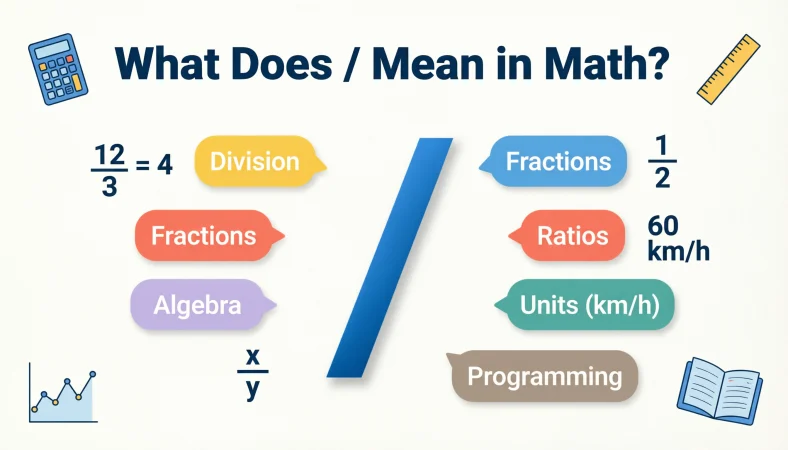
Definition: The / symbol in math is called the forward slash or solidus, and it most commonly represents division. It tells you to divide one number by another, such as 12/3 = 4. The slash is also widely used to write fractions, algebraic expressions, ratios, measurement units, calculator formulas, spreadsheets, and computer programming languages.
If you’ve ever used a calculator, typed a math problem on a computer, or written a fraction online, you’ve probably seen the / symbol. But what does / mean in math?
Simply put, the / symbol means division. It separates two values, indicating that the first number (called the dividend) should be divided by the second number (called the divisor).
For example:
- 10/2 = 5
- 24/6 = 4
- 100/25 = 4
In mathematical notation, the slash is an alternative way to write the division operation. While elementary textbooks often use the ÷ symbol, digital devices, calculators, spreadsheets, and programming languages almost always use the forward slash.
Quick Example Table
| Expression | Meaning | Answer |
| 8/2 | 8 divided by 2 | 4 |
| 15/3 | 15 divided by 3 | 5 |
| 36/6 | 36 divided by 6 | 6 |
| 50/10 | 50 divided by 10 | 5 |
| 81/9 | 81 divided by 9 | 9 |
The slash can also represent:
- Fractions (1/2)
- Ratios
- “Per” in units (km/h)
- Algebraic expressions (x/y)
- Programming division operations
- Scientific formulas
Because of its versatility, the slash is one of the most commonly used mathematical symbols in the digital world.
Introduction
Think about the last time you solved a math problem on your phone, used an online calculator, or entered a formula into Microsoft Excel. Chances are, you used the / symbol without giving it much thought.
Although it looks like a simple punctuation mark, the forward slash has become one of the most important symbols in modern mathematics. From elementary arithmetic to advanced engineering equations, it helps people express division, fractions, ratios, rates, and mathematical relationships in a concise and universally understood way.
Many students, parents, and even professionals ask questions such as:
- What does / mean in math?
- Is / the same as the division sign?
- Why don’t calculators use ÷?
- Can the slash represent fractions?
- Is it used differently in algebra and programming?
The answer is that the slash is much more than just a replacement for the division symbol. It has become the standard notation for mathematical calculations in digital environments because it’s easy to type, universally recognized, and supported by virtually every keyboard and software application.
Whether you’re learning basic arithmetic, studying algebra, writing computer code, or simply trying to understand a homework assignment, knowing how and when to use the forward slash correctly is an essential math skill.
In this guide, you’ll learn:
- The meaning of the slash in mathematics
- Its historical background
- Why it’s so popular today
- Different ways it’s used
- Practical examples
- Common mistakes to avoid
- Helpful tips for students and professionals
By the end of this article, you’ll understand exactly what the / symbol means in different mathematical contexts and how to use it confidently.
Origin
The concept of division is ancient, dating back thousands of years. Long before modern mathematical symbols existed, civilizations such as the Egyptians, Babylonians, Greeks, Indians, and Chinese developed methods for dividing quantities.
However, the forward slash (/) itself did not originally exist as a mathematical division symbol.
Early Mathematics
Ancient mathematicians usually expressed division using words or written explanations rather than symbols. Fractions were written in different ways depending on the culture, and many calculations were performed using counting boards or the abacus.
As mathematics evolved, scholars began searching for simpler and more standardized notation.
The Development of Division Symbols
Over the centuries, several methods were introduced to represent division:
| Symbol | Purpose |
| Fraction bar (—) | Writing fractions and division |
| ÷ | Traditional division sign |
| / | Keyboard-friendly division notation |
The familiar ÷ symbol became common in elementary education because it clearly indicated the division operation. However, it was never universally adopted in higher mathematics.
Why the Slash Became Popular
The rise of computers during the twentieth century dramatically increased the popularity of the forward slash.
Early keyboards didn’t include the ÷ symbol, but they did include the slash (/). As a result, software developers and mathematicians adopted it as the standard way to represent division.
Today, the slash appears in:
- Scientific calculators
- Online calculators
- Microsoft Excel
- Google Sheets
- Computer programming
- Engineering software
- Mathematical modeling
- Statistical applications
Because nearly every digital device supports the slash, it has become the global standard for typed mathematical expressions.
Popularity
Today, the forward slash is one of the most recognizable symbols in mathematics.
While students first encounter it in simple arithmetic, its importance grows as they progress into algebra, calculus, statistics, engineering, economics, and computer science.
Why Is the Slash So Popular?
Several factors explain its widespread use:
- Easy to type on any keyboard
- Universally recognized
- Supported by calculators
- Standard in programming languages
- Common in spreadsheets
- Used in scientific research
- Compatible with digital communication
Unlike the traditional division symbol, which may not appear on every keyboard, the slash is available on virtually every computer, smartphone, and tablet.
Real-World Usage
Outside the classroom, the slash appears in many everyday situations:
| Field | Example |
| Mathematics | 20/5 |
| Algebra | x/y |
| Physics | m/s |
| Engineering | N/m² |
| Finance | Profit/Employee |
| Statistics | Successes/Trials |
| Computer Science | 100/25 |
| Chemistry | mol/L |
This broad adoption means that understanding the slash isn’t just useful for passing math exams it’s essential for interpreting formulas across many professions.
Digital Mathematics
Modern technology relies heavily on the slash.
You’ll encounter it when using:
- Smartphone calculators
- Scientific calculators
- Spreadsheet formulas
- Financial software
- Coding environments
- Data analysis tools
- Online math platforms
Because digital communication dominates education and business, the forward slash has effectively become the standard notation for division.
How It Is Used
Although the slash primarily represents division, its meaning can vary slightly depending on the mathematical context.
Let’s explore the most common uses.
1. Division
This is the most familiar use.
Examples:
- 12/4 = 3
- 30/5 = 6
- 90/9 = 10
Here, the slash simply means “divided by.”
2. Writing Fractions
Instead of drawing a horizontal fraction bar, people often use a slash.
Examples:
- 1/2
- 3/4
- 5/8
- 7/10
These are read as:
- One-half
- Three-fourths
- Five-eighths
- Seven-tenths
Using a slash makes fractions easy to type in emails, documents, websites, and calculators.
3. Algebraic Expressions
Variables are frequently divided using the slash.
Examples:
- x/y
- a/b
- (x+2)/5
- (m+n)/p
In algebra, parentheses are especially important because they show exactly which terms are being divided.
For example:
- (a+b)/2 means divide the sum of a and b by 2.
- a+b/2 means divide only b by 2, then add a.
This small difference completely changes the result.
4. Rates and Units
In mathematics and science, the slash often means “per.”
Examples include:
| Unit | Meaning |
| km/h | Kilometers per hour |
| m/s | Meters per second |
| L/min | Liters per minute |
| $/hour | Dollars per hour |
| beats/min | Beats per minute |
Although these expressions involve division, they are commonly read using the word per instead of divided by.
5. Scientific Formulas
Scientists frequently use the slash in equations because it simplifies notation.
Examples:
- Distance/Time = Speed
- Mass/Volume = Density
- Work/Time = Power
These formulas express relationships between quantities and are easier to type using the forward slash than with stacked fractions.
6. Calculators and Computers
Perhaps the most common modern use of the slash is in digital calculations.
For example, if you want to calculate:
144 ÷ 12
Most calculators require you to type:
144/12
Similarly, spreadsheet applications such as Microsoft Excel and Google Sheets use the slash for division formulas, making it the default symbol for digital mathematics.
7. Programming Languages
Virtually every major programming language uses / as the division operator.
For example:
- Python
- Java
- JavaScript
- C++
- C#
- PHP
- Swift
When programmers write 20/5, the computer performs a division operation and returns the result.
This universal convention has made the slash one of the most frequently used mathematical symbols in software development.
Examples
Understanding the forward slash becomes much easier when you see it used in real-life situations. Below are examples that show how / is used in everyday mathematics, education, science, business, and technology.
Example Table
| Expression | Read As | Meaning | Result |
| 18/3 | Eighteen divided by three | Division | 6 |
| 1/2 | One-half | Fraction | 0.5 |
| 9/4 | Nine divided by four | Improper fraction | 2.25 |
| x/y | x divided by y | Algebra | Variable expression |
| 120 km/2 h | 120 kilometers in 2 hours | Rate calculation | 60 km/h |
| 50/100 | Fifty over one hundred | Fraction or percentage | 0.5 (50%) |
These examples demonstrate that the slash is much more than a simple division sign it can also represent fractions, rates, and mathematical relationships.
Friendly Examples
Here are some simple, everyday examples that students and beginners can easily understand.
- 12/4 = 3 → Twelve divided by four equals three.
- I ate 1/2 of the pizza. 🍕
- The recipe needs 3/4 cup of milk.
- We drove 180 km/3 hours, so our average speed was 60 km/h.
- My allowance is $20/4 weeks, so I receive $5 each week.
These examples show how the slash naturally appears in daily life, even outside the classroom.
Professional Examples
In workplaces and academic settings, the slash is commonly used in reports, formulas, and calculations.
- Revenue/Employee
- Cost/Unit
- Sales/Month
- Profit/Share
- Distance/Time = Speed
- Force/Area = Pressure
- Population/Region
- Errors/Hour
Example sentence:
“The average production rate was calculated by dividing the total output by the number of operating hours.”
In scientific writing, the slash often replaces longer phrases like divided by or per, making formulas easier to read.
Funny Examples
Math can be fun too! Here are a few light-hearted examples.
- Pizza/Friends = Never Enough 🍕
- Homework/Weekend = Too Much 😅
- Coffee/Hours Awake = Survival ☕
- Money/Days Until Payday = Not Enough 💸
- Sleep/Assignments = Impossible 😴
Although these aren’t mathematical equations, they creatively use the slash to express humorous relationships.
Comparison with Similar Terms
The forward slash is sometimes confused with other mathematical symbols. Understanding the differences helps avoid mistakes.
| Symbol | Name | Meaning | Common Usage |
| / | Forward Slash (Solidus) | Division | Calculators, programming, spreadsheets |
| ÷ | Division Sign | Division | Elementary school mathematics |
| — | Fraction Bar | Division/Fraction | Textbooks and printed equations |
| : | Colon | Ratio | Ratios and proportions |
| × | Multiplication Sign | Multiplication | Arithmetic |
| * | Asterisk | Multiplication | Programming and spreadsheets |
| % | Percent Symbol | Per hundred | Percentages |
Slash (/) vs Division Sign (÷)
| Forward Slash (/) | Division Sign (÷) |
| Used on keyboards | Rarely available on keyboards |
| Standard in programming | Mostly used in schools |
| Common in calculators | Less common in software |
| Preferred in digital math | Preferred in elementary textbooks |
Slash (/) vs Fraction Bar
Both represent division, but they’re written differently.
Example:
- 3/5
- 3
—
5
Mathematically, they represent the same value. The slash is simply more convenient when typing.
Slash (/) vs Colon (:)
Although both can represent relationships between quantities, they aren’t always interchangeable.
Example:
- Ratio: 2:1
- Division: 2/1
The first expresses a comparison, while the second performs a mathematical operation.
Alternate Meanings
Although the focus keyword refers to mathematics, the forward slash has several meanings in other fields.
| Context | Meaning |
| Mathematics | Division |
| Fractions | Fraction separator |
| Measurement | Per |
| Programming | Division operator |
| Dates | Separator (12/31/2026) |
| Grammar | Or |
| URLs | Website path separator |
| File Systems | Directory separator (Unix/Linux) |
In Everyday Writing
The slash often means or.
Examples:
- Pass/Fail
- Yes/No
- And/Or
In Web Addresses
Example:
example.com/blog/math
Here, the slash separates sections of a website rather than indicating division.
In Dates
Examples:
- 05/08/2026
- 12/25/2026
The slash simply separates the day, month, and year.
Recognizing the surrounding context helps determine the intended meaning.
Professional or Polite Alternatives
Unlike internet abbreviations or slang, mathematical symbols don’t have “polite” alternatives. However, in formal writing, teaching materials, or academic papers, authors often replace the slash with words to improve readability.
| Slash Expression | Formal Alternative |
| 20/5 | Twenty divided by five |
| x/y | x divided by y |
| km/h | Kilometers per hour |
| $/hour | Dollars per hour |
| 3/4 | Three-fourths |
When Should You Spell It Out?
Use words instead of symbols when:
- Writing educational content for beginners
- Preparing formal reports
- Creating textbooks
- Writing academic papers
- Explaining concepts verbally
For example:
Instead of:
Speed = Distance/Time
You might write:
Speed equals distance divided by time.
This approach is often clearer for readers who are unfamiliar with mathematical notation.
Common Mistakes
Even though the slash is easy to use, students frequently make mistakes with it.
1. Dividing by Zero
Incorrect:
- 8/0
Division by zero is undefined in mathematics.
2. Ignoring Parentheses
Compare:
- (12+8)/4 = 5
- 12+8/4 = 14
The parentheses completely change the calculation.
3. Misunderstanding Fractions
Some learners think:
- 1/2 means “one and two.”
In reality, it means:
One divided by two, or one-half.
4. Confusing Ratios with Division
Although similar, these expressions have different meanings:
- 3:2 → Ratio
- 3/2 → Division
Always consider the mathematical context.
5. Incorrect Order of Operations
Example:
24/6×2
Because multiplication and division have the same precedence, evaluate them from left to right.
- 24/6 = 4
- 4×2 = 8
6. Forgetting Units
Example:
120 km/2 h
Always include units in the final answer:
60 km/h
7. Using the Wrong Symbol
Students sometimes use:
- \ (backslash)
instead of:
- / (forward slash)
These are completely different characters.
Quick Tips
Remember these practical tips whenever you see the slash in mathematics.
- Think of / as “divided by.”
- Read fractions naturally (3/4 = three-fourths).
- Use parentheses around complex expressions.
- Never divide by zero.
- Follow the correct order of operations.
- Remember that / can also mean per in units.
- Use the slash when typing equations digitally.
- Double-check calculator entries before pressing =.
- Keep units consistent when solving rate problems.
- Practice with simple examples before moving to algebra.
FAQ
1. What does / mean in math?
The / symbol represents division. It tells you to divide the value before the slash by the value after it.
2. Is / the same as ÷?
Yes. Both symbols indicate division. However, the forward slash is much more common in calculators, computers, spreadsheets, and programming.
3. Why do calculators use / instead of ÷?
Because the forward slash is available on standard keyboards and is universally supported by software, making it the preferred digital notation.
4. Can / represent fractions?
Yes. Expressions like 1/2, 3/4, and 7/8 are typed versions of fractions and mean the same as writing them with a horizontal fraction bar.
5. What is x/y in algebra?
It means x divided by y. The expression is called a quotient or a rational expression, depending on the context.
6. Can you divide by zero using /?
No. Division by zero is undefined and has no valid mathematical result.
7. Does / always mean division?
In mathematics, it almost always indicates division. Outside math, it can also mean per, or, or act as a separator in dates and web addresses.
8. Where is the / symbol commonly used?
You’ll find it in:
- Arithmetic
- Algebra
- Geometry
- Calculus
- Physics
- Chemistry
- Statistics
- Engineering
- Finance
- Programming
- Scientific calculators
- Microsoft Excel
- Google Sheets
Conclusion
The / symbol may look like a simple punctuation mark, but it is one of the most important symbols in modern mathematics. In most mathematical contexts, it represents division, allowing us to calculate quotients, write fractions, express rates, and simplify complex formulas.
Its widespread use in calculators, spreadsheets, programming languages, scientific formulas, and engineering makes it an essential notation for students, teachers, professionals, and anyone working with numbers. Unlike the traditional ÷ symbol, the forward slash is easy to type and universally recognized across digital platforms.
Understanding how the slash functions in different contexts from arithmetic and algebra to measurements and programming helps you interpret mathematical expressions correctly and avoid common mistakes such as dividing by zero or misusing parentheses.
Whether you’re solving homework problems, building spreadsheets, writing code, or simply trying to understand a mathematical formula, mastering the meaning of / will improve your confidence and accuracy.
Whenever you encounter this symbol, remember its primary role: it tells you to divide. Once you understand that simple concept, you’ll be able to apply it across countless mathematical and real-world situations.
Read More Articles About:
- What Is Conflict In A Story? Meaning, Types, Examples & Why It Matters In 2026
- What Does N Mean In Statistics? Difference Between N and n,Explained In 2026
- What Does Neat Mean In A Drink? Definition, Origin, Examples and How to Order Like a Pro In 2026
- SE In Shoes Meaning: Features, Benefits & Key Differences In 2026











2 thoughts on “What Does / Mean In Math? – The Complete Guide To Understanding The Division Symbol”