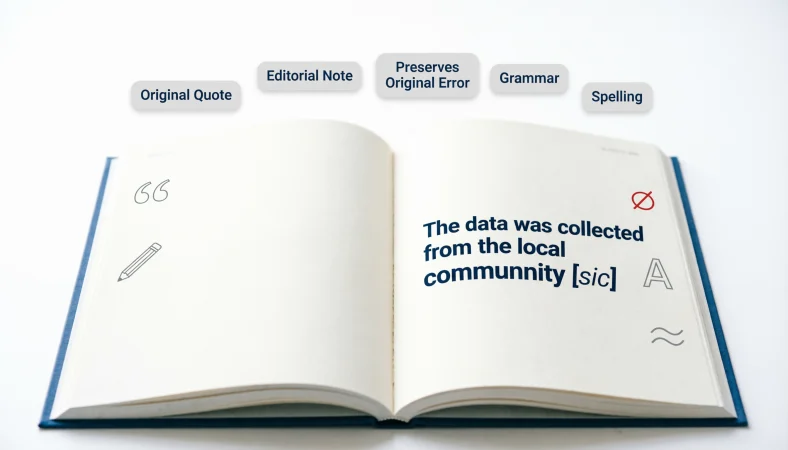
Definition: Sic is a Latin word meaning “thus” or “so.” When you see [sic] in a quote, it tells readers that a spelling, grammar, punctuation, or factual mistake appeared in the original source and has been reproduced exactly as written. The person quoting the text is signaling that the error belongs to the original author, not to the person quoting it.
If you’ve ever read a newspaper article, academic paper, legal document, or history book, you’ve probably come across a sentence like this:
“The committee has made there [sic] final decision.”
At first glance, you might think “there” is a typo. It is but the [sic] immediately after it tells you that the mistake existed in the original quotation. The writer intentionally copied the sentence exactly as it appeared and inserted [sic] to show that the error wasn’t introduced during quoting.
In simple terms, sic means:
- “This is exactly how the original text appeared.”
- “The mistake belongs to the original source.”
- “The quotation has not been corrected.”
Because of this, [sic] helps preserve accuracy and transparency when quoting someone else’s words.
| Detail | Explanation |
| Word | Sic |
| Language of Origin | Latin |
| Literal Meaning | Thus; So |
| Primary Purpose | Show that quoted text is reproduced exactly |
| Common Usage | Journalism, books, research papers, legal writing |
| Usually Written As | [sic] in brackets |
Unlike internet slang or texting abbreviations, sic is an editorial notation rather than a conversational expression.
Introduction
Reading a quote with [sic] can be confusing if you’ve never encountered it before. Some readers assume it highlights an important point, while others think it’s correcting a mistake. In reality, it does something quite different.
When you ask “what does sic mean in a quote,” you’re really asking why writers intentionally leave errors in quotations instead of fixing them. The answer lies in accuracy. Whether you’re reading a newspaper, a legal brief, a historical document, or a research article, [sic] tells you that the quoted material has been copied exactly as it originally appeared even if it contains a spelling mistake, grammatical error, unusual wording, or incorrect fact.
Understanding this small editorial mark helps you read quotations more confidently and avoid misunderstanding the writer’s intent. It also comes in handy if you’re writing essays, reports, or articles that include direct quotations.
Origin
The word sic comes directly from Latin, where it simply means “thus” or “so.” For centuries, scholars and editors have used it to indicate that a quoted passage appears exactly as it did in the original source.
Its use became especially common in:
- Academic writing
- Historical publications
- Newspapers
- Legal documents
- Government reports
- Scholarly journals
The notation serves an important editorial purpose. Rather than silently correcting someone else’s mistake, editors reproduce the original wording and add [sic] to make it clear that any unusual wording or error belongs to the original author.
For example:
Original letter:
“I recieved your package yesterday.”
Quoted version:
“I recieved [sic] your package yesterday.”
Here, “recieved” is misspelled in the original letter. Instead of correcting it to “received,” the editor preserves the original wording and inserts [sic] immediately after the error.
This practice maintains historical accuracy and protects the integrity of quotations.
Why Is It Written in Brackets?
You’ll almost always see sic inside square brackets:
[sic]
The brackets show that sic was added by the person quoting the material, not by the original speaker or writer.
For example:
Original statement:
“Their going tomorrow.”
Quoted version:
“Their [sic] going tomorrow.”
The brackets distinguish the editor’s note from the quoted text itself.
Why Don’t Writers Just Correct the Mistake?
Good editorial practice generally discourages changing someone else’s exact words without indicating the change.
Imagine a politician says:
“Our economy are improving.”
If a journalist quietly changes it to:
“Our economy is improving.”
the quotation is no longer exact.
Using:
“Our economy are [sic] improving.”
preserves the original wording while informing readers that the grammatical error came from the speaker.
This balance between accuracy and clarity is the primary reason [sic] exists.
Popularity
Although sic is centuries old, it remains widely used in modern publishing because accurate quotation is essential across many fields.
Today, you’re most likely to encounter [sic] in:
- News articles
- Magazine features
- Academic essays
- University research papers
- Court documents
- Legal opinions
- Biographies
- Historical books
- Fact-checking reports
- Investigative journalism
Interestingly, most people don’t use sic in everyday conversations or text messages. Instead, it belongs to the language of editors, journalists, researchers, lawyers, historians, and students who need to quote sources precisely.
Why Is It Still Relevant Today?
Even with spell-checking software and digital editing tools, [sic] remains valuable because it distinguishes intentional reproduction from accidental mistakes.
Consider these examples:
Without [sic]:
“The company recieved the shipment.”
Readers may assume the journalist made the spelling error.
With [sic]:
“The company recieved [sic] the shipment.”
Now readers immediately understand that the original source contained the mistake.
This small notation prevents confusion and protects the credibility of the person quoting the material.
Where You’re Most Likely to See It
| Publication Type | Common Use of [sic] |
| Newspapers | Preserving exact quotes from interviews or documents |
| Academic Papers | Maintaining accuracy in cited sources |
| Legal Documents | Reproducing testimony and evidence exactly |
| History Books | Preserving original historical language and spelling |
| Biographies | Quoting letters, diaries, and speeches accurately |
Because credibility and precision are essential in these fields, [sic] continues to be a standard editorial convention rather than an outdated practice.
Is [sic] Always Necessary?
Not always.
Many style guides recommend using [sic] only when the original error might confuse readers or when preserving the exact wording is especially important. If a quotation contains numerous obvious spelling mistakes, repeatedly inserting [sic] after every error can become distracting.
In some cases, editors instead mention that the quoted material has been reproduced exactly as written, avoiding multiple [sic] notations throughout the passage.
Used thoughtfully, [sic] helps readers distinguish between the original author’s mistakes and the editor’s faithful reproduction, making it one of the most useful editorial tools for accurate quotation.
How It Is Used
The primary purpose of [sic] is to indicate that a quotation has been reproduced exactly as it appeared in the original source, including any mistakes or unusual wording. It reassures readers that the person quoting the text did not accidentally introduce the error.
You’ll most often see [sic] immediately after the word or phrase in question, enclosed in square brackets.
Basic Rule
- Quote the original text exactly.
- Place [sic] immediately after the error.
- Do not correct the original wording if preserving the exact quote is important.
For example:
Original text:
“The meeting have been postponed.”
Quoted text:
“The meeting have [sic] been postponed.”
The grammatical error belongs to the original author, not the person quoting it.
Common Situations Where [sic] Is Used
1. Spelling Mistakes
Example:
“She definately [sic] agreed with the proposal.”
The original source misspelled definitely, and the quote preserves that mistake.
2. Grammar Errors
Example:
“Everyone are [sic] invited.”
The incorrect verb agreement is left unchanged because it’s part of the original quotation.
3. Incorrect Word Choice
Example:
“Their [sic] going to announce the winner.”
The original writer incorrectly used their instead of they’re.
4. Unusual Capitalization or Punctuation
Sometimes a source contains odd formatting that needs to remain unchanged.
Example:
“THIS Is [sic] My Final Answer.”
Again, [sic] tells readers the unusual capitalization appeared in the original.
5. Historical Documents
Older documents often contain spellings that look incorrect today but were standard at the time.
Example:
“Musick [sic] was played throughout the evening.”
In historical writing, editors may use [sic] to show that the spelling comes directly from the original document.
When You Shouldn’t Use [sic]
Although [sic] is useful, it shouldn’t appear after every small mistake.
Avoid using it:
- To mock someone’s spelling or grammar.
- Excessively in a quotation with many errors.
- When paraphrasing instead of quoting.
- To point out stylistic choices that aren’t actually mistakes.
Good editors use [sic] only when it genuinely helps readers understand the quotation.
Examples
Friendly Examples
These examples illustrate how [sic] works in everyday writing.
Example 1:
“I’ll definately [sic] be there tomorrow.”
Meaning: The original text misspelled definitely, and the quote reproduces it exactly.
Example 2:
“Your [sic] the best friend ever.”
Meaning: The original writer used your instead of you’re.
Example 3:
“This pizza is awsome [sic].”
Meaning: The misspelling awsome appeared in the original message.
Professional Examples
Journalists, researchers, and lawyers use [sic] frequently.
Example 1:
The report stated, “Sales has [sic] increased significantly.”
The grammar mistake belongs to the original report.
Example 2:
During testimony, the witness wrote, “I seen [sic] the accident.”
The legal document preserves the witness’s exact wording.
Example 3:
The historical letter reads, “The goverment [sic] has approved the request.”
The quotation faithfully reproduces the original spelling.
Funny Examples
Sometimes [sic] appears in humorous contexts, especially when quoting amusing social media posts.
Example 1:
“I’m a genious [sic].”
The irony is obvious because the misspelling contradicts the statement.
Example 2:
“No one is more humbler [sic] than me.”
The grammatical mistake unintentionally makes the sentence funnier.
Example 3:
“This is litterally [sic] impossible.”
The incorrect spelling is preserved because it appeared in the original post.
Although these examples can be amusing, editors should avoid using [sic] to embarrass or ridicule someone.
Comparison with Similar Terms
Many readers confuse [sic] with other editorial notations or citation terms. While they may appear in similar contexts, they serve different purposes.
| Term | Meaning | Primary Purpose | Example |
| [sic] | Thus; exactly as written | Shows the original contains an error | “Their [sic] going home.” |
| Quoted as written | Editorial note | Indicates the quotation is unchanged | Used in notes or introductions |
| Emphasis added | Editorial note | Indicates bold or italics were added by the editor | “The results were significant [emphasis added].” |
| Ellipsis (…) | Omitted words | Shows part of a quotation has been removed | “The meeting…was postponed.” |
| Brackets [ ] | Editorial insertion | Adds clarification without changing the original quote | “She [the manager] approved it.” |
[sic] vs. Ellipsis
These are often confused.
- [sic] preserves an error.
- … removes unnecessary words.
Example:
Original:
“I definately think the proposal should move forward because everyone supports it.”
Quoted:
“I definately [sic] think…everyone supports it.”
Here, [sic] identifies the spelling mistake, while the ellipsis indicates omitted words.
[sic] vs. Brackets
Although [sic] is written inside brackets, not every bracketed word is [sic].
Example:
“She [the director] approved the budget.”
The added words explain who “she” refers to.
By contrast:
“She recieved [sic] the budget.”
The brackets indicate an editorial note explaining that the misspelling belongs to the original source.
Alternate Meanings
Outside quotation and editing, sic can have a few other meanings depending on the context.
| Meaning | Context |
| Latin for “thus” or “so” | Original meaning in Latin |
| Editorial notation | Most common modern meaning |
| Military command “Sic ’em” (different word) | Informal English expression meaning “attack” or “go after” |
| Company or organization initials | Varies depending on the organization |
It’s worth noting that “sic” and “sic ’em” are unrelated. The latter is an English expression used to encourage a person or animal, often a dog to attack or chase something, while [sic] is purely an editorial notation.
For most readers searching “what does sic mean in a quote,” the editorial definition is the correct one.
Professional or Polite Alternatives
Using [sic] is not always the best editorial choice. In some situations, especially when the original text contains several mistakes, a more reader-friendly or respectful approach may be appropriate.
Here are some common alternatives:
1. Paraphrase the Original
If preserving the exact wording is unnecessary, paraphrasing avoids drawing attention to errors.
Original:
“The company dont have enough resources.”
Paraphrased:
The company stated that it did not have enough resources.
This approach improves readability while accurately conveying the meaning.
2. Correct Minor Errors (When Permitted)
Some style guides allow editors to silently correct obvious typographical mistakes, particularly if the correction does not alter the intended meaning. This is more common in informal publications than in academic or legal writing.
Example:
Original:
“The event wil begin at noon.”
Edited:
“The event will begin at noon.”
Always follow the publication’s editorial standards before making changes.
3. Add an Editorial Note
If a quotation contains multiple errors, a note before or after the quote may be clearer than inserting [sic] repeatedly.
Example:
The following quotation appears exactly as it was written in the original source.
This avoids clutter while informing readers that the wording has not been edited.
4. Use Brackets for Clarification
Brackets can add context without changing the original wording.
Example:
“She approved it,” referring to [the project proposal].
Unlike [sic], these bracketed words provide helpful explanations rather than identifying errors.
Common Mistakes
Many people misunderstand when and how to use [sic]. Avoid these frequent errors to keep your writing accurate and professional.
| Common Mistake | Correct Understanding |
| Using [sic] after every typo | Use it only when preserving the original wording is important. |
| Correcting the mistake and still adding [sic] | If you correct the error, [sic] is no longer appropriate. |
| Using (sic) instead of [sic] | Square brackets are the standard editorial format. |
| Assuming [sic] means “spelling is correct” | It actually signals that the original wording is reproduced exactly, including errors. |
| Using [sic] to mock someone | Its purpose is editorial clarification, not criticism or ridicule. |
| Adding [sic] when paraphrasing | It should appear only in direct quotations. |
Quick Tips
Remember these best practices whenever you encounter or use [sic] in writing:
- Use [sic] only in direct quotations.
- Place it immediately after the incorrect or unusual word.
- Keep the original wording unchanged.
- Avoid overusing it in quotations with multiple mistakes.
- Use square brackets, not parentheses.
- Don’t use [sic] to embarrass or criticize the original writer.
- Consider paraphrasing if preserving the exact wording isn’t necessary.
- Follow your organization’s style guide for academic, legal, or journalistic writing.
FAQs
What does [sic] mean in a quote?
It indicates that a quoted word or phrase appears exactly as it did in the original source, including any mistakes or unusual wording.
Why is [sic] written in brackets?
Square brackets show that [sic] is an editorial insertion added by the person quoting the text, not part of the original quotation.
Does [sic] always indicate a spelling mistake?
No. It can also identify grammar errors, unusual punctuation, outdated spellings, or intentionally preserved wording.
Is [sic] rude or offensive?
Not by itself. However, excessive or unnecessary use can seem mocking if it highlights minor mistakes without a valid editorial reason.
Can I use [sic] in academic writing?
Yes. Academic writing commonly uses [sic] to preserve accuracy when quoting original sources.
Should I correct the original quote instead of using [sic]?
Generally, no. If you are providing a direct quotation, you should preserve the original wording and use [sic] when clarification is needed.
What’s the difference between [sic] and an ellipsis (…)?
[sic] identifies an original error, while an ellipsis shows that part of a quotation has been omitted.
Can [sic] be used in everyday writing?
Yes, but it is most common in journalism, academic papers, legal documents, historical writing, and professional editing rather than casual conversations.
Conclusion
Understanding what does sic mean in a quote helps you read and write quotations more accurately. Rather than correcting someone else’s mistake, [sic] tells readers that the wording including any spelling, grammar, punctuation, or formatting errors appeared exactly that way in the original source. It serves as an editorial note that protects the accuracy and integrity of a quotation.
Although [sic] is a valuable tool in academic, legal, journalistic, and historical writing, it should be used thoughtfully. Overusing it or adding it simply to highlight minor mistakes can make your writing seem overly critical. When preserving exact wording isn’t necessary, paraphrasing or using an editorial note may be the better choice.
By knowing when to use [sic], when to avoid it, and how it differs from other editorial notations, you’ll be able to quote sources confidently, maintain credibility, and communicate with greater precision.
Read More Articles About:
- What Does AD Mean In Tennis? Complete Guide To Advantage Scoring In 2026
- 111 Meaning In Love: Signs, Soulmates & New Beginnings In 2026
- What Does N Mean In Statistics? Difference Between N and n,Explained In 2026
- Supplementary Angles Explained: Meaning, Definition, Properties & Examples In 2026










1 thought on “What Does Sic Mean In A Quote? Complete Meaning & Usage Guide In 2026”