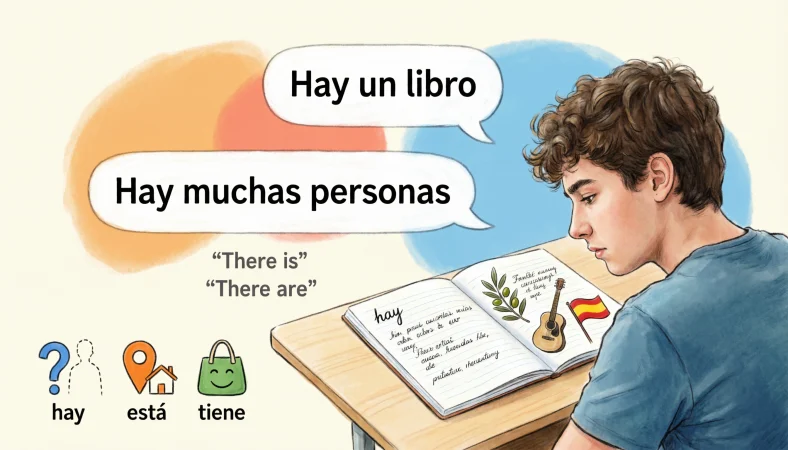
Definition: Hay in Spanish means “there is” or “there are” in English. It is used to say that something exists, is available, or is present. Unlike English, the Spanish word hay works for both singular and plural nouns.
If you are learning Spanish, one of the first words you will encounter is hay because it appears constantly in everyday conversations. The Spanish word hay translates to “there is” or “there are” and is used to describe the existence or presence of something.
Examples:
- Hay un libro en la mesa.
There is a book on the table. - Hay muchas personas aquí.
There are many people here.
A key difference between Spanish and English is that hay does not change depending on whether the noun is singular or plural.
| Spanish Sentence | English Meaning |
| Hay una casa. | There is a house. |
| Hay cinco casas. | There are five houses. |
| Hay un problema. | There is a problem. |
| Hay muchos problemas. | There are many problems. |
The word hay comes from the Spanish verb haber, which means “to have” in some contexts but is also used as an impersonal verb meaning “to exist” or “to be present.”
In modern Spanish, hay is mainly used when talking about the existence of something rather than ownership.
For example:
- Tengo un perro.
I have a dog. (ownership) - Hay un perro en el jardín.
There is a dog in the garden. (existence)
Understanding this difference helps avoid one of the most common beginner mistakes in Spanish.
Introduction
A traveler visiting Spain might hear someone say “Hay un restaurante cerca” and wonder why the speaker used hay instead of another form of “to be.” Spanish learners often find this small word confusing because English separates “there is” and “there are,” while Spanish uses one simple form for both.
So, what does hay mean in Spanish? It means “there is” or “there are,” and it tells you that something exists, happens, or can be found in a particular place. You will hear it in everyday conversations, questions, directions, descriptions, and announcements across Spanish-speaking countries.
Learning how to use hay correctly makes your Spanish sound more natural and helps you understand common phrases used by native speakers.
Origin of Hay
The word hay comes from the Spanish verb haber, which developed from the Latin verb habēre, meaning “to have” or “to possess.”
Over time, Spanish evolved different uses for haber. While modern speakers usually use tener for possession, haber became an important auxiliary verb and an impersonal verb.
The form hay developed as a way to express existence. It originally came from a phrase meaning something similar to “it has” or “it exists,” but its modern meaning is closer to:
- There is
- There are
- Something exists
- Something is available
Today, hay is considered one of the most common and useful Spanish words.
It appears in many everyday situations, such as:
- Asking if something exists
- Describing locations
- Talking about availability
- Explaining situations
- Making observations
Examples:
- ¿Hay agua?
Is there water? - Hay una solución.
There is a solution. - No hay problema.
There is no problem.
The phrase no hay problema is especially common and is often used in casual conversations to mean “no problem” or “don’t worry.”
Popularity of Hay
The word hay is widely used throughout the Spanish-speaking world because it is a basic part of daily communication. Spanish speakers use it naturally in countries across Latin America, Spain, and other Spanish-speaking communities.
Unlike some slang expressions or regional words, hay has the same general meaning in almost every Spanish-speaking region.
You may encounter it in:
- Spain
- Mexico
- Argentina
- Colombia
- Chile
- Peru
- Puerto Rico
- Other Spanish-speaking communities
Its popularity comes from its flexibility. A speaker can use hay to describe almost anything that exists or is available.
Common everyday examples include:
| Spanish Phrase | English Translation | Common Situation |
| Hay comida. | There is food. | Talking about availability |
| Hay tiempo. | There is time. | Discussing schedules |
| Hay una tienda cerca. | There is a store nearby. | Giving directions |
| Hay muchas opciones. | There are many options. | Making choices |
| No hay nadie. | There is nobody. | Describing absence |
Because hay is so common, mastering it helps beginners understand conversations much faster.
How It Is Used
The main use of hay is to indicate that something exists or is present. It does not describe who owns something or identify a specific person or object. Instead, it introduces the existence of something.
1. Talking About Something Existing
Use hay when introducing something for the first time or saying that something exists.
Examples:
- Hay una película nueva en el cine.
There is a new movie at the theater. - Hay muchas personas en la fiesta.
There are many people at the party.
The noun after hay can be singular or plural.
2. Asking Questions
You can use hay to ask whether something exists or is available.
Examples:
- ¿Hay un banco cerca?
Is there a bank nearby? - ¿Hay entradas para el concierto?
Are there tickets for the concert? - ¿Hay alguna pregunta?
Are there any questions?
Questions with hay are common when traveling, shopping, or making plans.
3. Talking About Availability
Spanish speakers often use hay when asking whether something is available.
Examples:
- ¿Hay habitaciones libres?
Are there available rooms? - Hay café en la cocina.
There is coffee in the kitchen. - No hay leche.
There is no milk.
4. Negative Sentences
To say that something does not exist or is unavailable, place no before hay.
Structure:
No + hay + noun
Examples:
- No hay agua.
There is no water. - No hay nadie aquí.
There is nobody here. - No hay problema.
There is no problem.
5. Describing Events or Situations
Hay can also describe that something is happening or taking place.
Examples:
- Hay una reunión mañana.
There is a meeting tomorrow. - Hay una fiesta esta noche.
There is a party tonight. - Hay mucho tráfico hoy.
There is a lot of traffic today.
Examples
Understanding hay becomes easier when you see how it works in real conversations. The meaning stays close to “there is” or “there are,” but the tone and purpose can change depending on the situation.
Friendly Examples
These examples show how friends and family commonly use hay in casual conversations.
Example 1:
Ana: ¿Hay comida en la casa?
Luis: Sí, hay pizza en la cocina.
Meaning:
Ana is asking if food exists or is available at home. Luis uses hay to explain that pizza is available.
Example 2:
María: ¿Hay algo interesante en la televisión?
Carlos: Sí, hay una película nueva.
Meaning:
The speakers are discussing available entertainment. Hay introduces the existence of a movie.
Example 3:
Sofía: ¿Hay planes para el fin de semana?
Daniel: Sí, hay una reunión con amigos.
Meaning:
Here, hay describes that an event has been planned.
Professional Examples
In professional settings, hay is often used in meetings, emails, reports, and announcements.
Example 1:
Hay varios cambios en el proyecto.
Meaning:
“There are several changes in the project.” The speaker is explaining that changes exist.
Example 2:
Hay una nueva oportunidad para mejorar el proceso.
Meaning:
“There is a new opportunity to improve the process.” The phrase introduces a possibility or option.
Example 3:
No hay información disponible en este momento.
Meaning:
“There is no information available at this moment.” This is a formal way to explain that information does not currently exist.
Funny Examples
Although hay itself is not a joke word, it can appear in humorous situations when describing unexpected things.
Example 1:
Hay un gato en mi computadora.
Meaning:
“There is a cat on my computer.” The sentence can be funny because the situation is unusual.
Example 2:
Hay demasiados mensajes en mi teléfono.
Meaning:
“There are too many messages on my phone.” This can humorously describe feeling overwhelmed.
Example 3:
Hay una montaña de ropa en mi habitación.
Meaning:
“There is a mountain of clothes in my room.” The exaggeration creates a funny image.
Comparison with Similar Terms
Spanish has several words that can confuse learners because English often translates them similarly. However, each word has a different purpose.
| Spanish Word | English Meaning | Main Difference | Example |
| Hay | There is / There are | Shows that something exists or is present | Hay un libro aquí. |
| Está / Están | Is / Are | Describes the location or condition of a specific thing | El libro está aquí. |
| Tiene / Tienen | Has / Have | Shows ownership or possession | Ella tiene un libro. |
| Es / Son | Is / Are | Describes identity or characteristics | El libro es interesante. |
| Existe / Existen | Exists / Exist | More formal way to talk about existence | Existe una solución. |
Hay vs. Está / Están
This is one of the most common differences Spanish learners need to understand.
Hay introduces something that exists:
Hay un restaurante cerca.
There is a restaurant nearby.
Está refers to a specific restaurant whose existence is already known:
El restaurante está cerca.
The restaurant is nearby.
The first sentence introduces the restaurant. The second sentence talks about a specific restaurant.
Hay vs. Tiene
Many beginners confuse hay with tiene because both can relate to having something.
Compare:
Hay un perro en el parque.
There is a dog in the park.
This means a dog exists in that location.
María tiene un perro.
María has a dog.
This means María owns the dog.
Hay vs. Existe
Both words can express existence, but they have different tones.
| Word | Tone | Typical Use |
| Hay | Everyday and natural | Conversations and normal descriptions |
| Existe | More formal | Academic, scientific, or official writing |
Examples:
Casual:
Hay muchas razones para aprender español.
Formal:
Existe evidencia que demuestra el cambio.
Both are correct, but hay sounds more natural in everyday speech.
Alternate Meanings
For most Spanish learners asking what does hay mean in Spanish, the answer is the existence form meaning “there is” or “there are.”
However, hay can sometimes appear in different contexts.
| Meaning | Context | Example |
| There is / There are | Standard Spanish usage | Hay una solución. |
| Part of the verb haber | Related verb forms | Hayamos terminado. |
| Hay (English word for dried grass) | Different language | Hay for animals to eat |
The last example can cause confusion because hay is also an English word meaning dried grass used as animal feed. However, this is unrelated to the Spanish word.
In Spanish, hay does not mean grass or farming material. It is a verb form used to express existence.
Professional or Polite Alternatives
In everyday Spanish, hay is already considered appropriate and natural. However, depending on the situation, other expressions may sound more formal or specific.
Formal Alternatives
Existe / Existen
Used in academic, legal, or professional contexts.
Example:
Existe una posibilidad de mejorar el sistema.
Translation:
There exists a possibility of improving the system.
Se encuentra / Se encuentran
Often used in formal descriptions.
Example:
El documento se encuentra disponible en línea.
Translation:
The document is available online.
Está disponible
Used when talking about availability.
Example:
El servicio está disponible para todos los usuarios.
Translation:
The service is available for all users.
There Is No Need to Replace Hay in Normal Speech
Many learners try to avoid hay because they think it sounds too simple. However, native Spanish speakers use it constantly. Replacing it unnecessarily with more formal words can make everyday speech sound unnatural.
For example:
Natural:
Hay un problema con la computadora.
Less common in casual speech:
Existe un problema con la computadora.
Both are correct, but the first sounds more conversational.
Common Mistakes
Learning hay is simple, but several mistakes are common among Spanish learners.
| Common Mistake | Correct Understanding |
| Changing hay to match singular or plural | Hay stays the same for both singular and plural nouns. |
| Using tiene instead of hay | Hay describes existence; tiene describes possession. |
| Saying “hayes” or “hays” | Hay has only one standard form in this use. |
| Using hay for specific objects already identified | Use está/están when referring to a known item’s location. |
| Translating word-for-word from English | Spanish structures do not always match English exactly. |
Mistake 1: Changing Hay for Plural Nouns
Incorrect:
Hayan muchas personas aquí.
Correct:
Hay muchas personas aquí.
The word hay remains unchanged.
Mistake 2: Confusing Hay and Tiene
Incorrect:
Hay un coche. (when meaning someone owns a car)
Correct:
Ella tiene un coche.
Use hay for existence and tener for possession.
Mistake 3: Using Hay for Location of Known Things
Incorrect:
Hay el libro en la mesa.
Correct:
El libro está en la mesa.
When talking about a specific known book, use está.
Quick Tips
Here are simple ways to remember how to use hay correctly:
- Think of hay as meaning “something exists.”
- Use it for both “there is” and “there are.”
- Never add -s for plural nouns.
- Use no hay to say something is unavailable or does not exist.
- Use hay when introducing something new in a conversation.
- Use está/están for the location of something specific.
- Use tiene/tienen for ownership.
A helpful memory trick:
Hay = existence
Está = location
Tiene = possession
Examples:
- Hay un libro. → There is a book.
- El libro está aquí. → The book is here.
- Ana tiene el libro. → Ana has the book.
FAQ
What does hay mean in Spanish?
Hay means “there is” or “there are” in Spanish and is used to describe that something exists or is available.
Is hay used for both singular and plural nouns?
Yes, hay is used for both singular and plural nouns without changing its form.
What is the difference between hay and está in Spanish?
Hay introduces the existence of something, while está describes the location or condition of a specific thing.
How do you say “there is no” in Spanish?
You say no hay, which means “there is no” or “there are no” depending on the context.
Does hay mean “have” in Spanish?
No, hay usually means “there is” or “there are,” while possession is normally expressed with tener.
Why is hay important in Spanish?
Hay is important because it appears frequently in everyday conversations, descriptions, questions, and announcements.
Can hay be used in formal Spanish?
Yes, hay is correct in both casual and formal Spanish, although alternatives like existe may appear in highly formal writing.
What is the difference between hay and existe?
Both express existence, but hay is more common in everyday speech while existe sounds more formal.
Conclusion
Understanding what does hay mean in Spanish is an important step for anyone learning the language. The word hay means “there is” or “there are” and is used whenever you want to say that something exists, happens, or is available.
The biggest thing to remember is that hay does not change for singular or plural nouns. Whether you are talking about one object, many people, an event, or a situation, the same word applies.
Although hay, está, and tiene can sometimes feel similar to beginners, each has a different purpose. Use hay for existence, está/están for location, and tiene/tienen for ownership. With regular practice, hay becomes one of the easiest and most useful Spanish words to recognize and use naturally.
Read More Articles About:
- What Is Love In Tennis? Definition, Origin, Rules, And Examples In 2026
- What Does LOML Mean in Text? Meaning, Examples, Usage and When to Use It In 2026
- What Does XD Mean In Text? Meaning, Origin, Examples and How to Use It Correctly In 2026
- What Do Wyll Mean In Text? Meaning, Origin, Examples, and How to Use It Correctly In 2026











1 thought on “What Does Hay Mean In Spanish? Complete Meaning, Uses & Examples For 2026”