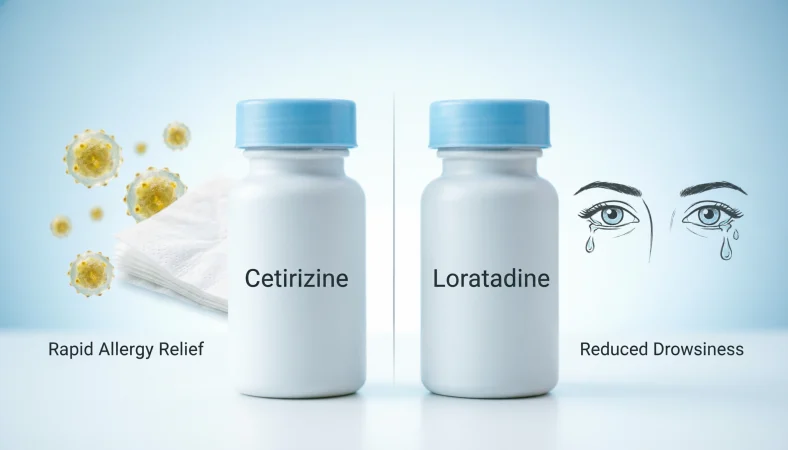
Zyrtec and Claritin are both second generation antihistamines used to relieve common allergy symptoms such as sneezing, runny nose, itchy eyes, and nasal or throat itching. Zyrtec contains cetirizine, while Claritin contains loratadine. They work in similar ways, but their effectiveness, onset of action, and likelihood of causing drowsiness can differ.
If you’re comparing Zyrtec or Claritin, the most important distinction is their active ingredient and how your body responds to it. Zyrtec contains cetirizine, an antihistamine that can provide strong allergy relief but may cause drowsiness in some people. Claritin contains loratadine and is marketed as a non drowsy option when taken as directed.
The two medicines belong to the same general category, so they are often considered alternatives rather than completely different types of treatment. However, choosing between them isn’t simply a matter of picking the stronger brand. Your symptoms, desired speed of relief, sensitivity to drowsiness, age, medical conditions, and other medicines can all matter.
Zyrtec vs Claritin: What’s the Difference?
At the simplest level, both medicines are oral antihistamines designed to reduce the effects of histamine, a chemical involved in allergic reactions. Histamine contributes to symptoms such as sneezing, itching, watery eyes, and a runny nose. Blocking its effects can therefore make allergy symptoms considerably easier to manage.
Zyrtec is the brand name associated with cetirizine, while Claritin is the brand name associated with loratadine. Both are classified as second generation antihistamines.
| Feature | Zyrtec | Claritin |
| Active ingredient | Cetirizine | Loratadine |
| Drug class | Second generation antihistamine | Second generation antihistamine |
| Common strength | 10 mg | 10 mg |
| Typical use | Allergy symptoms and hives | Allergy symptoms |
| Usual dosing for standard adult products | Once daily | Once daily |
| Drowsiness | Can occur | Less likely for most people |
| Main advantage | Often provides strong and relatively rapid relief | Generally less sedating |
| Common allergy symptoms treated | Sneezing, runny nose, itchy eyes, itchy nose or throat | Sneezing, runny nose, itchy eyes, itchy nose or throat |
The FDA labeling for Zyrtec lists cetirizine hydrochloride as its active ingredient and warns that drowsiness may occur. The Claritin label identifies loratadine as the active ingredient and describes the product as non drowsy when taken as directed. (FDA Access Data)
Quick recap:
Zyrtec contains cetirizine.
Claritin contains loratadine.
Both can treat common allergy symptoms.
Zyrtec may work faster for some people but is more likely to cause sleepiness.
Claritin is often preferred when avoiding drowsiness is especially important.
Is Zyrtec vs Claritin a Drug, Effectiveness, or Usage Issue?
Unlike a spelling question where one word is simply correct and the other is incorrect, this comparison involves two legitimate medicines with different active ingredients.
Neither medicine is universally better for everyone.
That distinction is important because people sometimes interpret effectiveness as a fixed property. In reality, a medicine can work extremely well for one person and less well for another. Individual response varies, and clinical studies have produced somewhat different results depending on the population, symptoms, and study design.
Both cetirizine and loratadine have demonstrated effectiveness for allergic rhinitis. A randomized clinical study involving 90 patients found that both were significantly better than placebo, while cetirizine showed a numerical advantage over loratadine in several measures.
Another controlled study involving 279 patients found that cetirizine produced greater symptom reductions than loratadine during seasonal allergy exposure. However, that does not mean every person will experience the same difference. (PubMed)
The comparison also involves lifestyle. Someone who needs allergy relief before driving, operating machinery, studying, or working may care greatly about sedation. Someone experiencing particularly troublesome symptoms may prioritize rapid or strong relief.
So the better question isn’t simply, “Which one is strongest?” It is, “Which option fits my symptoms and circumstances?”
Formal versus casual usage
There is no formal or informal distinction between these products in the way there is with ordinary vocabulary. Their names are brand names, while cetirizine and loratadine are the generic drug names.
In a medical setting, a healthcare professional may refer to the active ingredient rather than the brand.
For example:
“The patient takes cetirizine for seasonal allergic rhinitis.”
In ordinary conversation, someone might simply say:
“I take Zyrtec when my allergies get bad.”
Both are understandable, but the generic names are more precise when discussing pharmacology or treatment choices.
Academic and clinical usage
Academic writing generally emphasizes active ingredients, drug classes, dosage, study populations, outcomes, and adverse effects rather than relying only on brand names.
That distinction becomes especially important when comparing products because different formulations can exist under the same brand family.
Always check the actual Drug Facts label on the product you have rather than assuming every product carrying the same brand name contains exactly the same ingredients.
How Zyrtec Is Used
Zyrtec products containing cetirizine are used to temporarily relieve common symptoms associated with hay fever and other upper respiratory allergies. These include sneezing, runny nose, itchy or watery eyes, and itching of the nose or throat. (FDA Access Data)
Cetirizine is also used in products intended to relieve symptoms of hives. The exact approved uses depend on the formulation and labeling, so the package directions should always be checked.
Workplace example
Imagine someone develops severe sneezing and itchy eyes every morning during pollen season. They want an antihistamine that provides reliable relief throughout the workday.
Cetirizine may be an option, but drowsiness becomes an important consideration. FDA labeling specifically warns that drowsiness may occur and advises caution with driving or operating machinery.
That doesn’t mean everyone who takes cetirizine becomes sleepy. It means the possibility should be taken seriously, particularly when performing safety sensitive activities.
Academic example
In a research paper, you would normally write something like:
“Cetirizine is a second generation H1 antihistamine used in the management of allergic symptoms.”
You would then distinguish the drug from the brand name Zyrtec.
This makes the discussion more precise because another researcher can identify exactly which active ingredient is being studied.
Technology example
Digital health apps and medication databases generally work with generic drug names, active ingredients, strengths, and dosing information. A search for cetirizine can therefore provide information that is more transferable across brands than a search limited to Zyrtec.
Usage recap: Zyrtec refers to a brand associated with cetirizine. Cetirizine can provide effective allergy relief, but drowsiness is a relevant consideration for some users.
How Claritin Is Used
Claritin products containing loratadine are also used for temporary relief of common upper respiratory allergy symptoms. The FDA label identifies loratadine 10 mg as the active ingredient in standard Claritin tablets.
Claritin has become especially associated with the idea of non drowsy allergy relief. Its labeling states that the product is non drowsy when taken as directed. (FDA Access Data)
That wording is useful, but it shouldn’t be interpreted as an absolute guarantee that no individual will ever experience tiredness or another unwanted effect.
Workplace example
Suppose someone needs allergy relief before a long day at work and is particularly concerned about feeling sleepy. Loratadine may be attractive because it is generally considered less sedating than cetirizine.
Still, personal response matters. Someone who has never taken a medicine before should be cautious about assuming how it will affect them.
Academic example
In academic writing, you might describe loratadine as a second generation H1 antihistamine used for allergic rhinitis.
The word “loratadine” identifies the active substance, while “Claritin” identifies a major brand associated with that substance.
Technology example
Medication reminder applications may identify loratadine by its generic name and then display one or more corresponding brand names. This illustrates why knowing both names is useful.
Usage recap: Claritin contains loratadine. It is widely associated with non drowsy allergy relief, but individual responses and product formulations should still be considered.
When You Should NOT Choose Between Zyrtec and Claritin on Your Own
There are situations where comparing two over the counter antihistamines isn’t enough.
1. You have kidney disease
Cetirizine labeling specifically advises people with kidney or liver disease to consult a doctor because a different dose may be necessary. (FDA Access Data)
2. You have liver disease
Liver function can affect how certain medicines are processed. Don’t assume that an ordinary adult dose is appropriate if you have significant liver disease.
3. You’re taking sedatives or tranquilizers
The Zyrtec label advises consulting a doctor or pharmacist when taking tranquilizers or sedatives. It also warns that alcohol, sedatives, and tranquilizers can increase drowsiness.
4. You’re treating a child
Age and formulation matter. Never assume that an adult tablet or adult strength is appropriate for a child.
5. You’re pregnant or breastfeeding
The safest choice depends on your circumstances. Ask a qualified healthcare professional rather than choosing solely on brand reputation.
6. You have severe or unusual symptoms
An antihistamine isn’t a substitute for medical evaluation when symptoms are severe, persistent, or unexplained.
7. You’re having trouble breathing
Difficulty breathing can indicate a serious allergic reaction or another emergency. Do not rely on an over the counter allergy tablet as the only response.
8. You’re already taking another antihistamine
Taking multiple antihistamines without professional guidance can increase the risk of unwanted effects. Check the active ingredients carefully.
Common Mistakes When Comparing Zyrtec and Claritin
| Correct statement | Incorrect assumption | Explanation |
| Zyrtec contains cetirizine | Zyrtec and cetirizine are completely different medicines | Cetirizine is the active ingredient associated with Zyrtec |
| Claritin contains loratadine | Claritin and loratadine are unrelated | Loratadine is Claritin’s active ingredient |
| Cetirizine may cause drowsiness | Cetirizine always makes people sleepy | Drowsiness can occur, but individual responses differ |
| Claritin is marketed as non drowsy | Claritin can never cause tiredness in anyone | Product labeling does not guarantee an identical response for every individual |
| Both can treat allergy symptoms | They are identical medicines | They belong to the same general class but contain different active ingredients |
| Dose should follow the product label | More medicine means faster relief | Taking more than directed can increase risk without providing appropriate additional benefit |
Decision rule box
If you are comparing allergy medicines, first identify the active ingredient. Then consider the symptom you want to treat, how quickly you need relief, the possibility of drowsiness, your age, medical conditions, and other medicines you take.
This is a much safer decision rule than assuming that one brand is automatically superior.
Zyrtec and Claritin in Modern Technology and AI Tools
Modern medication searches increasingly happen through search engines, health applications, pharmacy websites, and AI powered assistants. That creates a useful opportunity, but also a risk.
An AI system may quickly summarize that cetirizine is associated with Zyrtec and loratadine with Claritin. That information is helpful, but medication decisions require more context.
A responsible digital health answer should distinguish:
Brand name: Zyrtec or Claritin
Active ingredient: Cetirizine or loratadine
Drug class: Second generation antihistamine
Common purpose: Relief of allergy symptoms
Important consideration: Individual effectiveness and side effects vary
AI tools should also avoid treating clinical trial averages as guarantees for individual patients. A study showing that one medicine performed better on average does not prove that every person will experience the same outcome.
This is particularly important for medications because age, kidney function, liver function, other medicines, pregnancy status, and personal sensitivity can affect safety and effectiveness.
What Research Says About Zyrtec and Claritin
Clinical evidence provides a more nuanced picture than a simple winner and loser comparison.
Case study 1: Seasonal allergy exposure
A randomized double blind outdoor study enrolled 279 patients with seasonal allergic rhinitis. Participants received cetirizine 10 mg, loratadine 10 mg, or placebo.
Cetirizine produced significantly greater reductions in major symptom severity than loratadine or placebo at most evaluation periods. The study also reported a faster onset pattern for cetirizine. Somnolence occurred in 13 percent of the cetirizine group compared with 2 percent of the placebo group.
The result is useful because it demonstrates a real tradeoff: stronger or faster symptom control in a particular study does not eliminate the importance of side effects.
Case study 2: Controlled pollen challenge
Another randomized study compared 10 mg cetirizine, 10 mg loratadine, and placebo in people exposed to ragweed pollen.
Cetirizine reduced the overall total symptom score by 36.7 percent, compared with 15.4 percent for loratadine and 12 percent for placebo. The study detected cetirizine’s effect within approximately one hour, while loratadine showed an effect at approximately three hours.
A later study designed to reproduce the findings again found earlier onset with cetirizine and greater overall symptom reduction during the controlled exposure period. (PubMed)
These results are valuable, but they shouldn’t be turned into an absolute statement that cetirizine is always better. Other studies have found similar effectiveness between the two medicines, and responses can vary among individuals.
Which One Causes More Drowsiness?
This is one of the most common reasons people compare these medicines.
Cetirizine is generally more associated with drowsiness than loratadine. The FDA label for Zyrtec explicitly states that drowsiness may occur and advises caution with driving and machinery.
Loratadine is marketed in standard Claritin products as non drowsy when taken as directed.
However, “less likely to cause drowsiness” does not mean “physically impossible to feel tired.”
Individual responses matter. If you take an antihistamine for the first time, pay attention to how you respond before assuming that it won’t affect alertness.
Alcohol and sedating medicines can also change the situation, particularly with cetirizine.
Which One Works Faster?
Research comparing the two medicines has often found a faster onset with cetirizine.
In one controlled pollen study, measurable symptom improvement appeared within about one hour with cetirizine and about three hours with loratadine. (PubMed)
Another replicated study found the same general pattern, with cetirizine showing an earlier onset and greater overall symptom reduction.
However, onset of action can vary according to the person, symptom, study design, and outcome being measured.
You therefore shouldn’t interpret research results as a promise that cetirizine will always work within exactly one hour for every person.
Can You Take Zyrtec and Claritin Together?
Generally, you shouldn’t combine two antihistamines simply because you want stronger allergy relief unless a healthcare professional specifically tells you to do so.
Both products are antihistamines. Taking additional medication without checking the active ingredients can increase the risk of unwanted effects without necessarily producing better symptom control.
If one antihistamine isn’t providing enough relief, ask a pharmacist or doctor about the appropriate next step. Depending on the type and severity of allergy symptoms, another treatment approach may be more suitable.
This is particularly important if you’re already taking cold medicines, sleep aids, sedatives, or other products that may contain antihistamines or ingredients that cause drowsiness.
Error Prevention Checklist
Always consider
- The active ingredient rather than only the brand name
- Whether you need relief from sneezing, itching, watery eyes, or other allergy symptoms
- Whether drowsiness would interfere with driving or work
- Your age and the specific product formulation
- Kidney or liver conditions
- Other medicines and supplements
- The dosage instructions printed on the package
Never assume
- That the strongest medicine is automatically the best choice
- That non drowsy means nobody can feel tired
- That adult doses are suitable for children
- That two antihistamines are safe to combine without professional advice
- That a clinical study guarantees the same result for you
- That all products under a brand name have identical formulations
Related Allergy Medicine Comparisons You Should Understand
If you’re researching antihistamines, these comparisons can also help you understand the terminology and treatment differences:
- Cetirizine versus loratadine
- Cetirizine versus fexofenadine
- Loratadine versus fexofenadine
- First generation versus second generation antihistamines
- Antihistamines versus nasal corticosteroids
- Allergy medicine versus decongestants
- Seasonal allergies versus perennial allergies
- Allergic rhinitis versus a common cold
- Allergy symptoms versus sinus symptoms
- Oral antihistamines versus antihistamine nasal sprays
The important lesson is that these comparisons involve different mechanisms, symptoms, and treatment goals. A medicine that works well for sneezing may not be the best solution for severe nasal congestion, for example.
FAQs
Is Zyrtec or Claritin better for allergies?
Neither is universally better. Zyrtec (cetirizine) may work faster or provide stronger relief for some people, while Claritin (loratadine) may be preferable if avoiding drowsiness is a priority.
Is Zyrtec stronger than Claritin?
Some studies suggest Zyrtec (cetirizine) may reduce allergy symptoms more effectively than Claritin (loratadine), but the better choice varies by person and symptoms.
Does Zyrtec make you sleepy?
It can. FDA labeling for cetirizine states that drowsiness may occur and advises caution with driving or operating machinery.
Does Claritin make you sleepy?
Claritin is generally considered non drowsy, but some people may still experience sleepiness. If it makes you drowsy, avoid driving or other activities requiring alertness.
Which works faster, Zyrtec or Claritin?
Zyrtec (cetirizine) generally starts working faster than Claritin (loratadine). Studies have found effects within about one hour for cetirizine, compared with around three hours for loratadine.
Can I take Zyrtec and Claritin together?
You shouldn’t routinely combine them without professional guidance. Since both are antihistamines, combining medicines can increase unwanted effects without necessarily improving allergy control.
Is cetirizine the same as Zyrtec?
Cetirizine is the active ingredient associated with Zyrtec. Zyrtec is a brand name, while cetirizine identifies the drug substance.
Is loratadine the same as Claritin?
Loratadine is the active ingredient associated with Claritin. The terms aren’t technically identical because one is the generic drug name and the other is a brand name.
Which is better for allergies if I need to drive?
Loratadine may be preferable when avoiding drowsiness is important, but individual reactions vary. If taking either medicine for the first time, see how it affects your alertness before driving.
Should I ask a doctor before taking Zyrtec or Claritin?
Yes, seek medical advice if you have kidney or liver disease, take interacting medicines, are pregnant or breastfeeding, are treating a young child, or have severe or unusual symptoms.
Conclusion: Understanding Zyrtec or Claritin
The best way to compare Zyrtec or Claritin is to look beyond the brand names. Zyrtec contains cetirizine, while Claritin contains loratadine. Both are second generation antihistamines used for common allergy symptoms, but they aren’t identical medicines.
Clinical studies have frequently found cetirizine to provide faster and sometimes greater allergy symptom relief, while loratadine is generally associated with less drowsiness.
Still, there isn’t a universal winner. Your symptoms, sensitivity to drowsiness, medical history, other medicines, age, and lifestyle all matter. The safest approach is to follow the product label and ask a pharmacist or doctor when your situation is complicated.
Author note: This article is written from a medical information and language clarity perspective. It is educational content, not individualized medical advice.