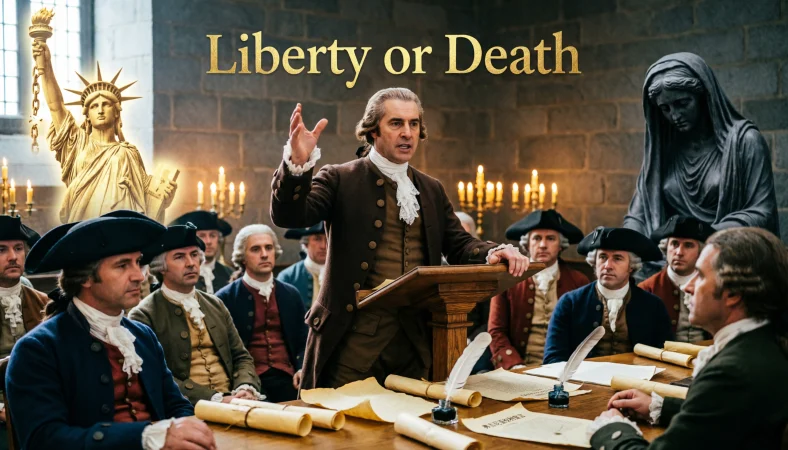
“Liberty or death” is a powerful expression meaning that freedom is considered more valuable than continued life under oppression or tyranny. It presents a stark choice between living freely and accepting subjugation. The phrase is strongly associated with Patrick Henry’s famous 1775 speech, although similar ideas existed in political thought long before his words.
The phrase liberty or death expresses an uncompromising preference for freedom over submission. Liberty means freedom from oppressive control or unjust restriction, while death means the end of life. Together, the words create a rhetorical contrast: accepting the loss of freedom is presented as worse than dying. The expression is therefore both literal and symbolic, depending on context.
Liberty or Death: What’s the Difference?
At first glance, liberty and death seem like unrelated nouns. One describes a condition of freedom, while the other describes the end of life. Their significance changes when they are joined in the expression liberty or death.
| Term | Part of speech | Basic meaning | Role in the expression |
| Liberty | Noun | Freedom from oppressive or arbitrary control | Represents freedom and self determination |
| Death | Noun | The end of biological life | Represents the ultimate consequence |
| Liberty or death | Fixed rhetorical expression | Freedom is preferable to submission | Creates a dramatic choice between freedom and surrender |
The expression uses or to establish an either or relationship. It does not necessarily mean that a person must literally choose between two immediate events.
Instead, it communicates a strong principle: a life without meaningful freedom may be considered unacceptable.
The Basic Idea
The phrase can be understood as:
Freedom is worth defending even at the greatest personal cost.
That is why the expression has been used in revolutionary speeches, political movements, literature, memorials, military contexts, and popular culture.
The wording is memorable because it compresses a complicated political argument into three words.
Liberty represents the desired condition.
Death represents the ultimate sacrifice.
Or turns the two concepts into a dramatic choice.
Is Liberty or Death a Grammar, Vocabulary, or Usage Issue?
This is primarily a meaning, rhetoric, history, and usage issue, rather than a grammar problem.
There is nothing grammatically unusual about the expression. Liberty and death are both nouns, and or is a coordinating conjunction connecting the alternatives.
What makes the phrase distinctive is its rhetorical force.
Is the Phrase Literal?
Sometimes it is.
In a historical revolutionary context, a speaker might genuinely be arguing that people should risk death rather than remain under political oppression.
But the phrase can also be figurative.
Someone might say:
“For her, creative independence is liberty or death.”
That sentence does not necessarily suggest physical death. Instead, it dramatically communicates that losing creative independence would feel unbearable.
Formal Versus Informal Usage
The expression has a strongly dramatic and formal historical tone.
It can appear naturally in:
- historical writing
- political speeches
- literature
- essays
- commentary
- dramatic dialogue
- motivational language
In everyday conversation, however, it can sound exaggerated.
If someone says:
“No coffee before work? Liberty or death!”
the statement is humorous because the grand historical language is being applied to an ordinary inconvenience.
Academic Versus Casual Usage
Academic writing can use the phrase when discussing political history, revolutionary rhetoric, freedom, nationalism, or Patrick Henry.
Casual writers may use it metaphorically for emphasis.
The context determines whether the expression sounds serious, dramatic, humorous, or intentionally exaggerated.
The Historical Meaning of Liberty or Death
The phrase is most famously associated with Patrick Henry, an American political leader and orator.
In March 1775, Henry delivered a speech at the Second Virginia Convention in Richmond. He argued that the American colonies needed to prepare for armed resistance against British authority.
The speech culminated in the famous declaration:
“Give me liberty, or give me death!”
The expression became one of the most recognizable statements associated with the American Revolutionary era.
The historical significance lies not merely in the wording but in the argument surrounding it. Henry was attempting to persuade his audience that continued political submission was not a satisfactory solution. His speech urged preparation for conflict at a time when tensions between Britain and the American colonies had become extremely serious.
The phrase therefore became associated with resistance, independence, sacrifice, and political freedom.
It is important to distinguish “liberty or death” from Henry’s full quotation. The shorter expression is often used as a general slogan, while “Give me liberty, or give me death!” is the famous wording traditionally attributed to his speech.
Why Patrick Henry’s Phrase Became So Famous
The expression succeeds rhetorically because it creates an extreme contrast.
Freedom is presented as the highest value.
Death is presented as preferable to surrender.
There is no complicated qualification in the wording. That simplicity gives the phrase considerable emotional force.
Political speeches often use contrasts because audiences can understand them immediately. Henry’s formulation transforms an abstract political argument into a personal choice.
Instead of merely arguing that independence is desirable, the phrase implies that freedom is so important that an individual should be willing to sacrifice everything for it.
This is one reason the wording has survived for centuries.
How Liberty and Death Work Together as Symbols
The expression becomes more powerful when the two words are treated symbolically.
Liberty as a Symbol
Liberty can represent:
- political independence
- freedom of speech
- personal autonomy
- civil rights
- freedom from oppression
- self government
- resistance to tyranny
The precise meaning depends on the context.
Death as a Symbol
Death can represent literal physical death, but it can also symbolize:
- sacrifice
- the end of a way of life
- destruction
- surrender
- loss of identity
- the consequences of resistance
This symbolic flexibility allows the phrase to appear in contexts far removed from eighteenth century revolutionary politics.
Practical Usage of Liberty or Death
Although the expression has a famous historical origin, modern writers can use it in several ways.
Workplace Example
A manager might jokingly tell a team:
“The deadline is tomorrow. Liberty or death!”
The statement is obviously exaggerated. It uses historical rhetoric for comic effect.
A serious workplace discussion could instead use the phrase metaphorically:
“For independent journalists, editorial freedom can sometimes feel like liberty or death.”
Here, the expression emphasizes the importance of professional independence.
Academic Example
A history student might write:
Patrick Henry’s rhetoric framed resistance as a choice between liberty and death.
This is a natural academic use because the sentence directly discusses revolutionary rhetoric.
Another example is:
The phrase became a powerful symbol of resistance to political oppression.
This version is more analytical and less dramatic.
Technology Example
A technology writer could use the expression humorously:
For some developers, losing control over their source code is practically liberty or death.
The phrase creates emphasis without being literal.
It could also appear in discussions of digital freedom, open source software, privacy, and censorship.
Usage Recap
Use the expression when you want to communicate a strong preference for freedom over submission.
For historical writing, connect it clearly to its political context.
For modern writing, metaphorical or humorous use can work well when the dramatic tone is intentional.
When You Should NOT Use Liberty or Death
Although memorable expressions can strengthen writing, liberty or death is not appropriate in every context.
1. Do Not Use It for Ordinary Decisions Without a Clear Reason
Calling a minor inconvenience “liberty or death” can make your writing sound melodramatic unless humor is intended.
2. Do Not Present the Phrase as a Neutral Description
The expression carries strong rhetorical and political associations. It communicates an extreme position rather than a neutral observation.
3. Do Not Confuse It With a Simple Definition of Liberty
Liberty does not inherently mean choosing death over oppression. The phrase creates that relationship through rhetoric.
4. Do Not Assume Every Historical Use Refers to Patrick Henry
The underlying idea of freedom being worth dying for predates Henry. His speech made the wording particularly famous, but the broader political concept is much older.
5. Do Not Use It Casually in Sensitive Historical Discussions Without Context
When discussing wars, revolutions, political violence, or oppression, dramatic slogans can oversimplify complex historical realities.
6. Do Not Treat the Expression as a Literal Requirement
The phrase is often rhetorical. It does not necessarily instruct every person to choose death.
7. Do Not Attribute Every Similar Expression to Henry
Different cultures and historical movements have used comparable ideas about freedom and sacrifice.
8. Do Not Remove the Historical Context in Academic Writing
If the expression is central to your analysis, explain who used it, when it was used, and what the speaker intended.
Common Mistakes and Decision Rules
| Correct sentence | Incorrect or misleading sentence | Explanation |
| Patrick Henry famously declared, “Give me liberty, or give me death!” | Patrick Henry invented the idea of liberty or death. | Similar political ideas existed before Henry. |
| The phrase expresses a willingness to sacrifice for freedom. | The phrase always means literal death. | It can be literal or rhetorical. |
| Liberty represents freedom in this expression. | Liberty simply means happiness. | Liberty specifically concerns freedom and autonomy. |
| The slogan has revolutionary associations. | The slogan is politically neutral. | Its historical use gives it strong political associations. |
| The writer used the phrase metaphorically. | The writer was literally facing death. | Context determines whether the expression is literal. |
Decision Rule Box
If you are discussing freedom as something worth defending at extreme cost, the expression may fit.
If you are discussing ordinary freedom without dramatic contrast, use a more precise phrase such as “individual liberty,” “political freedom,” or “personal autonomy.”
Liberty or Death in Modern Technology and AI Tools
Modern technology has expanded the metaphorical uses of revolutionary language.
Digital privacy advocates, open source communities, cybersecurity professionals, and free expression organizations sometimes use language about freedom and control to describe technological issues.
In AI discussions, the concept can also appear metaphorically when writers discuss user autonomy, data ownership, algorithmic control, or technological independence.
For example:
Developers increasingly debate whether technological autonomy is a form of digital liberty.
That sentence is more precise than simply using liberty or death, but a headline writer might use the stronger phrase for dramatic effect.
AI writing systems can also reproduce historically famous expressions because they occur frequently in literary and historical material. However, writers should still verify the context and attribution rather than assuming that a memorable quotation automatically describes the historical situation accurately.
The Etymology of Liberty and Death
The two words have very different histories.
Liberty entered English through Old French and ultimately derives from Latin libertas, meaning freedom or the condition of being free. Its history is closely connected with political philosophy, legal rights, and personal freedom.
Death is much older in English. It comes from Old English dēaþ and is related to other Germanic words concerning dying and mortality.
When combined in a rhetorical expression, these words create a striking semantic contrast.
One represents the condition people seek to preserve.
The other represents the ultimate consequence that may be accepted rather than surrendering that condition.
This contrast helps explain why the expression has such strong rhetorical power.
Liberty or Death as a Rhetorical Device
The expression is an example of antithesis, a rhetorical technique that places contrasting ideas close together.
Freedom and death are not natural opposites in the literal sense. However, the phrase places them in opposition by suggesting that a person would rather face death than live without liberty.
This creates a dramatic hierarchy of values.
The speaker is effectively saying:
Freedom is so important that survival without it is unacceptable.
The structure is memorable because the audience does not have to process a long explanation. The contrast carries much of the argument.
This technique appears throughout political rhetoric and literature. Speakers often use paired opposites such as freedom and oppression, independence and submission, or justice and tyranny to make an argument emotionally powerful.
Two Historical and Rhetorical Case Studies
Case Study 1: Patrick Henry and Revolutionary America
Patrick Henry’s 1775 speech is the most famous American example associated with the expression.
His objective was persuasion. He wanted delegates at the Second Virginia Convention to recognize the seriousness of the conflict with Britain and support military preparation.
The closing formulation gave the argument a memorable emotional climax.
Its lasting effect is evident from the fact that the phrase remains widely recognized more than two centuries later.
The important lesson for modern writers is that the phrase was not merely decorative language. It was part of a persuasive political argument aimed at a specific audience facing a specific historical crisis.
Case Study 2: Modern Metaphorical Usage
Modern writers frequently adapt revolutionary language to nonmilitary situations.
A technology columnist might describe privacy as a matter of personal liberty. A satirist might describe an everyday preference as “liberty or death.” A novelist might use the expression to characterize a rebellious protagonist.
The result is usually rhetorical rather than literal.
The phrase gains its power from the reader’s familiarity with the historical association. Even when the modern subject has nothing to do with revolution, the wording immediately suggests defiance and sacrifice.
Expert Style Interpretation
A useful way to understand the expression is this:
“Liberty or death” is less about death itself than about the value a speaker places on freedom.
That distinction matters. The phrase is fundamentally a statement of values. Death functions as the extreme alternative that demonstrates how important liberty is to the speaker.
This is why the expression remains useful in rhetoric even when no literal threat to life exists.
Error Prevention Checklist
Always Use Liberty or Death When
- You are discussing revolutionary rhetoric.
- You are analyzing Patrick Henry’s famous speech.
- You want to emphasize freedom as an extremely important value.
- You are intentionally using dramatic or rhetorical language.
- You are discussing sacrifice for political or personal freedom.
- You have enough context for readers to understand the expression.
Avoid the Expression When
- You need neutral academic language.
- You are describing ordinary personal choices.
- The dramatic tone would distract from your main point.
- You are discussing complex historical events that require careful qualification.
- You might accidentally imply a literal threat of death.
A more precise phrase would communicate your meaning better.
Related Grammar, Vocabulary, and Rhetorical Confusions You Should Master
Understanding liberty or death also connects with several broader language topics.
- liberty vs freedom: These words overlap substantially but can carry different legal, philosophical, and historical associations.
- liberty vs independence: Independence concerns freedom from external control, while liberty can refer more broadly to individual or political freedom.
- freedom vs autonomy: Autonomy emphasizes self direction and the ability to make one’s own decisions.
- life or death meaning: This expression often describes extremely important or consequential situations.
- give me liberty or give me death: This is the famous longer formulation associated with Patrick Henry.
- rhetorical question vs statement: Political rhetoric often uses dramatic structures to persuade rather than merely inform.
- antithesis in rhetoric: Contrasting concepts can make an argument more memorable and forceful.
- literal vs figurative language: Expressions involving death frequently have metaphorical meanings.
- freedom vs oppression: These concepts form a common contrast in political and historical writing.
- historical quotation vs modern slogan: A famous quotation may acquire new meanings when later generations reuse it.
FAQs
What does liberty or death mean?
“Liberty or death” means that freedom is considered more valuable than continued life under oppression or unjust control. It expresses a willingness to accept extreme consequences rather than surrender meaningful freedom.
Who said liberty or death?
The expression is most famously associated with Patrick Henry. His famous 1775 speech concluded with the words, “Give me liberty, or give me death!”
What does give me liberty or give me death mean?
It means that the speaker would rather die than live without freedom. In Patrick Henry’s historical context, the statement was part of an argument for resistance to British rule.
Is liberty or death a metaphor?
It can be used metaphorically. In modern writing, the phrase often emphasizes that something is extremely important without suggesting that literal death is actually involved.
Is liberty or death a political phrase?
Yes. It has strong political and revolutionary associations, particularly because of Patrick Henry’s 1775 speech and the broader history of political resistance.
What is the difference between liberty and death?
Liberty refers to freedom or the absence of oppressive control, while death refers to the end of life. In the expression, they are presented as opposing outcomes to emphasize the value of freedom.
Why is liberty or death so powerful?
The phrase is powerful because it creates an extreme contrast between freedom and the ultimate human consequence. Its short structure and emotional intensity make the idea easy to remember.
Can liberty or death be used humorously?
Yes. Writers sometimes use it humorously by applying its dramatic historical tone to an ordinary situation. The humor comes from the exaggerated contrast.
Is liberty or death the same as give me liberty or give me death?
They express essentially the same central idea, but “Give me liberty, or give me death!” is the famous formulation traditionally associated with Patrick Henry.
Conclusion: Liberty or Death
The expression liberty or death communicates an uncompromising commitment to freedom. Its most famous American association is Patrick Henry’s 1775 declaration, “Give me liberty, or give me death!” However, the broader idea that freedom may be worth extreme sacrifice is much older and has appeared across political and literary traditions.
The phrase can be literal in historical contexts, but modern writers often use it figuratively or humorously. Its power comes from the sharp contrast between liberty and death, making it an example of memorable rhetorical language.
If you’re writing about American history, political rhetoric, revolution, freedom, or resistance, the expression can be highly effective. In neutral or technical writing, however, more precise language is usually preferable.