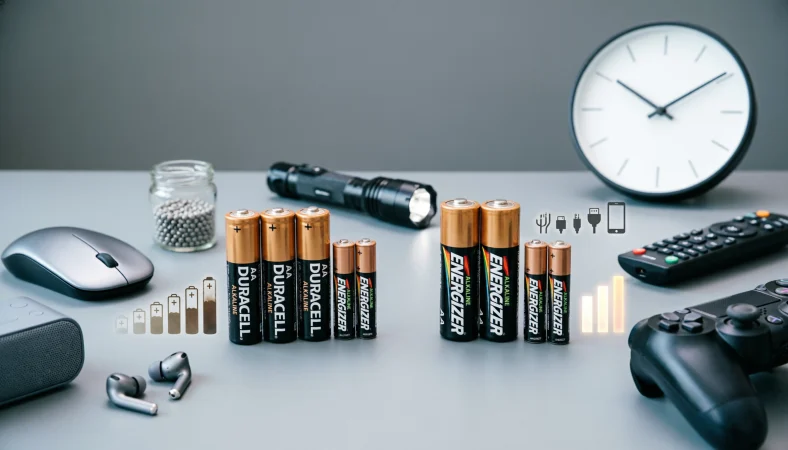
Duracell or Energizer are two major battery brands offering alkaline, lithium, rechargeable, and specialty batteries for everyday electronics. Both brands make batteries in common sizes such as AA, AAA, C, D, and 9V. The right choice depends on the battery chemistry, device, expected usage, storage needs, and specific product rather than brand name alone.
When people search for Duracell or Energizer, they are usually trying to answer a practical question: which battery should they buy for a particular device? Both brands are widely recognized, and both offer several battery families designed for different applications. That makes a simple brand comparison less useful than it first appears.
Duracell and Energizer are not single battery products. Each company sells multiple lines with different chemistries, specifications, sizes, and intended uses. For example, Duracell offers Coppertop alkaline batteries, while Energizer offers its MAX alkaline family as well as other battery technologies.
This distinction matters because battery performance depends heavily on the device and battery type. A battery used in a wall clock has different demands from one used in a digital camera, game controller, flashlight, wireless mouse, or emergency device.
Another common mistake is comparing a standard alkaline battery from one company with a premium lithium battery from another. That is not a fair comparison because chemistry, capacity, weight, operating temperature, and intended use can differ substantially.
The better approach is to compare equivalent products. Look at the battery chemistry, size, shelf life, leakage protection, expected workload, and manufacturer specifications. Once those factors are clear, choosing between the two brands becomes much easier.
Duracell vs Energizer: What’s the Difference?
Duracell and Energizer are competing battery manufacturers with broad product ranges. Both companies make alkaline batteries for common household devices, along with other technologies designed for more specialized applications.
A useful comparison starts with equivalent product categories. Duracell Coppertop is a general purpose alkaline range, while Energizer MAX is an everyday alkaline range. Both are intended for devices such as toys, remote controls, lights, clocks, and other consumer electronics.
| Feature | Duracell | Energizer |
| Brand type | Battery manufacturer | Battery manufacturer |
| Common alkaline range | Coppertop | MAX |
| Common sizes | AA, AAA, C, D, 9V | AA, AAA, C, D, 9V |
| Battery chemistry | Alkaline and other chemistries | Alkaline and other chemistries |
| Everyday applications | Toys, remotes, clocks, lights, electronics | Toys, remotes, clocks, lights, electronics |
| Rechargeable options | Available | Available |
| Lithium options | Available | Available |
| Storage life | Depends on product and size | Depends on product and size |
| Performance | Depends on product and device | Depends on product and device |
| Best comparison method | Compare equivalent battery types | Compare equivalent battery types |
Duracell’s current Coppertop AA and AAA batteries are alkaline batteries and are advertised with a 12 year storage guarantee for those sizes.
Energizer’s current MAX range also offers long storage life, with the company’s North American product information stating that AA and AAA MAX batteries can hold power for up to 15 years in storage.
These figures illustrate an important point: even within the same broad battery category, specifications can vary by product, size, market, and generation.
Quick recap
Duracell and Energizer both offer everyday alkaline batteries.
Neither brand has one battery that is ideal for every device.
Equivalent products should be compared rather than brand names alone.
Battery chemistry and device requirements can matter more than the logo on the package.
Is Duracell vs Energizer a Brand, Product, or Usage Issue?
The question is primarily a product comparison issue, not a simple brand preference question.
Someone comparing Duracell and Energizer may actually be asking several different questions at once. They may want to know which battery lasts longer, which is better for high drain devices, which stores longer, which has better leakage protection, or which offers better value.
Those questions require different answers.
Are Duracell and Energizer interchangeable?
At the most basic level, equivalent batteries from either brand can often serve the same type of device if the size and chemistry match.
For example, an AA alkaline battery from one brand can generally be used in a device designed for standard AA alkaline batteries from another manufacturer.
However, this does not mean every battery is interchangeable.
An AA alkaline battery and an AA rechargeable NiMH battery have different characteristics. A lithium battery may also have different voltage behavior and performance characteristics from an alkaline battery.
Always follow the device manufacturer’s battery requirements.
Formal versus casual comparison
In casual conversation, people often say:
Duracell or Energizer?
That question is understandable, but it leaves out important information.
A more useful question is:
Which AA alkaline battery is more suitable for this device?
That wording focuses on the actual product rather than relying entirely on brand reputation.
Everyday versus specialized use
For ordinary household devices, standard alkaline batteries are often the relevant comparison.
For high drain devices, extreme temperatures, professional equipment, cameras, or devices that remain unused for long periods, other battery chemistries may deserve consideration.
Energizer, for example, separates its alkaline MAX products from Ultimate Lithium products and identifies different intended applications for them.
How to Use Duracell Batteries
Duracell offers several battery families, so the specific product matters.
Its Coppertop alkaline batteries are designed for everyday household electronics. The manufacturer lists uses including toys, remote controls, flashlights, clocks, radios, portable electronics, and wireless mice and keyboards.
Workplace example
Imagine a workplace that uses wireless keyboards and mice throughout an office.
Standard AA or AAA alkaline batteries may be appropriate if the devices are designed for them. The practical decision should consider the number of devices, replacement frequency, storage conditions, and cost per battery.
Academic example
A classroom might use batteries in clocks, presentation accessories, wireless devices, or educational equipment.
In this situation, a standard alkaline battery can be a practical choice when the equipment specifies that chemistry.
Technology example
A wireless mouse or keyboard often places a moderate demand on batteries. The best option depends on the manufacturer’s recommendations and how frequently the equipment is used.
Duracell’s Coppertop AA and AAA products are specifically marketed for everyday devices including wireless mice and keyboards.
Usage recap
Duracell Coppertop is positioned as an everyday alkaline option.
It is available in common household sizes.
Its suitability depends on the device rather than the brand name alone.
Check the exact battery size and chemistry before installation.
How to Use Energizer Batteries
Energizer’s product range includes alkaline MAX batteries as well as lithium and rechargeable technologies.
The MAX range is designed for everyday devices and includes AA, AAA, C, D, and 9V formats. Energizer lists applications including toys, cameras, lights, remote controls, clocks, controllers, and other electronics.
Workplace example
A business using battery powered presentation accessories, clocks, wireless input devices, or portable electronics may use Energizer MAX alkaline batteries when the equipment calls for standard alkaline cells.
The decision should consider usage frequency and replacement requirements.
Academic example
Students and teachers may encounter battery powered calculators, clocks, presentation tools, or educational equipment.
A standard alkaline battery may be suitable when the device supports that battery type.
Technology example
Gaming controllers, cameras, doorbells, and wireless accessories can have different power demands.
Energizer specifically markets MAX batteries for devices such as controllers, cameras, doorbells, clocks, and toys.
Battery Chemistry Matters More Than the Logo
The chemistry inside a battery strongly affects how it behaves.
Alkaline batteries
Alkaline batteries are common primary batteries intended for one time use. They are widely used in household electronics and are available in many standard sizes.
Lithium batteries
Lithium batteries can offer advantages in applications where low weight, long storage life, or performance across demanding conditions matters.
Energizer describes its Ultimate Lithium batteries as a separate category from MAX alkaline products and identifies applications involving critical devices and outdoor use.
Rechargeable batteries
Rechargeable batteries can be charged repeatedly. Energizer identifies NiMH rechargeable batteries as a separate technology whose major advantage is repeated reuse.
This is why a simple Duracell versus Energizer question can be misleading. The chemistry and product family often have more practical significance than the manufacturer.
Etymology and Brand History
The names Duracell and Energizer developed as commercial brand identities within the battery industry.
Duracell became closely associated with household batteries and later developed several product categories, including Coppertop alkaline products.
Energizer developed a broad portfolio that includes alkaline, lithium, rechargeable, and specialty battery technologies.
Both companies have also used memorable advertising identities. Duracell became famous for its battery powered rabbit character, while Energizer developed the Energizer Bunny.
These marketing identities helped make battery brands recognizable to consumers, but branding should not replace technical comparison when selecting a battery.
What Experts Look For When Comparing Batteries
A useful battery comparison should consider several measurable factors rather than relying on brand familiarity.
The most important questions include:
What chemistry does the battery use?
What size is required?
How much power does the device consume?
How long will the battery remain unused?
Does the device operate in unusually hot or cold conditions?
Does the manufacturer recommend a particular battery type?
How much does each battery cost?
Is leakage protection important for the device?
A professional comparison therefore starts with specifications and intended use.
The most useful principle is:
“Compare the battery that performs the same job, not simply the brand printed on the package.”
That approach produces a more meaningful comparison and avoids many common purchasing mistakes.
Two Practical Case Studies
Case Study 1: Long term household storage
Suppose a household wants to store AA batteries for emergency use.
Duracell currently states that its Coppertop AA and AAA batteries have a 12 year storage guarantee.
Energizer currently states that its MAX AA and AAA batteries can hold power for up to 15 years in storage in its North American product information.
The concrete result is that storage specifications can differ between comparable product families. A consumer focused heavily on long term storage should therefore examine the current package and exact model rather than assuming both brands have identical storage claims.
This does not establish that one brand will perform better in every device. Storage life and operating life are different measurements.
Case Study 2: Everyday high use devices
Consider a household using batteries in toys, controllers, flashlights, remote controls, and wireless accessories.
Both brands offer alkaline products for these types of devices. Duracell identifies Coppertop batteries for toys, remote controls, flashlights, clocks, radios, and wireless accessories.
Energizer identifies MAX batteries for toys, controllers, cameras, doorbells, clocks, and other everyday electronics.
The practical result is that both product families target overlapping everyday applications. For this type of buyer, factors such as local price, pack size, availability, device requirements, and the specifications of the exact model may be more useful than broad brand reputation.
Error Prevention Checklist
Always check
- The battery size.
- The battery chemistry.
- The device manufacturer’s requirements.
- The exact product family.
- The current storage specification.
- The expected workload.
- The number of batteries included in the package.
- The cost per battery.
Never assume
- Every Duracell battery has identical performance.
- Every Energizer battery has identical performance.
- A lithium battery is equivalent to an alkaline battery.
- A longer storage claim means longer operating life in every device.
- An older battery review represents the current product.
- The more expensive battery is automatically the better choice for every device.
Related Battery Comparisons You Should Understand
Understanding battery technology becomes easier when you know the differences between related battery categories.
1. Alkaline or lithium
Alkaline batteries are common in everyday electronics, while lithium batteries offer different performance characteristics and may suit certain demanding applications better.
2. Disposable or rechargeable
Disposable batteries are replaced after use, while rechargeable batteries can be charged repeatedly.
3. AA or AAA
Both are common household battery sizes, but they are physically different and are not interchangeable unless the device specifically supports the required size.
4. C or D
C and D batteries are larger than AA and AAA batteries, so devices that need different physical dimensions or power characteristics commonly use them.
5. 9V or AA
A 9V battery has a different physical design and electrical configuration from AA batteries, so use it only in devices designed for it.
6. Primary or secondary batteries
Primary batteries are generally designed for single use, while secondary batteries are rechargeable.
7. Shelf life or operating life
Shelf life describes how long a battery can remain stored under specified conditions. Operating life describes how long it powers a particular device.
8. High drain or low drain devices
High drain devices consume energy more rapidly and may require batteries designed for heavier workloads.
9. Battery capacity or battery life
Capacity describes how much energy a battery can deliver under specified conditions, while battery life depends on the actual device and usage pattern.
10. Leakage protection or storage life
These are separate characteristics. A battery may have a long storage specification while leakage protection describes another aspect of product design.
FAQs:
Which is better, Duracell or Energizer?
There is no single answer that applies to every battery and device. Compare equivalent products based on chemistry, size, device requirements, storage conditions, expected workload, and price.
Is Duracell or Energizer better for everyday use?
Both brands offer alkaline batteries designed for everyday devices. The exact product, battery size, device, and usage pattern matter more than the brand name alone.
Do Duracell and Energizer batteries last the same amount of time?
Not necessarily. Battery life depends on the exact product, chemistry, device, discharge conditions, and usage pattern. Brand level comparisons can therefore be misleading.
Is Duracell or Energizer better for AA batteries?
Both manufacturers offer AA alkaline products. A meaningful comparison should examine the specific AA product, its specifications, storage claim, intended use, price, and the requirements of the device.
Is Duracell or Energizer better for remote controls?
Remote controls generally use relatively modest amounts of power, so standard alkaline batteries may be suitable when the device permits them. Check the exact battery size and manufacturer instructions first.
Is Duracell or Energizer better for gaming controllers?
Gaming controllers may use more battery power than some low power household devices. Choose alkaline or rechargeable batteries based on the controller’s requirements and your usage.
Do Duracell batteries last longer than Energizer batteries?
Performance varies by product and testing conditions. A broad claim about one brand always lasting longer would ignore differences in chemistry, battery model, device, and usage.
Are Duracell and Energizer batteries interchangeable?
You can often use equivalent batteries of the same size and compatible chemistry in the same devices. Always check the device instructions before substituting a different battery type.
Which has a longer shelf life, Duracell or Energizer?
Battery shelf life varies by type and size. Check the specific model’s manufacturer information rather than comparing brands as a whole.
Are Energizer lithium batteries better than Duracell alkaline batteries?
That is not a direct comparison because lithium and alkaline batteries use different chemistries. The appropriate choice depends on the device and the performance characteristics required.
Conclusion:
To answer the Duracell or Energizer question, look beyond the brand name. Both manufacturers offer multiple battery families, including alkaline products for everyday devices and other technologies for specialized applications.
For ordinary household electronics, compare equivalent alkaline products in the correct size. Also For demanding devices, consider whether lithium or rechargeable technology is more appropriate. For long term storage, check the current storage specification for the exact product.
The most important rule is simple: match the battery to the device first, then compare equivalent products based on specifications, availability, price, and intended use. That approach gives you a more accurate comparison than relying on brand reputation alone.