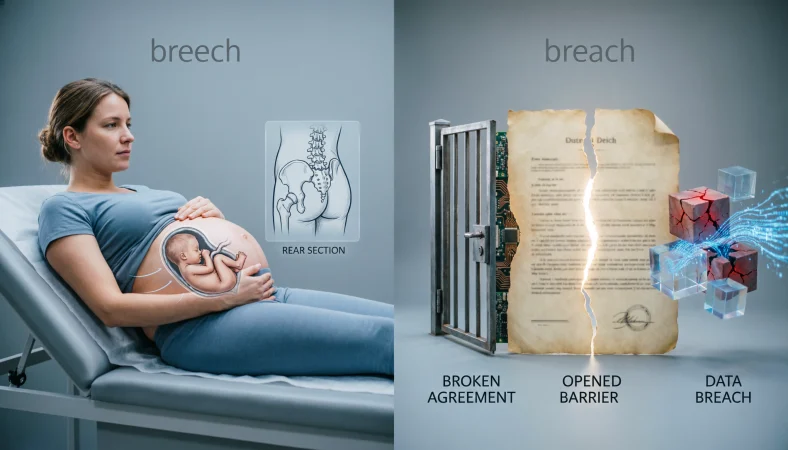
Breech or breach are two different English words with different meanings and uses. Breech usually refers to the lower part of a person’s body or the rear part of a firearm, while breach means a break, violation, or opening. Choosing the wrong word can change the meaning of a sentence completely, especially in medical, legal, workplace, and technical writing.
The confusion between these words mainly comes from their similar pronunciation. They look and sound alike enough to cause spelling mistakes, but they do not function as interchangeable terms. Understanding their meanings, grammatical roles, and common contexts makes the distinction much easier to remember.
For example, a medical writer may need to describe a breech position, while a legal writer may need to discuss a breach of contract. Replacing one with the other creates an entirely different meaning.
Breech vs Breach: What’s the Difference?
The easiest way to understand these words is to focus on what each one describes.
Breech is primarily a noun or adjective associated with the lower part of the body, the buttocks, the rear portion of a firearm, or a position in which a baby is positioned bottom first in the uterus.
Breach is mainly a noun and verb. As a noun, it describes a break, violation, gap, or failure to follow an agreement or rule. As a verb, it means to break, violate, or fail to honor something.
| Word | Part of speech | Main meaning | Common contexts | Example |
| Breech | Noun | The lower part or rear section | Medical, anatomy, firearms | The baby was in a breech position. |
| Breech | Adjective | Relating to the lower part or rear section | Medical, technical | The doctor discussed breech presentation. |
| Breach | Noun | A break, violation, or opening | Legal, security, general | The company reported a data breach. |
| Breach | Verb | To break or violate | Legal, security, formal writing | The company breached the agreement. |
Quick recap
Breech is connected with a lower or rear part.
Breach describes a break, violation, or failure to follow something.
A baby can be breech, but a contract can be breached.
A security incident is a breach, not a breech.
Is Breech vs Breach a Grammar, Vocabulary, or Usage Issue?
The distinction is primarily a vocabulary and usage issue rather than a complicated grammar rule. Both words are legitimate English words, but they belong to different semantic categories.
The problem occurs because English contains many words that sound similar but have unrelated meanings. Breech and breach belong to this group of easily confused words.
They are not interchangeable.
If you are talking about the position of a baby, the rear portion of a firearm, or the lower part of the body, breech is appropriate.
If you are talking about violating an agreement, breaking a rule, exposing protected information, creating an opening, or breaking through something, breach is appropriate.
Formal and informal usage
Both words can appear in formal writing, but they occur in very different fields.
Breech appears frequently in medical and technical contexts. You may encounter phrases such as breech presentation, breech birth, breech position, and breech mechanism.
Breach is common in legal, business, cybersecurity, security, and formal general English. Expressions such as breach of contract, breach of duty, security breach, and data breach are especially common.
Academic and casual usage
Academic writing tends to preserve the distinction carefully because precision matters. A medical paper discussing fetal position would use breech, while a legal research paper discussing an agreement would use breach.
In casual writing, people sometimes confuse the spellings because pronunciation can make the words difficult to distinguish. Spell checkers may catch some errors, but context based checking is still important.
How to Use Breech Correctly
Breech has several specialized meanings, so context matters.
One common meaning relates to anatomy. In older or literary usage, breech can refer to the buttocks or lower part of the body. The word is also associated with clothing terms derived from this meaning.
A much more common modern use occurs in medicine. A fetus is described as being in a breech position when the baby’s buttocks or feet are positioned to come first rather than the head.
Another important use appears in firearms terminology. The breech is the rear portion of a firearm barrel or the part where ammunition is loaded in certain firearm designs.
Workplace example
Imagine a medical workplace where a clinician is discussing a patient’s pregnancy.
The ultrasound showed that the baby was in a breech position.
Here, breech is correct because the sentence describes fetal position.
Using breach would make the sentence incorrect because a pregnancy does not involve a violation or broken agreement in this context.
Academic example
A medical textbook might say:
Breech presentation occurs when the fetus is positioned so that the buttocks or feet are directed toward the birth canal.
The word breech provides specific medical terminology. It should not be replaced with breach.
Technology and technical example
In technical writing about firearms, you may see:
The breech mechanism controls the rear portion of the firearm where the cartridge is positioned.
Again, breech refers to a physical part rather than a violation.
Usage recap
Use breech for certain meanings involving the lower or rear part of something.
Use it especially when discussing breech presentation or a firearm’s breech.
Do not use breech when you mean a broken rule, agreement, or security event.
How to Use Breach Correctly
Breach has a much broader range of modern uses.
As a noun, it can mean a violation of a rule, agreement, duty, or legal obligation. It can also describe a physical gap or opening.
As a verb, breach means to break or violate something.
Consider the sentence:
The employee breached the confidentiality agreement.
Here, breached means violated. The employee failed to follow a legally or professionally binding obligation.
Another common example is:
The company experienced a data breach.
In this case, breach refers to unauthorized access, exposure, or compromise of protected information.
Workplace example
In a business setting, you might write:
The supplier was accused of breaching the terms of the contract.
This is correct because the issue involves an agreement.
Another example is:
The incident resulted in a serious breach of company policy.
Again, the word refers to a violation.
Academic example
A legal studies paper might state:
A breach of contract occurs when one party fails to perform a contractual obligation.
Here, breach is essential legal vocabulary.
A research paper about cybersecurity might instead say:
The organization investigated a potential data breach after unauthorized access was detected.
The same spelling is used because the concept involves a security violation or compromise.
Technology example
Technology has made breach especially common.
You may see:
The security team investigated a possible network breach.
Or:
Customer information was exposed during a data breach.
These sentences have nothing to do with breech.
Usage recap
Use breach for violations, broken agreements, security incidents, and openings.
Use breached when describing the act of violating something.
Common expressions include breach of contract, breach of duty, security breach, and data breach.
When You Should NOT Use Breech or Breach
Knowing when not to use each spelling can prevent many common errors.
1. Do not use breech for a broken agreement
Incorrect:
The company committed a breech of contract.
Correct:
The company committed a breach of contract.
A contract can be violated, so breach is required.
2. Do not use breach for fetal position
Incorrect:
The doctor said the baby was in a breach position.
Correct:
The doctor said the baby was in a breech position.
The medical term is breech.
3. Do not use breech for cybersecurity incidents
Incorrect:
The company suffered a major breech of customer data.
Correct:
The company suffered a major breach of customer data.
Security incidents are described as breaches.
4. Do not use breach for the rear part of a firearm
Incorrect:
The technician inspected the breach of the firearm.
Correct:
The technician inspected the breech of the firearm.
The physical firearm component is the breech.
5. Do not assume pronunciation determines spelling
The similar pronunciation does not make the words interchangeable.
English spelling often preserves historical distinctions that pronunciation does not clearly reveal.
6. Do not rely entirely on spell checking
A spell checker may recognize both words as correctly spelled. It may not always understand which word fits the intended meaning.
7. Do not treat the words as grammatical variants
They are not alternative spellings of the same word. They represent separate vocabulary items.
8. Do not use breach simply because it sounds more familiar
Breach is far more common in modern general writing, but that does not make it appropriate for every context.
Common Mistakes and Decision Rules
The following examples show how easily the meaning changes when the wrong spelling is selected.
| Correct sentence | Incorrect sentence | Explanation |
| The baby was in a breech position. | The baby was in a breach position. | Medical fetal position requires breech. |
| The company suffered a data breach. | The company suffered a data breech. | A security violation is a breach. |
| The agreement was breached. | The agreement was breeched. | An agreement can be violated or breached. |
| The doctor explained breech presentation. | The doctor explained breach presentation. | Breech is the established medical term. |
| The technician examined the breech mechanism. | The technician examined the breach mechanism. | Breech refers to the relevant firearm component. |
| The employee breached the policy. | The employee breeched the policy. | Breached means violated. |
Decision Rule Box
If you mean a lower or rear part, especially in medical or firearm terminology, use BREECH.
If you mean a break, violation, opening, or failure to follow an agreement or rule, use BREACH.
A simple memory trick is to associate breech with a physical position or part and breach with something being broken or violated.
Breech and Breach in Modern Technology and AI Tools
Modern technology has increased the frequency of breach in everyday English.
Terms such as data breach, security breach, privacy breach, and network breach appear regularly in discussions about digital security.
AI systems also operate within this vocabulary. When unauthorized access exposes information stored by an organization, writers generally describe the event as a security or data breach.
The word breech remains more specialized. It can appear in technical documentation involving firearms or in medical information involving fetal presentation.
AI writing tools can help identify unusual word choices, but users should still understand the underlying distinction. Both words are valid English spellings, so an automated system may not always identify the intended meaning without enough context.
For professional writing, context remains the safest guide.
The Etymology of Breech and Breach
The two words look similar because they have historical connections to old English vocabulary, but their modern meanings developed along different paths.
Breech is associated historically with the lower part of the body. The word is related to older terms referring to the buttocks or lower body and eventually became associated with garments and technical meanings involving a rear or lower section.
Breach developed around the idea of breaking or breaking through. Its meanings expanded to include physical openings, violations, failures to honor obligations, and security compromises.
This historical distinction helps explain why the spellings remain different even though pronunciation can make them confusing.
The key idea is simple: breech developed around a physical lower or rear part, while breach developed around the concept of breaking or violating.
An Expert Style Explanation
A useful way to remember the distinction is:
“Breech identifies a position or physical part, while breach identifies something broken, violated, or opened.”
This is an explanatory principle rather than a formal quotation from a named linguist. It captures the central semantic distinction in a concise way.
When choosing between the words, don’t focus only on how they sound. Ask what the sentence is actually describing. Meaning should determine spelling.
Two Practical Case Studies
Case Study One: Medical Writing
Consider a healthcare article discussing fetal presentation.
The writer wants to explain that the baby’s lower body is positioned toward the birth canal. The correct sentence is:
The ultrasound showed a breech presentation.
Replacing breech with breach would create a serious terminology error. A breach means a violation or opening, neither of which describes fetal position.
The practical result is important: accurate spelling preserves medical meaning and prevents readers from misunderstanding specialized information.
Case Study Two: Cybersecurity Writing
Now consider a company announcing a cybersecurity incident.
The appropriate sentence is:
The company discovered a data breach affecting customer information.
Writing data breech would incorrectly replace a standard cybersecurity term with a word associated with a completely different set of meanings.
The practical result is equally clear. Correct terminology makes the incident immediately understandable to business readers, security professionals, and general audiences.
Error Prevention Checklist
Always use BREECH when
- You are discussing breech presentation.
- You are describing a baby positioned bottom first.
- You are referring to a firearm’s breech.
- You mean a lower or rear physical part in an appropriate technical context.
Never use BREECH when
- You mean a violation of a contract.
- You mean unauthorized exposure of information.
- You mean a broken rule or obligation.
- You mean a security incident.
Always use BREACH when
- You mean a violation.
- You mean a broken agreement.
- You mean a data or security incident.
- You mean a physical opening or gap.
- You mean the act of breaking through something.
Never use BREACH when
- You are describing fetal position.
- You mean the relevant rear portion of a firearm.
- You are using the established medical term breech presentation.
Related Grammar Confusions You Should Master
Learning breech or breach is part of a larger group of commonly confused English words. These pairs often sound similar or look alike but carry different meanings.
1. Affect or Effect
Affect commonly functions as a verb, while effect commonly functions as a noun.
2. Principal or Principle
A principal can be a person or a main item. A principle is a rule, belief, or guiding idea.
3. Stationary or Stationery
Stationary means not moving. Stationery refers to writing materials.
4. Complement or Compliment
A complement completes or enhances something. A compliment expresses praise.
5. Advice or Advise
Advice is a noun meaning guidance. Advise is a verb meaning to give guidance.
6. Then or Than
Then commonly relates to time or sequence. Than is used in comparisons.
7. Their or There
Their indicates possession. There usually refers to a place or introduces something.
8. Your or You’re
Your indicates possession. You’re is a contraction meaning you are.
9. Its or It’s
Its is possessive. It’s means it is or it has.
10. Loose or Lose
Loose means not tight. Lose means to misplace, fail to win, or no longer have something.
Understanding these distinctions improves both everyday communication and professional writing.
FAQs:
What is the difference between breech and breach?
Breech generally refers to a lower or rear physical part and is commonly used in medical and firearm terminology. Breach refers to a break, violation, opening, or failure to follow an agreement or rule.
Is it breech or breach of contract?
The correct expression is breach of contract. A breach of contract occurs when a party fails to meet a contractual obligation.
Is it breech or breach position for a baby?
The correct term is breech position. It describes a fetal position in which the baby’s buttocks or feet are positioned toward the birth canal rather than the head.
Is it a data breech or data breach?
The correct expression is data breach. A data breach involves unauthorized access, exposure, disclosure, or compromise of information.
Is breech a real word?
Yes. Breech is a legitimate English word. It has several specialized meanings, including fetal position and the rear portion of a firearm.
Is breach a noun or a verb?
Breach can be both a noun and a verb. As a noun, it can mean a violation or opening. As a verb, it means to break or violate something.
Why do breech and breach sound similar?
Their similar pronunciation makes them easy to confuse, but they have different meanings and historical development. Spelling must therefore be determined by context rather than pronunciation alone.
How do you remember breech vs breach?
Think of breech as a physical lower or rear part, especially in terms such as breech position. Think of breach as something being broken, violated, or opened.
Which is correct, breeched or breached?
The correct form depends on meaning. Breached means violated or broken, while breeched has a specialized meaning and should not be used for violations.
Can breech and breach be used interchangeably?
No. They are separate words with different meanings. Substituting one for the other can change or destroy the intended meaning of a sentence.
Breech or Breach:
The distinction between breech or breach becomes straightforward once you connect each word with its core meaning. Breech refers to a lower or rear physical part and is especially important in medical and technical terminology. Breach refers to a break, violation, opening, or failure to honor an obligation.
Remember the central rule: breech belongs with physical position or specialized physical parts, while breach belongs with violations, openings, broken agreements, and security incidents.
If you are discussing a baby, firearm terminology, or a relevant lower or rear section, check whether breech is intended. If you are discussing contracts, rules, privacy, security, or something being broken or violated, breach is almost certainly the word you need.
The two words may sound similar, but their meanings are clearly different. Once that semantic distinction becomes familiar, choosing the correct spelling becomes much easier.