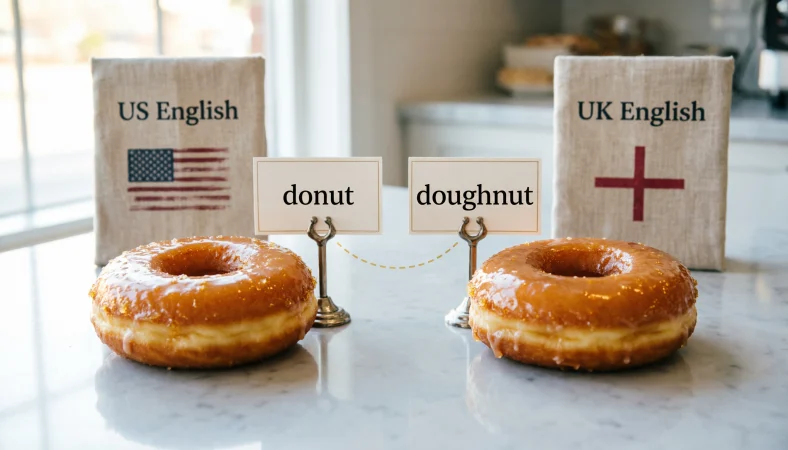
Both donut or doughnut are accepted spellings for the same ring shaped or filled fried pastry. Doughnut is the traditional and more widely recognized spelling, especially in formal writing and British English, while donut is a shorter modern form strongly associated with American English and everyday commercial usage. Neither spelling changes the food itself.
If you have ever wondered whether you should write donut or doughnut, you’re dealing with a genuine English spelling variation rather than a simple right or wrong situation. Both forms refer to the same familiar pastry, typically made from sweetened dough that is fried and sometimes glazed, filled, or covered with toppings.
The confusion matters because the choice can signal regional preference, writing style, or the conventions of a particular brand or publication. Understanding the history, pronunciation, regional usage, and formal writing preferences behind these spellings makes the choice much easier.
Donut vs Doughnut: What’s the Difference?
The primary difference between donut and doughnut is spelling, not meaning. Both words describe the same type of sweet fried pastry.
Doughnut is the older and more traditional spelling. It remains common in British English and is also completely standard in American English. Donut is a shortened spelling that became especially prominent in the United States and is now extremely common in advertising, menus, product names, newspapers, websites, and everyday writing.
| Feature | Donut | Doughnut |
| Part of speech | Noun | Noun |
| Meaning | A sweet fried pastry | A sweet fried pastry |
| Standard English | Yes | Yes |
| American English | Extremely common | Also standard |
| British English | Less common | More traditional |
| Formal writing | Acceptable | Often preferred |
| Informal writing | Very common | Also acceptable |
| Commercial usage | Extremely common | Common |
| Meaning difference | None | None |
The two spellings are therefore variant forms of the same noun.
Doughnut connects more visibly to the word dough, which describes the mixture from which the pastry is made.
Donut is a shortened spelling that became widely established in American usage.
Neither spelling automatically means a different kind of pastry.
If a menu says “glazed donut” and another says “glazed doughnut,” customers generally understand both to mean the same thing.
Is Donut vs Doughnut a Grammar, Vocabulary, or Usage Issue?
This is primarily a spelling and usage issue rather than a grammar problem.
Grammar determines how the word behaves in a sentence. Both donut and doughnut behave in essentially the same way because they are nouns.
For example:
I bought a donut.
and:
I bought a doughnut.
Both sentences are grammatically correct.
The real question is which spelling best fits the context.
Are donut and doughnut interchangeable?
In most ordinary contexts, yes. They can be used interchangeably without changing the meaning.
You can write:
She ordered a chocolate donut.
or:
She ordered a chocolate doughnut.
The pastry described is the same.
There can be one practical exception: brand names and official names should be preserved exactly as established by the organization using them. If a company chooses donut in its name, changing it to doughnut would alter the proper name.
Formal versus informal usage
Both spellings are accepted, but doughnut can feel more traditional or formal because it preserves the connection with dough.
Donut often feels shorter, more casual, and more distinctly American.
That does not mean donut is grammatically incorrect or unsuitable for serious writing. It is a standard spelling with a long history of actual usage.
Academic versus casual usage
In academic writing, consistency is more important than choosing one spelling as universally correct.
If you’re writing about food history, nutrition, culinary traditions, or American culture, either spelling can work. The important thing is to follow the style guide or regional convention required by the publication.
A British publication may naturally favor doughnut. An American publication may favor donut.
How to Use Donut Correctly
Donut is particularly common in American English and in commercial contexts.
You might see it on menus, restaurant websites, product packaging, advertisements, social media posts, and food blogs.
For example:
I grabbed a glazed donut before work.
The bakery sells fresh donuts every morning.
Chocolate donuts are popular with children.
The spelling is short and visually familiar, which helps explain its popularity.
Workplace example
In a workplace email, either spelling can be correct.
I brought donuts for everyone in the break room.
This sounds natural in American workplace communication.
A more formal food related report might instead use:
The bakery produces traditional doughnuts using a yeast based recipe.
Neither choice is inherently grammatically superior.
Academic example
An academic paper discussing American food culture might say:
The donut became an important part of American popular food culture.
That spelling is entirely acceptable, particularly when the paper follows American English conventions.
Technology example
Food delivery platforms, recipe applications, online menus, and search engines frequently use donut because it is a common American spelling.
A search query such as:
best chocolate donut near me
is completely natural.
Likewise:
How many calories are in a glazed donut?
uses a standard spelling.
Usage recap: Donut is a fully accepted spelling, especially common in American English and commercial contexts. It is not merely an informal mistake.
How to Use Doughnut Correctly
Doughnut is the traditional spelling and remains widely used in both American and British English.
It is especially useful when you want to make the connection with dough visually obvious.
For example:
The baker prepared the doughnuts early in the morning.
These doughnuts are filled with raspberry jam.
The cookbook includes a recipe for traditional doughnuts.
Workplace example
A professional food industry report might use doughnut when discussing production methods.
The bakery produces several varieties of filled doughnuts.
The longer spelling can feel more traditional and descriptive, particularly in culinary writing.
Academic example
A historical study could write:
Early descriptions of the doughnut reveal how the pastry developed across different culinary traditions.
This spelling works naturally in historical, culinary, and linguistic contexts.
Technology example
Online recipes frequently use doughnut in titles.
Easy homemade doughnut recipe
How to make baked doughnuts
The spelling is perfectly natural in digital content and remains widely recognized by search engines and readers.
Usage recap: Doughnut is the traditional spelling and is especially common in British English and formal or traditional contexts. It is also fully standard in American English.
When You Should NOT Use Donut or Doughnut
Although both spellings are correct, there are situations where choosing one over the other can create inconsistency or confusion.
Do not mix spellings randomly
If an article begins with doughnut and repeatedly switches to donut without a reason, the writing may look inconsistent.
Choose one form and generally maintain it.
Do not change an official brand name
If a business officially uses Donut in its name, reproduce the name accurately.
Proper names should not be rewritten simply because another spelling exists.
Do not assume doughnut is the only correct form
Some people learned that doughnut is the traditional spelling and therefore assume donut is wrong. That is not accurate. Donut is an established standard spelling.
Do not assume donut is always better for formal writing
Although donut is perfectly acceptable, some publishers and regional style traditions prefer doughnut. Follow the conventions of your intended audience.
Do not use regional assumptions as universal rules
American English commonly favors donut, while British English more strongly favors doughnut. Neither convention should automatically be treated as globally universal.
Do not alter a quotation
If you’re quoting a historical or contemporary source, preserve the source’s original spelling unless your editorial policy says otherwise.
Do not confuse spelling with pronunciation
The two spellings generally refer to the same pronunciation. Choosing between them is primarily a written language decision.
Common Mistakes and Decision Rules
| Correct sentence | Incorrect sentence | Explanation |
| I bought a donut. | I bought a doughnut. | The second sentence is not actually incorrect. Both are standard. |
| She made homemade doughnuts. | She made homemade donuts. | Both forms are acceptable. |
| The shop sells glazed donuts. | The shop sells glazed doughnuts. | Both spellings work. |
| I ordered a chocolate doughnut. | I ordered a chocolate donut. | Both are grammatically correct. |
| The brand calls them Donuts. | The brand calls them Doughnuts. | Use the official spelling of the brand. |
| British writing often uses doughnut. | British writing always uses donut. | Regional preferences vary, but doughnut is traditionally favored in British English. |
Decision Rule Box
- If you are writing for an American audience, “donut” is a natural and widely preferred choice.
- If you are writing for a British audience or want the traditional spelling, “doughnut” is a strong choice.
- If a brand, publication, or style guide specifies one spelling, follow that convention consistently.
The most important rule is consistency.
Donut or Doughnut in Modern Technology and AI Tools
Modern technology has made the spelling variation even more visible.
Search engines recognize both forms because both have established meanings and substantial usage. A person searching for donut recipes and another searching for doughnut recipes are looking for essentially the same category of food.
Artificial intelligence systems also generally interpret both spellings correctly because they appear frequently in natural language data.
For content creators, this creates an interesting SEO opportunity. Writers don’t need to force one spelling repeatedly into an article. Natural language can include both forms when discussing regional differences, spelling preferences, and search behavior.
For example, an article can explain that American English commonly uses donut, while British English commonly uses doughnut. That naturally covers the semantic relationship without producing awkward repetition.
AI writing tools can also help identify regional inconsistencies. If a document is intended for British readers but repeatedly switches between forms, an editor can standardize the spelling.
However, automated tools should not decide regional style blindly. A writer still needs to understand the intended audience.
For example, a British bakery may deliberately use doughnut as part of its identity, while an American bakery may deliberately use donut. The correct choice depends on context.
The Etymology of Donut and Doughnut
The history of the word helps explain why the two spellings exist.
The traditional form doughnut is transparently connected to dough, referring to the mixture of flour and other ingredients used to make bread and pastries. The second part of the word relates to the shape or preparation of the pastry.
The shortened form donut developed as an alternative spelling, particularly in American English. Shortened spellings have often become popular in English when they are easier to write, pronounce, recognize, or use in commercial settings.
The two forms eventually developed alongside one another rather than one completely replacing the other.
This is a useful reminder that English spelling isn’t always governed by a single worldwide standard. Regional varieties can develop their own preferences while still remaining mutually understandable.
An expert style explanation
A useful linguistic principle is:
When two spellings represent the same lexical item and both have established usage, context and regional convention often determine the preferred form.
That principle applies well to donut and doughnut. The variation is real, established, and meaningful from a stylistic perspective, but it does not create two different foods.
Two Practical Case Studies
Case Study 1: American food writing
Imagine an American food website publishing a recipe titled:
Easy Glazed Donut Recipe
The shorter spelling feels natural to many American readers and aligns with common commercial language.
Changing the title to:
Easy Glazed Doughnut Recipe
would not make the recipe more correct. It would simply shift the spelling toward the traditional form.
The lesson is that American writers can comfortably use donut without treating it as a mistake.
Case Study 2: British food writing
Now consider a British cookbook titled:
Traditional Homemade Doughnuts
The traditional spelling fits the regional convention and the tone of the publication.
Replacing every occurrence with donut would not necessarily make the book incorrect, but it could make the language feel less consistent with the publication’s British English style.
The lesson is that regional audience matters when selecting between accepted spelling variants.
Error Prevention Checklist
Always use donut when:
- You are writing primarily for an American audience and want the common American spelling.
- You are discussing contemporary American food culture.
- A brand or publication specifically uses donut.
- Your chosen style guide recommends donut.
- You want a concise spelling that is widely recognized.
Always use doughnut when:
- You are following a British English convention that favors the traditional spelling.
- Your publication or style guide requires doughnut.
- A specific brand uses doughnut.
- You are discussing traditional spelling or word history.
- You want to preserve the spelling used in a source or quotation.
The most important principle is not to treat either spelling as an error when it is used according to an appropriate convention.
Related Grammar Confusions You Should Master
English contains many spelling pairs where regional preference, historical development, or context influences the preferred form.
Color or colour: American English generally uses color, while British English traditionally uses colour.
Center or centre: American English generally favors center, while British English traditionally uses centre.
Favorite or favourite: Both are standard regional forms.
Theater or theatre: Both spellings are established, with regional and stylistic preferences.
Catalog or catalogue: American English commonly favors catalog, while British English often uses catalogue.
Traveler or traveller: The spelling differs partly because of regional conventions concerning doubled consonants.
Canceled or cancelled: American English commonly uses canceled, while British English often uses cancelled.
Program or programme: Program is standard in American English, while programme remains common in many British contexts outside computing.
Learned or learnt: Both forms are established, with regional preferences.
Gray or grey: Both spellings are standard, with gray more common in American English and grey common in British English.
These examples demonstrate why spelling questions should sometimes be approached through the lens of regional English rather than a simple correct versus incorrect framework.
FAQs
Is donut or doughnut the correct spelling?
Both donut and doughnut are correct spellings for the same pastry. Doughnut is the traditional form, while donut is especially common in American English. Your choice should depend on regional convention, audience, style guide, and consistency.
Is donut an American spelling?
Yes. Donut is strongly associated with American English and is extremely common in American everyday writing, advertising, menus, and commercial names. However, it is not exclusively American, and it can be understood widely in other varieties of English.
Is doughnut more correct than donut?
No. Doughnut is the traditional spelling, but donut is also an established standard spelling. Calling donut incorrect would ignore its long history of accepted usage, particularly in American English.
Do donut and doughnut mean the same thing?
Yes. In ordinary modern English, the two spellings refer to the same type of sweet fried pastry. The spelling difference does not normally indicate a difference in ingredients, preparation, shape, or meaning.
Which spelling is preferred in British English?
Doughnut is traditionally preferred in British English. However, actual usage can vary depending on the writer, publication, business, and context. Donut is also recognizable and increasingly visible.
Which spelling is preferred in American English?
Donut is extremely common in American English and is often the preferred spelling in everyday and commercial contexts. Doughnut remains fully acceptable and continues to appear in American writing.
Should I use donut or doughnut in formal writing?
Either can be appropriate, but you should follow the relevant style guide and regional convention. If no specific guidance exists, choose the form most natural for your intended audience and use it consistently.
Is donut a shortened form of doughnut?
The modern spelling donut is widely understood as a shortened form or spelling variant of doughnut. The two forms have developed alongside each other, with donut becoming especially prominent in American English.
Can I use both donut and doughnut in the same article?
You can, particularly when discussing the spelling difference itself. However, if you’re simply writing about the pastry, switching between forms without a reason can look inconsistent. Choose one as your main form and explain the alternative when relevant.
Which spelling is better for SEO?
Neither spelling is universally better. Search engines understand both. The strongest approach is to write naturally, consider the wording used by your audience, and address both forms when the search intent involves spelling or usage differences.
Conclusion:
When deciding between donut or doughnut, remember that both are legitimate spellings of the same word. Doughnut is the traditional spelling and remains particularly common in British English, while donut is strongly associated with American English and is extremely common in modern commercial and everyday writing.
There is no need to label one spelling as universally correct and the other as wrong. The better choice depends on your audience, regional English, publication style, and consistency.
For American content, donut is often the most natural choice. For British content or writing that follows the traditional form, doughnut may be preferable. If you’re discussing a specific company or product, always preserve its official spelling.
The simplest rule is this: both spellings are correct, but your audience and context should determine which one you use.