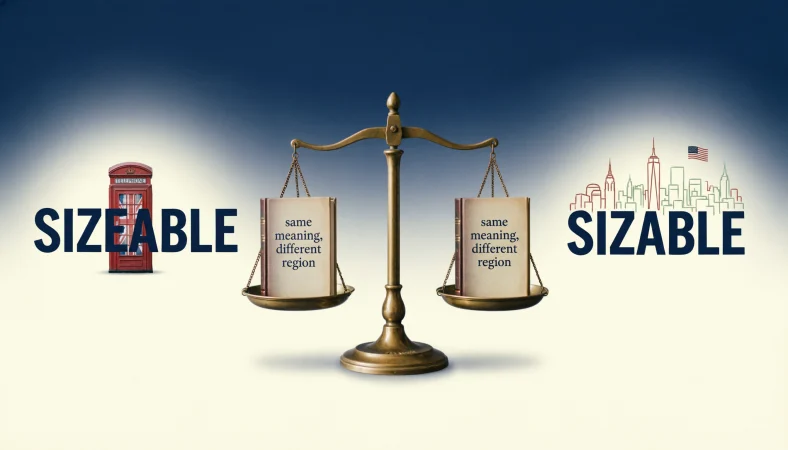
Sizeable and sizable are both correct spellings of the same adjective, meaning large or considerable in size, amount, or degree. Sizeable is more common in British English, while sizable is the preferred spelling in American English.
For example, “The company made a sizable investment in new technology” and “The company made a sizeable investment in new technology” are both correct. Choose the spelling that matches your audience and use it consistently throughout your writing.
Have you ever wondered whether to write sizeable or sizable? Both forms look correct because they are accepted variations of the same English word. The main difference is regional spelling preference, not meaning or grammar.
American English typically uses sizable, whereas British English generally favors sizeable. Understanding this distinction can help you avoid inconsistent spelling when writing articles, reports, emails, or academic assignments.
In this guide, you will learn the difference between sizeable and sizable, explore their meanings, and discover when to use each spelling.
Through clear definitions and practical sentence examples, you will understand how regional English conventions influence word choice and how to select the appropriate form for your target audience.
Sizeable vs Sizable: What’s the Difference?
The difference between sizeable and sizable is mainly a matter of spelling convention, not meaning. Both words describe something substantial in size, quantity, value, or extent. Choosing one over the other usually depends on whether you follow British or American English.
What Does Sizeable Mean?
Sizeable is an adjective meaning fairly large, substantial, or considerable. It can describe a physical object, a quantity of money, a group of people, a business opportunity, or an effect.
For example:
“The company received a sizeable investment from a new partner.”
Here, sizeable means the investment was considerable. It does not necessarily mean the amount was enormous, only that it was significant in context.
The spelling with the letter e before the final syllable is commonly associated with British English. It appears frequently in British publications, educational writing, and professional communication that follows British spelling conventions.
What Does Sizable Mean?
Sizable is also an adjective meaning fairly large, substantial, or considerable. It carries the same meaning as sizeable and can be used in the same kinds of sentences.
For example:
“The company received a sizable investment from a new partner.”
The meaning is identical to the version using sizeable. The difference is the spelling, not the amount of money or the importance of the investment.
Sizable is the preferred form in much American English writing. It is common in American newspapers, business documents, educational materials, and online publications.
Sizeable vs Sizable Comparison Table
| Feature | Sizeable | Sizable |
| Part of speech | Adjective | Adjective |
| Meaning | Fairly large or considerable | Fairly large or considerable |
| Spelling convention | Common in British English | Preferred in American English |
| Meaning difference | None in ordinary use | None in ordinary use |
| Formal writing | Acceptable | Acceptable |
| Business writing | Common in British contexts | Common in American contexts |
| Example | A sizeable profit | A sizable profit |
| Recommended use | Follow British English conventions | Follow American English conventions |
Quick recap: Both spellings are correct.
Sizeable is more common in British English, while sizable is generally preferred in American English.
Neither spelling indicates a different degree of size or importance.
Choose the version that matches your audience and keep it consistent throughout your writing.
Is Sizeable vs Sizable a Grammar, Vocabulary, or Usage Issue?
The difference between sizeable and sizable is primarily a spelling and regional usage issue. Both words are adjectives, and both express the same idea. The choice does not change the grammar of a sentence.
Are Sizeable and Sizable Interchangeable?
Yes. In ordinary English, sizeable and sizable are interchangeable because they have the same meaning.
Consider these sentences:
“The project requires a sizeable budget.”
“The project requires a sizable budget.”
Both sentences communicate that the project needs a considerable budget. Neither spelling changes the sentence structure, tone, or intended meaning.
The only practical reason to prefer one form is consistency with a regional spelling convention or a publication’s style guide.
British English vs American English
British English commonly uses sizeable, following a spelling pattern found in words such as recognisable and realise. American English generally prefers sizable, although American writers may encounter the alternative spelling.
These regional preferences are useful guidelines rather than absolute rules that make the other form incorrect everywhere.
If you are writing for a British audience, sizeable is a natural choice. For an American audience, sizable will usually fit the expected spelling style.
Formal vs Informal Usage
Both spellings work in formal and informal contexts. You can use either form in a business proposal, academic essay, news article, email, or everyday conversation.
For example, a formal report might state:
“The department experienced a sizable increase in operating costs.”
A casual message could say:
“That was a sizeable improvement.”
The tone comes from the sentence and its surrounding context, not from the extra letter in sizeable.
Academic vs Casual Usage
Academic writing should follow a consistent spelling standard. If an assignment uses British English, choose sizeable. If it uses American English, choose sizable.
Casual writing offers more flexibility, but readers may still expect the spelling used in their region. Consistency helps your writing look polished and prevents readers from wondering whether a spelling difference is intentional.
How to Use Sizeable Correctly
Use sizeable when your writing follows British English conventions or when a publication specifically prefers this spelling. The word can describe a substantial amount, a large group, a significant effect, or an important opportunity.
Workplace Example
A manager preparing a business report might write:
“The company made a sizeable investment in employee training.”
This sentence indicates that the company committed a considerable amount of money or resources to training. The adjective adds emphasis without giving an exact figure.
In a British workplace, sizeable is a natural choice. If the organization follows an American style guide, the editor may prefer sizable instead.
Academic Example
A student writing an essay about economic development might say:
“The region experienced a sizeable increase in employment opportunities.”
The adjective describes a meaningful increase. It does not provide a numerical measurement, so the writer should include statistics if the argument depends on the precise scale of that increase.
In academic work, spelling consistency matters more than choosing one form as universally correct.
Technology Example
A technology publication following British English might report:
“The software update produced a sizeable improvement in processing efficiency.”
Here, sizeable describes the extent of the improvement. If the article follows American English conventions, the editor would usually write sizable improvement instead.
More Examples of Sizeable
“The charity received a sizeable donation.”
“The town has a sizeable population.”
“The project created a sizeable number of new opportunities.”
“The new policy had a sizeable effect on operating costs.”
In each example, sizeable means considerable or fairly large. The word does not automatically mean the largest possible amount. Its exact force depends on the context.
Usage recap: Choose sizeable when following British English spelling conventions. It is suitable for business, academic, technical, and everyday writing.
How to Use Sizable Correctly
Use sizable when writing in American English or following a style guide that prefers this spelling. Its meaning is identical to sizeable, so you do not need to change the sentence structure when switching between the two forms.
Workplace Example
An American business analyst might write:
“The department secured a sizable budget increase for the next financial year.”
The sentence communicates that the budget increase is considerable. In a report, the writer could make the statement more informative by adding the actual amount or percentage.
For instance, “The department secured a sizable budget increase of 18 percent” gives readers a measurable detail, assuming that figure is accurate.
Academic Example
A researcher discussing survey findings might write:
“A sizable proportion of participants preferred the revised design.”
This is grammatically correct in American English. However, the phrase sizable proportion is somewhat general. If the study reports exact results, the researcher should provide the relevant percentage to support the statement.
The adjective works well when the exact size is not the main focus or when the surrounding text supplies the necessary detail.
Technology Example
An American technology website might publish this sentence:
“The new system delivered a sizable reduction in loading time.”
The adjective signals a meaningful improvement. For a technical audience, the article would be stronger if it also reported the measured reduction in seconds or percentage terms.
More Examples of Sizable
“The company has a sizable customer base.”
“The team gained a sizable advantage.”
“The repair required a sizable investment.”
“The update resulted in a sizable improvement in performance.”
These examples demonstrate that sizable can describe physical size, quantities, advantages, expenses, and changes.
Usage recap: Choose sizable for American English or when your chosen style guide recommends it. It carries the same meaning as sizeable.
When You Should NOT Use Sizeable or Sizable
Although both spellings are correct, neither is ideal for every situation. Clear writing depends on choosing a word that communicates the intended degree, provides enough detail, and fits the audience.
When You Need an Exact Measurement
Avoid relying on sizeable or sizable when readers need a precise figure.
Instead of writing, “The building has a sizable floor area,” provide the actual measurement if it is available and relevant.
For example, “The building has a floor area of 4,000 square metres” is more informative than a general description.
When the Amount Is Not Actually Large
Do not call an amount sizeable merely to make it sound impressive. The adjective suggests that something is substantial in its context.
If a small increase is not particularly important, words such as slight, modest, or small may be more accurate.
When You Are Following a Required Style Guide
Do not switch between sizeable and sizable randomly in the same article. If a publisher requires American English, use sizable. If it requires British English, use sizeable unless its own style guide says otherwise.
When You Mean Importance Rather Than Size or Extent
The word can describe an important quantity or effect, but it may not be the clearest choice when you mean significance alone.
For example, “The decision was sizeable” sounds unnatural in ordinary English. “The decision was significant” or “The decision had a substantial impact” communicates the intended idea more clearly.
When a Stronger or More Precise Word Is Better
Words such as substantial, considerable, extensive, and significant may fit better in some contexts. Choose the term that best describes the situation rather than repeating sizeable throughout an article.
When You Are Writing for an International Audience
Readers may be familiar with both spellings, but inconsistent regional spelling can make an article appear poorly edited. Pick a primary English convention and maintain it throughout the page.
When You Are Editing Someone Else’s Direct Quote
Do not silently change a spelling inside a quotation unless your editing rules permit it. If a speaker uses sizeable, preserve that spelling when quoting accurately. Outside the quotation, follow the spelling convention used in your own writing.
Common Mistakes and Decision Rules
The most common mistake is assuming that one spelling is correct and the other is wrong. In reality, both forms are accepted, and the preferred spelling depends largely on regional convention.
| Correct sentence | Incorrect or less suitable sentence | Explanation |
| British English: “The charity received a sizeable donation.” | British English: “The charity received a sizable donation,” when a strict house style requires sizeable. | Follow the publication’s chosen spelling convention. |
| American English: “The company made a sizable investment.” | American English: “The company made a sizeable investment,” when a strict house style requires sizable. | American style generally prefers sizable. |
| “The project had a sizeable impact.” | “The project had a sizeablely impact.” | Sizeablely is not the correct adverb form for this sentence. |
| “The company reported a sizable increase.” | “The company reported a sizeably increase.” | An adjective is needed before the noun increase. |
| “The company reported a substantial increase.” | “The company reported a sizeable increase of an unknown amount,” when exact data is essential. | A general adjective cannot replace a necessary measurement. |
| “The decision had a significant effect.” | “The decision was sizeable,” when you mean important rather than large in extent. | Significant is more natural for importance alone. |
The Simple Decision Rule
- If you are writing in British English, generally use sizeable.
- If you are writing in American English, generally use sizable.
- If your publication has a style guide, follow that guide.
- If exact size or quantity matters, provide a measurement instead of relying only on either adjective.
The key distinction is regional spelling, not meaning. You do not need to learn separate definitions for the two forms.
Sizeable and Sizable in Modern Technology and AI Tools
Digital writing tools often recognize both sizeable and sizable as valid spellings. However, a spelling checker may not know which form best suits your target audience unless the language settings specify British or American English.
For example, an American English document may recommend sizable, while a British English document may accept or prefer sizeable. Writers should check their language settings before accepting automatic corrections.
AI writing assistants can help identify inconsistent spelling, suggest alternatives, and improve clarity. They can also recommend more precise wording when a phrase such as “a sizable improvement” needs supporting figures.
Still, technology cannot always determine the intended style from a single sentence. A writer should specify the audience, check the publication’s style guide, and review the final draft manually.
For SEO content, consistent spelling can improve the reading experience and align the article with its intended audience. However, choosing sizeable instead of sizable does not by itself guarantee higher search rankings. Content quality, relevance, clarity, and usefulness remain important.
The Etymology of Sizeable and Sizable
Both sizeable and sizable developed from the word size, with the suffix able indicating that something has a particular quality or extent. The adjective describes something that can be regarded as considerable in size or amount.
The two spellings reflect different spelling preferences rather than different origins or meanings. British English commonly retains the form sizeable, while American English generally favors sizable, following a tendency to simplify certain spellings.
This pattern can be seen in other words too. British English often uses recognisable, while American English usually uses recognizable. However, spelling patterns are not completely uniform, so it is better to check each word rather than assume that every regional difference follows one rule.
Today, both forms remain accepted. Their use depends mainly on regional convention, editorial preference, and consistency.
An Expert Perspective on Sizeable or Sizable
A useful principle for professional writing is:
Consistency is more important than treating a valid regional spelling as an error.
When editing a document, first identify the English convention it follows. Then check whether the spelling matches that convention throughout the text.
For example, a British publication may prefer sizeable, while an American publication may prefer sizable. Neither choice changes the adjective’s meaning.
Writers should also consider precision. Describing an increase as sizeable may be enough in a general overview, but a report about financial results should provide actual figures when those figures are available and relevant.
Good editing combines correct spelling with clear, specific information.
Case Study One: Editing a Business Report
Consider an illustrative example involving a company preparing a report for its British investors.
The original draft uses sizeable in one section and sizable in another. Both forms are understandable, but the inconsistency makes the report look as though it has not been fully edited.
The editor checks the company’s style guide and standardizes the document to British English. Every relevant instance is changed to sizeable, while the original meaning remains unchanged.
Result: The report follows one consistent spelling convention and looks more polished. No change in meaning or financial performance is implied by the spelling correction.
The lesson is that regional consistency matters in professional writing, even when both forms are accepted.
Case Study Two: Improving an American Technology Article
Imagine an American technology writer preparing an article about a new software release. The draft states that the update produced a “sizeable improvement” in performance.
The editor changes sizeable to sizable to match the publication’s American English style. The editor also asks the writer to include a measured performance result, provided the testing supports it.
The revised sentence reads:
“The update produced a sizable improvement, reducing average loading time by 15 percent in the reported test.”
Result: The article uses consistent American spelling and provides a specific figure to support the claim, assuming the reported test is accurate.
This example illustrates two separate editing improvements: regional consistency and greater factual precision.
Error Prevention Checklist
Use this checklist when choosing between sizeable and sizable.
Always Use Sizeable When
- Your document follows British English conventions.
- Your publisher or organization specifically prefers this spelling.
- You are maintaining consistency with an established British English text.
- The adjective accurately describes something considerable in size, quantity, or extent.
Always Use Sizable When
- Your document follows American English conventions.
- Your publication’s style guide recommends the American spelling.
- You are editing an American English article and want consistent spelling.
- The adjective accurately describes a substantial amount, size, or effect.
Never Assume
- One spelling is universally wrong.
- The two forms have different meanings.
- A spelling checker always knows your intended regional convention.
- The word sizeable automatically means enormous.
- A general adjective can replace exact figures when precision matters.
Related Grammar Confusions You Should Master
The difference between sizeable and sizable is one example of how regional conventions affect English spelling. These related topics can help you develop stronger editing skills.
- Colour vs color: Learn the British and American spellings of a common noun.
- Recognisable vs recognizable: Compare regional spelling conventions for adjectives.
- Realise vs realize: Understand variations in the spelling of a common verb.
- Organise vs organize: Check which form your style guide prefers.
- Travelling vs traveling: Learn the difference in how British and American English often double the final consonant.
- Centre vs center: Recognize another familiar regional spelling distinction.
- Grey vs gray: Understand two accepted spellings of the same color.
- Licence vs license: Learn how British English distinguishes the noun and verb forms.
- Practice vs practise: Compare noun and verb spellings in British English with American usage.
- Enquiry vs inquiry: Explore regional preferences and differences in meaning or usage.
The best approach is to identify your audience and follow one spelling system consistently rather than mixing conventions without a reason.
FAQs
Is sizeable or sizable correct?
Both sizeable and sizable are correct spellings of the same adjective. Sizeable is more common in British English, while sizable is generally preferred in American English. Neither form changes the meaning.
What is the difference between sizeable and sizable?
Sizeable and sizable have the same meaning, but British English favors sizeable, while American English generally prefers sizable.
Is sizeable British English or American English?
Sizeable is commonly associated with British English. It is also understood elsewhere, but American English generally prefers sizable. If you are writing for a particular publication, follow its style guide.
Is sizable the American spelling?
Yes. Sizable is generally the preferred American English spelling. It means the same thing as sizeable and can describe a substantial amount, a considerable increase, or something fairly large.
Should I use sizeable or sizable in formal writing?
Sizeable is more common in British English, while sizable is preferred in American English; both are acceptable in formal writing.
What does sizeable mean in a sentence?
In the sentence “The organization received a sizeable donation,” the word sizeable means the donation was considerable. It describes the amount as substantial without stating an exact figure.
What does sizable mean in business?
In business writing, sizable describes a considerable amount or scale, such as a large investment, budget, customer base, or increase in sales.
Can I use sizeable and sizable in the same article?
You can, but it is usually better to choose one spelling and use it consistently. Mixing regional conventions may make a document look uneven, especially if it is intended for a specific audience or publication.
Is sizeable a synonym for significant?
Sizeable emphasizes size or amount, while significant emphasizes importance or meaning, so the best choice depends on the context.
Conclusion:
When deciding between sizeable or sizable, remember that both spellings are correct and have the same meaning. The main difference is regional preference: sizeable is commonly used in British English, while sizable is generally preferred in American English.
For polished writing, choose the spelling that matches your audience or publication’s style guide and use it consistently. When the exact size or amount matters, support the adjective with a clear measurement.
The simplest rule is this: use sizeable for British English, sizable for American English, and prioritize consistency in either case.