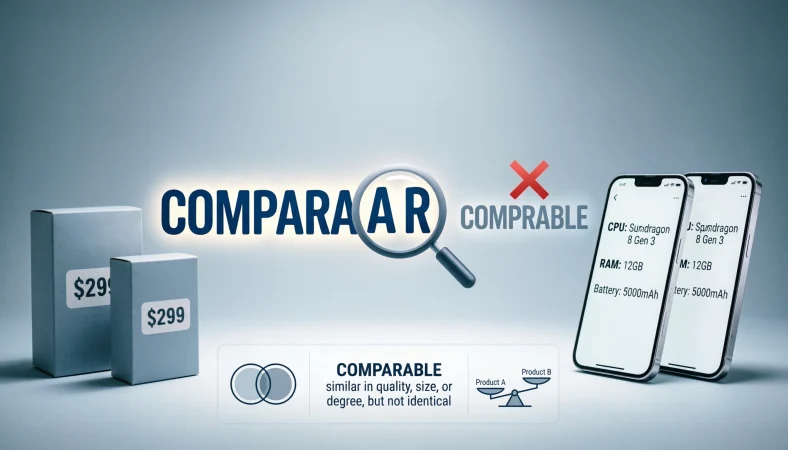
The correct spelling is comparable. It is an adjective that describes two or more things that can be compared because they share relevant qualities, characteristics, or features. Comprable is a misspelling and is not accepted as a standard English word. Learning the correct spelling helps you write more clearly in academic assignments, business reports, product reviews, and everyday communication.
Confusing comprable or comparable is an understandable spelling mistake because the word contains several syllables, and the middle sounds can be easy to overlook when speaking quickly. However, using the incorrect form can make professional writing look less polished and may reduce clarity in important documents.
The word comparable is especially useful when discussing prices, performance, quality, statistics, qualifications, and similarities between people or things. For example, two products may have comparable prices, or two studies may produce comparable results. Understanding its spelling, meaning, pronunciation, and grammatical role will help you use it accurately in different contexts.
Comprable vs Comparable: What’s the Difference?
The difference between comprable and comparable is straightforward. Comparable is the correct English spelling, while comprable is an incorrect spelling.
Comparable is an adjective. It describes things that are sufficiently similar in relevant ways to allow a meaningful comparison. The things do not need to be identical. They only need to share characteristics that make a comparison useful.
For example:
The two smartphones offer comparable battery life.
This sentence means that the smartphones provide similar battery performance, although their specifications may differ in other respects.
Another example is:
The company offers salaries comparable to those of its competitors.
Here, comparable describes salaries that are similar enough to be evaluated against one another.
The incorrect spelling comprable often occurs when writers leave out the second syllable’s vowel sound or type the word from memory.
| Word | Correct or incorrect | Part of speech | Meaning | Example |
| Comparable | Correct | Adjective | Similar enough for comparison | The two offers are comparable. |
| Comprable | Incorrect | Not standard | Misspelling of comparable | The two offers are comparable. |
The key distinction is that comparable is the accepted spelling in standard English. Comprable does not have a separate recognized meaning that makes it appropriate in ordinary writing.
Remember the middle letters in comparable. The correct word includes the sequence para within its spelling: compar able is a useful way to visualize its structure.
Is Comprable vs Comparable a Grammar, Vocabulary, or Spelling Issue?
The difference is primarily a spelling issue rather than a grammatical or vocabulary distinction. Both forms are usually intended to represent the same adjective, but only comparable is standard English.
Grammar concerns how words function in sentences. Vocabulary concerns word meanings. Spelling concerns the correct arrangement of letters. In this case, understanding the meaning of comparable is useful, but the immediate problem is remembering how to spell it.
Are comprable and comparable interchangeable?
No. Comparable is correct, and comprable should not be used as an alternative spelling.
For example:
Correct: The two apartments have comparable rental prices.
Incorrect: The two apartments have comprable rental prices.
The incorrect sentence may still be understandable, but the spelling needs correction.
Formal and informal usage
Comparable is appropriate in both formal and informal English. You can use it in a casual conversation about shopping, a professional discussion about salaries, or an academic explanation of research findings.
In informal writing, a reader might overlook a typo. That does not make the incorrect form acceptable.
In formal documents, accurate spelling is particularly important because readers expect careful and consistent language.
Academic and everyday writing
Academic writing frequently uses comparable when researchers evaluate results, populations, methods, or conditions.
For example:
The researchers compared two groups with comparable characteristics.
In everyday communication, the word can describe similar prices, experiences, or choices.
For example:
These two jackets are comparable in quality.
The context changes, but the spelling remains the same.
What Does Comparable Mean?
Comparable means similar enough in particular respects to be compared fairly or meaningfully. It does not necessarily mean equal, identical, or exactly alike.
The word is often used when people need to evaluate alternatives. A customer may compare two products, an employer may compare salaries, or a researcher may compare findings from separate studies.
Consider three examples:
The two houses have comparable floor areas.
This means their floor areas are similar, not necessarily identical.
The candidates have comparable levels of experience.
This indicates that their experience is similar enough to evaluate side by side.
The new model delivers comparable performance at a lower price.
This suggests that its performance is similar to that of another model, despite the price difference.
The precise meaning depends on the quality being compared. Two products may have comparable prices but very different durability. Two employees may have comparable experience but different qualifications.
Comparable therefore describes a relevant similarity rather than complete sameness.
Comparable and similar
Similar is a broad adjective that describes things sharing characteristics. Comparable emphasizes that the things can be evaluated against one another in a meaningful way.
For example, two paintings may look similar because they use the same colors. Two job offers may be comparable because they provide similar salaries, benefits, and working conditions.
The words overlap, but they are not identical in every context.
Comparable and identical
Identical means exactly the same in the relevant sense. Comparable means sufficiently similar for comparison.
Two phones may have comparable camera quality while using different camera systems. Two documents may be identical if their contents match exactly.
Using comparable when you mean identical can weaken the accuracy of your statement.
How to Use Comparable Correctly
Comparable works naturally before nouns and after linking verbs. It is often followed by the preposition to or with, depending on the sentence and intended meaning.
Comparable to
Comparable to is widely used when one thing is evaluated against another.
Examples:
The quality of this product is comparable to that of the premium model.
Her research findings are comparable to the results of earlier studies.
The cost of living in the two cities is comparable to some extent.
The construction highlights a relationship between the things being compared.
Comparable with
Comparable with is also correct, particularly when emphasizing a direct comparison between two things.
Examples:
The latest figures are comparable with last year’s results.
The service provides benefits comparable with those offered by larger companies.
Both comparable to and comparable with are established English constructions. The best choice depends on the sentence, regional preference, and context.
Workplace example
The applicant has qualifications comparable to those of the other shortlisted candidates.
Comparable helps explain that the qualifications are similar enough for evaluation without claiming that every candidate has the same background.
Academic example
The study used a sample size comparable to that of previous research.
Here, comparable describes a meaningful similarity between research methods or conditions.
Technology example
This laptop delivers performance comparable to that of more expensive models.
The sentence compares performance without suggesting that every feature or specification is identical.
Usage recap: Use comparable when you want to explain that two or more things share relevant characteristics. Choose the characteristic carefully so readers understand exactly what is similar.
When You Should Not Use Comprable or Comparable
Although comparable is versatile, it is important to avoid the incorrect spelling and use the correct word for the meaning you intend.
1. Do not write comprable in professional documents
Incorrect: The two proposals offer comprable benefits.
Correct: The two proposals offer comparable benefits.
The correction removes the spelling error.
2. Do not use comparable when you mean identical
Incorrect: The two files are comparable, so every character must match.
Better: The two files are identical, so every character matches.
Comparable does not guarantee exact equality.
3. Do not assume comparable means better
Incorrect: This product is comparable to the premium model, so it must be better.
Better: This product has comparable performance to the premium model.
Comparable describes similarity, not superiority.
4. Do not compare unrelated qualities without explanation
A statement such as The two companies are comparable may be too vague if the reader does not know whether you mean size, revenue, reputation, or workforce.
A clearer version is:
The two companies have comparable annual revenues.
5. Do not ignore important differences
Two job offers may have comparable salaries but very different schedules and benefits. Avoid implying that the entire offers are equivalent when only one feature is similar.
6. Do not use comparable when the comparison is misleading
If one product costs substantially more and performs much worse, calling the products comparable overall may misrepresent the evidence. Identify the specific feature that supports your comparison.
7. Do not confuse comparable with comparative
Comparable means similar enough to compare. Comparative generally relates to comparing things or examining their differences.
For example, comparable prices describes similar prices, while a comparative analysis describes an analysis that compares items.
Common Spelling Mistakes and Decision Rules
The following examples show how to correct frequent mistakes involving comparable.
| Correct sentence | Incorrect sentence | Explanation |
| The two products have comparable features. | The two products have comprable features. | Comparable is the correct spelling. |
| Their salaries are comparable. | Their salaries are comprable. | The adjective retains the complete spelling. |
| The findings are comparable to previous results. | The findings are comprable to previous results. | The incorrect form is not standard English. |
| The two candidates have comparable experience. | The two candidates have comprable experience. | Comparable describes similar experience. |
| The devices offer comparable performance. | The devices offer comprable performance. | Comparable is appropriate when evaluating performance. |
| The costs are comparable with last year’s costs. | The costs are comprable with last year’s costs. | The spelling remains unchanged before with. |
Decision rule
If you mean similar enough to compare, use comparable.
If you are tempted to write comprable, restore the missing letters and check the spelling.
A simple memory technique is to break the word into parts when learning it: com + par + able. This visual method can help you remember the full sequence of letters.
Comparable in Modern Technology and AI Tools
Comparable is common in technology reviews, data analysis, search results, and artificial intelligence discussions.
Technology writers frequently compare processing speed, battery life, storage capacity, camera quality, and prices. For example:
The new processor offers performance comparable to the previous generation.
In AI assisted writing, comparable may describe the similarity between model outputs, test results, or benchmark scores. However, a claim that two AI systems produce comparable results should be supported by appropriate evidence.
A useful comparison requires consistent conditions. If two systems are tested on different datasets or under different settings, the results may not be directly comparable.
Spelling tools and grammar checkers can help identify comprable as an error. However, automated tools may not explain why comparable is correct or whether it accurately describes the relationship between two things.
The best approach combines correct spelling with careful reasoning about the comparison itself.
The Origin and Word Structure of Comparable
Comparable comes from the verb compare, which entered English through French from Latin roots associated with pairing or placing things together for comparison.
The suffix able commonly forms adjectives meaning capable of being acted upon or suitable for a particular purpose. In comparable, it conveys the idea that things can be compared.
The word’s structure provides a useful memory aid. Compare is the base word, and comparable develops the adjective meaning that something can be compared with something else.
This relationship also explains related words such as comparison and comparative. They share a connection with the act of examining similarities and differences, although each has its own grammatical function.
Two Practical Case Studies
The following illustrative examples show how correct spelling and precise meaning improve communication. They are teaching examples, not reports of independently measured outcomes.
Case study 1: Comparing product prices
Imagine an online retailer describing two washing machines.
The first draft reads:
These machines have comprable prices and different washing programs.
The corrected version is:
These machines have comparable prices and different washing programs.
The correction fixes the spelling and keeps the comparison specific. The statement tells readers that the prices are similar, while acknowledging that the machines differ in their programs.
The practical result is clearer product information and more professional presentation.
Case study 2: Comparing research findings
Imagine a student summarizing two academic studies.
The original sentence reads:
The findings from both studies are comprable because the researchers examined similar populations.
The corrected sentence reads:
The findings from both studies are comparable because the researchers examined similar populations.
The correct spelling improves the presentation, while the explanation about similar populations gives readers a reason the comparison may be meaningful.
The student should still consider other research conditions, such as study design and measurement methods, before claiming that the results are directly comparable.
Error Prevention Checklist
Always use comparable when
- You mean that things share relevant characteristics.
- You are comparing prices, salaries, performance, quality, or results.
- You want to describe similarities without claiming exact equality.
- You are writing academic research or business reports.
- You are comparing products, services, candidates, or alternatives.
- You need an adjective derived from the verb compare.
Never use comprable when
- You are writing standard English.
- You are preparing a formal email or business report.
- You are submitting academic work.
- You are writing a product description or review.
- You are discussing research results or statistics.
- You want to present a polished and accurate document.
Remember that correct spelling is only one part of effective writing. The comparison should also be relevant, fair, and clearly explained.
Related Grammar and Spelling Confusions You Should Master
Learning comparable can help you recognize other common spelling and word choice problems.
- Comparable or comparative: Understand the difference between similarity and the act or method of comparison.
- Compare or contrast: Compare can examine similarities and differences, while contrast emphasizes differences.
- Similar or identical: Similar means alike in some ways, while identical means exactly the same in the relevant sense.
- Affect or effect: Affect is usually a verb, while effect is usually a noun.
- Complement or compliment: Complement means something that completes or goes well with another thing; compliment means praise.
- Separate or seperate: Separate is the correct spelling.
- Definitely or definately: Definitely is correct.
- Necessary or neccessary: Necessary is the standard spelling.
- Occasion or ocassion: Occasion is correct.
- Recommend or reccommend: Recommend is correct.
Studying these distinctions improves spelling, vocabulary, and precision in everyday writing.
FAQs
What is the correct spelling, comprable or comparable?
Comparable is the correct spelling. Comprable is a misspelling and is not accepted as a standard English word. Use comparable in academic writing, professional documents, and everyday communication.
What does comparable mean in simple English?
Comparable means similar enough to compare. Two products with comparable prices cost about the same, while two studies with comparable methods share features that make their results suitable for evaluation.
Why do people spell comparable as comprable?
People may leave out letters when typing quickly or spelling from memory. The word’s pronunciation can also make its internal structure less obvious. Remembering the sequence in comparable helps prevent the mistake.
Is comparable an adjective or a verb?
Comparable is an adjective. It describes a person, thing, result, or quality that can be meaningfully compared with another. Compare is the related verb.
How do you use comparable in a sentence?
You could write, The two phones offer comparable battery life. This means their battery performance is similar enough to compare, although other features may differ.
Is comparable to or comparable with correct?
Both comparable to and comparable with are accepted English constructions. Comparable to is widely used, while comparable with is also natural in many contexts. Choose the form that best fits your sentence.
Does comparable mean equal or identical?
No. Comparable means sufficiently similar in relevant respects. Equal means the same in a particular quantity or value, while identical suggests exact sameness in the relevant sense.
Is comparable a formal word?
Comparable works in formal and informal English. It is common in academic writing, business reports, product comparisons, financial discussions, and everyday conversations.
What is the difference between comparable and comparative?
Comparable means suitable for comparison because of relevant similarities. Comparative relates to comparing things or examining their differences, as in a comparative study or comparative analysis.
How can I remember the spelling of comparable?
Remember that comparable comes from compare and contains the sequence comparable. Practicing the full spelling in a sentence, such as The results are comparable, can reinforce the correct form.
Final Thoughts:
When choosing between comprable or comparable, always use comparable. It is the standard English adjective for describing things that share relevant qualities and can be compared meaningfully. Comprable is simply a misspelling.
Use comparable when discussing similar prices, performance, quality, qualifications, or research results. Be specific about what makes the items similar, and avoid using the word to suggest that they are identical or that one is necessarily better than the other.
Correct spelling combined with precise meaning makes your writing more credible, clear, and professional.