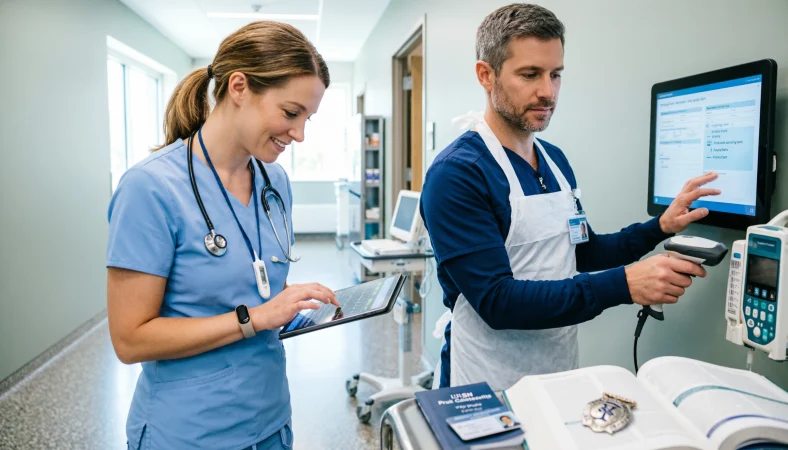
LPN and RN are both licensed nursing professionals, but they have different education, responsibilities, and scopes of practice. LPN stands for Licensed Practical Nurse, while RN stands for Registered Nurse.
RNs generally complete more extensive education and can handle a broader range of patient care responsibilities, while LPNs commonly provide basic nursing care under the direction of RNs or other healthcare professionals.
Choosing between LPN or RN can be confusing if you’re considering a career in nursing or trying to understand the credentials of a healthcare professional. Although both roles involve direct patient care, they differ in education requirements, licensing, responsibilities, work settings, and potential career paths.
This guide explains LPN and RN in simple, beginner friendly language, covering their education, duties, scope of practice, work environments, and career differences. Understanding these distinctions can help prospective nursing students and patients better understand what each nursing role involves.
LPN vs RN: What’s the Difference?
The main difference between an LPN and an RN involves education, scope of practice, clinical responsibilities, and professional role. Both are licensed nurses who provide direct patient care, but their preparation and authorized responsibilities are not identical.
An LPN means licensed practical nurse. In some states, a similar role is called an LVN, or licensed vocational nurse. LPNs provide practical nursing care in settings such as hospitals, nursing facilities, clinics, private homes, and other healthcare environments.
An RN means registered nurse. RNs generally have broader responsibilities that include assessing patients, developing or contributing to care plans, administering treatments and medications, coordinating care, monitoring patients, and educating patients and families.
The exact scope of practice is determined by state law, regulations, and employer policies. Therefore, an LPN’s or RN’s responsibilities can vary depending on location and workplace.
The simplest distinction is this:
An LPN is prepared for practical nursing care.
An RN receives broader nursing education and generally has wider responsibilities.
Both roles require licensure.
The exact legal scope depends on the jurisdiction and practice setting.
Is LPN vs RN a Grammar, Vocabulary, or Usage Issue?
Unlike ordinary word comparisons, this is primarily a professional terminology and career comparison.
The abbreviations LPN and RN aren’t interchangeable. They identify different nursing credentials and professional roles.
Calling someone an RN when that person is licensed as an LPN can create an inaccurate impression of their education and professional credentials. In healthcare, precise terminology matters because professional titles communicate qualifications and scope of practice.
Formal vs Informal Usage
LPN and RN are standard professional abbreviations.
In formal writing, it is useful to write the full term first:
“Maria is a licensed practical nurse.”
Afterward, the abbreviation can be used:
“Maria works as an LPN.”
The same approach applies to registered nurse and RN.
Academic Usage
Nursing schools, licensing organizations, healthcare employers, and government agencies commonly distinguish LPN and RN education and licensure.
The National Council of State Boards of Nursing develops separate examination plans for practical or vocational nurses and registered nurses. The NCLEX PN is associated with practical and vocational nursing, while the NCLEX RN is associated with registered nursing.
Casual Usage
In everyday conversation, someone might simply say “nurse.” That word can be too broad when the specific credential matters.
For example, if someone is discussing education requirements, job duties, or licensing, identifying whether the person is an LPN or RN provides much more information.
What Does an LPN Do?
LPNs provide practical nursing care to patients. According to the U.S. Bureau of Labor Statistics, LPNs and licensed vocational nurses provide basic medical care in settings that can include nursing facilities, hospitals, physicians’ offices, and private homes.
The specific duties depend on state regulations and the employer.
An LPN may take vital signs, provide prescribed treatments, administer certain medications, assist with personal care, monitor patients, document care, and communicate observations to other members of the healthcare team.
LPNs can work with patients who have short term illnesses, chronic conditions, disabilities, or rehabilitation needs.
Workplace Example
Consider a long term care facility.
An LPN may monitor residents, administer medications within the applicable scope, provide nursing care, document changes, and communicate important observations to an RN or other healthcare professional.
The role can involve substantial direct patient interaction.
Academic Example
A person entering an approved practical nursing program generally studies subjects such as anatomy, physiology, nursing fundamentals, pharmacology, and clinical nursing skills.
The Bureau of Labor Statistics states that LPN and LVN programs typically take about one year and include supervised clinical experience.
Technology Example
LPNs increasingly work with electronic health records, medication documentation systems, digital vital sign equipment, electronic communication systems, and other healthcare technology.
Technology changes how care is documented, but it does not independently determine an LPN’s legal scope of practice.
Usage Recap
Use LPN when referring to a licensed practical nurse.
LPN preparation is generally shorter than RN preparation.
LPN responsibilities depend heavily on state law and workplace policies.
What Does an RN Do?
Registered nurses generally have broader responsibilities than LPNs.
The Bureau of Labor Statistics describes RNs as professionals who provide and coordinate patient care, educate patients and the public, and provide advice and support. Typical duties include assessing patients, recording medical histories and symptoms, administering medications and treatments, developing or contributing to care plans, collaborating with healthcare professionals, monitoring equipment, and educating patients and families.
The exact responsibilities still vary according to state law, specialty, employer, and clinical environment.
Workplace Example
Imagine an RN working in a hospital.
The RN may assess a patient’s condition, interpret changes in clinical status, coordinate care with physicians and other professionals, administer treatments, educate the patient, and update the nursing care plan.
The RN may also delegate appropriate tasks to other members of the healthcare team when permitted by law and organizational policy.
Academic Example
RN education can follow more than one pathway.
The Bureau of Labor Statistics states that prospective RNs commonly enter through a bachelor’s degree in nursing, an associate degree in nursing, or a diploma from an approved nursing program.
Educational requirements can differ by employer and jurisdiction, particularly when discussing hiring preferences and long term career development.
Technology Example
RNs may use electronic health records, clinical monitoring equipment, medication systems, telehealth platforms, diagnostic information systems, and computerized documentation tools.
Technology can support clinical decision making, but professional nursing judgment remains an essential part of the RN role.
Usage Recap
Use RN for a registered nurse.
RNs generally receive broader nursing preparation.
Their responsibilities can include assessment, care coordination, education, and care planning.
When You Should NOT Use LPN or RN
Understanding when these titles apply can prevent several common mistakes.
1. Do Not Treat LPN and RN as Identical Credentials
They represent different nursing licenses and educational pathways.
2. Do Not Assume Every Nurse Is an RN
The word nurse can describe professionals with different credentials. When credentials matter, use the appropriate title.
3. Do Not Assume Every LPN Has the Same Scope
State nursing regulations determine what an LPN can legally perform.
4. Do Not Assume Every RN Has Identical Responsibilities
An RN working in a hospital intensive care unit can have very different responsibilities from an RN working in a clinic, school, or community setting.
5. Do Not Use Salary Alone to Define the Difference
Compensation varies by location, experience, specialty, employer, shift, and other factors.
6. Do Not Assume an LPN Is Simply an Entry Level RN
The two are distinct licensed nursing roles with different educational preparation and scope.
7. Do Not Assume a Bachelor’s Degree Is the Only RN Pathway
The Bureau of Labor Statistics identifies several common educational routes into registered nursing, including associate degree and diploma pathways.
8. Do Not Assume Job Duties Are Identical Across States
Nursing scope is affected by jurisdictional rules, so a task permitted in one location may have different requirements elsewhere.
LPN vs RN Education and Training
Education is one of the clearest differences between the two pathways.
LPN education is generally shorter. The Bureau of Labor Statistics reports that approved LPN and LVN programs typically take about one year and include classroom instruction and supervised clinical experience.
RN education generally requires a longer and broader course of study.
Common RN pathways include an associate degree in nursing, a bachelor’s degree in nursing, or a diploma from an approved nursing program.
The choice between these paths can depend on educational goals, finances, time, employer expectations, and long term career plans.
An LPN who later wants to become an RN may pursue an LPN to RN educational pathway. The Bureau of Labor Statistics specifically identifies LPN to RN education as one possible advancement route.
LPN vs RN Licensing and NCLEX Exams
Both professions require licensure, but the licensing examinations are different.
Students pursuing practical or vocational nursing generally take the NCLEX PN.
Students pursuing registered nursing generally take the NCLEX RN.
The National Council of State Boards of Nursing develops separate practice analyses and examination plans for these nursing populations. Its practice analysis work helps establish the content and clinical expectations reflected in the respective examinations.
Passing the appropriate examination is only one part of professional licensure. Applicants must also satisfy the requirements established by the relevant nursing regulatory authority.
Because licensing requirements can change, prospective nurses should verify the rules applicable to the jurisdiction where they intend to practice.
LPN vs RN Salary and Job Outlook
Compensation is another reason people search for LPN or RN comparisons.
According to current U.S. Bureau of Labor Statistics data, the median annual wage for LPNs and LVNs was $64,400 in May 2025. Employment for the occupation is projected to grow by 3 percent from 2025 through 2035.
For RNs, the median annual wage was $97,550 in May 2025, with employment projected to grow by 6 percent from 2025 through 2035.
These figures describe U.S. occupational data rather than guaranteed salaries for individual workers.
Actual earnings can differ substantially according to geographic area, specialty, experience, employer, overtime, shift differentials, and other factors.
The same principle applies to job opportunities. National projections provide a broad picture, but local employment conditions can be very different.
LPN or RN: Which Work Settings Are Common?
Both LPNs and RNs can work in multiple healthcare environments, although the available roles and responsibilities differ.
LPNs commonly work in nursing and residential care facilities, hospitals, physicians’ offices, and private homes.
RNs can work in hospitals, physicians’ offices, home healthcare services, nursing facilities, outpatient clinics, and schools. Some RNs also specialize in particular areas of healthcare.
The setting can significantly influence daily work.
An LPN in long term care may focus heavily on ongoing patient needs, medication administration within scope, documentation, and monitoring.
An RN in an acute care hospital may spend more time on assessment, care coordination, clinical decision making, education, and management of changing patient conditions.
Neither description applies identically to every position.
LPN or RN in Modern Technology and AI Tools
Technology is becoming increasingly important in nursing.
Electronic health records allow nurses to document assessments, treatments, observations, and other patient information. Digital medication systems can support medication administration processes. Remote monitoring and telehealth can also expand how healthcare professionals interact with patients.
Artificial intelligence is introducing additional tools for documentation support, data analysis, scheduling, clinical information retrieval, and other administrative or clinical workflows.
However, AI does not replace the legal distinction between an LPN and an RN.
A software system can assist with information processing, but it does not determine whether a specific nursing activity is legally within an individual’s scope of practice.
That determination comes from applicable law, nursing regulations, professional standards, and employer policies.
For nurses, technology is best understood as a tool that supports professional practice rather than a substitute for professional accountability.
Etymology and Meaning of LPN and RN
The abbreviation LPN comes from licensed practical nurse.
The word licensed indicates that the individual has obtained legal authorization to practice the relevant occupation under applicable regulatory requirements.
The word practical reflects the practical nursing role and preparation associated with the credential.
RN stands for registered nurse.
The word registered reflects professional registration or licensure through the relevant regulatory system.
These abbreviations became useful because healthcare environments require concise ways to distinguish professional credentials.
Today, LPN and RN appear frequently in employment descriptions, clinical documentation, educational materials, licensing information, and healthcare communication.
An Expert Perspective on LPN and RN Roles
“The most useful way to understand LPN and RN is to view them as distinct licensed nursing roles with different educational preparation and legally defined scopes of practice.”
This distinction is important because job duties can overlap while the professional credentials remain different.
Both LPNs and RNs contribute to patient care. The difference is not simply whether one person provides hands on care and the other does not. Both can provide direct care. Their education, assessment responsibilities, care coordination duties, and legally authorized activities can differ.
Two Practical Case Studies
Case Study 1: Choosing the Faster Entry Into Nursing
Consider a student who wants to enter nursing relatively quickly and begin working in patient care.
An approved practical nursing program can typically take about one year, followed by the required licensing process.
Concrete result: The student may reach entry into licensed practical nursing sooner than someone completing a longer RN education pathway.
Later, the student could pursue additional education through an LPN to RN pathway.
This is an illustrative career scenario. Actual program length and licensing requirements vary.
Case Study 2: Comparing National Career Data
Consider a person comparing national U.S. occupational data before choosing between the two career paths.
The BLS reported a May 2025 median annual wage of $64,400 for LPNs and LVNs and $97,550 for RNs. It also projected 3 percent employment growth for LPNs and LVNs and 6 percent growth for RNs from 2025 through 2035.
Concrete result: The national data show measurable differences in reported median compensation and projected employment growth, although those figures should not be interpreted as guarantees for a particular worker.
Common Mistakes and Decision Rules
Decision Rule Box
- If you mean a licensed practical nurse, use LPN.
- If you mean a registered nurse, use RN.
- If you are comparing career paths, examine education, licensing, scope of practice, work setting, and long term goals.
Error Prevention Checklist
Always use LPN when:
- You mean licensed practical nurse.
- You are discussing practical nursing education.
- You are referring to the practical nursing license.
- You are describing an LPN position or credential.
Always use RN when:
- You mean registered nurse.
- You are discussing registered nursing education.
- You are referring to the RN license.
- You are describing a registered nursing position or credential.
Never use LPN when:
- The person is actually licensed as an RN.
- You are discussing RN specific education or licensure.
- You are assuming LPN and RN scope are identical.
Never use RN when:
- The person holds an LPN license instead.
- You are describing practical nursing education.
- You are using the title simply because the person works in healthcare.
Related Nursing Comparisons You Should Understand
Once you understand LPN and RN, several related healthcare terms become easier to distinguish.
LPN vs LVN
These terms describe closely related practical or vocational nursing roles, with terminology varying by state.
RN vs BSN
RN describes licensure, while BSN describes a bachelor’s degree in nursing.
ADN vs BSN
These are educational pathways associated with registered nursing.
RN vs Nurse Practitioner
An RN and nurse practitioner represent different levels of nursing education, licensure, and practice.
LPN vs CNA
These are different healthcare roles with different education, licensing, and responsibilities.
RN vs Medical Assistant
Both may work in healthcare environments, but they represent different professional roles and training pathways.
Nursing Diploma vs Nursing Degree
These describe different educational structures that can lead toward registered nursing depending on the program and jurisdiction.
NCLEX PN vs NCLEX RN
These are separate licensing examinations associated with practical or vocational nursing and registered nursing.
Licensed vs Certified
A license provides legal authority to practice an occupation, while certification generally recognizes specialized knowledge or skills and does not itself provide the same legal authority.
Scope of Practice
Scope of practice describes the activities a professional is legally and professionally authorized to perform.
FAQs
What is the difference between LPN and RN?
An LPN provides practical nursing care within their scope, while an RN has broader education and responsibilities, including assessment, care planning, coordination, and patient education.
Is an LPN a nurse?
Yes. LPN stands for licensed practical nurse. An LPN is a licensed nursing professional.
Is an RN higher than an LPN?
LPN and RN are different levels of nursing licensure and preparation. RNs generally have broader education and responsibilities, but the exact scope depends on jurisdiction and employment setting.
How long does it take to become an LPN?
An approved LPN or LVN program typically takes about one year, according to the U.S. Bureau of Labor Statistics. Licensing requirements must also be completed.
How long does it take to become an RN?
The time varies by program. Common pathways include associate degrees, bachelor’s degrees, and approved diploma programs, with prerequisites and licensing requirements also affecting the total time.
Can an LPN become an RN?
Yes. An LPN can pursue additional nursing education through an LPN to RN pathway and then meet the requirements for RN licensure.
Is LPN or RN better for a nursing career?
The best pathway depends on your education goals, desired responsibilities, time, finances, work setting, and long term plans. The credentials are not interchangeable.
Do LPNs and RNs work in the same places?
Both can work in hospitals, clinics, nursing facilities, and other healthcare settings, but specific roles and responsibilities vary by employer and jurisdiction.
Which earns more, LPN or RN?
In U.S. BLS data for May 2025, the median annual wage was higher for RNs than for LPNs and LVNs. Individual compensation varies by location, experience, specialty, employer, and other factors.
Conclusion:
Understanding LPN or RN starts with recognizing that both are licensed nursing credentials, but they represent different educational pathways and professional roles.
An LPN is a licensed practical nurse who generally provides practical and basic nursing care within the applicable scope of practice. An RN is a registered nurse whose preparation generally supports broader responsibilities involving patient assessment, care planning, coordination, treatment, monitoring, and education.
The choice between these paths depends on individual career goals rather than a single universal rule. Some people may value the shorter educational route associated with practical nursing, while others may want the broader opportunities associated with registered nursing education.
If you are comparing the two, look beyond salary. Consider education length, licensing requirements, scope of practice, work environment, advancement opportunities, employer requirements, and the type of patient care you want to provide.
The key distinction is simple: LPN means licensed practical nurse, while RN means registered nurse. Understanding that difference gives you a clear foundation for comparing nursing education and career pathways.