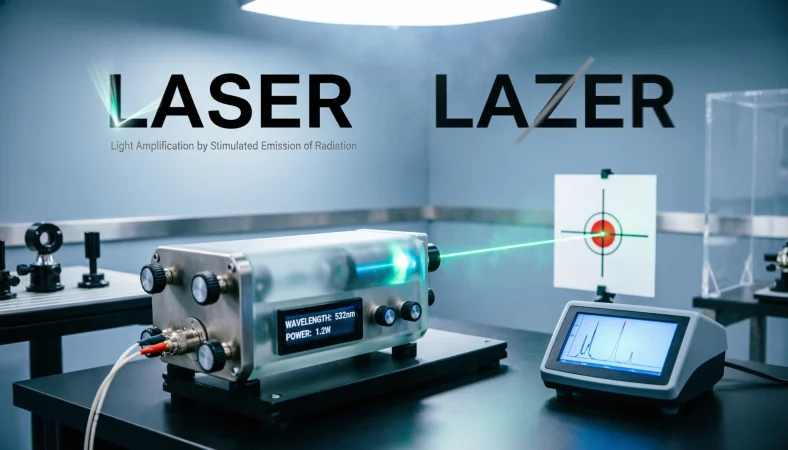
Laser is the correct and standard spelling for the device, technology, or beam of concentrated light. Lazer is generally a misspelling, although it can appear in brand names, informal writing, fictional names, or creative contexts. The confusion usually comes from pronunciation because laser sounds almost exactly like the way some people expect “lazer” to be spelled.
The question laser or lazer is common because English spelling does not always follow pronunciation perfectly. When people hear the word laser, the final sound can naturally suggest the letter combination “zer,” making lazer seem plausible.
However, the established English spelling is laser. The word is now used across science, medicine, manufacturing, communications, entertainment, computing, and everyday technology. Choosing the correct spelling matters because laser is not simply a casual variation. It is the internationally recognized term for a specific technology based on stimulated emission of light.
Laser vs Lazer: What’s the Difference?
The difference between laser and lazer is primarily a matter of standard spelling and established terminology.
Laser is the accepted English spelling. It functions primarily as a noun and refers to a device that produces a concentrated, coherent beam of electromagnetic radiation through stimulated emission.
The word can also be used attributively to describe things associated with laser technology.
For example:
The technician used a laser cutter.
The doctor recommended laser treatment.
The laboratory measured the laser beam.
Lazer is generally not the standard spelling of the technology. In most ordinary English writing, it should be treated as a misspelling of laser.
| Term | Part of speech | Meaning | Standard usage | Example |
| Laser | Noun | A device that produces concentrated coherent light | Standard spelling | The engineer aligned the laser. |
| Laser | Modifier | Relating to laser technology | Standard spelling | She underwent laser treatment. |
| Lazer | Noun | Usually intended to mean laser | Generally nonstandard | The word may appear as a spelling mistake. |
| LASER | Noun and acronym origin | Light amplification by stimulated emission of radiation | Historical technical form | LASER explains the origin of the modern word. |
Why Does Lazer Look Correct?
The answer lies largely in pronunciation.
Laser is commonly pronounced in a way that resembles “lay zer.”
English has many words where the spelling does not provide an obvious guide to pronunciation. Once a person hears a word without seeing it written, they may reconstruct the spelling based on familiar patterns.
The spelling “lazer” therefore seems intuitive to some people.
But established vocabulary cannot always be reconstructed from sound alone.
The correct form is laser.
Laser Is More Than a Spelling Preference
It is important to understand that laser is not merely the spelling preferred by a particular style guide.
The term identifies a specific scientific technology.
LASER originated as an acronym for Light Amplification by Stimulated Emission of Radiation. Over time, the uppercase acronym became a regular English word written as laser.
That history explains why the spelling is fixed.
Quick Recap
Laser is the standard spelling.
Lazer is generally a misspelling when referring to laser technology.
Laser can function as a noun or as a modifier.
The word originated from a scientific acronym.
Is Laser vs Lazer a Grammar, Vocabulary, or Usage Issue?
The question of laser or lazer is mainly a spelling and vocabulary issue rather than a grammar problem.
Grammar determines how a word behaves within a sentence.
Spelling determines how the word is written.
Vocabulary concerns the words used to express particular meanings.
Here, the primary question is whether the established term for a particular technology should be written laser or lazer.
The answer is laser.
Are Laser and Lazer Interchangeable?
In most contexts, no.
A reader will usually understand lazer if the writer clearly means laser technology. However, understanding an error does not make the error a standard spelling.
This distinction matters in technical writing.
For example:
The laser system requires calibration.
is standard.
The lazer system requires calibration.
is generally understood, but the spelling is incorrect in ordinary English.
Formal vs Informal Usage
Laser is appropriate in virtually every register.
It can appear in scientific papers, medical information, business documents, product descriptions, technical manuals, school textbooks, news articles, and casual conversation.
Lazer does not become standard simply because the writing is informal.
A casual message might contain a typo, but that doesn’t establish a new spelling.
For example:
I need to get my laser pointer.
is correct in casual writing.
Academic vs Casual Usage
Academic writing should use laser.
A scientific paper might discuss laser spectroscopy, laser physics, laser communication, or laser materials processing.
A casual conversation might involve a laser pointer or laser printer.
The same spelling applies in both settings.
This is useful because some spelling differences disappear when the underlying word is a technical term with a well established international form.
How to Use Laser Correctly
The noun laser refers to a device that produces a concentrated beam of light through a process involving stimulated emission.
The technology has many applications.
Lasers can be used to cut materials, measure distance, transmit information, read optical media, perform medical procedures, create images, scan objects, and support scientific experiments.
The word can appear in many common expressions.
- laser beam
- laser pointer
- laser printer
- laser cutting
- laser treatment
- laser surgery
- laser scanner
- laser technology
- laser light
The spelling remains laser in each expression.
Workplace Example
A manufacturing company might write:
The technician inspected the laser cutting system before production began.
Here, laser describes the technology used for cutting.
Academic Example
A physics student might write:
The experiment examined how a laser beam behaved when it passed through the optical system.
The word belongs naturally in technical and scientific writing.
Technology Example
A consumer might say:
My printer uses laser technology.
This is another ordinary use of the term.
Usage Recap
Use laser when referring to the technology or device.
The spelling remains the same whether the context is scientific, professional, medical, technical, or casual.
How to Use Lazer Correctly
In ordinary English, there is usually no reason to choose lazer when you mean the light technology.
If you see the word in a sentence such as:
The lazer cut through the material.
the intended meaning is almost certainly:
The laser cut through the material.
There are, however, situations in which Lazer can intentionally appear as a proper name, fictional name, brand element, username, character name, or creative spelling.
That is different from using lazer as the ordinary English name of the technology.
For example, a fictional game character could theoretically be called “Lazer.” In that case, capitalization and context identify it as a name rather than a spelling of the scientific term.
Workplace Example
A professional document should normally say:
The laser system needs maintenance.
It should not use “lazer” simply to create a casual tone.
Academic Example
A scientific assignment should say:
Lasers can produce highly concentrated beams of light.
Writing “lazers” would introduce a spelling error.
Technology Example
A technology article should use expressions such as:
- laser printer
- laser scanner
- laser sensor
- laser communication
not their “lazer” equivalents.
Usage Recap
Use laser for the established technology.
Use Lazer only when it is intentionally functioning as a separate proper name or creative spelling.
When You Should NOT Use Laser or Lazer
Knowing when a spelling does not apply can prevent several common errors.
1. Do not write lazer as the standard spelling
If you mean the technology, use laser.
2. Do not change laser to lazer because of pronunciation
The spoken sound does not determine the established written form.
3. Do not use lazer in technical documentation
Technical writing requires consistent terminology.
4. Do not assume informal writing makes lazer correct
A casual context can contain informal vocabulary, but established technical terms still retain their standard spelling.
5. Do not confuse laser with light
A laser produces a particular type of highly organized light. Not every light source is a laser.
6. Do not use laser and LASER without understanding the context
LASER reflects the historical acronym. Laser is the normal modern English word.
7. Do not treat a brand or fictional name as evidence of standard spelling
A company or fictional creator may intentionally use “Lazer,” but that does not change the standard English spelling.
8. Do not assume spellcheck acceptance proves correctness
Some dictionaries and software systems may recognize unusual names or variants. Context still matters.
Common Mistakes and Decision Rules
The simplest way to avoid the spelling problem is to remember that the scientific term is laser.
| Correct sentence | Incorrect sentence | Explanation |
| The technician adjusted the laser. | The technician adjusted the lazer. | Laser is the standard spelling. |
| She bought a laser printer. | She bought a lazer printer. | The technology is called laser printing. |
| The doctor used a laser. | The doctor used a lazer. | Medical laser technology retains the standard spelling. |
| The laser beam was visible in the experiment. | The lazer beam was visible in the experiment. | Laser is the established technical term. |
| Researchers developed a new laser system. | Researchers developed a new lazer system. | Lazer is generally a spelling error in this context. |
Decision Rule Box
- If you mean the light based technology or device, use laser.
- If you mean a person, brand, character, or creative name intentionally spelled Lazer, retain that specific spelling.
- If you are writing formal, academic, technical, medical, or professional content, use laser for the technology.
This rule eliminates almost every ordinary spelling problem involving the two forms.
Laser and Lazer in Modern Technology and AI Tools
Modern technology has made laser terminology part of everyday vocabulary.
Lasers are no longer limited to physics laboratories. People encounter them in printers, barcode scanners, optical systems, medical devices, manufacturing equipment, surveying instruments, communication systems, and entertainment technology.
AI tools can also recognize the difference between standard terminology and common spelling errors.
For example, a user might ask:
Is lazer the correct spelling?
A language model should identify laser as the standard spelling while recognizing that the user may have encountered “lazer” elsewhere.
This distinction is particularly important for writing assistants.
Suppose someone enters:
The lazer sensor measures distance.
A useful writing assistant should normally correct this to:
The laser sensor measures distance.
However, if the user writes:
Lazer is the name of our fictional robot.
the system should preserve the spelling because it is functioning as a proper name.
Context therefore matters.
Search Intent and Spelling Queries
Someone searching laser or lazer is usually trying to resolve a spelling uncertainty.
They may have seen both forms online and want to know which one is correct.
A strong answer should therefore provide the answer immediately:
Laser is the standard spelling.
After that, it should explain why lazer appears and when it might intentionally be used.
This structure satisfies both users and search systems because the core answer appears before the longer explanation.
What Does Laser Mean?
Laser refers to a device that generates or amplifies light through stimulated emission.
The resulting beam can have characteristics that make it very useful for precise applications.
Lasers can produce light that is highly directional and can be concentrated into a small area. Depending on the design, they can operate at different wavelengths and power levels.
This versatility explains their enormous range of applications.
A low power laser pointer can be used for presentations.
A medical laser can be used in carefully controlled procedures.
An industrial laser can cut or engrave materials.
A scientific laser can support precise measurements and experiments.
The word therefore covers a broad technological category rather than one single machine.
Why Is It Called a Laser?
The term comes from the phrase:
Light Amplification by Stimulated Emission of Radiation
The first letters form LASER.
This is known as an acronym.
As the technology became widely known, the acronym evolved into a normal English noun.
Modern writing usually uses lowercase laser rather than treating the word as an all capital acronym.
This process is common in English.
Some technical acronyms eventually become ordinary words used without conscious awareness of their original expansion.
Laser is one of the best known examples.
Understanding this history also helps explain why “lazer” is not an equally accepted spelling.
The word’s spelling developed from a specific scientific acronym, not from an ordinary English word ending in “zer.”
Laser vs Other Light Sources
Another useful distinction is between a laser and ordinary light.
A household lamp produces light that spreads in many directions and contains a broad range of wavelengths.
A laser is designed to produce highly organized light with properties that make it useful for precision applications.
This difference explains why laser technology is so valuable.
- In manufacturing, concentration allows energy to be delivered to a specific area.
- In measurement, a laser beam can provide a precise reference.
- In communications, certain lasers can transmit information through optical systems.
- In medicine, controlled laser energy can be directed toward particular tissues.
The term therefore represents both a physical process and a large family of technologies built around it.
Authority and Trust: Why Correct Terminology Matters
Using the standard spelling is particularly important when discussing scientific or technical subjects.
A misspelling such as “lazer” might seem harmless in casual conversation, but repeated terminology errors can weaken the credibility of an article.
This becomes especially noticeable when a page discusses technical subjects.
Readers expect terms such as laser, radiation, wavelength, optics, sensors, and spectroscopy to be spelled consistently.
Case Study 1: Technical Documentation
Consider an illustrative technical documentation project involving a laser measurement device.
The initial draft uses “lazer” throughout 15 references.
An editor replaces all 15 instances with laser and standardizes related terminology.
The concrete result is 15 corrected terminology instances and a more consistent technical document.
The example demonstrates why terminology checks matter even when readers can infer the intended meaning.
Case Study 2: Educational Content
Imagine an educational article explaining how laser printers work.
The first version uses “lazer” in headings, body text, and image descriptions.
An editorial review changes every technical reference to laser.
The concrete result is consistent terminology across the page and a clearer presentation for students who may encounter the correct term elsewhere in textbooks and technical materials.
These examples are illustrative rather than reports of measured industry experiments. Their purpose is to show how a simple spelling correction can improve consistency and authority.
Author Bio
About the Author: A senior SEO strategist and professional language content specialist focused on spelling, vocabulary, technical terminology, search intent, and people first educational writing.
Error Prevention Checklist
Always use laser when:
- You mean the scientific technology.
- You mean a laser beam.
- You mean laser equipment.
- You are discussing laser treatment.
- You are writing about laser cutting.
- You are discussing laser printers.
- You are writing technical documentation.
- You are preparing academic content.
Use Lazer only when:
- It is an intentional proper name.
- It is part of a brand name.
- It identifies a fictional character.
- The creative spelling itself is relevant.
Never use lazer when:
- You are simply trying to spell the standard technology term.
- You are writing a scientific assignment.
- You are preparing medical information.
- You are creating professional technical documentation.
- You are explaining laser technology.
Remember the spelling
Laser = standard technology term
Lazer = generally a misspelling
LASER = historical acronym form
Related Spelling and Vocabulary Confusions You Should Master
The laser or lazer question belongs to a larger category of English spelling problems where pronunciation can influence how people write unfamiliar words.
1. Laser or Lazer
Laser is the standard spelling for the technology.
2. Light or Lite
Light is the standard form in most general contexts, while lite has specialized informal and commercial uses.
3. Meter or Metre
Both are established forms, with regional differences in English usage.
4. Center or Centre
Both are standard, with American and British English preferring different forms.
5. Theater or Theatre
Both are accepted regional spellings.
6. Color or Colour
The spelling depends on the variety of English being used.
7. Program or Programme
Both forms exist, although their usage differs by region and context.
8. Catalog or Catalogue
Both forms are established, with regional preferences.
9. Alright or All Right
The two forms have different histories and varying levels of acceptance depending on style and context.
10. Everyday or Every Day
Everyday is generally an adjective, while every day refers to each individual day.
These examples demonstrate an important principle: not every spelling difference is an error. Some are genuine regional variants, while others are nonstandard forms. Laser and lazer generally belong to the latter category when referring to the technology.
FAQs:
Is laser or lazer correct?
Laser is the correct standard spelling for the technology that produces a concentrated beam of light. Lazer is generally considered a misspelling unless it is intentionally being used as a proper name, brand name, or creative spelling.
Why do people spell laser as lazer?
The pronunciation of laser can make “lazer” seem logical. People often spell unfamiliar words according to how they sound, especially when they have heard a term but have rarely seen it written.
Is lazer a word?
Lazer can appear as a name, brand element, fictional term, or creative spelling. However, it is not the standard spelling of the scientific technology. When referring to the technology, use laser.
What does laser stand for?
LASER originally stands for Light Amplification by Stimulated Emission of Radiation. The acronym eventually became the ordinary English noun laser.
Is laser an acronym?
Historically, laser originated as an acronym. In modern English, however, laser functions as a regular noun and is commonly written in lowercase.
Should laser be capitalized?
In ordinary modern English, laser is normally written in lowercase. The uppercase form LASER is useful when discussing its historical acronym expansion.
Is lazer ever correct?
Yes, it can be correct when Lazer is deliberately used as a proper name, brand, character name, username, or other creative designation. It is not the standard spelling for laser technology.
What is the plural of laser?
The plural is lasers.
For example:
The laboratory contains several lasers.
Is laser a noun or adjective?
Laser is primarily a noun, but it can also function as a modifier in expressions such as laser printer, laser beam, laser cutting, and laser treatment.
Why is laser spelled with an s?
The spelling comes from the historical acronym LASER. The s represents the word “stimulated” in the original phrase. The modern word retained the acronym’s spelling as it entered general English.
Final Thoughts:
The answer to laser or lazer is clear: laser is the standard spelling when you mean the technology that produces a concentrated beam of light.
The alternative spelling lazer is understandable because the pronunciation makes it seem natural. However, pronunciation does not determine the established spelling. Laser has a specific scientific history, originating from the acronym Light Amplification by Stimulated Emission of Radiation.
Today, laser is a normal English word used in science, medicine, manufacturing, communications, computing, printing, measurement, entertainment, and many other fields.
If you are writing about a laser printer, laser beam, laser treatment, laser cutter, laser scanner, or laser system, use laser.
If you encounter Lazer as the name of a fictional character, brand, product, or creative project, the spelling may be intentional. Context determines whether the form is a proper name or simply a spelling mistake.
The easiest rule is:
Laser is the standard technology term.
Lazer is generally a misspelling.
Lazer can be valid when it is intentionally used as a separate name.
Once you remember that laser comes from a scientific acronym rather than ordinary pronunciation based spelling, the correct form becomes much easier to recognize.