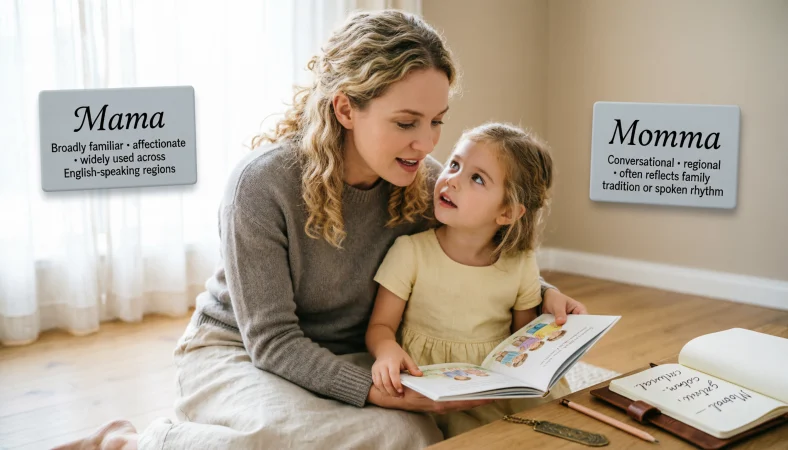
Momma or mama are both informal terms for a mother, and neither spelling is inherently wrong. Mama is the more widely used and generally more neutral form, while momma is a longer variant often associated with affectionate, familiar, or regional speech. The best choice depends on dialect, family preference, tone, and context.
The question of whether to write momma or mama often arises because both forms represent the same basic relationship but carry slightly different stylistic associations. In everyday speech, children may use either word when addressing their mother. In writing, however, the choice can suggest something about regional English, family identity, age, character voice, or emotional tone.
Understanding that distinction matters because spelling is not always a simple matter of one form being correct and the other being incorrect. Some words have multiple established forms that developed naturally through pronunciation and regional usage. Mama and momma belong to this category.
Momma or Mama: What’s the Difference?
The most important point is that mama and momma are both established informal terms for a mother. They are usually interchangeable when the intended meaning is simply “mother.”
The difference lies mainly in spelling, pronunciation, dialect, and tone.
| Word | Part of speech | Meaning | Typical tone | Common usage |
| Mama | Noun | Mother | Affectionate, familiar, informal | Everyday family speech and writing |
| Momma | Noun | Mother | Affectionate, familiar, sometimes regional | Family speech, songs, stories, character dialogue |
Mama is generally the more concise and widely recognized spelling.
Momma adds another syllable in the written form and can reflect a particular pronunciation or dialect.
Neither spelling automatically indicates greater affection.
The surrounding context often matters more than the extra letter.
What does mama mean?
Mama is an informal noun meaning mother. It is one of the many familiar words used by children and adults when referring to or addressing a mother.
Examples include:
Mama is making dinner.
I called Mama this morning.
My mama taught me how to cook.
The word can sound warm and personal, although its exact tone varies across English speaking communities.
What does momma mean?
Momma also means mother and is generally used in the same basic situations.
For example:
Momma said we should wait.
Her momma always supported her.
The little boy ran toward his momma.
The spelling can create a more distinctly colloquial or regional impression. Writers sometimes choose it because it reflects how a particular speaker sounds.
Quick recap
Mama is the more common and broadly neutral spelling.
Momma is an established variant with a more colloquial or regional feel in some contexts.
Both can refer to a mother.
The right choice often depends on dialect, family preference, and writing style.
Is Momma or Mama a Grammar, Vocabulary, or Usage Issue?
This is primarily a vocabulary and usage issue, rather than a grammar problem.
Grammar determines how the word functions within a sentence. Both mama and momma can function as nouns, and both can be used in grammatical sentences.
The real question is which form best matches the intended tone and variety of English.
Are mama and momma interchangeable?
In many everyday contexts, yes.
For example:
My mama lives nearby.
and
My momma lives nearby.
Both sentences communicate essentially the same idea.
The difference is stylistic rather than semantic. A reader may perceive one spelling as more familiar, regional, childlike, traditional, or conversational, but the basic meaning remains mother.
Is mama more formal?
Neither word is truly formal. Both are informal alternatives to mother.
If you are writing a legal document, academic paper, professional report, medical document, or formal letter, mother is generally more appropriate.
Compare:
The patient’s mother attended the appointment.
with:
The patient’s mama attended the appointment.
The first sentence has a neutral professional tone. The second sounds personal and conversational.
What about academic writing?
Academic writing normally favors mother unless the subject itself concerns language, culture, literature, family terminology, or a quotation.
For example:
The study examined communication between mothers and children.
This is more appropriate for a conventional academic context than using mama or momma.
However, if a researcher is quoting a participant who uses mama, preserving that wording may be important.
What about casual writing?
Both forms can work well in casual writing.
Social media posts, personal messages, family stories, songs, fiction, memoirs, and informal conversations often use these words naturally.
The choice can also help establish a speaker’s voice.
How to Use Mama Correctly
Mama is useful when you want an affectionate, familiar, or conversational word for mother without strongly emphasizing a particular regional spelling.
It can appear as either a common noun or a form of direct address.
Mama as a common noun
Her mama picked her up after school.
Here, mama refers to the speaker’s or another person’s mother.
Mama as direct address
Mama, can you help me?
In this sentence, the word directly addresses the mother. Because it functions as a name or form of address, capitalization is appropriate in standard writing.
Compare:
My mama is coming home.
with:
Mama, are you coming home?
The first uses mama as a common noun. The second uses Mama as direct address.
Workplace example
Informal family language occasionally appears in workplace storytelling.
My mama always told me to finish what I started.
This can sound natural when an employee is sharing a personal story. It would not normally replace mother in formal business documentation.
Academic example
A linguistics paper might discuss the use of mama as a kinship term:
The children consistently used mama when addressing their mothers.
Here, the word is being discussed as a linguistic form rather than used in an informal personal statement.
Technology example
A messaging application might contain a sentence such as:
I just sent the photo to Mama.
This is completely natural in a personal message, especially when Mama functions as a family member’s familiar title.
Usage recap
Choose mama when you want a familiar word for mother that works comfortably across many English speaking contexts. It is especially useful in personal writing, family conversations, dialogue, and informal communication.
How to Use Momma Correctly
Momma has the same basic meaning as mama, but its spelling can create a stronger sense of spoken language.
Writers may use it to preserve a character’s voice or represent a particular dialect.
Momma in family speech
Momma will be home soon.
This sounds affectionate and informal.
Another example is:
I asked Momma if I could go.
The word can function as a familiar family title.
Momma in fiction
Fiction writers sometimes choose momma because it helps establish character and setting.
For example:
“Momma said the storm would pass.”
The spelling contributes to the character’s voice. If the character consistently uses momma, changing it to mama could subtly alter the intended voice.
Workplace example
Suppose someone tells a colleague a personal story:
My momma used to make this recipe every Sunday.
The word is perfectly understandable, but it creates a more personal and conversational impression than mother.
Academic example
In academic writing, momma is uncommon outside discussions of language, culture, literature, or quoted speech.
A linguist might write:
The spelling momma appears in informal representations of family speech.
Here, the word itself is the subject of discussion.
Technology example
A user might save a contact as:
Momma
rather than:
Mama
There is no grammatical issue. Contact names are personal choices, and either form can be meaningful to the person using it.
Usage recap
Use momma when its particular conversational, affectionate, or regional flavor fits the context. It is especially effective when reproducing natural dialogue or preserving a speaker’s identity.
When You Should NOT Use Momma or Mama
Although both forms are legitimate, there are situations where neither is the best choice.
1. Formal legal writing
Use mother rather than mama or momma in formal legal documents unless a specific name or quotation requires otherwise.
2. Professional medical writing
Medical records generally require precise, neutral terminology. Mother is normally preferable.
3. Academic writing
Unless you are discussing the word itself or quoting someone, mother usually fits academic prose better.
4. Technical documentation
Software manuals, instructions, and technical reports generally benefit from neutral terminology.
5. When describing a biological relationship precisely
Depending on context, terms such as mother, maternal parent, or another precise term may communicate the relationship more clearly.
6. When a character’s voice requires a different form
A novelist should not choose momma merely because it looks more emotional. The spelling should fit the character.
7. When consistency matters
If a personal essay uses mama throughout, suddenly switching to momma without a reason can look like an editing error.
8. When the intended audience expects neutral English
For international readers, mother is usually the clearest choice.
Common Mistakes and Decision Rules
| Correct sentence | Incorrect or unsuitable sentence | Explanation |
| My mama called me yesterday. | My mama called yesterday mother. | Mama is a noun referring to the mother. |
| Momma is waiting outside. | Momma are waiting outside. | Momma is singular and takes a singular verb. |
| Mama, can you help me? | mama, can you help me? | Capitalization is appropriate when the word is used as direct address. |
| My mother is a doctor. | My momma is a doctor. | The second sentence is grammatical but less formal. |
| Her mama lives nearby. | Her mother lives nearby. | Both are correct, but mother is more neutral. |
| Momma told us to stay inside. | Momma tell us to stay inside. | The singular subject requires the singular verb told. |
Decision Rule
Use mama when you want a familiar and widely recognized informal term for mother.
Use momma when the regional, conversational, affectionate, or character specific spelling fits the context.
If the setting is formal, choose mother unless there is a specific reason to preserve the informal form.
Mama and Momma in Modern Technology and AI Tools
Modern communication has made informal family terms especially visible.
People use family names in text messages, contact lists, social media posts, captions, digital diaries, and personal notes. As a result, forms such as Mama, Momma, Mom, and Mommy can appear side by side.
AI writing tools also encounter these variations frequently. An AI system may identify mama and momma as synonyms because they share the same basic meaning. However, a good writing system should preserve the stylistic distinction when context makes it relevant.
For example, if a fictional character consistently says momma, automatically changing every occurrence to mama could weaken the character’s voice.
This is especially important when AI assists with dialogue. Dialogue does not need to sound like standardized formal English. Real speakers use regional vocabulary, family terminology, pronunciation based spellings, and personal expressions.
The same principle applies to editing. A spelling variant should not be changed simply because another variant is more common.
The Etymology and History of Mama and Momma
The history of these words is closely connected with the simple sounds children often use when developing speech.
Forms related to mama occur in many languages and cultures. The repeated m sound is particularly common in early speech because it is relatively easy for young children to produce. As children acquire language, these early sounds can become established family terms.
English developed several familiar words for mother, including mama, mom, mommy, mam, and mum. Different regions and speech communities favored different forms.
Momma can be understood as an expanded spelling of the familiar mom or mama family of forms. Its use is especially noticeable in informal and regional varieties of English.
The important point is that these forms did not arise because English speakers needed completely different meanings. They developed through pronunciation, dialect, family usage, and linguistic tradition.
An expert style explanation
“Mama and momma differ more in form and social flavor than in basic meaning.”
That distinction is useful because it prevents a common mistake: treating every spelling difference as a question of correctness.
Two Practical Case Studies
Case study one: Personal writing
Imagine someone writing a memoir about childhood.
Every Sunday, Mama made pancakes before church.
The spelling Mama feels intimate but relatively straightforward. It identifies the family relationship without strongly emphasizing a particular regional pronunciation.
Now consider:
Every Sunday, Momma made pancakes before church.
This version can sound more distinctly conversational or character driven.
Neither sentence changes the basic event. The difference is in voice.
A memoir writer might deliberately select one form and use it consistently throughout the book to maintain a recognizable family voice.
Case study two: Fictional dialogue
Suppose a novelist creates a character whose speech reflects a particular regional community.
“Momma told me not to go near the river.”
Using momma may reinforce the character’s spoken identity.
If the same character later says:
“Mother told me not to go near the river.”
the change could suggest a shift in emotional distance, social setting, or speaking style.
This illustrates why spelling variants can matter in creative writing. The choice is not always about dictionary correctness. Sometimes it is part of characterization.
Error Prevention Checklist
Always use mama when
- ☑ You want a common informal term for mother.
- ☑ You are writing casual family dialogue.
- ☑ You want an affectionate but broadly recognizable form.
- ☑ You are discussing a family member in personal writing.
- ☑ You prefer the shorter and more widely recognized spelling.
Use momma when
- ☑ You want a conversational or regional flavor.
- ☑ You are reproducing a character’s speech.
- ☑ The spelling reflects family preference.
- ☑ You want to preserve a particular voice in a quotation.
- ☑ The context supports an informal tone.
Use mother instead when
- ☑ The writing is formal.
- ☑ You are preparing academic prose.
- ☑ You are writing professional documentation.
- ☑ You need a neutral term for a parent.
- ☑ The informal family tone is unnecessary.
Related Grammar Confusions You Should Master
Learning the distinction between mama and momma can lead to several other useful vocabulary comparisons.
1. Mom or mum
Both are informal terms for mother, but regional usage differs. Mom is especially common in American English, while mum is strongly associated with British English and several other varieties.
2. Mommy or mummy
These are affectionate terms for mother. Regional spelling and pronunciation determine which form feels natural.
3. Mama or mother
Mama is informal and affectionate, while mother is more neutral and formal.
4. Child or kid
Both can refer to a young person, but kid is much more informal.
5. Father or dad
Father is generally neutral or formal, while dad is familiar and conversational.
6. Grandmother or grandma
Grandmother is neutral, while grandma is informal and affectionate.
7. Grandfather or grandpa
Grandfather is neutral, while grandpa is familiar and personal.
8. Mom or mommy
Mom is a common informal term for mother, while mommy often carries a more childlike or affectionate tone.
9. Mother or mama
The meaning overlaps, but the register differs significantly.
10. Family or household
These terms are related but are not interchangeable. A family describes a social or biological relationship, while a household generally describes people living together.
FAQs
Is mama or momma more correct?
Both are accepted informal forms referring to a mother. Mama is generally more widely recognized, while momma is an established variant often associated with conversational or regional usage. Neither spelling is universally more correct.
Is momma a real word?
Yes. Momma is an established informal word for mother. It appears in personal writing, family speech, literature, songs, and fictional dialogue. Its use is more stylistically marked than the more widely used mama.
What is the difference between mama and momma?
The basic meaning is the same. Both refer to a mother. Mama is generally the shorter and more broadly neutral informal form, while momma can have a more conversational, affectionate, or regional feel.
Is mama more common than momma?
Generally, yes. Mama is widely recognized across English speaking communities. Momma is also established but tends to be more restricted by personal preference, dialect, and context.
Should I capitalize mama?
Capitalize Mama when it is being used as a name or direct form of address.
Mama, can you help me?
Lowercase it when it functions as an ordinary noun.
My mama is coming tomorrow.
Should I capitalize momma?
The same capitalization principle applies to momma.
Momma, I need your help.
But:
My momma lives nearby.
Is momma more affectionate than mama?
Not necessarily. Both can express affection. Momma may sound more intimate or regional in some contexts, but emotional meaning depends heavily on the speaker, family, dialect, and situation.
Can I use mama in formal writing?
You can, but it is usually not the best choice for formal writing. Mother is generally more appropriate in professional, legal, academic, and official contexts.
Which spelling should I use in a story?
Choose the form that best matches the narrator or character. If the character’s speech has a strong regional or conversational quality, momma may work well. If you want a more broadly familiar informal term, mama may be better.
Is mama an American English word?
Mama is used in American English, but it is not limited to the United States. Related forms occur across many English speaking communities and languages. Regional preferences determine how frequently particular family terms appear.
Conclusion:
The choice between mama or momma is rarely a question of right versus wrong. Both are legitimate informal terms for mother, and their core meaning is essentially the same. The more important difference involves spelling, dialect, personal preference, and tone.
Mama is usually the safer general choice when you want a familiar, affectionate, and widely recognized word. Momma can be especially effective when you want to preserve a conversational, regional, family specific, or character driven voice.
For formal contexts, neither is normally necessary. Mother provides a neutral alternative that works well in academic, professional, legal, and official writing.
When deciding between the two, ask yourself what the sentence needs to communicate. If you simply mean mother in an informal setting, either form can work. If the spelling is intended to reflect someone’s speech, background, or family identity, choose the form that preserves that voice. Consistency is also important. Once you choose one spelling for a particular speaker or piece of writing, use it consistently unless there is a deliberate reason to change.