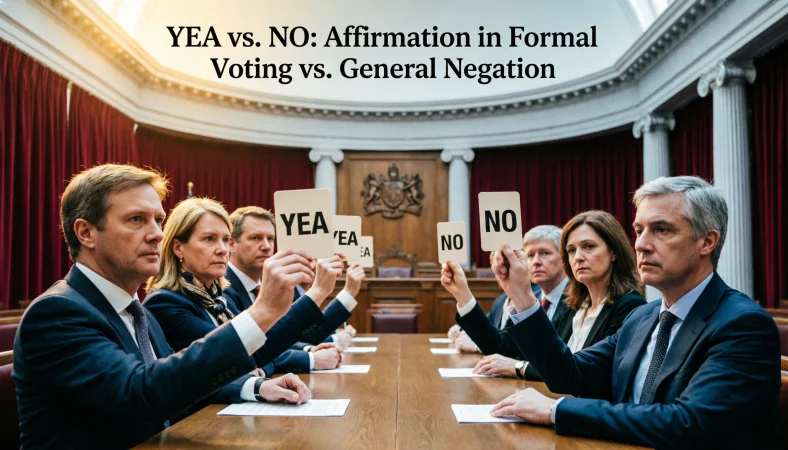
Yea or no asks for an affirmative or negative response, but the two words have different roles and contexts. Yea is a formal or traditional word meaning yes, especially when someone votes in favor of a proposal. No expresses refusal, disagreement, or a negative answer. In everyday conversation, yes is usually more natural than yea.
If you have encountered the phrase yea or no, you may wonder whether yea simply means yes and whether it can be used in the same situations. The answer is partly yes, but context matters. Yea is an established English word meaning an affirmative answer or vote, while no expresses a negative response.
The confusion usually comes from seeing yea in voting procedures, formal announcements, or phrases such as “yea or nay.” In ordinary conversation, however, people normally say yes or no, not yea or no. Choosing the wrong form can make a sentence sound unusually formal, old fashioned, or unnatural.
Yea vs No: What’s the Difference?
The words yea and no can both function as responses to a question or proposition, but they communicate opposite positions.
Yea is generally an adverb or noun associated with an affirmative response, agreement, or an affirmative vote. In formal voting language, a person may vote “yea” to indicate support for a proposal.
No is primarily an adverb, determiner, adjective, noun, or interjection depending on how it is used. As a response, it indicates refusal, disagreement, denial, or a negative answer.
| Word | Part of speech | Basic meaning | Typical use | Example |
| Yea | Adverb or noun | Yes or an affirmative vote | Formal voting and traditional language | “The motion passed with 42 yea votes.” |
| No | Adverb, noun, determiner, adjective, or interjection | Negative response or refusal | Everyday and formal communication | “No, I do not agree.” |
| Yes | Adverb, noun, or interjection | Affirmative response | Everyday communication | “Yes, I agree.” |
| Nay | Adverb or noun | No or negative vote | Formal or traditional voting | “The proposal received three nays.” |
The basic distinction is easy to remember.
Yea means an affirmative response or vote.
No means a negative response.
Yes is normally preferred over yea in ordinary conversation.
Yea is especially associated with formal voting language.
Nay is the traditional counterpart of yea in many voting contexts.
Is Yea vs No a Grammar, Vocabulary, or Usage Issue?
The difference between yea and no is primarily a vocabulary and usage issue.
There is nothing grammatically wrong with either word. The important question is whether the word fits the context.
If someone asks, “Are you coming to dinner?” the natural response is:
“Yes.”
A response such as:
“Yea.”
is understandable, but it sounds unusual in contemporary everyday English.
Now consider a formal vote:
“All those in favor, say yea.”
Here, yea is completely appropriate because the word belongs to the traditional vocabulary of voting.
This distinction is important for writers because English contains many words that are technically correct but contextually unusual. A word can be grammatically valid while still sounding unnatural in casual speech.
Formal versus informal usage
Yes is neutral and extremely common.
Yea is more formal, traditional, or specialized.
No is neutral and widely used.
Nay is formal or traditional and often appears alongside yea in voting contexts.
For example:
“Yes, I approve the plan.”
sounds natural in ordinary conversation.
By contrast:
“Yea, I approve the plan.”
may sound deliberately formal, humorous, historical, or affected depending on the situation.
Academic versus casual usage
Academic writing may use yea when discussing historical voting practices, parliamentary language, political procedures, or older English.
It would be unusual to use yea simply to make an ordinary academic sentence sound more sophisticated.
For example:
“Participants answered yes or no.”
is perfectly natural.
There is little reason to write:
“Participants answered yea or no.”
unless the wording is deliberately connected to a particular voting convention.
How to Use Yea Correctly
The word yea has a narrower modern role than yes.
Its most recognizable use is in voting. When a group votes on a motion, resolution, amendment, or proposal, members may be asked to vote yea or nay.
Workplace example
Imagine a company committee deciding whether to approve a new workplace policy.
The chairperson might say:
“Those in favor, vote yea. Those opposed, vote nay.”
That sounds formal but appropriate in a structured voting procedure.
In an ordinary workplace conversation, however, someone might simply ask:
“Do you agree with the proposal?”
The natural response would be:
“Yes.”
not:
“Yea.”
Academic example
A history professor discussing legislative procedures might write:
“The measure received a majority of yea votes.”
That usage is appropriate because the word describes a voting result.
A student answering a simple question would normally write:
“Yes, the evidence supports this conclusion.”
Using yea there would add unnecessary formality.
Technology example
Digital voting systems sometimes use terminology such as yea, nay, approve, and reject when modeling formal voting procedures.
A software interface could theoretically display:
Yea: Approve
Nay: Reject
This can make sense when the system is designed around parliamentary or organizational voting.
For a simple survey, however, Yes and No are usually clearer.
Usage recap
Use yea when you mean an affirmative vote or want a formal or traditional tone.
Do not automatically replace yes with yea.
In ordinary questions, yes is usually the natural choice.
How to Use No Correctly
No is much more versatile than yea.
It can answer a question, reject a proposal, deny a statement, or indicate absence.
Consider these examples:
“Are you available tomorrow?”
“No.”
Here, no directly provides a negative answer.
You can also use it in a sentence:
“No, I cannot attend the meeting.”
Or to reject an idea:
“No, that approach will not solve the problem.”
Unlike yea, no is completely ordinary in casual conversation.
Workplace example
A manager might ask:
“Can we complete this project by Friday?”
An employee could respond:
“No, we need more time.”
That sounds direct and natural.
Academic example
A researcher might report:
“The results did not support the original hypothesis.”
If the question is phrased as a yes or no question, the answer could be:
“No, the results did not support the hypothesis.”
Technology example
Forms, applications, databases, and digital surveys commonly use Yes and No as binary choices.
For example:
“Would you like to receive notifications?”
The available choices might be:
Yes
No
Using yea instead would generally be unnecessary unless the application is deliberately designed around formal voting terminology.
Usage recap
No is the standard negative response in contemporary English.
It works in casual, professional, academic, and technological contexts.
Unlike yea, it does not require a special voting context.
When You Should NOT Use Yea or No
Knowing when not to use a word is just as important as knowing when to use it.
1. Do not use yea as a universal replacement for yes
Although yea can mean yes, it does not sound natural in every situation.
“Yea, I would like some coffee.”
is understandable, but:
“Yes, I would like some coffee.”
is much more natural.
2. Do not use yea in casual conversation unless the tone is intentional
Using yea in ordinary speech can make you sound formal, theatrical, old fashioned, or humorous.
3. Do not confuse yea with yeah
Yea and yeah are different words.
Yeah is an informal form of yes.
Yea traditionally refers to an affirmative response or vote.
So:
“Yeah, I agree.”
is casual.
“Yea, the motion passed.”
has a more formal or voting related flavor.
4. Do not use no when you mean agreement
This may seem obvious, but complicated questions can make negative responses confusing.
For example:
“You do not disagree with the proposal, do you?”
A simple “no” can be ambiguous because the question itself is negative.
A clearer response might be:
“Correct, I agree with the proposal.”
5. Do not use yea in ordinary binary forms without a reason
If a website asks users to select an option, Yes and No are usually clearer.
6. Do not assume yea and nay are required in every vote
Organizations may use different voting systems and terminology. Some simply use yes and no.
7. Do not confuse yea with a general expression of enthusiasm
Yea does not normally function like modern slang expressions such as “awesome,” “sure,” or “yeah.”
8. Do not use archaic wording simply to sound authoritative
Formal language is useful when it improves precision. Unnecessarily old fashioned language can make otherwise clear writing harder to understand.
Common Mistakes and Decision Rules
| Correct sentence | Incorrect sentence | Explanation |
| “Yes, I agree.” | “Yea, I agree.” | Yea is possible but unusually formal in ordinary conversation. |
| “The committee voted yea.” | “The committee voted yes” | Both can work, but yea fits traditional voting terminology better. |
| “No, I disagree.” | “Nay, I disagree.” | Nay sounds formal or traditional in modern conversation. |
| “The motion received 20 yea votes.” | “The motion received 20 yes votes.” | Yes is understandable, but yea is conventional in formal vote descriptions. |
| “Would you like to come? Yes.” | “Would you like to come? Yea.” | Yes is the natural everyday response. |
| “The proposal received five nays.” | “The proposal received five nos.” | Nay is traditionally paired with yea in formal voting language. |
Decision Rule: If you are giving an ordinary affirmative answer, use yes. If you are describing or casting a formal affirmative vote, yea may be appropriate. If you are giving a negative answer, use no in ordinary communication and nay when traditional voting terminology is appropriate.
Yea and No in Modern Technology and AI Tools
Modern technology generally favors simple, recognizable language.
Digital interfaces are designed for rapid comprehension, which is why Yes and No remain common labels for binary choices.
Consider a confirmation window:
“Are you sure you want to delete this file?”
The natural buttons are:
Yes
No
Replacing them with:
Yea
Nay
would make the interface feel unusual unless it intentionally uses formal or historical language.
AI systems face a similar challenge. When a user asks whether something is “yea or no,” an effective answer should recognize that yea means an affirmative response but explain that yes or no is the normal modern phrase for everyday questions.
AI writing tools should also distinguish between yea, yeah, yes, and nay because spelling alone can change tone and meaning.
This is particularly useful for content creators who want their writing to sound natural. A technically valid word is not always the best word for a particular audience.
The Etymology and History of Yea
Yea is an old English word with roots in Germanic language history. It has been used for centuries to express affirmation or agreement.
Its long history explains why it appears frequently in older texts, religious writing, legal language, political proceedings, and traditional voting terminology.
The word also appears in the well known expression:
“Yea and nay”
meaning affirmative and negative responses.
Over time, everyday English increasingly favored yes as the ordinary affirmative response. Yea survived more strongly in specialized and formal contexts.
This history explains an important modern distinction. Yea is not an incorrect spelling of yes. It is a legitimate English word with its own history and usage pattern.
An expert style explanation
Yea is best understood as a formal or traditional affirmative, while yes is the ordinary modern affirmative response.
That distinction captures the practical difference without suggesting that either word is grammatically defective.
Why Yea and Yes Are Often Confused
The confusion exists because the meanings overlap.
- Both words can communicate agreement.
- Both can answer a question affirmatively.
- Both can appear in contexts involving approval.
The difference is primarily one of usage, register, and context.
Imagine someone asking:
“Did you finish the report?”
The natural answer is:
“Yes.”
Now imagine a parliamentary style vote:
“All those in favor of the amendment, say yea.”
Here, yea sounds appropriate because the context is formal voting.
The meaning overlaps, but the language situation is different.
This is similar to many English words that share a broad meaning but differ in tone or typical context. Knowing the difference helps writers avoid sentences that are technically understandable but stylistically awkward.
Yea, Yeah, Yes, Nay, and No Compared
These five words deserve special attention because they are easy to confuse.
| Word | Main meaning | Tone | Common context |
| Yea | Affirmative or affirmative vote | Formal or traditional | Voting and historical language |
| Yeah | Informal yes | Casual | Conversation and texting |
| Yes | Affirmative response | Neutral | Almost any context |
| Nay | Negative or negative vote | Formal or traditional | Voting and historical language |
| No | Negative response | Neutral | Almost any context |
The easiest distinction is:
Yes is the normal affirmative.
Yeah is the casual affirmative.
Yea is the formal or traditional affirmative, especially in voting.
No is the normal negative.
Nay is the formal or traditional negative, especially in voting.
Once these five words are separated by context, most usage problems disappear.
Error Prevention Checklist
Always use yes when
- You are answering an ordinary question.
- You are writing conversational English.
- You are creating a simple survey.
- You are responding to someone in a workplace conversation.
- You want a neutral affirmative response.
Always use no when
- You are giving an ordinary negative answer.
- You are refusing a request.
- You are disagreeing with a statement.
- You are creating a simple binary choice.
- You want clear modern English.
Use yea when
- You are discussing a formal vote.
- You are describing an affirmative voting result.
- You are intentionally using traditional language.
- You are writing historical or parliamentary material.
Avoid yea when
- You simply mean modern conversational yes.
- You are writing for a general audience and want maximum naturalness.
- You are creating a straightforward question and answer format.
- You want informal conversational English.
Related Grammar Confusions You Should Master
Understanding yea or no can lead naturally to several other commonly confused words and expressions.
- Yes vs yeah
- Yea vs yay
- Yea vs yeah
- Yea vs nay
- No vs nope
- Nay vs no
- Accept vs except
- Agree vs approve
- Maybe vs may be
- Everyday vs every day
These pairs demonstrate an important principle of English usage: words that appear similar can have very different meanings, tones, or grammatical functions.
FAQs
Is yea the same as yes?
Yea can mean yes, particularly as an affirmative response or vote. However, yes is the normal word for everyday affirmative answers. Yea is more formal, traditional, or associated with voting language.
Should I say yea or yes?
In ordinary conversation, say yes. Use yea when referring to a formal vote or when you deliberately want a traditional or formal tone.
Is yea or no correct English?
Yes. The phrase can be understood as asking for an affirmative or negative response. However, yes or no is much more natural in contemporary everyday English.
What does yea mean in voting?
In voting, yea means an affirmative vote in favor of a proposal, motion, or measure. It is traditionally paired with nay, which indicates a negative vote.
Is yea the opposite of no?
In a broad sense, yes. Yea expresses affirmation, while no expresses negation. However, in traditional voting terminology, the more direct pair is yea and nay.
Is yea the same as yeah?
No. Yea is a formal or traditional affirmative associated especially with voting. Yeah is an informal form of yes used frequently in casual speech and writing.
Is yea the same as yay?
No. Yea means yes or an affirmative vote. Yay is an informal exclamation expressing happiness, excitement, or approval.
For example:
“Yea, I approve the motion.”
and:
“Yay, we won!”
have different meanings and uses.
Can I use yea in a text message?
You can, but it may sound unusual. If you mean casual yes, yeah is generally more natural. If you mean a neutral affirmative, yes is the clearest choice.
Why do people say yea or nay instead of yes or no?
The expression comes from traditional voting language. Yea represents an affirmative vote, while nay represents a negative vote. The pair has a formal and historical flavor that remains familiar today.
Is yea formal or informal?
Yea is generally formal, traditional, or specialized. It is much less common than yes in everyday contemporary English.
Conclusion:
The difference between yea or no is mainly a matter of meaning, context, and register. Yea is a legitimate English word meaning an affirmative response or vote, but it is most strongly associated with formal, traditional, or voting language. No is the ordinary modern word for a negative response.
For everyday communication, the most natural pair is yes or no. For formal voting, yea and nay may be appropriate. Remembering that distinction will help you choose words that are not only grammatically correct but also natural for the situation.
If you are answering an ordinary question, choose yes or no. If you are discussing a formal vote, yea and nay may be the better terminology. That small difference in context is what makes the usage clear and precise.
Author expertise: Written from a professional linguistics and SEO content perspective, with emphasis on modern English usage, vocabulary distinctions, register, and search intent.










1 thought on “Yea or No: Understanding The Difference And Choosing the Right Word For 2026”