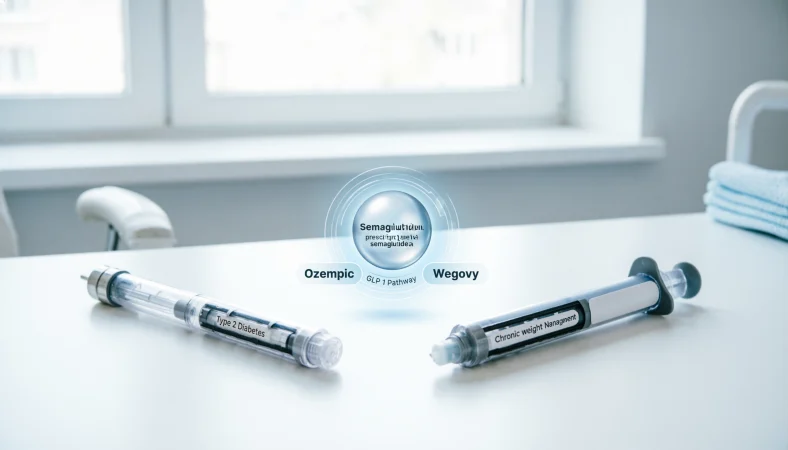
Ozempic and Wegovy both contain semaglutide, a GLP 1 receptor agonist, but they are approved for different primary purposes. Ozempic is primarily approved for managing type 2 diabetes and reducing certain cardiovascular risks in adults with diabetes, while Wegovy is approved for chronic weight management in eligible people and for certain cardiovascular risk reduction. (U.S. Food and Drug Administration)
When people search for Ozempic or Wegovy, they are usually trying to understand whether these medications are interchangeable, which one is intended for weight loss, and why doctors prescribe one rather than the other. The confusion is understandable because both medicines contain the same active ingredient, semaglutide, and both are given as injections. However, they are separate branded products with different FDA approved indications, dosing options, and prescribing contexts. (U.S. Food and Drug Administration)
That distinction matters. Choosing between the two is not simply a matter of picking the medication that appears to produce the most weight loss. The appropriate medicine depends on the condition being treated, the patient’s medical history, eligibility, other medications, risks, and the specific product approved for that purpose.
Ozempic or Wegovy: What’s the Difference?
The biggest difference is what each product is specifically approved to treat. Both Ozempic and Wegovy contain semaglutide and belong to the GLP 1 receptor agonist class. However, the FDA approved Ozempic for improving blood glucose control in adults with type 2 diabetes and for reducing certain cardiovascular risks in adults with type 2 diabetes and established cardiovascular disease. Ozempic also has an FDA indication related to reducing certain kidney and cardiovascular risks in adults with type 2 diabetes and chronic kidney disease. (U.S. Food and Drug Administration)
Wegovy is approved, alongside a reduced calorie diet and increased physical activity, for chronic weight management in adults with obesity, adults with higher weight plus at least one weight related condition, and pediatric patients aged 12 and older with obesity. Wegovy also has an indication for reducing major cardiovascular events in certain adults with established cardiovascular disease and higher weight or obesity. (U.S. Food and Drug Administration)
| Feature | Ozempic | Wegovy |
| Active ingredient | Semaglutide | Semaglutide |
| Drug class | GLP 1 receptor agonist | GLP 1 receptor agonist |
| Primary FDA use | Type 2 diabetes management | Chronic weight management |
| Cardiovascular indication | Certain adults with type 2 diabetes and established cardiovascular disease | Certain adults with cardiovascular disease and higher weight or obesity |
| Kidney related indication | Certain adults with type 2 diabetes and chronic kidney disease | Not the same indication |
| Weight management indication | Not its primary FDA indication | Yes |
| Pediatric obesity indication | Not the same indication | Yes, for eligible patients aged 12 and older |
| Administration | Injection | Injection |
| Prescription | Yes | Yes |
The important point is that same active ingredient does not mean identical product.
Ozempic and Wegovy are different branded formulations with different approved uses.
Wegovy is specifically approved for chronic weight management in eligible patients.
Ozempic is primarily associated with type 2 diabetes treatment and certain cardiovascular and kidney benefits.
Is Ozempic or Wegovy a Medical, Vocabulary, or Usage Issue?
Unlike a spelling comparison, this is not simply a vocabulary question. It is a medical distinction between two prescription products that share the same active ingredient.
People sometimes use the names casually as though they mean the same thing because both medicines contain semaglutide. That can create confusion when discussing prescriptions, treatment goals, or insurance coverage.
Are they interchangeable?
They should not be treated as automatically interchangeable.
The FDA prescribing information for Wegovy specifically states that coadministration with other semaglutide containing products or another GLP 1 receptor agonist is not recommended. (FDA Access Data)
That means someone should not independently decide to combine, switch, or duplicate semaglutide products simply because both contain the same active ingredient.
A clinician determines whether a particular product is appropriate based on the patient’s diagnosis, treatment goal, medical history, and other relevant factors.
Formal versus casual usage
In everyday conversation, someone might say:
“I’m taking Ozempic for weight loss.”
That statement may reflect how people discuss semaglutide in popular culture, but it does not necessarily describe the product’s FDA approved indication.
A more precise description would distinguish the product from the active ingredient and its approved purpose.
Academic and professional usage
Medical and academic writing should be especially precise.
Instead of treating Ozempic and Wegovy as synonyms, professional writing should identify them as separate semaglutide products and explain their relevant indications.
That distinction becomes important when discussing clinical research, prescribing information, adverse reactions, or regulatory approvals.
How Ozempic Is Used
Ozempic contains semaglutide and is FDA approved as an adjunct to diet and exercise for improving glycemic control in adults with type 2 diabetes. It is also approved to reduce the risk of major cardiovascular events in adults with type 2 diabetes and established cardiovascular disease. FDA materials also identify an indication involving sustained kidney function decline, end stage kidney disease, and cardiovascular death in certain adults with type 2 diabetes and chronic kidney disease. (U.S. Food and Drug Administration)
Workplace example
Consider an employee with type 2 diabetes who works with a healthcare professional to improve blood glucose management.
A clinician might prescribe Ozempic as part of an overall diabetes treatment plan.
The relevant goal in this context is diabetes management, not simply cosmetic weight reduction.
Academic example
A medical article might discuss Ozempic when examining treatments for type 2 diabetes.
For example:
Ozempic is a semaglutide injection approved for improving glycemic control in adults with type 2 diabetes.
This wording is more precise than simply calling Ozempic a weight loss drug.
Technology example
Digital healthcare systems may display medication information, appointment records, prescription details, or diabetes monitoring data associated with Ozempic.
However, a digital platform does not change the medicine’s approved indication. Technology can make medication information easier to access, but treatment decisions still require appropriate clinical oversight.
Usage recap
Ozempic contains semaglutide.
Its primary FDA approved role is type 2 diabetes management.
It also has specific cardiovascular and kidney related indications.
Its use should be based on a clinician’s assessment rather than its popularity as a weight loss medication.
How Wegovy Is Used
Wegovy also contains semaglutide, but its FDA approved uses place greater emphasis on chronic weight management.
The FDA indicates that Wegovy is used alongside a reduced calorie diet and increased physical activity to reduce excess body weight and maintain weight reduction over the long term in eligible adults and in pediatric patients aged 12 and older with obesity. It is also approved for certain adults with higher weight and at least one weight related condition. (U.S. Food and Drug Administration)
Workplace example
An eligible employee with obesity might discuss long term weight management with a healthcare professional.
If Wegovy is considered appropriate, the treatment would form part of a broader management plan rather than functioning as a standalone substitute for healthy eating or physical activity.
Academic example
A health sciences paper might describe Wegovy as a semaglutide product approved for chronic weight management in specific populations.
This distinction helps readers understand why the medication has a different regulatory role from Ozempic even though both contain semaglutide.
Technology example
A healthcare application may help eligible patients track appointments, medication schedules, body weight, or treatment progress.
Such technology can support treatment management, but it does not determine whether Wegovy is appropriate for a particular individual.
Usage recap
Wegovy contains the same active ingredient as Ozempic.
Its FDA approved indications include chronic weight management for eligible patients.
It also has a cardiovascular risk reduction indication for certain adults.
It should be used under appropriate medical supervision.
When You Should NOT Use Ozempic or Wegovy
There are several important misconceptions to avoid when discussing these medications.
1. Do not assume they are identical
They contain the same active ingredient, but they are different branded products with different approved indications.
2. Do not switch between them without medical guidance
A person should not independently change prescription products or dosing schedules.
3. Do not combine semaglutide products
The Wegovy prescribing information states that coadministration with other semaglutide containing products or other GLP 1 receptor agonists is not recommended. (FDA Access Data)
4. Do not describe Ozempic simply as a weight loss drug
Ozempic is FDA approved primarily for type 2 diabetes management and specific cardiovascular and kidney related benefits.
5. Do not assume Wegovy is suitable for everyone who wants to lose weight
FDA approved indications apply to specific patient populations and treatment circumstances.
6. Do not ignore contraindications
Wegovy carries a boxed warning concerning thyroid C cell tumors and should not be used by people with a personal or family history of medullary thyroid carcinoma or people with multiple endocrine neoplasia syndrome type 2. (U.S. Food and Drug Administration)
7. Do not treat online anecdotes as medical evidence
Individual experiences can differ substantially from clinical trial results and approved prescribing information.
8. Do not buy or use unapproved versions from questionable sources
The FDA has repeatedly warned about products marketed as semaglutide without appropriate approved drug applications.
Common Mistakes and Decision Rules
| Correct statement | Incorrect statement | Explanation |
| Wegovy is approved for chronic weight management in eligible patients. | Wegovy is simply a stronger version of Ozempic. | The products have different approved indications and should not be reduced to a simple strength comparison. |
| Ozempic is approved for type 2 diabetes management. | Ozempic is officially a weight loss medication. | Weight reduction can occur with semaglutide, but Ozempic’s FDA approved primary role is diabetes management. |
| Both products contain semaglutide. | Ozempic and Wegovy are completely different drugs. | They contain the same active ingredient but are separate branded products. |
| A clinician can determine whether a particular product is appropriate. | Patients should choose whichever product loses more weight. | Treatment selection depends on individual medical circumstances. |
| Wegovy has specific cardiovascular indications. | All semaglutide products have identical indications. | Regulatory indications differ between products. |
Decision Rule
If the treatment goal involves an FDA approved indication for type 2 diabetes, Ozempic may be the relevant branded product.
If the treatment goal involves chronic weight management in an eligible patient, Wegovy specifically targets that purpose.
This is a general explanation, not a personal prescribing recommendation.
Ozempic and Wegovy in Modern Technology and AI Tools
Modern healthcare technology has made medication information much easier to search, compare, and discuss.
People can now encounter Ozempic and Wegovy through telehealth platforms, electronic health records, medication tracking applications, online pharmacies, social media, and AI powered health tools.
That convenience creates a new challenge: information can be easy to access without necessarily being easy to interpret.
An AI tool might correctly explain that both products contain semaglutide, but users still need to distinguish active ingredient, brand name, approved indication, dosage, contraindications, and individual suitability.
This is particularly important because regulatory information changes over time. For example, the FDA approved a higher dose version of Wegovy, called Wegovy HD, in March 2026 for certain adult patients for weight loss and long term maintenance. (U.S. Food and Drug Administration)
Therefore, current prescribing information should take priority over older online comparisons.
Etymology and the Science Behind the Names
The names Ozempic and Wegovy are brand names rather than ordinary English words describing two different classes of medicine.
Their shared scientific identity is semaglutide.
Semaglutide belongs to the GLP 1 receptor agonist class. GLP 1 is a hormone involved in appetite regulation, glucose metabolism, and other physiological processes.
Semaglutide medicines act on the GLP 1 receptor, which helps explain why they can influence blood glucose levels and appetite.
However, the scientific mechanism does not erase the distinction between branded products.
A useful professional principle is:
Same active ingredient does not automatically mean same approved use.
That distinction is essential when explaining Ozempic and Wegovy accurately.
Two Important Case Studies
Case Study One: Diabetes management
Ozempic was approved by the FDA in December 2017. Its regulatory role includes improving glycemic control in adults with type 2 diabetes, alongside diet and exercise. It also has cardiovascular and kidney related indications for specific populations. (U.S. Food and Drug Administration)
This illustrates why describing Ozempic solely as a weight loss treatment misses an important part of its approved medical role.
Case Study Two: Chronic weight management
Wegovy was approved by the FDA in June 2021 for chronic weight management. Its approved use includes eligible adults with obesity, certain adults with higher weight and a weight related condition, and pediatric patients aged 12 and older with obesity. (U.S. Food and Drug Administration)
The FDA later expanded Wegovy’s cardiovascular role. In March 2024, the agency approved an indication to reduce cardiovascular death, heart attack, and stroke in certain adults with established cardiovascular disease and higher weight or obesity. (U.S. Food and Drug Administration)
These regulatory milestones show why you cannot reduce the distinction between Ozempic and Wegovy to internet discussions about which one is “better.”
Author expertise
This article approaches medication terminology from an evidence based health information and medical writing perspective, with emphasis on accurate product distinctions, regulatory indications, and clear consumer education.
Error Prevention Checklist
Always remember
Both products contain semaglutide.
Ozempic is primarily associated with type 2 diabetes treatment.
Wegovy is specifically approved for chronic weight management in eligible patients.
Both are prescription medicines.
Treatment decisions depend on individual circumstances.
Current prescribing information matters because approved indications can change.
Never assume
That the two products can be used interchangeably.
That a medication is appropriate simply because someone else used it successfully.
That online testimonials replace professional medical advice.
That higher dosing automatically means better results.
That weight loss is the only relevant outcome.
That the same active ingredient means identical regulatory indications.
Related Medical Terms You Should Understand
Understanding these related concepts can make comparisons between semaglutide products much easier.
1. Semaglutide
The active ingredient found in Ozempic and Wegovy.
2. GLP 1 receptor agonist
A medication class that acts on receptors associated with the GLP 1 pathway.
3. Type 2 diabetes
A metabolic condition involving elevated blood glucose and impaired insulin action.
4. Chronic weight management
Long term management of body weight rather than a short term dieting approach.
5. Obesity
A chronic health condition associated with excess body fat and increased risk of various health problems.
6. Cardiovascular risk
The likelihood of experiencing events involving the heart and blood vessels.
7. Glycemic control
Management of blood glucose levels within an appropriate target range.
8. Active ingredient
The substance in a medicine responsible for its pharmacological effects.
9. Prescription medication
A medicine that requires authorization from an appropriately licensed healthcare professional.
10. Adverse reaction
An unwanted or harmful response associated with a medicine.
FAQs
Is Ozempic or Wegovy better for weight loss?
Wegovy is the semaglutide product specifically FDA approved for chronic weight management in eligible patients. That does not mean it is automatically appropriate for every person seeking weight loss. A healthcare professional should determine which treatment, if any, is suitable.
Is Ozempic the same as Wegovy?
They are not identical products, although both contain semaglutide. They have different FDA approved indications and should not simply be treated as interchangeable medicines. (U.S. Food and Drug Administration)
Do Ozempic and Wegovy have the same active ingredient?
Yes. Both contain semaglutide. Their different brand names and approved indications distinguish the products.
Is Wegovy for diabetes?
Wegovy primarily supports chronic weight management in eligible populations and also carries specific indications for reducing cardiovascular risk. Ozempic has the FDA approved indication for improving glycemic control in adults with type 2 diabetes. (U.S. Food and Drug Administration)
Is Ozempic approved for weight loss?
Ozempic is not the semaglutide product whose primary FDA indication is chronic weight management. Wegovy is specifically approved for that purpose in eligible patients.
Can you take Ozempic and Wegovy together?
The Wegovy prescribing information does not recommend using Wegovy together with other semaglutide containing products or other GLP 1 receptor agonists.Patients should not combine these medicines unless specifically directed by an appropriate healthcare professional. (FDA Access Data)
What is the main difference between Ozempic and Wegovy?
The central difference is their approved use. Ozempic treats type 2 diabetes and has specific cardiovascular and kidney indications, while Wegovy supports chronic weight management in eligible patients and has specific cardiovascular indications.(U.S. Food and Drug Administration)
Does Wegovy have the same side effects as Ozempic?
Because both contain semaglutide, they can have overlapping adverse effects. Wegovy’s FDA prescribing information lists gastrointestinal effects such as nausea, diarrhea, vomiting, constipation, and abdominal pain among commonly reported reactions. (U.S. Food and Drug Administration)
Is semaglutide the same thing as Ozempic?
No. Semaglutide is the active ingredient. Ozempic is a brand name for a semaglutide product. Wegovy is another branded semaglutide product.
Which one should I take?
A qualified healthcare professional should make that decision after considering your diagnosis, medical history, other medicines, treatment goals, contraindications, and current prescribing information.
Conclusion:
When comparing Ozempic or Wegovy, the most important point is that both contain semaglutide but serve different approved purposes.
Ozempic primarily treats type 2 diabetes and also carries specific cardiovascular and kidney related indications. Wegovy specifically treats chronic weight management in eligible patients and also helps reduce cardiovascular risk in certain adults with higher weight or obesity.(U.S. Food and Drug Administration)
Neither product is appropriate simply because it is more popular online or because someone else experienced a particular result. The right medication depends on the individual’s health circumstances and the reason for prescribing it.
Because these are prescription medicines with important warnings and contraindications, current professional prescribing information and advice from a qualified healthcare professional should guide treatment decisions.