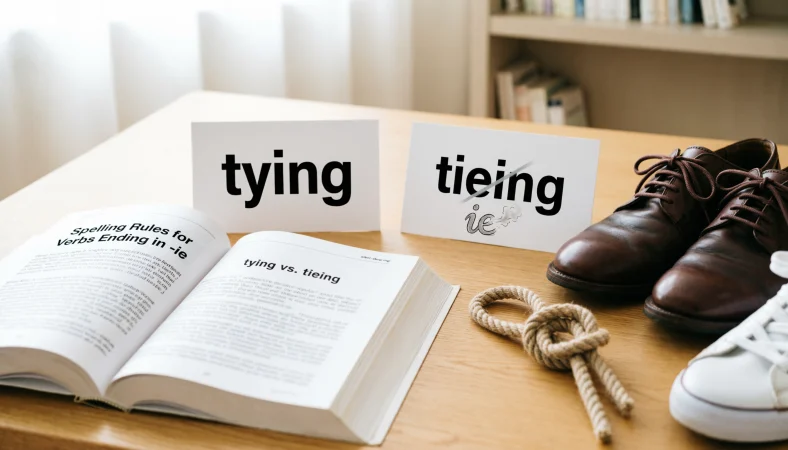
The correct spelling is tying, not tieing, when you add the suffix “ing” to the verb tie. This follows the standard English spelling rule for verbs ending in a silent “e”: the final “e” is usually removed before adding “ing.” Understanding this rule makes it easier to avoid a common spelling mistake.
The question tying or tieing causes confusion because tie does not look like verbs such as play or work when its spelling changes in the present participle. The word tying means fastening, connecting, or forming a tie, while tieing is generally considered an incorrect spelling in standard modern English. The confusion often appears in writing because the pronunciation gives no obvious clue about which letters should be used.
Whether you’re writing an email, school assignment, business document, product description, or social media post, choosing the correct form matters. A single extra letter can make otherwise polished writing look careless. The good news is that the spelling rule behind tying is straightforward once you understand what happens to the final silent e.
Tying or Tieing: What’s the Difference?
The difference is simple: tying is the standard correct spelling, while tieing is normally treated as a misspelling.
The word tying is the present participle and gerund form of the verb tie. It can describe the physical act of fastening something with a knot, connecting two things, or creating a figurative connection.
For example:
She is tying her shoelaces.
Here, tying describes an action happening now.
The spelling tieing is usually not accepted in standard contemporary English. Although it might seem logical to keep the e from tie and simply add ing, English spelling rules generally remove a final silent e before the suffix ing is added.
| Word | Part of speech | Standard spelling | Meaning | Example |
| tying | Verb form and gerund | Correct | Fastening or connecting something | He is tying the rope. |
| tieing | Verb form | Generally incorrect | Intended to mean the same thing as tying | Avoid this spelling in standard writing. |
| tie | Verb | Correct | To fasten or connect | Tie the package securely. |
| tied | Past tense and past participle | Correct | Fastened or connected | She tied the ribbon. |
The important point is that tie becomes tying, not tieing.
The change may initially seem unusual, but it follows a broader spelling pattern in English. The final silent e disappears before ing, allowing the suffix to attach to the appropriate base form.
Quick recap
Tying is the standard spelling.
Tieing is generally considered incorrect in modern standard English.
Tying can mean fastening, connecting, or linking something.
The spelling follows the rule that usually removes a final silent e before ing.
Is Tying or Tieing a Grammar, Vocabulary, or Usage Issue?
This is primarily a spelling issue, rather than a grammar or vocabulary issue.
Both forms are intended to represent the same verb, tie, but only one is normally accepted in standard written English. Grammar determines how the word functions within a sentence, while spelling determines how the word is written.
For instance:
I am tying the ribbon.
The grammar is correct because am is followed by the present participle tying.
The problem with tieing is not the sentence structure. The problem is the spelling of the verb form.
This distinction is useful because writers sometimes assume that an unfamiliar spelling represents a different grammatical form. In this case, it doesn’t. The intended verb remains tie.
Is tying interchangeable with tieing?
No. In standard modern English, you should use tying.
The spelling tieing may occasionally appear in informal writing, historical texts, user generated content, or material containing errors. Its appearance does not make it the preferred spelling.
Formal and informal usage
In formal writing, use tying without hesitation.
This applies to:
- Business communication
- Academic writing
- Professional reports
- Educational materials
- Published articles
- Formal correspondence
Informal communication follows the same spelling preference. Even in a text message or casual post, tying is the normal form.
Academic and casual usage
Academic writing should always use tying because spelling accuracy contributes to credibility. Casual writing also benefits from the standard form because there is no practical reason to use tieing.
The distinction is therefore not really about register. Unlike some spelling differences between British and American English, tying is not simply a regional alternative to tieing.
How to Use Tying Correctly
The word tying has several common uses, and understanding them helps reinforce the spelling.
Physical fastening
The most familiar meaning involves fastening something with a knot, string, rope, cord, ribbon, or similar material.
Maria is tying her shoes.
He is tying the package with a piece of string.
They were tying the boat to the dock.
In each example, tying describes an action in progress.
Connecting things
Tying can also describe connecting one thing to another.
The engineer is tying the new system to the existing database.
Here, the word does not necessarily describe a physical knot. Instead, it describes establishing a connection.
Creating a relationship
The word can also have a figurative meaning.
The agreement is tying the two companies together.
The companies are not literally being tied with a rope. The expression describes a relationship or connection.
Linking ideas
Tying is also common when discussing reasoning or communication.
The researcher is tying the findings to earlier studies.
This means the researcher is connecting the findings with previous research.
Usage recap
Use tying when describing fastening, connecting, linking, or creating a relationship.
The word works in both literal and figurative contexts.
Its spelling remains the same regardless of meaning.
How Tie Is Formed in Different Verb Tenses
Understanding the other forms of tie makes the spelling of tying easier to remember.
The basic verb is tie.
- Its past tense is tied.
- Its past participle is also tied.
- Its present participle is tying.
| Verb form | Example |
| Base form | Please tie the rope. |
| Third person singular | She ties her shoes quickly. |
| Past tense | He tied the package. |
| Past participle | The ribbon was tied securely. |
| Present participle | She is tying the ribbon. |
Notice that English makes several different spelling changes here.
The base form tie becomes ties when used with a third person singular subject.
It becomes tied in the past tense.
It becomes tying when ing is added.
These changes are not random. They reflect established English spelling patterns.
Tying in Workplace Writing
Professional writing often contains words describing actions that happen during a project, process, or task. Tying is perfectly natural in these situations.
Consider:
We are tying the new reporting system to the existing database.
This sentence uses tying metaphorically to describe a technical connection.
Another example is:
The team is tying the final recommendations to the research findings.
Here, the word describes a logical relationship.
A professional writer might also say:
The manager is tying the performance goals to measurable outcomes.
The meaning is figurative, but the spelling remains tying.
Using tieing in a professional document could distract readers and create an unnecessary impression of poor proofreading.
Academic example
Academic writing frequently uses tying in discussions about relationships between ideas.
The author is tying the historical evidence to the broader argument.
This construction is useful when explaining how evidence supports an interpretation.
Technology example
Technology writing commonly uses tying to describe systems and processes.
The software is tying customer records to individual accounts.
Again, no physical knot is involved. The word means connecting or associating.
Usage recap
In workplace, academic, and technology writing, tying can describe both literal and figurative connections.
When You Should NOT Use Tieing
There are several situations where writers may be tempted to use tieing. In standard English, these are situations where tying should be used instead.
1. When describing fastening
Write:
She is tying her shoes.
Not:
She is tieing her shoes.
2. When describing a knot
Write:
He is tying a knot.
The spelling does not retain the final e.
3. When describing a connection
Write:
The system is tying the records together.
Do not write tieing simply because the base word is tie.
4. When describing a relationship
Write:
The contract is tying the organizations together.
5. In academic assignments
A student should use tying in essays, reports, and research papers.
6. In business documents
Professional documents should use the established standard spelling.
7. In published content
Articles, websites, manuals, and educational materials should use tying.
8. When adding the suffix ing
Whenever the verb is tie and you need its present participle or gerund form, the standard spelling is tying.
Common Mistakes and Decision Rules
| Correct sentence | Incorrect sentence | Explanation |
| She is tying her shoes. | She is tieing her shoes. | Remove the final silent e before adding ing. |
| He is tying the rope. | He is tieing the rope. | Tying is the standard present participle. |
| They are tying the two systems together. | They are tieing the two systems together. | The same spelling applies to figurative connections. |
| I am tying the ribbon. | I am tieing the ribbon. | The final e is removed. |
| She spent time tying the knot. | She spent time tieing the knot. | The gerund form is tying. |
Decision Rule Box
If the verb is tie and you are adding ing, use tying.
Do not preserve the final e.
A useful way to remember this is:
tie + ing = tying
Not:
tie + ing = tieing
The spelling changes because the final e in tie is silent.
Why Does Tie Become Tying?
English spelling rules often remove a final silent e before a suffix beginning with a vowel is added.
For example:
make becomes making
write becomes writing
hope becomes hoping
use becomes using
The same general pattern applies to tie.
However, tie looks slightly different because removing the final e produces ti before ing. The result is tying, not tiing. The spelling changes to preserve the familiar sound and established written form.
This is one reason learners sometimes hesitate over the word. The transformation is less visually obvious than make becoming making.
The pronunciation also contributes to the confusion because both imagined spellings might seem plausible if someone thinks only about the sound.
English spelling, however, does not always work by simply adding letters according to pronunciation. Established spelling conventions matter.
Tying or Tieing in Modern Technology and AI Tools
Modern writing environments can make spelling decisions easier, but they do not eliminate the need to understand the underlying rule.
Word processors and browser based writing tools commonly recognize tying as the standard spelling. Automated systems may flag tieing as an error, although spelling tools are not perfect and should not replace human judgment.
AI writing systems also encounter this distinction. When asked to generate standard English, an effective language system should select tying.
This matters in digital publishing because incorrect spelling can spread quickly. A misspelled word copied into several articles, product descriptions, captions, or automated responses can become repeated across large amounts of content.
Human review remains useful, especially when content needs to meet professional or editorial standards.
The important lesson is that technology can help identify a spelling error, but understanding the rule gives writers the ability to recognize and correct the problem themselves.
The Etymology and History Behind Tie
The verb tie has a long history in English and is related to older Germanic words associated with fastening or binding.
Its historical development helps explain why the modern word has an unusual relationship between spelling and pronunciation. English spelling has evolved through centuries of linguistic change, borrowing, regional variation, and standardization.
The modern spelling tie became established while the verb continued to carry meanings associated with fastening, binding, and connecting.
The form tying developed according to English spelling conventions rather than through a simple visual addition of ing.
This illustrates a broader point about English vocabulary: a word’s modern spelling often reflects historical development as well as grammatical rules.
An expert style perspective
A useful editorial principle is:
Standard spelling should be judged by established usage and grammatical formation, not by which version looks most intuitive.
That principle explains why tieing may appear logical but still remain outside standard modern usage.
Two Practical Case Studies
Case study one: Academic writing
Imagine a student writing:
The author is tieing the historical evidence to the central argument.
The meaning is clear, but the spelling error weakens the sentence. Correcting it produces:
The author is tying the historical evidence to the central argument.
The correction changes only one letter, yet the second sentence conforms to standard written English.
For academic work, this small distinction matters because repeated spelling mistakes can distract readers from otherwise strong arguments.
Case study two: Workplace communication
Consider a project update:
We are tieing the customer database to the new reporting platform.
A polished version reads:
We are tying the customer database to the new reporting platform.
The meaning remains unchanged, but the standard spelling makes the sentence suitable for professional communication.
These examples show that the issue is not about meaning. It is about using the accepted spelling of the verb form.
Error Prevention Checklist
Always use tying when:
- You mean fastening something.
- You mean creating a knot.
- You mean connecting two things.
- You mean creating a figurative relationship.
- You are adding ing to the verb tie.
- You are writing formal or academic English.
- You are preparing professional content.
- You are publishing edited material.
Never use tieing when:
- You mean the standard present participle of tie.
- You are writing an academic assignment.
- You are preparing a professional report.
- You are editing published content.
- You are writing instructional material.
- You want standard contemporary English.
The simplest correction is always to replace tieing with tying.
Related Grammar Confusions You Should Master
Learning one spelling rule often makes other English spelling questions easier. If you frequently confuse verb forms, these related topics are worth studying:
- lying or lieing and why lying drops the final e.
- dying or dieing and the standard spelling of die with ing.
- making or makeing and the silent e rule.
- writing or writeing and why the final e disappears.
- coming or comeing and the standard formation of the present participle.
- using or useing and the spelling change before ing.
- aging or ageing and the difference between American and British spelling.
- traveling or travelling and regional spelling conventions.
- canceling or cancelling and doubled consonant patterns.
- beginning or begining and consonant doubling before ing.
These examples show that English spelling depends on patterns rather than simply attaching suffixes to unchanged words.
FAQs
Is tying or tieing correct?
Tying is the standard correct spelling in modern English. Tieing is generally considered a misspelling and should be avoided in formal, academic, professional, and edited writing.
Why is tying spelled without the e?
The final e in tie is removed when the ing suffix is added. The resulting standard spelling is tying. English uses this type of spelling change with many verbs ending in a silent e.
Is tieing ever correct?
In standard contemporary English, tieing is generally not considered correct. You may encounter it in older material, informal writing, or texts containing spelling errors, but tying is the normal standard form.
Is tying a verb?
Yes. Tying is the present participle of the verb tie. It can also function as a gerund when the action itself is treated as a noun.
For example:
Tying the rope securely takes practice.
What is the past tense of tie?
The past tense of tie is tied.
For example:
She tied her shoes before leaving.
What is the difference between tie and tying?
Tie is the base form of the verb, while tying is its present participle and gerund form.
For example:
Tie the rope tightly.
He is tying the rope tightly.
Why does tie become tying instead of tieing?
English spelling conventions remove the final silent e before adding ing. The established form is therefore tying. The spelling is not created by simply adding the suffix to the unchanged word.
How do you remember the spelling of tying?
Remember the simple pattern:
tie + ing = tying
Think of the final e as disappearing before ing is added. Once you remember this pattern, tieing becomes much easier to recognize as incorrect.
Conclusion:
The correct standard spelling is tying. The form tieing may look logical because it appears to preserve the complete spelling of tie, but English spelling rules remove the final silent e before ing is added. The result is tying, whether you mean fastening a shoelace, connecting two systems, forming a relationship, or linking ideas.
The most useful rule to remember is simple: when you add ing to tie, write tying, not tieing. This small spelling distinction can make a noticeable difference in academic, professional, and published writing.
Once you understand why the spelling changes, there is little reason to hesitate. If the sentence describes the ongoing action of tie, tying is the form you want.











1 thought on “Tying Or Tieing: Which Spelling Is Correct? Meaning, Rule & Usage For 2026”