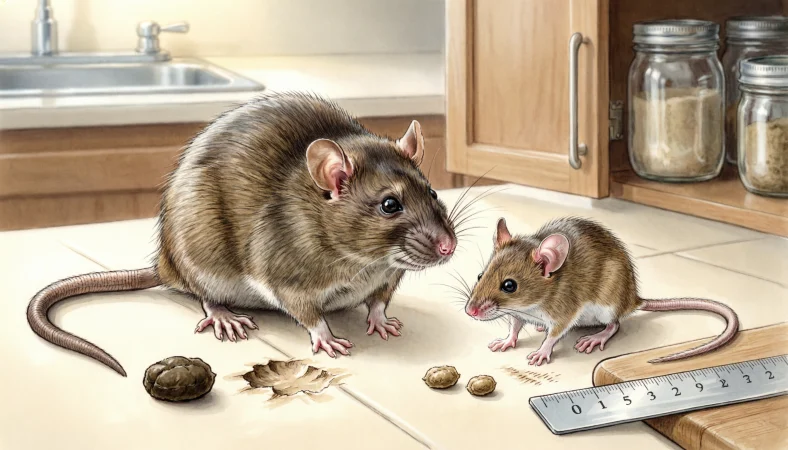
A rat and a mouse are both small rodents, but they differ in size, body shape, behavior, droppings, nesting habits, and signs of activity. When identifying rat or mouse activity, size alone can help, but it is better to consider several clues together. Correct identification can also guide the most appropriate control approach.
The question rat or mouse usually comes up when someone notices a small animal, droppings, scratching sounds, gnaw marks, or other signs of rodent activity. Although rats and mice belong to the same broad rodent group, they aren’t simply different sizes of the same animal. Their physical features, behavior, habits, and preferred environments can differ noticeably.
A mouse is generally smaller, lighter, and more delicate in appearance. A rat is usually larger, heavier, and more robust, with a thicker body and larger feet. However, young rats can sometimes be mistaken for mice because their smaller bodies have not yet developed the proportions associated with adult rats.
This confusion can cause practical mistakes. Someone who assumes a large rodent is a mouse may underestimate the size of the problem. Likewise, someone who sees a small rodent and assumes it must be a mouse may overlook the possibility of a young rat.
The distinction also matters when identifying evidence rather than the animal itself. Droppings, sounds, tracks, gnaw marks, nesting materials, and entry points can provide valuable clues. Looking at several signs together is more reliable than relying on one feature.
The good news is that you don’t need to be a wildlife specialist to make a reasonable identification. By comparing body proportions, ears, tails, droppings, movement patterns, and typical behavior, you can usually narrow down whether you’re dealing with a rat or a mouse.
Rat vs Mouse: What’s the Difference?
The most obvious difference is physical size, but several other characteristics can help distinguish the two.
A rat is a noun referring to a rodent commonly associated with species such as the Norway rat and roof rat. The word can also have figurative meanings in English, but its literal meaning refers to these larger rodents.
A mouse is a noun referring to a smaller rodent. The house mouse is particularly familiar around human buildings, where it can find food, shelter, and nesting locations.
The following comparison provides a quick overview.
| Feature | Rat | Mouse |
| Typical body size | Larger and heavier | Smaller and lighter |
| Body shape | Thick and robust | Small and slender |
| Snout | Relatively blunt | Usually pointed |
| Ears | Smaller relative to head | Larger relative to head |
| Feet | Larger and more substantial | Smaller |
| Tail | Usually thick and relatively long | Thin and relatively long |
| Droppings | Larger and thicker | Smaller and narrower |
| Movement | Often deliberate and cautious | Often quick and agile |
| Climbing ability | Strong, depending on species | Strong, especially around structures |
| Typical indoor signs | Larger gnaw marks and droppings | Small droppings and fine gnaw marks |
Mini Recap
Rats are generally larger, heavier, and more robust than mice.
Mice usually have proportionally larger ears and more delicate features.
Young rats can resemble mice, so size alone isn’t always enough.
Dropping size, tracks, gnaw marks, and behavior can provide additional evidence.
Is Rat vs Mouse a Grammar, Vocabulary, or Usage Issue?
Unlike many comparison topics, rat vs mouse is primarily a vocabulary and identification issue, not a grammar problem.
Both words are ordinary English nouns. The challenge is knowing which noun accurately describes the animal being discussed.
You would normally use rat when referring to a larger rodent that fits the physical and behavioral characteristics of a rat.
You would use mouse when referring to a smaller rodent with the characteristic proportions and behavior associated with mice.
The terms are not interchangeable in precise communication.
For example:
“I saw a mouse in the kitchen.”
This statement identifies the animal as a mouse.
“I saw a rat near the garage.”
This identifies a different type of rodent.
Formal and Informal Usage
Both rat and mouse are suitable in casual and formal English. There is no rule saying that one word is formal and the other is informal.
The difference is factual rather than stylistic.
A scientist may use rat in a research paper. A homeowner may use rat while describing an animal seen outside. A child may use mouse when talking about a cartoon character.
The same basic vocabulary applies across these settings.
Academic and Scientific Usage
In academic contexts, the distinction can become especially important because scientific writing requires precise identification.
Researchers may specify the particular species, strain, or population rather than simply using rat or mouse.
For example, laboratory studies commonly distinguish experimental rats from laboratory mice because they have different biological characteristics.
Everyday Usage
In ordinary conversation, people sometimes use the two words loosely. A person who sees a small rodent in a dark room may call it a mouse without examining it closely.
That isn’t unusual, but it can lead to incorrect identification.
How to Identify a Rat
Rats generally have a more substantial appearance than mice. Their bodies look heavier, their heads appear broader, and their feet are noticeably larger.
Adult rats can vary considerably in size depending on species and environment, so there is no single measurement that identifies every rat. Body proportions are often more useful than trying to memorize one exact size.
Workplace Example
Imagine a warehouse employee notices large droppings near stored materials. The droppings appear considerably larger than typical mouse droppings, and there are signs of substantial gnawing around a storage area.
Calling the animal a rat may be more appropriate if the other evidence supports that identification.
In a workplace, accurate identification can help staff communicate the problem clearly with building managers or pest professionals.
Academic Example
In biological research, rats are frequently distinguished from mice because the two animals differ in anatomy, physiology, behavior, and research applications.
A scientific paper that refers to a rat when the study actually involves mice would contain a significant factual error.
Technology Example
Modern monitoring systems can use cameras, motion sensors, and image recognition to help identify rodents. When an automated system detects a relatively large animal with rat like proportions, the classification may be compared with other evidence before a final identification is made.
Technology can assist identification, but visual evidence still needs context.
Usage Recap
A rat is generally larger and more robust.
Its head and body usually appear heavier than those of a mouse.
Large droppings and substantial gnaw marks can support rat identification.
Young rats require extra caution because they can look surprisingly similar to mice.
How to Identify a Mouse
Mice generally have smaller bodies and more delicate features. Their ears often appear large in proportion to the head, and their snouts are typically more pointed.
House mice are highly adaptable and can live close to people when food, water, and shelter are available.
Workplace Example
A small office may occasionally show signs of mice around kitchens, storage rooms, or areas where food is kept. Tiny droppings near cabinets can be an important clue.
If employees report seeing a small, fast moving rodent, the evidence may point toward a mouse, particularly when the physical features match.
Academic Example
Mice are widely used in biological and medical research. Their small size, reproductive characteristics, and established research resources have made them important model organisms.
In an academic setting, referring to a mouse as a rat would not simply be a stylistic mistake. It would identify the wrong animal.
Technology Example
Technology can help detect mouse activity through motion activated cameras, sensors, and monitoring systems. A camera positioned near a suspected entry point may capture useful information about the animal’s size and movement.
Automated identification should still be treated as supporting evidence rather than absolute proof.
Usage Recap
Mice are generally smaller and more delicate.
Their ears often look large compared with the head.
They can move quickly through narrow spaces.
Small droppings and fine gnaw marks can support mouse identification.
When You Should NOT Assume Rat or Mouse
Correct identification requires more than seeing something move quickly across the floor. Several situations can produce misleading clues.
1. Don’t Identify the Animal Only by Sound
Scratching sounds can indicate rodent activity, but sound alone doesn’t reliably tell you whether the animal is a rat or mouse.
2. Don’t Assume Every Small Rodent Is a Mouse
A young rat can be considerably smaller than an adult rat and may initially look mouse like.
3. Don’t Identify It Only From One Dropping
Droppings can provide useful information, but age, moisture, lighting, and comparison with other evidence can affect interpretation.
4. Don’t Assume a Rodent Seen Outdoors Is a Rat
Several rodent species can appear outdoors, and not every unfamiliar rodent is a rat.
5. Don’t Assume Every Indoor Rodent Is a Mouse
Mice are common indoors, but rats can also enter buildings when food, shelter, and suitable access are available.
6. Don’t Rely Only on Color
Both rats and mice can have different coat colors. Fur color isn’t a dependable identification method by itself.
7. Don’t Use Size Without Considering Proportions
A young rat can be small, while a mouse can appear relatively large depending on the individual and viewing conditions.
8. Don’t Treat Internet Images as Perfect Matches
Photographs can distort apparent size and proportions. Lighting, camera distance, and perspective can make an animal appear larger or smaller.
Common Rat and Mouse Identification Mistakes
| Correct sentence | Incorrect sentence | Explanation |
| I found evidence of a mouse in the pantry. | I found evidence of a rat in the pantry. | The evidence should match the identified animal. |
| The animal appears to be a rat because of its size and body shape. | The animal is a rat because it is brown. | Color alone is not reliable. |
| The droppings appear consistent with mice. | The droppings prove it is a mouse. | Droppings provide clues but should be considered with other evidence. |
| The animal could be a young rat. | It must be a mouse because it is small. | Young rats can be mistaken for mice. |
| The camera captured what appears to be a mouse. | The camera proves the animal is a mouse. | Automated or photographic identification can still require confirmation. |
| Several signs point toward rat activity. | One scratch proves there is a rat. | Multiple clues provide stronger evidence than one isolated sign. |
Decision Rule Box
- If the animal is small and delicate with proportionally large ears and a pointed snout, consider MOUSE.
- If the animal is larger and more robust with a heavier body, larger feet, and substantial features, consider RAT.
- If the animal is unusually small but has rat like proportions, consider the possibility of a young rat rather than relying on size alone.
Rat or Mouse in Modern Technology and AI Tools
Technology has changed how people identify rodents. Motion activated cameras can record activity that would otherwise happen at night or when nobody is present. Smart monitoring devices can also track movement around buildings and identify patterns over time.
Artificial intelligence can assist with image classification. A camera system may compare a captured image against visual characteristics associated with known animals. Such systems can be useful, particularly in commercial buildings where continuous monitoring is difficult.
However, AI identification should not automatically be treated as definitive. Poor lighting, partial views, unusual body positions, and camera angles can produce misleading classifications.
A good identification process combines technology with physical evidence and context.
For example, an image may suggest mouse activity, while the size of the droppings and gnaw marks may suggest a larger rodent. When evidence conflicts, further observation is sensible.
Etymology and Meaning of Rat and Mouse
The words rat and mouse have very old roots in English.
Mouse can be traced to Old English mus, which is related to ancient Germanic forms and ultimately connects with a much older Indo European word associated with the animal.
Rat has a different history. The English word appeared later and is associated with forms found in several European languages.
Both words have also developed figurative meanings.
Mouse can refer to a computer input device because the device’s shape and cord were thought to resemble the animal.
Rat can be used figuratively for a person considered dishonest or unpleasant. Context makes it clear whether the word refers to an animal or a person.
An Expert View on Rat and Mouse Identification
A useful principle in animal identification is to avoid relying on one isolated characteristic.
“Reliable identification comes from combining physical features with behavior, location, and supporting evidence.”
That principle is especially useful when distinguishing rats from mice. Size is helpful, but body proportions, ears, snout shape, feet, droppings, movement, and environmental clues can make the identification considerably more reliable.
Two Practical Case Studies
Case Study 1: A Kitchen With Small Droppings
Imagine a homeowner discovers small, narrow droppings behind kitchen appliances. The person also notices light gnaw marks around a food storage area and occasional quick movement along the wall.
The combination of small droppings, fine gnawing, and rapid movement would be consistent with mouse activity.
The important lesson is that identification should come from several clues rather than from the person’s first impression.
Case Study 2: Activity Around a Garage
Now imagine a garage where someone finds noticeably larger droppings, heavier gnaw marks, and signs of activity near a larger opening.
The physical evidence is more consistent with a larger rodent such as a rat, particularly if a camera later captures an animal with a thick body and substantial feet.
The practical result is better communication. Describing the evidence accurately allows the situation to be assessed according to the animal and circumstances involved.
Rat vs Mouse: A Simple Error Prevention Checklist
Always Consider Mouse When
The animal is small and delicate.
The ears appear large compared with the head.
The snout looks pointed.
The droppings are very small.
The animal moves quickly through narrow spaces.
Always Consider Rat When
The animal has a thick and robust body.
The head appears broad.
The feet look relatively large.
The droppings are substantially larger.
Gnaw marks appear relatively heavy.
The animal has clearly rat like proportions even if it is not fully grown.
Never Assume
- Never assume every small rodent is a mouse.
- Never identify an animal from color alone.
- Never rely on one isolated sign.
- Never assume an automated identification is infallible.
Related Animal and Vocabulary Confusions You Should Master
Understanding rat and mouse terminology can lead naturally into other commonly confused animal names and everyday vocabulary.
Rabbit vs Hare
These animals are related but differ in physical characteristics, behavior, and life cycle.
Toad vs Frog
Both are amphibians, but their bodies, skin, habitats, and behavior can differ.
Alligator vs Crocodile
These reptiles are often confused because they share many physical characteristics.
Possum vs Opossum
These names can refer to different animals depending on geographic and zoological context.
Moth vs Butterfly
Both are insects with similar life cycles, but their physical features and behavior differ.
Seal vs Sea Lion
Both are marine mammals, but their ears, movement, and body structure help distinguish them.
Mouse vs Mole
Despite similar names in some contexts, these animals belong to different groups and have very different lifestyles.
Deer vs Elk
These related mammals can be confused because of their similar appearance, especially at a distance.
Leopard vs Jaguar
Both are spotted big cats, but their markings, build, geographic range, and other characteristics differ.
Crow vs Raven
These closely related birds share many features, but size, calls, and physical proportions can help distinguish them.
FAQs
What is the main difference between a rat and a mouse?
The main difference is overall size and body structure. Rats are generally larger and more robust, while mice are smaller and more delicate. Their ear size, snout shape, feet, tails, and droppings can also help distinguish them.
How can I tell if I have a rat or mouse?
Look at several clues together. Examine the animal’s size, body proportions, ears, snout, feet, tail, droppings, and gnaw marks. If you only see signs rather than the animal, the evidence can still help narrow down the possibilities.
Can a young rat look like a mouse?
Yes. A young rat can be mistaken for a mouse because it is much smaller than an adult rat. Body proportions can provide more useful information than size alone when the animal is young.
Are rats bigger than mice?
Generally, yes. Adult rats are substantially larger and heavier than typical mice. However, individual animals vary, and young rats can be much smaller than adults.
Do rats and mice have different droppings?
Yes. Rat droppings are generally larger and thicker, while mouse droppings are much smaller and narrower. Droppings can provide useful identification clues, but they should be considered alongside other evidence.
Can you tell a rat from a mouse by its tail?
The tail can help, but it shouldn’t be the only feature used. Both rats and mice have relatively long tails, although their thickness and overall proportions can differ.
Do rats and mice make the same sounds?
They can produce some similar sounds, particularly scratching and movement noises. Sound alone usually isn’t enough to identify the animal reliably.
Can AI identify whether an animal is a rat or mouse?
AI based camera systems can assist with visual classification, but results can be affected by lighting, image quality, camera angle, and partial views. Human assessment and supporting evidence can still be important.
Is a mouse just a small rat?
No. Rats and mice are different animals with different physical characteristics and biological classifications. A young rat may look mouse like, but that doesn’t make it a mouse.
Which is more common indoors, rats or mice?
Both can enter buildings, but house mice are particularly well adapted to living close to people. Rats can also occupy buildings when food, water, shelter, and suitable access are available.
Conclusion:
Distinguishing a rat from a mouse isn’t simply a matter of deciding which animal looks bigger. Adult rats are generally larger and more robust, while mice tend to have smaller bodies, proportionally larger ears, and more delicate features.
When you need to identify rat or mouse activity, consider several clues together. Body proportions, snout shape, ears, feet, tail characteristics, droppings, gnaw marks, movement, and location can all contribute to a more accurate assessment.
The most important rule is simple: don’t let one clue make the decision for you. A small animal may be a young rat, and a dark photograph may make a mouse appear larger than it really is.
Accurate identification starts with careful observation. Once you understand the major physical and behavioral differences, the distinction becomes much easier to make.











1 thought on “Rat Or Mouse: How To Tell The Difference And Identify Them Correctly In 2026”