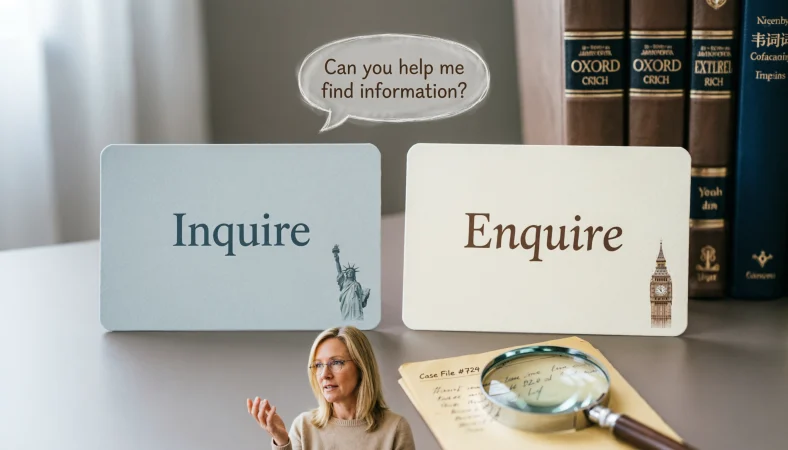
Both inquire or enquire can be correct spellings, but their use varies by English variety and meaning. In American English, inquire is the standard spelling for asking for information or making a formal investigation. In British English, enquire is common for ordinary questions, while inquire often suggests a formal investigation.
The words inquire and enquire are a classic spelling variation in English. They look almost identical, sound alike in most varieties of English, and share the same basic meaning. That makes the choice easy to overlook, especially when writing for an international audience.
The confusion matters because spelling conventions often signal the variety of English being used. A British company may naturally write that a customer can enquire about a service, while an American company will usually say that customers can inquire about the same service.
The distinction becomes even more interesting in formal contexts. British English traditionally allows both forms, with enquire commonly associated with asking for information and inquire sometimes associated with conducting a formal investigation.
Inquire or Enquire: What’s the Difference?
The main difference is not that one word is correct and the other is wrong. Both are established English verbs. The important difference concerns regional spelling conventions and, in some varieties of English, differences in usage.
Inquire is a verb meaning to ask for information, seek an answer, or investigate something. It is the overwhelmingly preferred spelling in American English.
Enquire is also a verb meaning to ask for information. It is especially common in British English and other varieties influenced by British spelling conventions.
Here is the basic comparison.
The simplest rule is straightforward.
American English normally prefers inquire.
British English commonly uses enquire for ordinary questions.
British English can also use inquire, especially for formal investigation.
Neither spelling should automatically be treated as a misspelling.
The correct choice depends mainly on your intended variety of English and the context in which you are writing.
Is Inquire or Enquire a Grammar, Vocabulary, or Usage Issue?
This is primarily a spelling and usage issue, rather than a grammar problem.
Both words function as verbs. You can say that someone inquires about a product, inquired about a position, or will inquire about a service. The same grammatical patterns work with enquire.
For example:
I inquired about the course.
In British English, the following is also natural:
I enquired about the course.
The sentence structure has not changed. Only the spelling has changed.
Are Inquire and Enquire Interchangeable?
In many contexts, yes. If someone asks for information, both forms can communicate the same basic idea.
However, they are not equally common everywhere.
American readers generally expect inquire. The spelling enquire may look unusual or distinctly British to an American audience.
British readers are familiar with both forms. Enquire is especially natural in everyday requests for information, while inquire can sound more formal when it refers to an investigation.
Formal and Informal Usage
The distinction becomes useful in formal writing.
A British organization might write:
Please enquire about availability before booking.
An American organization would normally write:
Please inquire about availability before booking.
For investigations, British English may prefer inquire:
The committee will inquire into the allegations.
This creates a useful semantic distinction in some British contexts.
Enquire can refer to asking for information.
Inquire can refer to conducting a formal investigation.
That distinction is not absolute, but it can help explain why both spellings continue to exist.
Academic and Casual Usage
Academic writing should follow the spelling system used by the institution, publication, or intended audience.
An American academic paper would normally use inquire.
A British academic paper may use enquire when referring to an ordinary request for information and inquire when discussing a formal investigation.
In casual communication, regional preference matters more than formality. A British speaker may naturally write enquire, while an American speaker will normally choose inquire.
How to Use Inquire Correctly
Inquire is the safest choice when writing in American English. It can describe asking a question, requesting information, or conducting an investigation.
Workplace Example
I would like to inquire about the status of my application.
This sounds natural in American professional writing.
Another example is:
The client called to inquire about the delivery schedule.
Here, inquire means to ask for information.
Academic Example
Researchers sought to inquire into the causes of the decline.
In this context, the verb can suggest investigation or examination.
A student might also write:
I contacted the department to inquire about the admission requirements.
The meaning is simply to request information.
Technology Example
Users can inquire about account requirements through the support system.
The verb describes a request for information.
Modern digital services frequently use inquire in customer support language, especially when the organization follows American English conventions.
Usage Recap
Use inquire when writing for an American audience.
Use it when you mean asking for information.
Use it when referring to investigation, especially in formal contexts.
It is also perfectly acceptable in British English.
How to Use Enquire Correctly
Enquire is particularly common in British English. It is often used when someone asks for information about a service, product, event, application, or situation.
Workplace Example
I would like to enquire about the position advertised on your website.
This sounds natural in British English.
A customer service message might say:
Please enquire with the office for further details.
The spelling fits British usage conventions.
Academic Example
Students should enquire about examination requirements before submitting their applications.
Here, enquire simply means ask for information.
Technology Example
Customers can enquire about available plans through the online support portal.
A British company may naturally use this spelling in its customer communication.
Usage Recap
Use enquire when following British spelling conventions for ordinary requests.
It is especially natural when asking about availability, prices, services, applications, or general information.
Do not assume that enquire is an incorrect form simply because American English normally uses inquire.
When You Should NOT Use Inquire or Enquire
Understanding when not to use each spelling can prevent awkward or inconsistent writing.
1. Do not switch spelling systems randomly
If an American article uses inquire, suddenly using enquire in another paragraph can make the content look inconsistent.
Choose one spelling convention and maintain it.
2. Do not treat enquire as an American spelling
American English strongly favors inquire. If you are writing specifically for an American audience, enquire is usually an unnecessary regional variation.
3. Do not assume inquire is exclusively American
British English also uses inquire, particularly when discussing formal investigations.
4. Do not use enquire automatically for every British sentence
British English allows both spellings. Context can influence which one sounds more appropriate.
5. Do not confuse spelling with pronunciation
In most modern varieties of English, the two words are pronounced essentially the same way.
The difference is primarily written.
6. Do not change the verb structure
The spelling changes, but the grammatical behavior remains similar.
You can write:
She inquired about the meeting.
Or:
She enquired about the meeting.
7. Do not use one spelling simply because it looks more formal
Enquire is not automatically more formal than inquire.
The surrounding context determines the level of formality.
8. Do not mix regional conventions in official documents
A company writing for customers should establish a consistent house style. Consistency improves credibility and makes the document easier to edit.
Common Mistakes and Decision Rules
The following examples show how the two spellings work in practical writing.
Decision Rule
If you write American English, normally choose inquire.
If you write British English and mean an ordinary request for information, enquire is a natural choice.
If you mean a formal investigation in British English, inquire may be preferred.
This rule handles most everyday situations without unnecessary complexity.
Inquire and Enquire in Modern Technology and AI Tools
Digital communication has made regional spelling differences more visible.
Websites, customer support systems, application forms, chatbots, and artificial intelligence tools often serve international audiences. As a result, a single interface may need to account for several English varieties.
An American software company might write:
Inquire about enterprise pricing.
A British service provider might write:
Enquire about enterprise pricing.
Both messages tell the user to request additional information.
Artificial intelligence systems also need to understand the relationship between the two spellings. A language model should generally recognize inquire and enquire as related forms rather than treating one as an automatic spelling error.
This matters for proofreading as well. A British English document containing enquire should not automatically be changed to inquire merely because American English is more common online.
The better approach is to identify the target audience first.
The Etymology of Inquire and Enquire
The two forms have a closely connected history.
Both ultimately trace back through French and Latin forms associated with asking, seeking, examining, or investigating. The Latin verb inquirere carried the sense of seeking into or investigating something.
English developed related forms through historical changes in spelling and pronunciation. Over time, inquire and enquire became established variants.
Their shared history explains why the meanings overlap so strongly.
The modern distinction is therefore less about two completely different words and more about how English developed regional spelling and usage preferences.
The related nouns are also worth remembering.
Inquiry is common in American English.
Enquiry is common in British English for an ordinary request for information.
However, British English can also use inquiry, especially for formal investigations.
What Linguists Mean by Regional Spelling Variation
A useful way to understand this distinction is to stop thinking of one spelling as correct and the other as incorrect.
English has many regional spelling differences.
American English commonly uses color, while British English commonly uses colour.
American English commonly uses center, while British English commonly uses centre.
The same broad principle applies to inquire and enquire.
A spelling can be completely correct within one established variety of English and less common in another.
As a practical editorial principle, the best spelling is the one that matches the audience.
Expert style guidance: “The strongest choice is not always the spelling that is most common everywhere, but the spelling that consistently matches the English variety and context of the reader.”
This principle is especially important for businesses, publishers, universities, and websites that publish large amounts of content.
Two Practical Case Studies
Case Study 1: An American Customer Service Page
Imagine an American company creating a customer support page for users who want pricing information.
The original sentence says:
Please enquire about our business plans.
The editorial team changes it to:
Please inquire about our business plans.
The result is greater consistency with American English. The company already uses American spellings throughout its website, so inquire fits the established style.
The concrete improvement is editorial consistency. Readers are less likely to notice a regional spelling that does not match the rest of the site.
Case Study 2: A British University Information Page
Now consider a British university writing for prospective students.
The page says:
Please inquire about accommodation availability.
The university could reasonably retain inquire, particularly if the wording refers to a formal investigation or follows the institution’s established style.
However, if the intended meaning is simply asking for information, the university may prefer:
Please enquire about accommodation availability.
The concrete result is clearer alignment with ordinary British usage.
These examples show why context matters more than declaring one spelling universally correct.
Inquire or Enquire: Which One Should You Choose?
If you are writing for an American audience, inquire is the safest and most natural choice.
If you are writing for a British audience and asking for ordinary information, enquire is often the more natural choice.
If you are discussing a formal investigation, inquire can be preferred in British English as well.
The important point is consistency.
A website should not alternate randomly between the two forms. A university should follow its institutional style. A business should consider the English variety used by its customers.
For international content, the choice should be based on the dominant audience rather than personal preference.
Error Prevention Checklist
Always use inquire when
- You are writing standard American English.
- You are preparing American business communication.
- You are writing American academic content.
- You mean asking for information in American English.
- You are describing a formal investigation and want the standard verb form.
Use enquire when
- You are following British English conventions.
- You are making an ordinary request for information.
- Your organization consistently uses British spelling.
- Your intended readers are accustomed to British English.
Never assume
- That enquire is always wrong.
- That inquire is only American.
- That the two verbs have completely different meanings.
- That one spelling is automatically more professional.
- That a spell checker can determine the correct regional form without knowing your audience.
Related Grammar Confusions You Should Master
Understanding inquire or enquire becomes easier when you also recognize other regional and spelling differences.
- Color or colour
- Center or centre
- Favorite or favourite
- Realized or realised
- Offense or offence
- Catalog or catalogue
- Adviser or advisor
- Modeling or modelling
- Aging or ageing
- Learned or learnt
These comparisons reinforce an important principle: English spelling is not completely uniform across regions.
FAQs
Is inquire or enquire correct?
Both are correct English spellings. Inquire is the standard choice in American English, while enquire is especially common in British English for ordinary requests for information.
Is enquire British or American?
Enquire is strongly associated with British English and other varieties that follow British spelling conventions. American English normally uses inquire instead.
Is inquire American or British?
Inquire is especially common in American English, but it is also used in British English. In British usage, it can be particularly useful when referring to a formal investigation.
Should I use inquire or enquire in British English?
Both can be used. Enquire is common for ordinary requests for information, while inquire may be preferred in formal contexts involving investigation.
Should I use inquire or enquire in American English?
Use inquire. It is the normal American spelling and is the safest choice for American professional, academic, and general writing.
Is enquire more formal than inquire?
Not necessarily. The difference is mainly regional and contextual. In British English, enquire often describes an ordinary request for information, while inquire can suggest investigation.
What is the difference between inquiry and enquiry?
Inquiry is the standard American spelling. Enquiry is common in British English when referring to a request for information. British English can also use inquiry, particularly for formal investigations.
Can I use enquire in a formal email?
Yes. If you are writing British English, enquire can be entirely appropriate in a formal email, especially when asking for information about a service, application, appointment, or product.
Is it inquire about or enquire about?
Both expressions are grammatical. American English normally uses inquire about, while British English commonly uses enquire about for ordinary requests.
Conclusion:
The choice between inquire or enquire is mainly a matter of regional spelling and context rather than a simple question of right versus wrong. Inquire is the standard American form and is also used in British English. Enquire is especially common in British English when someone asks for information.
The safest decision is to identify your audience first.
For American English, choose inquire.
For British English, enquire is often natural for ordinary questions.
For formal investigation, inquire can be especially appropriate in British usage.
Once you understand that distinction, the choice becomes much easier. Rather than memorizing one spelling as correct and the other as incorrect, match your word choice to the variety of English and the meaning you intend.