A stye and a chalazion are both common eyelid lumps, but they usually have different causes. A stye is typically a tender, red infection involving an eyelid gland, while a chalazion is usually a firm, less painful lump caused by a blocked oil gland. Both can improve with proper care, but persistent, painful, or vision affecting lumps should be evaluated by an eye care professional.
Have you noticed a bump on your eyelid and wondered whether it is a stye or chalazion? These two conditions can look similar, but differences in pain, redness, location, and how they develop can provide useful clues. Knowing the distinction can help you understand what you are seeing without confusing one condition with the other.
This guide explains stye and chalazion in simple, beginner friendly language, covering their causes, symptoms, differences, and common care approaches. It is designed to make the terminology easier to understand while emphasizing that persistent, worsening, or vision affecting symptoms should be assessed by an appropriate healthcare professional.
Stye or Chalazion: What’s the Difference?
The terms stye and chalazion are often confused because both can appear as bumps on or around the eyelid. They may cause swelling, tenderness, redness, or a feeling that something is irritating the eye. However, their underlying causes are different.
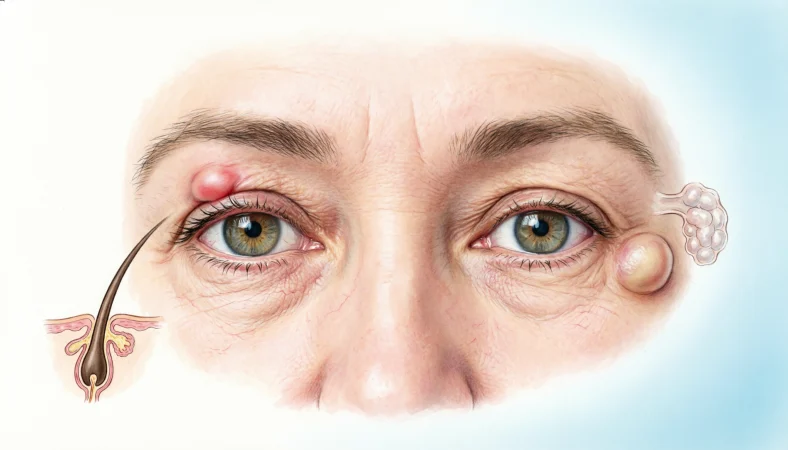
A stye is an acute, localized inflammation that commonly develops when bacteria contribute to infection around an eyelash follicle or an eyelid gland. It often appears suddenly and can be painful or tender. A stye may look like a small red bump close to the edge of the eyelid.
A chalazion develops when an oil producing gland in the eyelid becomes blocked. Instead of being primarily an infection, it is usually an inflammatory response associated with retained gland secretions. A chalazion often feels firmer and may develop farther back from the eyelid edge.
Understanding that distinction matters because appearance alone does not always tell the whole story. A painful, red lump near the eyelashes is more suggestive of a stye, while a firm lump that is less painful and persists longer may be more consistent with a chalazion.
The simplest distinction is this: a stye is commonly painful and associated with an acute infection, while a chalazion is usually a blocked gland that produces a firmer, less tender lump.
A stye can sometimes leave behind a chalazion after the initial inflammation settles. That is one reason the two conditions can appear related or seem to change from one into the other.
What Is a Stye?
A stye, medically known as a hordeolum, is a localized inflammatory condition of the eyelid. It commonly develops around an eyelash follicle or one of the small glands associated with the eyelid.
A typical stye may begin with tenderness, redness, and swelling. The area can become increasingly uncomfortable over a short period. Some styes develop a small yellowish point that resembles a tiny pimple because inflammatory material has collected near the surface.
There are different types of styes. An external stye generally develops near the base of an eyelash. An internal stye involves a gland located deeper within the eyelid and may produce more generalized eyelid swelling.
Styes are common and usually resolve without serious complications. The discomfort can nevertheless be significant, particularly when the swollen area rubs against the eye or makes blinking uncomfortable.
How a Stye Usually Feels
People often describe a stye as sore, tender, or painful to touch. The eyelid may feel swollen or heavy. Blinking can sometimes make the discomfort more noticeable.
The surrounding skin may appear red, particularly when inflammation is pronounced. Some people also experience tearing or mild irritation of the eye.
The presence of pain is an important clue, although it is not an absolute rule. Not every stye causes severe pain, and other eyelid conditions can also cause tenderness.
Workplace Example
Imagine someone notices a tender red bump along the eyelid shortly before going to work. They may feel discomfort while looking at a computer screen or blinking repeatedly.
A reasonable description would be:
“I developed a painful bump along my eyelid this morning.”
That description is more consistent with a typical stye than with a longstanding, painless lump.
Academic Example
In a health education article, a writer might explain:
“A stye usually causes a localized, tender swelling of the eyelid.”
This wording distinguishes the condition from a chalazion without claiming that every case will have exactly the same symptoms.
Technology Example
Digital health tools may ask users about symptoms such as redness, tenderness, swelling, discharge, duration, and location. These details can help organize information, but a symptom checker or artificial intelligence system cannot reliably replace an eye examination when the diagnosis is uncertain.
Stye Usage Recap
Think of a stye as a tender, inflamed eyelid bump that often develops quickly. Infection and inflammation are important features, and the bump is commonly located near the eyelid margin.
What Is a Chalazion?
A chalazion is a localized eyelid lump caused by blockage of an oil producing gland. These glands, called meibomian glands, contribute an oily component to the tear film that helps reduce evaporation.
When one of these glands becomes blocked, its contents can become trapped within the eyelid. The body may respond with inflammation, producing a rounded lump.
Unlike a typical stye, a chalazion is often not painful. It may initially be associated with swelling or tenderness, but as the condition develops, the lump can become firm and relatively painless.
A chalazion may occur on either the upper or lower eyelid. It can be visible from the outside or feel like a small nodule within the eyelid.
How a Chalazion Usually Feels
A chalazion often feels like a small, firm bead or lump beneath the eyelid skin. It may be more noticeable when touching the eyelid than when simply looking at the person.
Pain is usually less prominent than with a stye. However, larger chalazia can cause pressure or irritation. In some cases, a sufficiently large lump can press against the eye and temporarily affect vision.
Workplace Example
Suppose someone has had a firm eyelid lump for several weeks. It is noticeable but not particularly painful.
They might say:
“There’s a small, firm lump in my eyelid, but it doesn’t really hurt.”
That pattern is more typical of a chalazion than an acute stye.
Academic Example
A textbook could describe the condition this way:
“A chalazion is an inflammatory lump associated with blockage of a meibomian gland.”
This definition emphasizes its glandular origin and distinguishes it from a primarily infectious process.
Technology Example
An online health questionnaire might ask whether an eyelid lump is painful, how long it has been present, and whether vision has changed. Those questions can provide useful background information, but they should not be treated as a definitive diagnosis.
Chalazion Usage Recap
Think of a chalazion as a firm eyelid lump associated with a blocked oil gland. It is commonly less painful than a stye and may remain noticeable for weeks.
Is Stye or Chalazion a Medical Diagnosis or a Symptom Description?
The distinction between these terms is more than a vocabulary issue. Stye and chalazion describe different eyelid conditions, although their symptoms can overlap.
A person may initially notice only redness, swelling, or a lump. Those symptoms do not automatically establish whether the problem is a stye, chalazion, another eyelid disorder, or something unrelated.
The clinical history is important. Doctors may consider when the lump appeared, whether it hurts, where it is located, whether it has changed, and whether there are symptoms involving the eye itself.
This is especially relevant when an eyelid lump does not behave like an ordinary stye or chalazion. A persistent or recurrent lesion may require professional assessment rather than repeated home treatment.
How to Tell a Stye and Chalazion Apart
The easiest way to approach the difference is to consider several characteristics together rather than relying on one symptom.
Pain and Tenderness
A stye is commonly tender. Touching the affected area may be uncomfortable, and blinking can sometimes increase irritation.
A chalazion is usually less painful. It may be tender at first, but persistent chalazia often become relatively painless.
Location
A stye often occurs near the eyelid edge, especially around an eyelash follicle.
A chalazion tends to develop deeper within the eyelid because it originates from a blocked oil gland.
Location is helpful, but it is not a perfect diagnostic test. Eyelid anatomy varies, and conditions can overlap.
Speed of Development
Styes often seem to appear quickly. Someone may notice tenderness and swelling over a relatively short period.
Chalazia can develop more gradually. A person may first notice a small lump and then realize that it has remained present over time.
Appearance
A stye can look like a small red, swollen bump and may develop a visible point.
A chalazion is often a more rounded or firm lump beneath the skin. The surrounding redness may be less obvious, particularly when the condition has been present for some time.
Duration
Many uncomplicated styes improve as the inflammation settles.
Chalazia can take longer to disappear. Some resolve gradually without intervention, while others persist and may require assessment or treatment.
The duration alone does not establish a diagnosis. A persistent eyelid lump should be evaluated when its behavior is unusual or concerning.
Can a Stye Turn Into a Chalazion?
Yes, a stye and a chalazion can be related. In some situations, an episode that begins with acute inflammation can later leave behind a firm blocked gland.
This helps explain why someone may initially experience a painful, red eyelid bump and later notice a smaller, firmer lump that is no longer painful.
The change does not necessarily mean that the original diagnosis was wrong. The inflammatory process and blocked gland can evolve over time.
However, not every persistent bump following a stye is automatically a chalazion. If the lump continues to grow, repeatedly returns, affects vision, or otherwise looks unusual, professional evaluation is appropriate.
When You Should Not Assume It Is a Stye or Chalazion
There are situations in which it is better to avoid self diagnosing an eyelid lump.
1. The Lump Keeps Returning
A repeatedly recurring lump in the same area deserves attention. Recurrent lesions can have different causes and should not automatically be treated as ordinary styes.
2. Vision Changes
Blurred or altered vision can occur when significant eyelid swelling affects the eye, but new or persistent visual changes should be taken seriously.
3. Severe or Spreading Swelling
Swelling that becomes extensive or extends beyond the immediate eyelid area may require prompt medical evaluation.
4. Significant Eye Pain
Pain coming from the eye itself rather than only the eyelid can indicate a problem that needs professional assessment.
5. Light Becomes Unusually Uncomfortable
Marked sensitivity to light can occur with several eye conditions. It should not simply be attributed to an ordinary eyelid bump.
6. The Eye Becomes Very Red
Mild redness around an eyelid bump is different from pronounced redness involving the eye. Significant eye redness warrants closer attention.
7. The Lump Does Not Behave Normally
A persistent, enlarging, bleeding, or unusual eyelid lesion should be assessed rather than repeatedly treated at home.
8. Symptoms Are Severe in a Child
Children can develop styes and chalazia, but significant swelling, fever, visual symptoms, or changes in general behavior deserve prompt medical attention.
Common Mistakes When Comparing a Stye With a Chalazion
One of the biggest mistakes is assuming that every eyelid bump is a stye. The word is commonly used for many different types of eyelid swelling.
Another mistake is assuming that a chalazion can never be painful. Pain is less typical, but inflammation can cause tenderness, especially during its early stages.
A third mistake is trying to diagnose the condition based only on color. Redness can occur with several inflammatory eyelid conditions.
Decision Rule
If the eyelid bump is suddenly tender, red, and inflamed, a stye may be more likely. If it becomes a firm, relatively painless lump associated with a blocked oil gland, a chalazion may be more likely.
This is a useful general distinction, not a substitute for professional diagnosis.
How Is a Stye Usually Managed?
Most uncomplicated styes improve with conservative care. Warm compresses are commonly recommended because gentle warmth can help soften material within blocked eyelid glands and support natural drainage.
A clean warm compress can be applied to the closed eyelid for several minutes at a time. The compress should be comfortably warm rather than hot enough to burn the skin.
Eyelid hygiene may also be useful, particularly for people who frequently experience eyelid gland problems.
It is important not to squeeze, puncture, or forcibly pop an eyelid bump. Doing so can worsen inflammation and potentially spread infection.
People who wear contact lenses or eye makeup may need to temporarily avoid them while the eyelid is irritated, particularly if using them increases discomfort or creates hygiene concerns.
If symptoms are severe, persistent, recurrent, or associated with concerning eye symptoms, a healthcare professional can determine whether additional treatment is necessary.
How Is a Chalazion Usually Managed?
Small chalazia often improve gradually. Warm compresses and gentle eyelid care may be recommended as initial measures.
Some chalazia disappear naturally, while others remain for an extended period. When a chalazion is persistent or large enough to cause discomfort or visual problems, an eye care professional may consider additional treatment.
Depending on the circumstances, professional management can include procedures designed to drain the lesion or other treatment selected according to the patient’s individual situation.
The appropriate approach depends on the size, location, duration, symptoms, and clinical appearance of the lesion.
Trying to drain a chalazion at home with a needle or other sharp object is not advisable because the eyelid and surrounding eye structures are delicate.
Stye or Chalazion in Modern Technology and AI Tools
Modern technology has made it easier to search for information about eye symptoms. Smartphone applications, online questionnaires, telehealth services, and artificial intelligence tools can help people organize symptoms and prepare questions for a healthcare professional.
However, an image based system may struggle to distinguish between conditions that look similar. Lighting, camera quality, skin tone, image resolution, eyelid position, and the absence of a physical examination can all affect interpretation.
AI can be useful for education, but it should not be treated as an ophthalmic examination.
For example, an AI tool might explain that tenderness and rapid onset are commonly associated with a stye, while a firm and less painful lump may suggest a chalazion. That information can improve understanding, but it cannot confirm what is happening in a particular person’s eye.
What Causes Styes and Chalazia?
The mechanisms behind the two conditions help explain their different appearances.
A stye is commonly associated with infection and inflammation involving an eyelash follicle or eyelid gland. Bacteria that normally live on the skin can contribute to the process when they enter or affect vulnerable tissue.
A chalazion develops when an oil gland becomes blocked. The trapped material can trigger inflammation within the eyelid.
Certain people may be more prone to recurrent eyelid gland blockage or inflammation. Chronic eyelid inflammation, certain skin conditions, and problems involving the oily component of the tear film can contribute to repeated eyelid gland problems.
Good eyelid hygiene may help reduce irritation, but it cannot guarantee that a person will never develop a stye or chalazion.
Etymology and Medical Terminology
The word stye comes from an old English term associated with a swelling of the eyelid. The medical term hordeolum has Latin roots and is associated with the appearance of a small grain.
The word chalazion comes from Greek and is associated with a small lump or hailstone like swelling.
These historical roots are useful because medical vocabulary often preserves descriptions of how a condition looks. They do not, however, provide a modern explanation of the underlying biology.
The distinction between the everyday word stye and the medical term hordeolum is also worth remembering. In ordinary conversation, people generally say stye, while healthcare professionals may use more precise medical terminology.
What Experts Want Patients to Understand
A useful clinical principle is that appearance should be considered together with symptoms, location, duration, and progression.
That principle is especially important with eyelid problems because several different conditions can produce similar visible changes.
A tender red lump that appears quickly tells a different clinical story from a firm painless lump that has remained for several weeks. Yet neither description should be used as an absolute diagnosis without considering the complete situation.
Clinical Case Example 1
Consider an adult who notices a tender red bump close to the base of an eyelash. The eyelid becomes mildly swollen over the following day, and blinking is uncomfortable.
The pattern is consistent with a typical stye. Conservative care may be appropriate when symptoms are mild and there are no warning signs.
The important point is not that every similar bump is definitely a stye. Rather, the combination of rapid onset, tenderness, localized swelling, and eyelid margin involvement provides a useful clinical pattern.
Clinical Case Example 2
Now consider someone who notices a small firm lump within the upper eyelid. It is not particularly painful and remains present for several weeks.
That pattern is more consistent with a chalazion.
If the lump remains persistent, becomes large, affects vision, or repeatedly returns, professional assessment becomes more important. The outcome of treatment varies according to the size and duration of the lesion and the individual patient’s circumstances.
These examples demonstrate why symptom patterns are more useful than relying on a single feature.
Error Prevention Checklist
Always Use the Term Stye When
- You are describing a typical tender eyelid bump associated with acute inflammation.
- The swelling appeared relatively quickly.
- The bump is located near the eyelid margin or an eyelash.
- You are using the everyday term for a suspected hordeolum.
Always Use the Term Chalazion When
- You are describing a firm lump associated with a blocked oil gland.
- The lesion is relatively painless.
- The lump has persisted longer than expected for an acute inflammatory bump.
- You are specifically referring to a meibomian gland related lesion.
Never Assume
- Every eyelid bump is an infection.
- Every painless eyelid lump is harmless.
- Every persistent lump will disappear without evaluation.
- A photograph alone can establish a diagnosis.
- Squeezing an eyelid lump is a safe treatment.
Related Eye and Medical Confusions You Should Understand
Understanding related terminology can make eye health information much easier to follow.
- Conjunctivitis vs allergy: Both can cause redness and irritation, but their triggers and associated symptoms can differ.
- Dry eye vs eye irritation: Dry eye is a specific ocular condition, while irritation can describe a broader symptom.
- Blepharitis vs stye: Blepharitis involves eyelid inflammation and can contribute to recurrent eyelid problems.
- Chalazion vs eyelid cyst: These terms can describe different processes even when the visible lump appears similar.
- Eye infection vs eyelid inflammation: Infection of the eye itself is not the same as localized inflammation of an eyelid gland.
- Pink eye vs red eye: Pink eye commonly refers to conjunctivitis, while red eye is a broader symptom description.
- Tear duct blockage vs eyelid gland blockage: These involve different structures and can produce different symptoms.
- Eye allergy vs infection: Itching is particularly important when distinguishing common allergic symptoms from some infectious conditions.
- Eyelid swelling vs eye swelling: The location of swelling can provide important information about what structures are involved.
- Eye pain vs eyelid tenderness: Pain originating inside or around the eye can have different significance from tenderness limited to an eyelid lump.
FAQs
Is a stye or chalazion more painful?
A stye is generally more likely to be painful or tender because it commonly involves acute inflammation and infection. A chalazion is usually less painful, particularly after the initial inflammation settles. However, symptoms can overlap, so pain alone cannot establish a diagnosis.
How can you tell if you have a stye or chalazion?
A tender, red bump that develops relatively quickly near the eyelid margin is more typical of a stye. A firm, relatively painless lump deeper within the eyelid is more typical of a chalazion. Location, duration, appearance, and progression should all be considered together.
Can a stye turn into a chalazion?
A stye can sometimes be followed by a persistent blocked gland that resembles a chalazion. The painful inflammation may settle while a firm lump remains. This can make the two conditions appear connected.
How long does a chalazion last?
A chalazion may resolve gradually, but some remain for weeks or longer. The duration varies from person to person. A persistent, enlarging, recurrent, or visually significant lump should be evaluated by an appropriate healthcare professional.
How long does a stye last?
Many uncomplicated styes improve as the inflammation settles. The exact duration varies. If symptoms become severe, spread, recur frequently, or fail to improve, professional assessment may be appropriate.
Should you squeeze a stye?
No. Squeezing or puncturing a stye can irritate the tissue and potentially worsen or spread infection. Warm compresses and appropriate eyelid hygiene are generally safer conservative approaches for uncomplicated cases.
Should you squeeze a chalazion?
No. A chalazion should not be punctured or squeezed at home. The eyelid contains delicate tissue, and attempting to drain a lesion yourself can cause injury or infection.
Can a chalazion affect vision?
A larger chalazion can sometimes press against the eye and temporarily affect vision. Any significant, persistent, or unexplained change in vision should receive appropriate medical attention rather than being automatically attributed to a chalazion.
When should you see a doctor for an eyelid lump?
Professional evaluation is appropriate when an eyelid lump is persistent, recurrent, unusually large, increasingly painful, associated with significant swelling, accompanied by vision changes, or associated with symptoms involving the eye itself.
Are styes and chalazia contagious?
A typical chalazion caused by a blocked gland is not generally considered contagious. A stye can involve bacteria, but having a stye does not mean the condition spreads like a typical respiratory infection. Good hand and eyelid hygiene remain sensible.
Conclusion:
Knowing the difference between a stye and a chalazion makes eyelid symptoms easier to understand. A stye is commonly a sudden, tender, inflamed bump associated with infection around an eyelash follicle or eyelid gland. A chalazion is typically a firmer, less painful lump caused by blockage and inflammation of an oil producing eyelid gland.
The distinction is useful, but it should not encourage overconfidence in self diagnosis. Eyelid conditions can resemble one another, and persistent or unusual lumps deserve appropriate evaluation. Warm compresses may help uncomplicated cases, while squeezing or puncturing an eyelid lesion should be avoided.
When symptoms include significant eye pain, spreading swelling, vision changes, marked redness, recurrence, or an unusual persistent lesion, professional eye care is the safest approach.