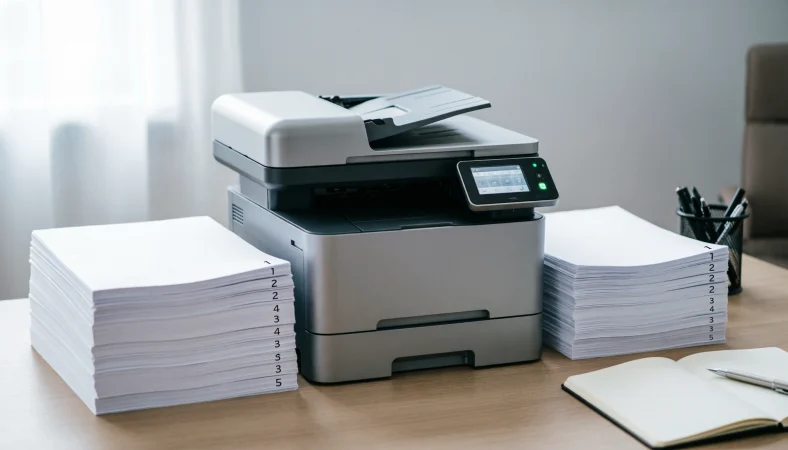
Collate means to collect, arrange, and organize information, documents, or pages in a specific order. In printing, collate means arranging printed pages into complete sets in the correct sequence. For example, “Please collate the documents before the meeting.” The word is useful in office, academic, publishing, and data related contexts.
Have you ever seen the word collate and wondered what it means or whether you should use it? Although it may sound technical, “collate” has a straightforward meaning: to collect and arrange information or documents in a particular order.
Understanding collate is especially useful in office work, academic writing, printing, and document management. This guide explains its meaning, pronunciation, grammar, common uses, and practical examples in simple language, helping you understand when and how to use the word correctly.
Collate vs Not Collate: What’s the Difference?
The word collate can seem confusing because its meaning changes slightly depending on the context. In general English, it means to collect information or documents and arrange them carefully for comparison or organization. In printing, it has a more specific practical meaning: arranging printed pages into the correct sequence so that each copy forms a complete set.
The opposite situation is usually described as not collated or uncollated. When pages are not collated, identical pages are commonly grouped together rather than arranged into complete document sets.
Imagine you need three copies of a five page document.
A collated print job produces:
Page 1, Page 2, Page 3, Page 4, Page 5
Then the second complete copy:
Page 1, Page 2, Page 3, Page 4, Page 5
Then the third complete copy follows in the same order.
An uncollated print job may produce:
Page 1, Page 1, Page 1
Then:
Page 2, Page 2, Page 2
Then:
Page 3, Page 3, Page 3
The pages are all printed, but the copies are not assembled into complete sets.
The distinction matters because choosing the wrong printer setting can create extra work. If you need several ready to distribute copies, collating can save time. If you intend to sort or organize the pages yourself, an uncollated arrangement may be more useful.
| Term | Part of speech | Meaning | Typical context |
| Collate | Verb | Collect and arrange items in order | Documents, information, printing |
| Collated | Adjective or past participle | Arranged into complete sets or a specific order | Printing and document preparation |
| Uncollated | Adjective | Not arranged into complete sets | Printing and paper handling |
| Not collate | Verb phrase | Choose not to arrange items into complete sets | Printer settings and instructions |
The main idea is simple.
Collate means arrange related pages or items into the correct sequence.
Uncollated means the pages remain grouped separately rather than assembled into sets.
The correct choice depends on what you plan to do after printing.
Is Collate or Not a Grammar, Vocabulary, or Usage Issue?
The distinction is mainly a vocabulary and usage issue. Collate is a standard English verb, while uncollated describes something that has not been arranged into the desired sequence or complete sets.
The grammar itself is straightforward.
You can say:
“Please collate the documents.”
“The printer will collate the copies.”
“We need to collate the reports before the meeting.”
You can also use the past participle:
“The documents have been collated.”
In printing instructions, however, people often encounter Collate as a button, checkbox, or menu option. The word therefore functions as part of a user interface rather than simply appearing as an ordinary verb in a sentence.
The term is more common in formal, professional, academic, administrative, and technical contexts than in casual conversation.
Someone might say:
“Can you put these pages in order?”
In a printer interface, the same concept may simply appear as:
“Collate.”
Both communicate related ideas, but their contexts differ.
Formal usage
In professional writing, collate is useful when discussing reports, records, research, invoices, applications, or printed materials.
For example:
“The assistant was asked to collate the survey responses.”
Academic usage
Academic researchers may collate information from several sources before analyzing it.
For example:
“The researchers collated the results from several studies.”
Casual usage
In everyday conversation, people often use simpler expressions such as “put together,” “sort,” or “put in order.”
That does not make collate overly formal or incorrect. It simply reflects the difference between specialized vocabulary and ordinary conversational language.
When to Use Collate
Use collate when you need to collect separate pieces of information, documents, pages, or materials and arrange them into a meaningful order.
One important point is that collate does not always mean physically printing pages.
It can describe an intellectual or organizational process.
For example:
“The researcher collated data from five different surveys.”
Here, the researcher is gathering information from multiple sources and organizing it for analysis.
Another example is:
“The administrator collated the applications according to submission date.”
The documents may never have been printed. The verb still works because the person collected and organized the information.
Workplace example
Consider an office preparing for an important meeting:
“Please collate the financial reports before Friday.”
This means the reports should be gathered and organized, probably into a logical sequence or complete document package.
Another workplace example is:
“The assistant collated the invoices by department.”
Here, the emphasis is on collecting and organizing information.
Academic example
An academic researcher might write:
“The study collated responses from participants across three universities.”
The word communicates systematic collection and organization.
A student might also say:
“I collated my research notes before writing the report.”
This suggests that scattered information was gathered and organized.
Technology example
Digital systems can also collate information.
For example:
“The software collates customer records from several databases.”
The process does not involve physical paper. The software brings information together and organizes it.
Usage recap
Use collate when information or pages need to be collected and organized.
Use it for both physical documents and digital information.
In printing, it often means arranging pages into complete copies.
When Not to Collate
There are situations where collating is unnecessary or even inconvenient.
If you are printing pages for later manual sorting, you may choose not to collate them.
For example, suppose an office needs 500 copies of a two page form. Employees may want all the first pages together and all the second pages together because they plan to process the forms in batches.
In that situation, an uncollated print arrangement can be useful.
Another example involves booklets that require a separate finishing process. A print shop may intentionally keep pages grouped by page number so another machine can handle the final assembly.
The important point is that not collating is not an error. It is simply a different organization method.
The choice depends on the intended workflow.
If the pages need to be distributed immediately as complete sets, collating is usually useful.
If another process will sort, fold, bind, or assemble the pages later, not collating may make more sense.
Collate or Not: How Printing Settings Work
One of the most common places people encounter the word collate is the printer settings menu.
Suppose you are printing a six page document and need four copies.
With Collate selected, the printer attempts to produce four complete sets:
Copy one:
Page 1, Page 2, Page 3, Page 4, Page 5, Page 6
Copy two:
Page 1, Page 2, Page 3, Page 4, Page 5, Page 6
Copy three:
Page 1, Page 2, Page 3, Page 4, Page 5, Page 6
Copy four:
Page 1, Page 2, Page 3, Page 4, Page 5, Page 6
Without collating, the printer may output:
Page 1, Page 1, Page 1, Page 1
Then:
Page 2, Page 2, Page 2, Page 2
And so on.
The exact physical behavior can vary depending on the printer, software, and finishing equipment, but the fundamental distinction remains the same.
Why does the setting matter?
Because it affects what happens after printing.
If you print a large report for a meeting, collating can make the finished copies immediately usable.
If you are printing forms for later processing, uncollated pages may be easier to handle.
The printer setting therefore isn’t about print quality. It is about page order and document assembly.
Common Mistakes and Decision Rules
Many mistakes involving collate come from assuming that the word simply means “print” or “organize.”
It has a more specific meaning.
| Correct sentence | Incorrect sentence | Explanation |
| Please collate the reports. | Please print the reports. | Collate focuses on organizing, not simply printing. |
| Select the collate option for complete copies. | Select the collate option for better quality. | Collating controls page arrangement, not print quality. |
| The printer produced three collated copies. | The printer produced three sorted copies automatically. | Collated specifically describes complete page sets. |
| The assistant collated the documents. | The assistant collated the documents by printing them. | Collating does not necessarily require printing. |
| The pages were left uncollated. | The pages were left unprinted. | Uncollated means not arranged into sets, not absent from printing. |
| We need to collate the research findings. | We need to print the research findings. | Collating can describe organizing information. |
Decision Rule
- If you mean collecting and arranging information or pages into the required order, use collate.
- If you mean printing without arranging complete copies, choose an uncollated setting.
- If you simply mean producing a physical page, use print, not collate.
This distinction prevents one of the most common misunderstandings surrounding the word.
When You Should NOT Use Collate
There are several situations where using collate can be misleading.
1. When you only mean printing
Printing and collating are different processes.
“The printer printed the document” simply describes producing the pages.
“The printer collated the document” focuses on arranging pages into the appropriate order.
2. When there is only one page
If you are printing a single page, there is generally no meaningful page sequence to assemble.
3. When you mean alphabetizing
Collating can involve arranging material, but if you specifically mean putting names into alphabetical order, alphabetize may be more precise.
4. When you mean summarizing
Collating information means gathering and organizing it. It does not automatically mean reducing it into a summary.
5. When you mean proofreading
Checking spelling, punctuation, and grammar is proofreading. Collating documents is a different task.
6. When you mean scanning
Scanning creates a digital representation of a physical document. Collating concerns organization and sequence.
7. When you mean binding
Binding involves physically joining pages into a book, report, or booklet. Collating can happen before binding, but the two processes are not identical.
8. When you mean sorting for any reason
The word sort is broader. Collate is appropriate when the specific purpose involves gathering and arranging material into an intended sequence or set.
Collate in Modern Technology and AI Tools
The word collate remains useful in modern digital environments even though its historical association is strongly connected to paper documents.
Cloud applications can collate information from multiple files. Database systems can collate records for analysis. Document management platforms can organize pages into complete files.
AI systems can also perform tasks that resemble collation.
For example, an AI tool might receive information from several documents and organize it into categories. It could be described as collating the information before producing a report.
However, there is an important distinction between collating and analyzing.
- If a system gathers information from ten reports and places the relevant information into a structured collection, that resembles collation.
- If the system interprets those reports and reaches conclusions, that is analysis.
- If it produces a shorter version of the reports, that is summarization.
Understanding these distinctions makes technical writing more precise.
The Etymology of Collate
The word collate has a long history connected with bringing things together.
It ultimately traces back to Latin collatus, related to the idea of bringing or carrying together. The English verb developed meanings involving comparison, gathering, and arranging material.
This history helps explain why collate is used in both document organization and information management.
The central idea is bringing separate things together in an organized way.
That core meaning remains visible in modern usage.
An Expert Perspective on Collate
A useful way to understand collate is to focus on the relationship between separate items.
“To collate is not merely to gather information; it is to bring separate items together in an ordered and usable form.”
This distinction separates collate from broader words such as “collect.”
You can collect papers by placing them in a pile. You collate them when you organize them into the required sequence or sets.
Similarly, you can collect data from several sources. You collate it when you bring the material together in a structured way for comparison, review, or further use.
That extra organizational element is central to the word.
Two Practical Case Studies
Case Study 1: Printing Meeting Reports
An office needs to prepare 30 copies of a ten page meeting report.
If the printer is set to collate, each printed set contains pages one through ten in the correct sequence.
The employees can pick up the sets and distribute them immediately.
If the printer does not collate, the office may receive 30 copies of page one, followed by 30 copies of page two, and so forth.
The total number of pages is identical, but the handling time is different.
In this situation, selecting the correct printer setting directly affects the office workflow.
Case Study 2: Research Data
A researcher receives information from four separate surveys.
The first file contains demographic information. The second contains responses to one group of questions. The third contains responses to another group. The fourth contains follow up comments.
Before analyzing the material, the researcher collates the information into a structured dataset.
The researcher has not yet interpreted the results. The primary task is bringing the separate information together in an organized form.
This example shows that collate is not limited to physical pages.
Author expertise: This article applies established principles of English vocabulary, document terminology, grammar, and practical usage to explain the word in both everyday and technical contexts.
Error Prevention Checklist
Always use Collate when
- You need to arrange pages into complete printed sets.
- You are gathering documents into a specific order.
- You are organizing information from multiple sources.
- You are preparing reports for distribution.
- You are bringing separate records together for comparison.
Do not confuse Collate with
- Printing
- Scanning
- Binding
- Proofreading
- Summarizing
- Alphabetizing
- Analyzing
The word has a specific organizational meaning, even though several related activities may occur at the same time.
Related Grammar Confusions You Should Master
Understanding collate becomes easier when you also distinguish it from other document and information terms.
1. Collect or collate
Collect means gather items. Collate adds the idea of organizing them into a useful order or sequence.
2. Sort or collate
Sort is a broad term for arranging things according to a system. Collate often emphasizes bringing separate pages or information together into ordered sets.
3. Compile or collate
Compile means gather material into a single collection, often for a particular purpose. Collate emphasizes bringing separate items together and arranging them.
4. Analyze or collate
Analyze means examine information to understand it. Collate means organize it before or during that process.
5. Summarize or collate
Summarize means express the main points in a shorter form. Collate does not necessarily shorten information.
6. Print or collate
Print means produce physical pages. Collate means arrange those pages into complete sets.
7. Bind or collate
Bind means physically join pages. Collate means put the pages into the appropriate order before or during document production.
8. Organize or collate
Organize is a broad term. Collate is more specific when separate materials need to be gathered and arranged.
9. Compare or collate
Compare means examine things to identify similarities or differences. Collate can prepare those things for comparison by arranging them together.
10. Consolidate or collate
Consolidate means combine separate elements into a more unified whole. Collate focuses more directly on gathering and ordering information or pages.
FAQs:
What does collate mean when printing?
In printing, collate means arranging pages in the correct order to create complete copies of a document.
What does collate mean on a printer?
The collate option tells the printer or printing software to organize multiple copies of a document into complete page sets. It is useful when you want ready to distribute copies.
Should I choose collate when printing multiple copies?
Choose collate when you want each copy to come out as a complete document. If you plan to sort or assemble the pages yourself, an uncollated arrangement may be more convenient.
What does uncollated mean?
Uncollated means that pages have not been arranged into complete document sets. Multiple copies may be grouped according to page number rather than assembled into individual copies.
Is collate the same as print?
No. Printing means producing the physical pages, while collating means arranging those pages into the correct order or complete sets.
What does collate mean in documents?
In document management, collate means bringing separate pages, records, or pieces of information together and arranging them systematically.
What is the difference between collate and sort?
Sort is a broad term for arranging items according to a particular system. Collate often refers specifically to gathering and arranging documents, pages, or information into a useful sequence or set.
What is the difference between collate and compile?
Compile means gather material into a collection or larger work. Collate emphasizes bringing separate items together and arranging them in an appropriate order.
Can digital information be collated?
Yes. Collate can describe digital information as well as physical documents. Data, records, research findings, and files can be collated before further analysis or processing.
Does collate mean put in alphabetical order?
Not necessarily. Collate means gather and arrange material into an appropriate order or set. If the specific requirement is alphabetical order, alphabetize may be the more precise word.
Conclusion:
Understanding collate or not becomes much easier when you focus on the intended workflow. Collate means bringing separate pages, documents, or pieces of information together and arranging them in the required order. In printing, it usually means producing complete copies rather than grouping identical pages together.
Choose collate when you want ready to use document sets. Choose an uncollated arrangement when pages need to remain grouped separately for another process.
The key distinction is simple: printing produces pages, while collating organizes them. Once that difference is clear, printer settings, document instructions, and professional writing become much easier to understand.